Tag: Malay culture

  • Telling Stories To Spread The Love Of Malay During Malay Language Month (Bulan Bahasa)

    Telling Stories To Spread The Love Of Malay During Malay Language Month (Bulan Bahasa)

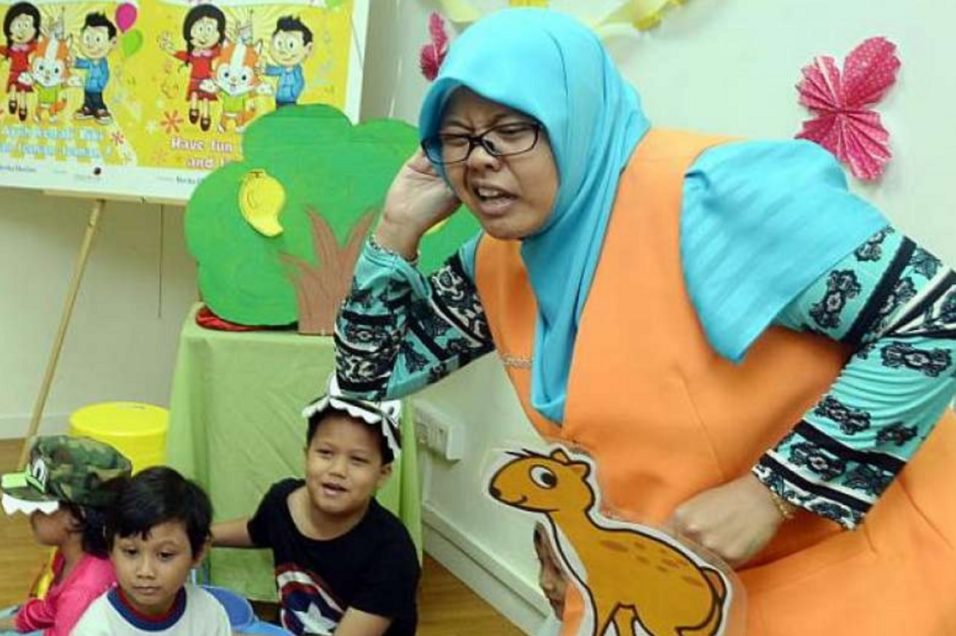
    Author and storyteller Jumaini Ariff’s fondest memories of the Malay language come from her childhood, when she listened to the radio at home.

    “I would sit at the counter while my mother was cooking, and other than speaking to her or annoying her, I would learn things like pantun (rhymes)… how they speak, how they addressed the elderly and… storytelling,” said the 38-year-old.

    With eight Malay-language books published, she sees herself as an educator for her tongue, which is why she jumped at the chance to be one of this year’s three duta bahasa (language ambassadors) for Bulan Bahasa, or the Malay Language Month.

    She has already participated in Bulan Bahasa multiple times.

    During its launch on Sept 9 at the Malay Heritage Centre in Kampong Glam, she will tell stories with live gamelan music accompanying her.

    There will be a series of programmes on 2017’s themes of ilmu (knowledge), budaya (culture) and mesra (relationships), spread out between Aug 15 and Oct 15, and in a mixture of Malay and English for members of the public to enjoy.

    The location of the launch, as well as the focus on culture as one of this year’s themes, means that most of the programmes will be in Malay.

    The festival was launched in 1988 by the Malay Language Council to encourage the use of Malay in the everyday lives of Singapore’s Malay community.

    Said chairman of the Bulan Bahasa 2017 committee, Ms Rahayu Mahzam: “Our legacy, stories and values can survive the test of time only if we make the effort to preserve our appreciation of the Malay language.

    “Our mastery of the language can only enrich our understanding of our Malay identity. It is important to perpetuate this in the younger generation so we can continue to flourish as one community.”

    Ms Rahayu told The Straits Times that the challenge lies in getting people to use Malay in their daily lives and to learn to appreciate the importance of preserving the Malay culture through the language.

    “The celebration of the Malay culture is out there – everybody loves Malay culture and it’s easy to have activities revolving around it, but the appreciation of how language ties in with that is not as strong,” she said, citing the example of silat, the Malay martial art form, and how people may not appreciate the strong links between the cultural value of the weapons and moves and the Malay words for them.

    In light of recent language gaffes, such as the use of a wrong character in the Speak Mandarin Campaign launch and wrongly typed Tamil in some National Day Parade pamphlets, she said that the Malay Language Council has a large network of people which it taps to ensure the correct translation and dissemination of Malay-language material.

    Ms Rahayu, who is a member of the council, said the network is composed of people such as literary experts, teachers and previous Bulan Bahasa language ambassadors.


    Source: http://www.straitstimes.com

  • Prince Harry Joined Jamiyah Singapore For Iftar Session With Muslims At Start Of Singapore Visit

    Prince Harry Joined Jamiyah Singapore For Iftar Session With Muslims At Start Of Singapore Visit

    Britain’s Prince Harry opened his visit to Singapore by breaking fast with local Muslims on Sunday (Jun 4).

    He joined Jamiyah Singapore for a tradition iftar session – the breaking of fast at sunset during the Muslim month of Ramadan – at its headquarters at Guillemard Crescent.

    On his arrival there, Prince Harry received a traditional welcome from ten kompang (Malay hand drum) players, a customary way to mark a celebratory occasion in Malay culture.

    He was also given a silat demonstration, led by former world champion Sheik Alauddin Yacoob Marican.

    As the sun started to set, he joined around 80 young Muslims for iftar.

    After breaking fast, the prince sat at a number of tables so that he could chat with guests about the celebration.

    Earlier in the day, Prince Harry visited an Action for AIDS event, where he learnt more about HIV and AIDS issues in Singapore.

    During the event at Eden Hall in Nassim Road, Prince Harry saw a rapid HIV test and met with Action for AIDS’ staff, volunteers and service users to understand more about the challenges facing the HIV-positive community in Singapore.

    He was accompanied by Dr Amy Khor, Senior Minister of State for Health and chair of the National HIV/Aids Policy Committee; British High Commissioner to Singapore Scott Wightman; and Professor Roy Chan, president of Action For Aids.

    HIV and AIDS are issues that are particularly close to the prince’s heart, according to the British High Commission. He will be taking part in the Royal Sentebale Royal Salute Polo Cup, an annual fundraising event that will take place on Monday.

    Sentebale is a charity that Prince Harry and Prince Seeiso of Lesotho established in 2006 to support children living with HIV in Southern Africa.

    The prince will head to Sydney on Wednesday (Jun 7), where he will launch the fourth Invictus Games.

    The Invictus Games, founded by the prince, is an international sporting event for wounded, injured and sick servicemen and women.


    Source: http://www.channelnewsasia.com/

  • Defending Malay Culture With The Keris

    Defending Malay Culture With The Keris

    The keris has captured their hearts since they were little, when the traditional weapon was wielded by a Malay warrior in old films.

    However, Suhaimi Nasrain, Sharif Rashid and Shahrial Tahar collect keris not to become swordsmen. On the contrary, they have turned their hobby into an effort to preserve Malay culture.

    Their passion has cost them tens of thousands of dollars. A good-quality antique keris in their collection, which are between 100 and 500 years old, is worth $500 to $10,000.

    “The aim to collect these keris is not only to please myself, but also to study them in detail to defend the Malay people’s culture and existence,” said Mr Suhaimi, 44, a public transport worker who is one of the founders of the Yayasan Keris Singapura (YKS).

    He has been collecting keris for eight years, and has nearly 30 antique keris.

    Mr Shahrial, an information technology analyst aged 47, began his hobby 30 years ago.

    “As a symbol of Malay tradition and philosophy by its design and workmanship, the keris can offer a glimpse into the Malay culture from various areas in this Malay archipelago,” said the owner of 20 keris of good grade, who also has nearly 100 reference books on the weapons.

    He is also active in researching the background and history of keris.

    “Although my interest in Malay culture generally lessens with each day, I feel proud because there are those who try to preserve Malay culture,” said Mr Shahrial, who is also a founder of YKS, the cultural wing of Perguruan Seni Silat Gayung Singapura.

    Mr Sharif, a driving instructor, has been active in the world of keris collecting for 25 years and owns a collection of 50.

    Other than buying keris and other traditional Malay weapons from the Malay Art Gallery in Bussorah Street, the three keris collectors source for the artefacts on Facebook and eBay, linking up with suppliers and keris enthusiasts from Malaysia, Indonesia, Europe and the United States.

    “Keris enthusiasts are not limited to one area or race. In fact, it is a global hobby,” said Mr Shahrial.

    Mr Shahrial, Mr Suhaimi and other members of YKS conduct talks about keris at schools and cultural events to raise awareness among the Malays on the various aspects of Malay culture.

    Mr Sharif, 58, feels that the first step that has to be taken to raise interest in the art of keris collecting is to dispel misconceptions.

    “It’s quite sad if the Malays associate keris only with the occult, because the keris is a work of art that was like the calling card of ancient times,” said Mr Sharif, who is also secretary of a body known as the Sri Ikatan Pusaka Melayu Singapura.

    “By studying the unique properties of a keris, we can ascertain the origins and even the rank of the person owning it.”

    BERITA HARIAN


    Source: http://mypaper.sg