Tag: Malayness

  • People’s Power Party (PPP): We Should Deny PAP 2/3 Majority In The Next GE, After Their Blatant Political Ploy In Reserved PE

    People’s Power Party (PPP): We Should Deny PAP 2/3 Majority In The Next GE, After Their Blatant Political Ploy In Reserved PE

    Date: 12 Sep 2017
    For Immediate Release:

    People’s Power Party (PPP) Statement on Singapore Presidential Elections 2017

    The Elections Department announced on 11th of September 2017 that Madam Halimah Yacob is set to be the 8th President of the Republic Singapore, having been the only potential candidate to have been issued both the Malay Community Certificate and the Certificate of Eligibility.

    This means that the other two presidential hopefuls, Mr Mohamed Salleh Marican and Mr Farid Khan were not successful in their application to stand although both gentlemen had also been issued the Malay Community Certificate each. Both had failed to satisfy the ridiculously stringent criteria imposed upon private sector applicants.

    The People’s Power Party (PPP), first of all, would like to express gratitude to both gentlemen who had bravely stepped forward to provide an opportunity for Singapore citizens to choose their next Elected President reserved for the Malay community. Mr Salleh and Mr Farid had subjected themselves to be scrutinised by the public with regard to their “Malayness” since they are of Indian and Pakistani by descent respectively. Madam Halimah, though technically an Indian by descent, have had her “Malayness” certified four times over in general elections previously.

    PPP views this latest development of PE2107 as opportunity denied to both private sector candidates since the Presidential Elections Committee (PEC) has discretionary powers. We also note the administrative manipulation of what could have been a participatory democracy.

    First and foremost, the virtue of Reserved Presidential Elections had been eclipsed by the notion that the Malays are not capable of winning in an open contest. The Malays of Singapore are actually sick of such tokenism. To add salt to injury, the “Malayness” of Presidential hopefuls are being questioned by the general public and subjected to a special committee to certify that they are Malays.

    Mr Salleh and Mr Farid should be lauded as successful self-made men who are truly non-partisan and independent. That cannot be said of Madam Halimah, who, despite of her claim to not be serving any political party after stepping down as Speaker of Parliament just about a month ago, would always be seen to be beholden to her supposedly erstwhile political masters. This indebtedness would forever be etched in the memory of Singapore for generations to come should she submit her nomination forms this Wednesday, 23rd of September 2017.

    When victory is declared on a battle not fought, there is no glory nor dignity.

    While we could grudgingly accept that this may be a Reserved Presidential Elections for the Malay but we definitely could not agree with the blatant political ploy to turn it into Reserved President for PAP’s Halimah!

    While Dr Tony Tan was not the President of 64.8% of Singaporeans who voted against him in PE2011, at the very least he fought a battle and won by 0.35% margin against his closest contender, Dr Tan Cheng Bock.

    PPP is disappointed without reservation that the office of the Elected Presidency is once again tweaked in forms and eventually, it denies robust electoral challenge that is the essence of our Democratic guarantee. In our view, Mr Salleh and Mr Farid who are prominent individuals of the Malay community with the exceptional capabilities to perform the role of the Elected President with full competency. The denial of their candidacy is really regrettable.

    PPP shares the sentiments of Singapore Malays who feel insulted that they been taken for a ride. The community sees themselves, yet again, as a scapegoat for the political agenda of the Powers That Be. They are the ones paying the ultimate political price. They rightly feel used, betrayed, played out and stupefied now that they bear witness to political gains built upon Malay dignity.

    Last but not least, PPP further reiterates that we should not allow electoral rules to be manipulated in such divisive way and the Constitution should not be changed so frequently by the ruling party just to suit their own political agenda. An Independent Commission appointed by the Elected President should look into every attempt of amendment made to the Constitution and the Elected President should also be vested with Veto power to such amendment with the advice of the Commission.

    Most importantly, we hope that Singaporeans should realize that giving PAP 70% mandate with overwhelming power via the dominance of parliamentary seats will not work in the interests of our Nation. We should deny PAP Two Third Majority in the next General Elections so that they could not just bulldoze any amendment to our Constitution at their fancy. This will ensure a truly fair electoral process and this will enhance the independent role of the Elected Presidency above and beyond partisan politicking.

    Syafarin Sarif
    Chairman
    People’s Power Party (PPP), Singapore For CEC


    Source: People’s Power Party – PPP
  • Issues That Need To Be Addressed Fast Before The Formal PE 2017 Process Begins

    Issues That Need To Be Addressed Fast Before The Formal PE 2017 Process Begins

    PE 2017 by Former MP Inderjit Singh

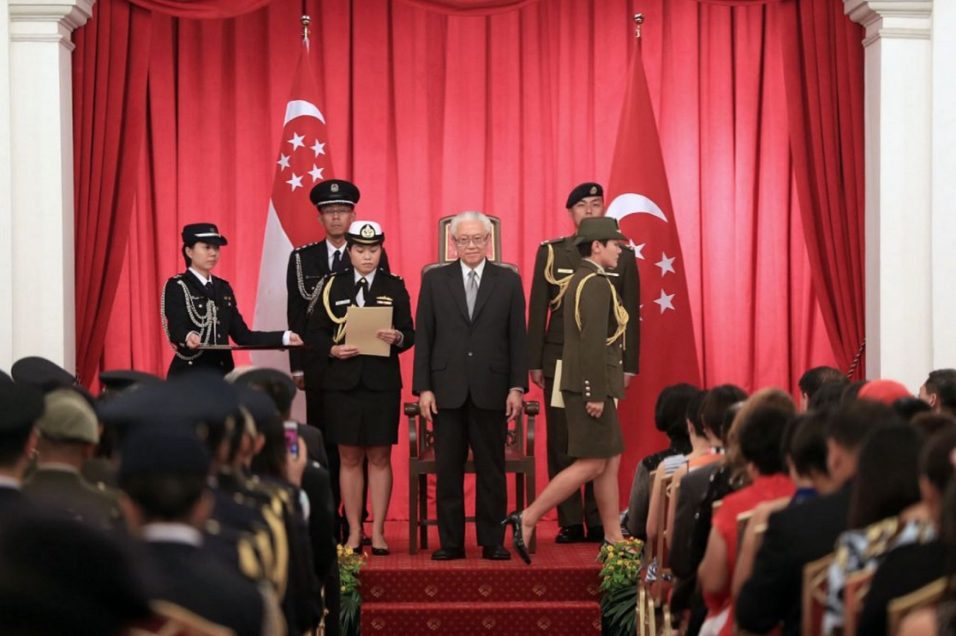
    In less than 2 months, Singaporeans will get a new elected President. Unlike the past Presidential Elections (PE), the run up to this year’s PE has not been a smooth sailing one. Parliament passed a new ruling allowing for a Reserved Election. While many have questioned the wisdom of a reserved PE, Parliament has passed the law and this is our current system of how we will select our future Presidents.
    As the Head of State, the President must have the respect of all Singaporeans once he or she is elected (or appointed as in the past). After the new President has been elected in the reserved PE in September this year, I hope all Singaporeans will give that elected person the respect the office of the President of Singapore deserves.
    Many of us are saddened with the recent developments and comments from different quarters of society but I hope that we can put all these differences behind us. Once the new President is elected, we should all unite behind that person and focus on uniting the nation so that the respect accrued to the office of the President remains intact.
    To help that process, I feel that the following issues need to be addressed fast before we go into the formal PE 2017 process:

    1. For the purposes of effecting a reserved election, it is important to establish who our first elected president was Some feel that it is Mr Ong Teng Cheong. He was the first person who was formally elected to the office of President. Before him though, Mr Wee Kim Wee had exercised the powers of the elected president during his term, which was when the constitutional changes were made to allow for Singapore to have an elected President. The court will be deciding on this very soon, but I feel the policy makers could have avoided this question all together by paying more attention to this issue – the constitution could have said that the 5th election should be a reserved election and not the 6th. Nevertheless, once the courts decide, we have to move on.

    2. The concept of “Malayness” has also become a debatable issue. Questions about how Mendaki and SINDA classify who is a Malay and who is an Indian do not seem to be aligned with how a Malay or an Indian is defined for the purposes of a GE or a PE. For now, it is critical that the leaders of the Malay community and the government come out and make this position clear and hopefully this position will apply to all aspects of life in Singapore. I hope this can be resolved before the formal process of PE 2017 starts.

    3. This being the 1st ever reserved PE, many hope to see qualified Malays step forward and give Singaporeans an opportunity to choose their President. It is also very important that Singaporeans and the rest of the world see that we have enough qualified Malays in Singapore who meet the very stringent requirements set in the constitution. It will be a pity if we don’t have enough qualified candidates to choose from for the first ever reserved PE. So, I hope all those who meet the criteria, come forward for this wider call.

    4. While the constitution is open about having a current sitting government politician standing for the PE, some Singaporeans have expressed concerns on the prospects of a current government MP, still in parliament, resigning as an MP and immediately standing for the PE. The spirit of the Elected President is independence of office as intended by Mr Lee Kuan Yew when the idea was mooted. While I have no question about how each person will do his or her duty to serve the office they are elected to serve, public perception is also important. While Mr Ong Teng Cheong also did the same in 1993, I sense people are increasingly uncomfortable with this.

    As the Head of State, the President of Singapore holds the highest office and he or she must get the full respect of all Singaporeans. I hope the above issues are addressed before PE 2017 kicks off formally. It is good that Singaporeans are debating the issue of the reserved PE. My hope is that we can largely come to an understanding of the above 4 issues before we kick off PE 2017. And once our President has been elected, let’s all show respect for the President of Singapore and stand united as Singaporeans.


    Source: Inderjit Singh

  • Next Question: What Actually Is The Definition Of Malay In Mendaki Context?

    Next Question: What Actually Is The Definition Of Malay In Mendaki Context?

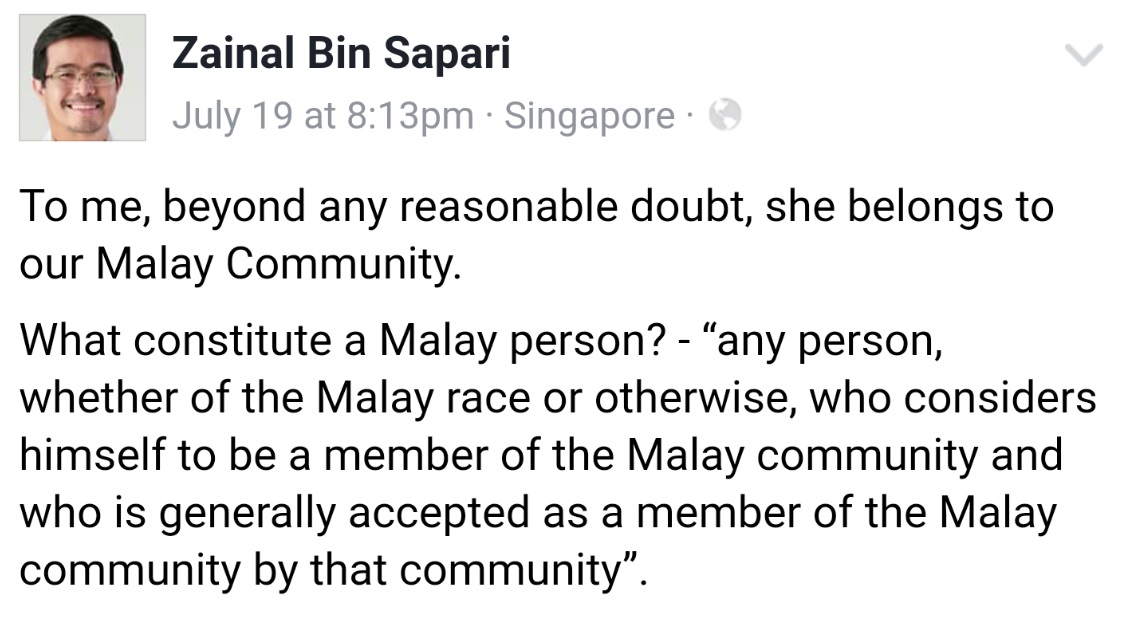
    So we all know that PAP MP Zainal Sapari vouches for Halimah Yacob’s malayness from a facebook post that he made. Here we want to share some highlights from netizens that may be important.

    Someone said, “I thought she is an Indian Muslim? Meaning Islam is her religion but her race is Indian, not Malay. That qualifies her to run for a president that is reserved for Malay race?”

    Another asked, “Mr Zainal bin Sapari, regarding the definition of a “Malay” which u hv quoted, does d govt applies it across all matters? Or is it only for this PE?”

    Unfortunately, it is pointless to debate or argue with them about the definition of a Malay when all this while they pushed down the throats of the people this simple definition:

    What constitute a Malay person? – “any person, whether of the Malay race or otherwise, who considers himself to be a member of the Malay community and who is generally accepted as a member of the Malay community by that community”.

    But there was another important question that was brought up by one of the netizens. What is the definition of Malay in Mendaki context?


    Someone hurled, “Then how come students of Indian Muslim father but who speak Malay and behave like Malay does not qualify for Mendaki assistance cause Mendaki considers them as Indian race and not Malay. so haw does Mendaki define Malay”

    *mike drop*

    The response? Apparently there was nothing but silence. Even when others probed the MP further quoting the same question. Korang rasa dorang akan reply ke?

    Based on that comment, it is easily interpreted that the definition of Malay given for the reserved presidential elections 2017 vastly contrast the Mendaki’s view of definition of Malay. At this moment it may seem as though the current definition was created only for #PE2017 or certain reasons. Because Singaporean Malays and Singaporean Indian Muslims know best if they qualify for Mendaki’s assistance or not.

    This comment sums up all the comments posed to our dear PAP MP Zainal Sapari,

    “When it suits all of you, you change the def. But when a non Malay Muslim asks for help from Mendaki, its a no go. Tak tahu malu ke? Not every Malay is a muslim and not every muslim is a Malay. Ada Melayu Christian, Hindu, Atheist and etc Islam transcends races and here you are doing the opposite. So here we are with this quandary again and again.”


    Rilek1Corner


  • How Malays Define Malayness? Well Truth Is Its Very Confusing And Inconsistent

    How Malays Define Malayness? Well Truth Is Its Very Confusing And Inconsistent

    So how does one define who is or isn’t Malay? Having actually researched this for my thesis for the past two years, please let me share with ya’ll SOME of what I’ve learned.

    How Malays define Malayness has always been head-scratchingly confusing to those who are not Malay and even to us who identify as Malay in Singapore, it’s blatantly inconsistent. It is something of a pet passion of mine, probably because people keep assuming I’m chinese. Also, why is Malayness confusing? This is because there are actually competing definitions of Malayness. Dr. David Tantow identifies three which can be found in Sg:

    1) there is the Islamic ummah, which basically imagines ALL Muslims in the Malay archipelago regardless of ethnicity as being part of the larger Malay community (basically, it’s: you are Arab? Pakistani? Well, hello, welcome, cuz as long as you Muslim, you my bro). Apparently, This emerged as kind of an identity-based counter to Western imperialism and colonialism in the 19th and early 20th centuries but which has now gotten a pretty bad rep because talk about a southeast Asian caliphate now (which is what this definition alludes to) and people will be like, eh, don’t become Isis leh, I call police.

    2) Then, for the second, we have Malayness defined by cultural signifiers and codes, where we talk about people who practise Malay customs (adat), speak the Malay language (Bahasa), and practise Islam (agama). These three thingies form the basis of whether someone is either Malay (Melayu) or if that person has “enter (has become) Malay” (masuk Melayu). What confuses people about THIS definition is that it does NOT take genetic heritage into account. Basically, it’s: oh, you have Pakistani parents? But you now speak Malay, love motorcycles, know how to eat nasi ambeng, and go Friday prayers? Then we same-same Melayu lah bro.

    3) The third definition is the one Mendaki and the gahmen loves cuz it’s the simplest one; using parentage/ancestry or “genetic and territorial qualifiers”. It’s really just, oh, your father is Malay, your mother is Malay, then two plus two equals four cikgu. It’s the most exclusive kind of Malayness but also one that people who are not Malay are least confused by. Also, can anyone spell “administrative convenience”?
    (Source: www.tandfonline.com/doi/abs/10.1080/13639811.2012.725553)

    4) THEN, as if these three ways of defining Malayness is not enough, we’ve not even touched on the fact that “Malay” also refers to an umbrella term for “the Malay races”, which is when we further divide Malays up into whether they are Minang, or Bawean (Boyan), or Javanese, or Bugis, even Filipinos and Orang Asli,etc, etc, oh so many many, many of which have their own languages, customs, even religious practices, some of whom are chill with being called Malay and others who are less chill because of reasons. All of them are represented in singapore so JOY.

    5) THEN, as if I don’t have a migraine already, not only are all these different ways of defining Malays competing with each other, they are COEXISTING in some kind of strange equilibrium because, you know, we Malays don’t have enough problems in our lives. It’s why some of us say, Wah, this Marican cannot Bahasa Melayu, is he really Melayu (second definition)? Then with Khan, whom no one has criticised for not being able to speak Malay, people are like, eh, he Pakistani ancestry means he’s not Malay right (third definition).

    6) THIS EQUILIBRIUM SHIFTS, because Malays cannot duduk diam-diam, between each other but also internally within the three definitions as well. For example, increased religiosity in recent decades means many Malays absolutely require someone to be Muslim to be considered Malay while others like the 1960s Malay nationalists placed a premium on customs and heritage. Before that, there was also the phrase “Bahasa jiwa bangsa” (language is the soul of a nation) which was a huge draw for the malay intelligentsia because they ardently believe that MALAY LIT IS MORE LIT THAN YOUR ROKOK. It’s only really with the (racist) British system of colonial administration, and later on with the (rac-Er-problematic) CMIO system that the third definition really became much more dominant in the lives of Malays in sg. All in all, these shifting lines evolve to adhere to historical and cultural changes.

    7) So, really, what I am trying to say is defining who is Malay and how has been one long historical ?&$?? that has resulted in the inconsistency many people are now seeing in how the Malay community is treating the candidates. ALSO, AND MOST IMPORTANTLY, it has resulted in me extending my MA Programme by one semester, WHICH LIKE WAHLAO NI MELAYUNESS MAKAN MELAYU KE PE, incidentally. Now, with this development in the Presidential Election, this headache is finally going to be passed on to, as it usually happens here, a committee. I’m kinda looking forward to what they’re gonna say. For research purposes. Of course, they could just use the simplest, most boring way which is the third, genetically defined one, which will disqualify Khan. But this would leave us with Marican who many Malays would like to instinctively disqualify because of the second definition.

    Of course, likely, both will be disqualified because of the 500 million dollar in whatever equity rule, neatly avoiding this headache, which will mean, happily, that this migraine will continue, resulting in more MC days for my Malay brethren and me.

    Disclaimer: While Malay identity is important to my thesis, it’s not the main subject I am investigating for my research project. As such, what I know is limited and no doubt incomplete. So please feel free to add in any gaps or correct any inaccuracies as you spot them.


    Source: Hidhir Razak