Tag: Masjid Sultan

  • The Day I Got Drenched At Kampong Gelam

    The Day I Got Drenched At Kampong Gelam

    THE DAY I GOT DRENCHED AT KAMPONG GELAM

    #MYFsg office is located at 62A Arab Street, in the heart of Kampong Gelam. It is just 2 minutes walk to Sultan Mosque. I was often asked why I chose that location. To me, its a no brainer. It is a centralised youth hotspot.

    Today, I found out that its not just that.

    Throughout our stay in Kampong Gelam, there have been several funeral prayers conducted at Sultan Mosque for prominent community leaders who spent their life in His servitude, whose legacies helped set Singapore on a path of peace and progress. At MYF, we have a culture encouraging each other to take time to pay our last respect to our pioneer leaders, regardless of their fields. I didn’t think much of of it, then.

    Just recently, the nation laid to rest one of its first-generation leaders, the late Mr Othman Wok. The funeral prayer was conducted at Sultan Mosque. The congregation itself was filled with changemakers, old and young. The sky teared heavily the moment when the casket was being transported in the pouring rain to a gun carriage to begin its journey to the burial site.

    Witnessing the moment barely 5 metres away, its was solemn, drenched.

    That moment, I realised the reason God placed me in Kampong Gelam.

    He wants me to constantly be reminded of the contributions made by our pioneer leaders. The prosperity today could not be achieved without their sacrifices. More than I know, I needed these moments to gather strength to be steadfast in courage and passion into creating a better life, a better tomorrow for the community.

    I was also reminded that there are no such thing as retirement on the path of service. You simply serve till your last breath and may our death too benefits the community, triggering reflection and repentance. When that day come, we can only hope that the next generation is ready to carry on the torch. Moving faster than us. Breaking more things than us.

    It is up to us to live up to the legacy that was left for us, and to leave a legacy that is worthy of our children and of future generations.

    It is no longer a question of how much we believe we owe those living in the future, not just our own children or grandchildren, but the generations of people who will come long after we are gone.


    Rilek1Corner

    Credit: Shah Reza

  • Late Minister Othman Wok To Be Given Highest State Honour For Funeral

    Late Minister Othman Wok To Be Given Highest State Honour For Funeral

    The late Mr Othman Wok will be given a state-assisted funeral on Tuesday (April 17), with a memorial service for invited guests to be held on Wednesday evening.

    At a quarter past noon on Tuesday, a private hearse carrying the casket will make its way from his residence in Kew Avenue to the Sultan Mosque at North Bridge Road for funeral prayers.

    After the prayers, the State Flag will be draped over the casket in the presence of Mr Othman’s family.

    A statement issued on Monday by the State-assisted Funeral Organising Committee said the draping of the flag is “the highest State honour that can be accorded to a deceased person”.

    It added: “The State flag is placed over the casket with the crescent and stars lying over the head and close to the heart. The Order of Nila Utama (2nd Class) that was awarded to the late Mr Othman Wok will accompany the casket.” Mr Othman was conferred the honour in 1983 for his contributions to Singapore and nation-building efforts.

    At 2pm, the gun carriage carrying the casket will travel to the burial site at the Choa Chu Kang Muslim Cemetery — passing through North Bridge Road, North Boat Quay, River Valley Road as well as the heartlands of Alexandra Road, Commonwealth Avenue, Commonwealth Avenue West and Clementi Avenue 6.

    On Tuesday, Mr Othman’s body will be moved to Sultan Mosque, which was closed to visitors on Monday. The mosque’s manager, Mr Zainal Abidin Omar, said regular prayers will start shortly after 1pm, followed by prayers for Mr Othman.

    After that, Mr Othman will make his final journey to Pusara Aman at Choa Chu Kang Muslim Cemetery. In a statement on Monday, the Prime Minister’s Office (PMO) said Mr Othman will be accorded the honour of being borne on the Ceremonial Gun Carriage for the journey to the cemetery.

    The Mufti of Singapore, Dr Mohamed Fatris Bakaram, will lead the last rites.


    Source: www.todayonline.com

  • Where Malay Royalty Once Lived And Worshipped

    Where Malay Royalty Once Lived And Worshipped

    You can say this was a “glam” kampung, given that it used to be where Malay royalty lived, but Kampong Glam, also called Kampong Gelam, is probably named after a tree.

    Still, Kampong Glam stands as a glamorous attraction today, with its Middle Eastern eateries and trendy fashion shops.

    Beyond these modern additions, sitting grandly in the heart of the enclave are two historic monuments – the Istana Kampong Gelam and the Masjid Sultan.

    The Istana Kampong Gelam was the palace of Sultan Hussein Shah, the 19th-century ruler of the Johor Sultanate which Singapore was part of, while the Masjid Sultan next door had been constructed shortly after upon his request.

    The two grand buildings serve as a reminder of the Malay royalty who once ruled the area.

    The Sultan’s original residence was a timber structure built on stilts in the traditional Malay style.

    According to the National Heritage Board’s (NHB) Preservation of Sites and Monuments division, the present two-storey brick-and-mortar structure was completed in 1843 and commissioned by his son and heir Tengku Mohammed Ali.

    The building’s design reflects both classical European and traditional Malay architecture.

    The round arches at the entrance porch showcase the European design influence, while its layout corresponds to Malay Limas house typology, where the main entrance leading to the main house is connected to an annexe where the kitchen would traditionally be located.

    Meanwhile, the Masjid Sultan, or the Sultan’s Mosque, was originally a single-storey brick structure built in the 1820s.

    Almost a century later, it was in need of repairs and a new mosque was planned. Irish architect Denis Santry from local architectural firm Swan and Maclaren was commissioned for the rebuilding project spanning 1924 to 1928.

    He designed it in an Indo-Saracenic style, which offers a mix of traditional Indian and Islamic elements.

    The mosque features two gold onion domes, and the base of each dome is adorned with glass bottle ends collected from poor Muslims as donations.

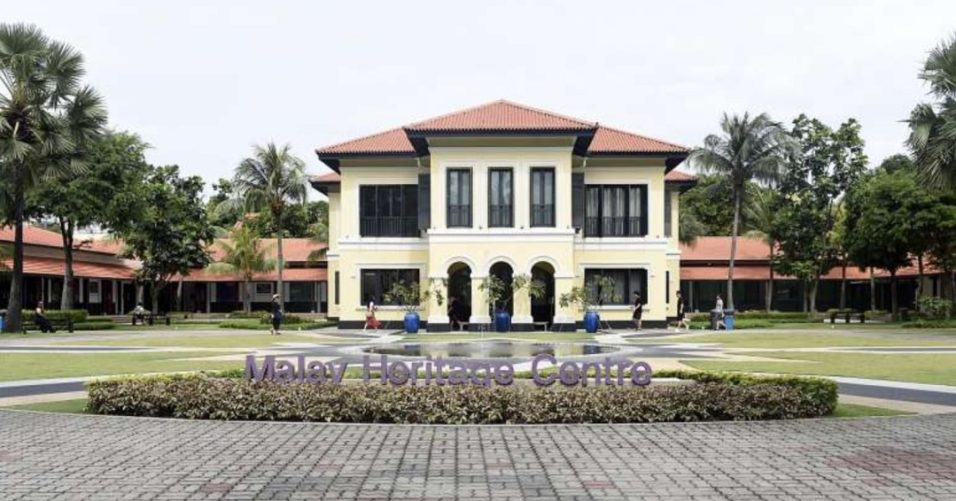
    These monuments are key in telling the larger story of early Singapore, said Ms Suhaili Osman, assistant curator of the Malay Heritage Centre, which now occupies Sultan Hussein’s former palace.

    For instance, porcelain plates dug up from the compound of the Istana Kampong Gelam bear the insignia of ceramic producers from Asia and Europe such as J. & G. Meakin of England. This reflects how the area near the Kallang Basin had thrived as an emporium, with goods from across the globe, in the 19th and 20th centuries.

    Chinese, Jawi and Dutch East India Company coins, also unearthed during two archaeological surveys in the early 2000s, further underscore the cosmopolitan nature of Kampong Glam as well as its economic importance.

    Ms Suhaili said the artefacts “prove that there are more layers to Singapore’s story beyond the traditional narrative of its early beginnings as a sleepy fishing village”.

    According to heritage conservation expert Johannes Widodo, an associate professor at the National University of Singapore, the Kampong Glam compound was laid out based on Hindu and Buddhist mandala symbol principles.

    The mosque and royal graveyard in Jalan Kubor functioned as its crown and the palace was its body, while a market town and old settlement stood as its feet.

    The Istana Kampong Gelam palace compound itself was allotted to Sultan Hussein, after he and Temenggong Abdul Rahman signed a treaty with Sir Stamford Raffles for the British East India Company to set up a trading post here on Feb 6, 1819.

    But to diminish the power of the royals, the British sliced up the area, with Victoria Street and North and South Bridge roads cutting through the place.

    In 1999, the Government announced that the Istana Kampong Gelam would be conserved.

    Some 79 beneficiaries and tenants, including Mr Tengku Shawal, the seventh-generation descendant of Sultan Hussein, were awarded a total of $350,000 a year for 30 years.

    The former palace was restored after its residents moved out and it was turned into the Malay Heritage Centre in 2005.

    The centre, which is managed by NHB in partnership with the Malay Heritage Foundation, houses six permanent galleries.

    Mr Harneis Hadir, general manager at the Malay Heritage Centre, said it aims to provide all communities that go through its doors “a holistic and well-rounded cultural experience”.

    He said visitors can look forward to the annual Malay CultureFest and a special exhibition on the Bugis community this year.

    The Masjid Sultan, meanwhile, took home the Urban Redevelopment Authority’s Architectural Heritage Award last year for its $4.6 million restoration, which included a fresh coat of paint for its golden domes and the addition of elderly- friendly facilities such as a glass lift.

    The mosque won in the restoration category which honours work done to sensitively repair and restore heritage buildings.

    The chairman of its board of trustees, Mr Mohamed Patail, 65, said the restored monument has attracted both worshippers and tourists far and wide.

    On the congregants, he said: “They feel a sense of belonging to the mosque, which is one of the oldest in Singapore. They also come here for a nice family outing – pray at a historically significant mosque, walk around the enclave and then eat at one of the nasi padang stalls.”


    Source: ST

  • Masjid Sultan Staff Apologised To Complainant, Matter Closed

    Masjid Sultan Staff Apologised To Complainant, Matter Closed

    Assalamualaikum wr wb.

    Bismillahirahmanirahim

    1. Sultan Mosque Board of Trustees thanked Mr Saifudeen and his team for meeting the committee at Sultan Mosque.

    2. H Eusope was present and apologised. Saifudeen and his team accepted it.

    3. H Eusope said that he regretted saying, ‘ kalau nak discuss tolong pergi ke kedai kopi’

    4. The doa penutup for the meeting between the board and Saifudeen and team was recited by one of them, Mohd Shafik.

    5. Both groups agreed to close the matter.

    Wasalam


    Source: Masjid Sultan Singapore

  • [Clarification] Masjid Sultan – Investigation Completed, Staff Did Not Chase Away Congregant, Reminded To Be Sensitive, Careful When Attending To Congregants

    [Clarification] Masjid Sultan – Investigation Completed, Staff Did Not Chase Away Congregant, Reminded To Be Sensitive, Careful When Attending To Congregants

    Assalamualaikum wr wb,

    Sultan Mosque viewed this matter seriously and has invited Mr Saifudean Mead for a meet up session to resolve this pertinent issue, amicably.

    The Mosque Management has investigated the case and found that our staff concerned did not chase away the congregant and his group from Sultan Mosque.

    Our management has reminded all staff to be vigilant and at the same time to be more sensitive and careful when attending to our congregants’ needs.

    Management Sultan Mosque.

    Wasalam.


    Source: Masjid Sultan Singapore