Tag: mendaki

  • Next Question: What Actually Is The Definition Of Malay In Mendaki Context?

    Next Question: What Actually Is The Definition Of Malay In Mendaki Context?

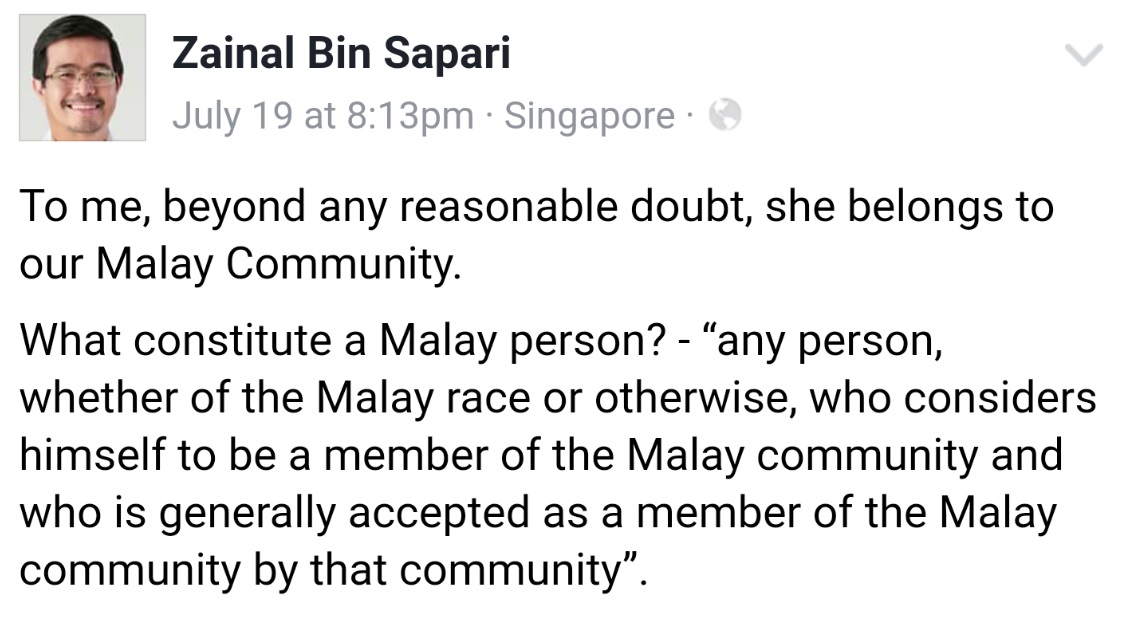
    So we all know that PAP MP Zainal Sapari vouches for Halimah Yacob’s malayness from a facebook post that he made. Here we want to share some highlights from netizens that may be important.

    Someone said, “I thought she is an Indian Muslim? Meaning Islam is her religion but her race is Indian, not Malay. That qualifies her to run for a president that is reserved for Malay race?”

    Another asked, “Mr Zainal bin Sapari, regarding the definition of a “Malay” which u hv quoted, does d govt applies it across all matters? Or is it only for this PE?”

    Unfortunately, it is pointless to debate or argue with them about the definition of a Malay when all this while they pushed down the throats of the people this simple definition:

    What constitute a Malay person? – “any person, whether of the Malay race or otherwise, who considers himself to be a member of the Malay community and who is generally accepted as a member of the Malay community by that community”.

    But there was another important question that was brought up by one of the netizens. What is the definition of Malay in Mendaki context?


    Someone hurled, “Then how come students of Indian Muslim father but who speak Malay and behave like Malay does not qualify for Mendaki assistance cause Mendaki considers them as Indian race and not Malay. so haw does Mendaki define Malay”

    *mike drop*

    The response? Apparently there was nothing but silence. Even when others probed the MP further quoting the same question. Korang rasa dorang akan reply ke?

    Based on that comment, it is easily interpreted that the definition of Malay given for the reserved presidential elections 2017 vastly contrast the Mendaki’s view of definition of Malay. At this moment it may seem as though the current definition was created only for #PE2017 or certain reasons. Because Singaporean Malays and Singaporean Indian Muslims know best if they qualify for Mendaki’s assistance or not.

    This comment sums up all the comments posed to our dear PAP MP Zainal Sapari,

    “When it suits all of you, you change the def. But when a non Malay Muslim asks for help from Mendaki, its a no go. Tak tahu malu ke? Not every Malay is a muslim and not every muslim is a Malay. Ada Melayu Christian, Hindu, Atheist and etc Islam transcends races and here you are doing the opposite. So here we are with this quandary again and again.”


    Rilek1Corner


  • Who Is Most Malay Among Three Aspiring Presidential Candidates?

    Who Is Most Malay Among Three Aspiring Presidential Candidates?

    Aspiring Presidential candidate,  Mr Salleh Marican wants to donate his salary to charity if elected while Mr Farid Khan says he will focus on countering the threat of radicalism by working closely with the Government and the various groups to build trust among people of different races and religions.

    Despite their noble intentions, netters gave the perception that all Singapore care about is if they are Malay enough, to qualify as the second Malay President of Singapore.

    Being Malay has nothing to do with your IC. That is just the government’s (and previously Colonial) lazy way of categorising its citizens for its administrative purposes.

    Being Malay is an identity, it is cultural, it is language, and it the community.

    The latest tweak in the Constitution was made to preserve the multiracial nature of the institution, because  ‘studies’ showed that Singaporeans tend to vote along their racial identity and thus needed to be nudged to practice what they preach – a multiracial community.

    Why do you even bother asking if the person is Malay enough? 

    The essence of the minority rule is, to ensure that the official races in Singapore i.e. Chinese, Malay, Indian, Others all have an equal chance of qualifying to be the President of Singapore.

    So what if MENDAKI has a rigid definition of your race? We have enough anecdotal evidence to show that it’s silly  – Why then do you want to follow their silly definition?

    Aspiring candidates for the presidential election have to see the office, not as a job but a calling and the President has to ultimately unite Singaporeans, beyond just the Malay community.

    Asking an individual from the community if he/she is Malay enough question is harmful and are generally asked by people who have more to gain by distracting and fragmenting the Malay community further.

    It achieves nothing.

    Salleh Marican, Farid Khan and even Halimah Yacob (if she runs) IS Malay enough to me

    They speak the language, they dress the part, they celebrate Hari Raya, even the people that they interact with on daily basis even thinks they are Malay.

    Ethnic identity is a “matter of socialisation”. “It has nothing to do with skin colour or other so-called racial features.

    What we should be asking is, what are their credentials?, Are they saying things just to play to the gallery, is their heart in the right place?

    Have they consistently stood by and work for the community all their years or are they just doing this now because they want to be considered for the Presidency.

    Do they represent meritocracy, equality and progress, values and ethos which Singaporeans hold dearly?

    Can they unite Singaporeans, young and old? Can they uphold the highest level of integrity required and inspire others to do the same?

    We are still months away from September and there would probably be more candidates coming forward.

    The next time someone tries to engage you on the PE by asking if the potential candidates are Malay enough, ask them if they know what being Malay means in the first place.

    The beauty and strength of the Malay race has always been its unity in diversity with regard to customs, practices and everyday living. The kinship ties between the various communities in different countries, particularly in the Southeast Asian region known as the Nusantara, is what defines Malay as a collective ethnic group

    F***  Mendaki and their shallow and rigid definition of what is Malay.


    Source: www.thoughtssg.com

  • How Malays Define Malayness? Well Truth Is Its Very Confusing And Inconsistent

    How Malays Define Malayness? Well Truth Is Its Very Confusing And Inconsistent

    So how does one define who is or isn’t Malay? Having actually researched this for my thesis for the past two years, please let me share with ya’ll SOME of what I’ve learned.

    How Malays define Malayness has always been head-scratchingly confusing to those who are not Malay and even to us who identify as Malay in Singapore, it’s blatantly inconsistent. It is something of a pet passion of mine, probably because people keep assuming I’m chinese. Also, why is Malayness confusing? This is because there are actually competing definitions of Malayness. Dr. David Tantow identifies three which can be found in Sg:

    1) there is the Islamic ummah, which basically imagines ALL Muslims in the Malay archipelago regardless of ethnicity as being part of the larger Malay community (basically, it’s: you are Arab? Pakistani? Well, hello, welcome, cuz as long as you Muslim, you my bro). Apparently, This emerged as kind of an identity-based counter to Western imperialism and colonialism in the 19th and early 20th centuries but which has now gotten a pretty bad rep because talk about a southeast Asian caliphate now (which is what this definition alludes to) and people will be like, eh, don’t become Isis leh, I call police.

    2) Then, for the second, we have Malayness defined by cultural signifiers and codes, where we talk about people who practise Malay customs (adat), speak the Malay language (Bahasa), and practise Islam (agama). These three thingies form the basis of whether someone is either Malay (Melayu) or if that person has “enter (has become) Malay” (masuk Melayu). What confuses people about THIS definition is that it does NOT take genetic heritage into account. Basically, it’s: oh, you have Pakistani parents? But you now speak Malay, love motorcycles, know how to eat nasi ambeng, and go Friday prayers? Then we same-same Melayu lah bro.

    3) The third definition is the one Mendaki and the gahmen loves cuz it’s the simplest one; using parentage/ancestry or “genetic and territorial qualifiers”. It’s really just, oh, your father is Malay, your mother is Malay, then two plus two equals four cikgu. It’s the most exclusive kind of Malayness but also one that people who are not Malay are least confused by. Also, can anyone spell “administrative convenience”?
    (Source: www.tandfonline.com/doi/abs/10.1080/13639811.2012.725553)

    4) THEN, as if these three ways of defining Malayness is not enough, we’ve not even touched on the fact that “Malay” also refers to an umbrella term for “the Malay races”, which is when we further divide Malays up into whether they are Minang, or Bawean (Boyan), or Javanese, or Bugis, even Filipinos and Orang Asli,etc, etc, oh so many many, many of which have their own languages, customs, even religious practices, some of whom are chill with being called Malay and others who are less chill because of reasons. All of them are represented in singapore so JOY.

    5) THEN, as if I don’t have a migraine already, not only are all these different ways of defining Malays competing with each other, they are COEXISTING in some kind of strange equilibrium because, you know, we Malays don’t have enough problems in our lives. It’s why some of us say, Wah, this Marican cannot Bahasa Melayu, is he really Melayu (second definition)? Then with Khan, whom no one has criticised for not being able to speak Malay, people are like, eh, he Pakistani ancestry means he’s not Malay right (third definition).

    6) THIS EQUILIBRIUM SHIFTS, because Malays cannot duduk diam-diam, between each other but also internally within the three definitions as well. For example, increased religiosity in recent decades means many Malays absolutely require someone to be Muslim to be considered Malay while others like the 1960s Malay nationalists placed a premium on customs and heritage. Before that, there was also the phrase “Bahasa jiwa bangsa” (language is the soul of a nation) which was a huge draw for the malay intelligentsia because they ardently believe that MALAY LIT IS MORE LIT THAN YOUR ROKOK. It’s only really with the (racist) British system of colonial administration, and later on with the (rac-Er-problematic) CMIO system that the third definition really became much more dominant in the lives of Malays in sg. All in all, these shifting lines evolve to adhere to historical and cultural changes.

    7) So, really, what I am trying to say is defining who is Malay and how has been one long historical ?&$?? that has resulted in the inconsistency many people are now seeing in how the Malay community is treating the candidates. ALSO, AND MOST IMPORTANTLY, it has resulted in me extending my MA Programme by one semester, WHICH LIKE WAHLAO NI MELAYUNESS MAKAN MELAYU KE PE, incidentally. Now, with this development in the Presidential Election, this headache is finally going to be passed on to, as it usually happens here, a committee. I’m kinda looking forward to what they’re gonna say. For research purposes. Of course, they could just use the simplest, most boring way which is the third, genetically defined one, which will disqualify Khan. But this would leave us with Marican who many Malays would like to instinctively disqualify because of the second definition.

    Of course, likely, both will be disqualified because of the 500 million dollar in whatever equity rule, neatly avoiding this headache, which will mean, happily, that this migraine will continue, resulting in more MC days for my Malay brethren and me.

    Disclaimer: While Malay identity is important to my thesis, it’s not the main subject I am investigating for my research project. As such, what I know is limited and no doubt incomplete. So please feel free to add in any gaps or correct any inaccuracies as you spot them.

     

    Source: Hidhir Razak

  • A Call To Lead – Qualified Malay Candidates Must Show Courage, Step Up And Give Singaporeans True Choice

    A Call To Lead – Qualified Malay Candidates Must Show Courage, Step Up And Give Singaporeans True Choice

    As we get closer to Syawal, Malays in Singapore are also getting closer and closer to the day of reckoning – come election day in September, Singapore will have its first Malay President since the late Encik Yusof Ishak, albeit in a reserved election. People like Dr Tan Cheng Bock and human rights lawyer M Ravi are challenging the constitutionality of the elections but chances are, the elections will go through. Up till now, we still don’t know which candidate PAP will support but everyone thinks it’ll be current Speaker of Parliament, Halimah Yacob. What about alternative candidates who are independent from PAP? Besides Mr Salleh Marican, no one has stood up to be counted. The silence is deafening but unsurprising.

    Poor Mr Salleh Marican has faced a lot criticism the moment he announced his candidacy. A lot of people have, rightly so, questioned his candidacy as he is not purely of Malay ethnicity. His lepak interview with BeritaMediacorp outside the elections department where he basically mangled the Malay language, did nothing to convince Singaporeans that he is adequately Malay. Some more critical ones have even taken to disparaging his wife’s appearance. All this is nothing but damaging to his confidence in running for Presidency.

    What Singaporeans must appreciate is that it takes a lot of courage for a successful businessman like Mr Salleh Marican to take up public office. He does not need to do this because he needs the money. He doesn’t. He is already rich. He is doing this because he wants to. He wants to serve because heeded the call of Lee Hsien Loong for capable and qualified Malay Singaporeans to step up to contest the elections.

    He may have been a mess but it could just be nerves, One doesn’t create a multi-million dollar empire overnight. Mr Salleh Marican has the mettle and the political savvy to succeed.

    He also has his heart in the right places. Besides his business, Mr Salleh Marican is actively involved in philanthropic activities. Since 2009, Mr Salleh Marican was appointed a founding member of the Board of Temasek Cares, a philanthropic organisation established by GIC Temasek Holdings. Halimah Yacob was also a founding board member.

    Temasek Cares had help fund the setting up of the Family Therapy Institute in Eunos, run by PPIS.

    He is now also a Treasurer of the Temasek Cares Board, ‘who now includes former PAP MP, Zainul Abidin Rasheed.

    There are not many candidates with Mr Salleh Marican’s background. There are also not many candidates like him who are brave enough to step up. However, is he truly the candidate for the Malay community?

    We call on other Malay leaders to follow in the footsteps of Mr Salleh Marican to offer themselves as a candidate for Presidency. Some may say that too many candidates will dilute the votes for non-establishment candidates but an election is about the exercise of power by the individual through the ballot box. Singaporeans are smart enough to choose the right candidates with the right credentials. One who is independent from the influences of the incumbent.


    Said

    Reader Contribution

  • SG Malay-Muslim Community Can Be The “Beacon For The Rest Of The World”

    SG Malay-Muslim Community Can Be The “Beacon For The Rest Of The World”

    The Malay-Muslim community in Singapore has made concrete progress in the areas of education, jobs and wealth, said Home Affairs Minister K. Shanmugam yesterday.

    However, it also has to take a hard look at three challenges facing the community – radicalisation, more professionals losing their jobs and a significant over-representation of Malays in crime and drug statistics as well as the prison population.

    He called on Malay-Muslim organisations such as self-help group Mendaki, the Association of Muslim Professionals (AMP) and the Islamic Religious Council of Singapore to step forward and help tackle these issues. The roles that such groups can play include counselling former offenders and supporting their families, as well as turning those who are at risk away from crime and drug abuse, said Mr Shanmugam, who is also Law Minister.

    He was addressing about 140 community leaders and volunteers at an annual seminar organised by the AMP. In his speech, he highlighted the significant social and economic progress made by the Malay- Muslim community over the years.

    For instance, the proportion of Malay Primary 1 pupils who go on to post-secondary education has doubled from 45 per cent in 1995 to 93 per cent in 2015. One out of every five Malay pupils who enters the education system will eventually obtain a degree or diploma, he said.

    And while the proportion of Malays who are professionals, managers, executives and technicians (PMETs) was 28 per cent in 2010, “I am sure it has gone up more by now”, he noted. On housing, he said nearly 90 per cent of Malay households own their own homes, with 70 per cent of them living in four-room Housing Board flats or bigger.

    “A Singapore Malay today in educational standing, in terms of skills and wealth, is better off than a Malaysian Malay or an Indonesian Malay,” he said. “The same goes for the Indians, and for the Chinese, in Singapore.”

    The Government will continue to provide support to all Singaporeans, with additional help given to Malay-Muslims, he noted. The support includes financial help when infants are born, subsidising childcare and school fees, cash grants to buy HDB flats and healthcare subsidies.

    But while the progress made by the community is encouraging, he warned of dangers posed by radicalisation and exclusivism. He cited a study by US-based Pew Research Centre on Malaysia, which showed 10 per cent of Malaysian Malays had a favourable opinion of terror group Islamic State in Iraq and Syria and nearly a quarter were not prepared to denounce it. “We have to make sure that we do not get there,” he said.

    On the jobs front, a committee led by parliamentary secretaries Amrin Amin and Faishal Ibrahim is being set up to help Malay-Muslim PMETs hit by job losses, he said.

    In addition, Malay-Muslim groups can work with the Government to tackle the problem of “significant over-representation” of Malays in crime, drug and prison statistics, the minister noted.

    He is optimistic that the Malay- Muslim community can overcome the challenges it faces, and be a “beacon for the rest of the world” – one that is confident, modern, vibrant and integrated.

    AMP chairman Abdul Hamid Abdullah said the association can work with the Government to reach out to more families. “Community groups are in a better position to reach out to Malay families because we are on the ground,” he noted.

    On the Malay community becoming an example for other countries, he said: “This is motivating. We can be an example of how a minority community can thrive in a multi-racial country.”


    Source: ST