Tag: MOE

  • Father Resorts To Crowfunding To Pay $69,000 To MOE For Daughter’s Failure In Teaching Program

    Father Resorts To Crowfunding To Pay $69,000 To MOE For Daughter’s Failure In Teaching Program

    Dear Friends,

    Our whole family was delighted that our second daughter got through the teaching interview. She was an exemplary student in school and her strongest characteristic is that, she does not give up in all her pursuits.

    She got all the relevant teachers and even her PE teacher to write her testimonials in order to support her application to join the teacher’s trainee programme for ‘O’ Level students.

    Prior to this, my daughter had already gained entry to one of the diploma courses in the Polytechnic through their Direct Admission exercise, where they base the qualification on the student’s preliminary examination.

    She qualified for health and fitness, event management and nursing courses. If we had a crystal ball, we would not have opted for the teaching course.

    I had always thought of my daughter’s strong determination to overcome all odds to succeed in life would enable her to be successful in any course that she took. This is after seeing her excel in the National Team in Silat (Malay Martial Arts) and doing well in training others to master the skill.

    She even cleared her studies in the Polytechnic even though she had never studied chemistry and additional mathematics during her secondary school years.

    Our main intention for her to take up the profession was because of the values she can pass on to her students, if she were to become a teacher eventually.

    She proved herself well when she was doing the course at NIE scoring over 3 points for her GPA. The practicum was supposed to be just a formality before she became a teacher.

    Life is known to throw you a curved ball and we were shocked when my daughter did not get through her first practicum despite almost getting a pass for the second observation.

    She had to pay $700 to do the second practicum without getting any allowance for it.

    This is very stressful for everyone because it is at the tail-end of the course and the amount to be paid back to MOE is certainly much more compared to if she were to drop out of the course earlier.

    At the second practicum, she had to take it in a different school. It was as though she started from ground zero because the school’s culture was different from the previous school.

    She did not go to a higher ranking school so actually she was in a worse position coupled with the mentors having no interest to coach anyone.

    One mentor was furthering her studies during the night and the other mentor had lost all passion for teaching. The other mentor has since left the teaching profession.

    My daughter wanted to do her best at this second practicum but it seemed that nothing was going her way.

    The following is her personal account of what she went through at the second practicum.

    1. I spent sleepless nights to prepare the lesson plan and taken every feedback to improve it and work on it.

    2. I spent a lot of time improving my lesson plans, I did my very best to execute everything I have planned during lesson. Due to the amount of time I spent improvising the lesson plan, it hinder my progress to prepare for my other topics.

    3. I have spared time to participate in preparing for teacher’s day celebration. I choreographed a presentation by the students for the occasion which have taken much of my own time.

    4. I am involved and present in every Judo session and wrote a reflection about what I had observed

    5. I paid $700+ to redo my practicum and when I explained to Ms June (CT 2). She said that money doesn’t go to them. I was taken back by this reaction and felt lost.

    6. Ms Yati (CT 1), she was taking part-time degree studies, she made me felt that I was a burden to her hence, I dared not approach her for help. She too had sleepless nights, her son was falling sick most of that time. I felt stress about it. She did try to share with me about her problems and how she was able to overcome it.

    7. She could only spend a certain amount of time with me as she has to complete her own assignments.

    8. Ms June (CT 2) was planning to resign and she did.

    9. I came very early to school at 6am to prepare equipments for students so that I was able to save time and able to carry out my lesson smoothly.

    10. I tried to approach to Ms June (CT 2) for advice and motivation to persevere; she said that if I failed this practicum, I have a diploma to get a stable career and pay the liquidated damages and the numbers will eventually go down.

    11. I have a friend in the same school, she’s a classmate of mine. She too was teaching the same subject as me. The CTs goes to her and tell her what were my flaws and finding out from her what was wrong with me. My friend would come to me and tell me what they had spoken about me. Why must they do that instead of discussing this with me directly?

    12. My friend and I, we quarrelled about it because I was unhappy that the CTs went through her instead of facing me. The CTs tried to find out more from her about me whether I am always this emotional. I felt that this situation was as if they were talking behind my back.

    13. This caused me to build a barrier between myself and the CTs. I was clear that I have to work together with them. Due to this incident, I dared not to speak or seek help from anyone.

    14. When my NIE supervisor wanted me to do a reflection, I did and email to her. I never got any reply from her on how I could overcome it.

    15. A week before the moderation, I came to my senses and told the subject head; Ms Mai that I want to put all this behind and forgive my friend, I want to keep moving forward and do my best in the moderation.

    16. I went back home and take every feedback and make amends. The feedback that kept appearing was that there was no link in my PowerPoint slides and in my delivery. I should add more visual so to cater the different learning needs of the students.

    17. I felt the moderation was my only hope that I could prove to them I have not given up. I had searched for hours, videos and clear explanations for the terms which were one of the areas of improvement that I felt I did quite well but still it was not significant enough

    18. I have done well in NIE as I passed all the modules.

    19. I was late once because of the traffic jam. The rest of the week I reported punctually to work. (unquote)

    The thing that we feared most has now dawned upon us. My daughter is now slapped hard with a SGD$69,000.00 debt.

    What is worse than this is, the diploma that she received from this course is too specialized for teaching and have no commercial value. This means that she had wasted 4 years of her life pursuing something that cannot be used unless she is a teacher.

    So friends, this is where we as a family are now. We are burdened with a debt of SGD$69,000/-. We cannot afford to pay and have exhausted all avenues for appeal, including to the Prime Minister Lee Hsien Loong. MOE says our daughter has to pay and there is no other alternative.

    We appeal to your good sense to help us in our bad financial times, so that, as a family, we can move on and have closure to this horrendous episode in our lives. No amount is too small for us. We thank everyone for reading and understanding our plight and donating to us.

    May God bless you all!

    Your humble family of 5!

    Editor’s note: Zulkifli Jabal is a regular volunteer at our charity events and his wife joins him regularly. The crowdfunding site is listed here –https://life.indiegogo.com/…/help-pay-liquidated-fee-after-…

    – See more at: http://www.transitioning.org/…/father-resorts-to-crowdfun…/…


    Source: Gilbert Goh

  • Madrasah Students Need Not Pay National Examination Fees Effective This Year

    Madrasah Students Need Not Pay National Examination Fees Effective This Year

    Madrasah students will not need to pay national examination fees starting this year, Minister-in-charge of Muslim Affairs Yaacob Ibrahim said today.

    His announcement comes after Deputy Prime Minister and Finance Minister Tharman Shanmugaratnam announced in his Budget speech last month that the Education Ministry would waive fees for national examinations for Singapore citizens studying in Government-funded schools.

    The six full-time madrasahs, or Islamic religious schools, are largely funded by the Muslim community, and are not covered by this waiver.

    But Dr Yaacob said on Thursday that the Ministry of Culture, Community and Youth would assist the Islamic Religious Council of Singapore (Muis) so that madrasah students will not need to pay these fees too.

    Besides full-time madrasahs, Muis is also working to strengthen part-time Islamic education and make it available to more people in the Muslim community.

    A home-schooling programme, Kids aLive (Learning Islamic Values Everyday) Home Edition, for parents to teach their children about Islam at home was launched in 2014.

    And more than 16,000 students were enrolled in its aLive programme, for children between seven and 16 years old, in mosques last year. This year, Muis plans to start extra sessions on weekdays and weekends, and extend the operating hours for these centres, aiming for a 12 per cent increase in spaces within the next year.

    Meanwhile, to meet rising demand for its Adult Islamic Learning (Adil) classes, Muis has also increased the number of participating mosques to 13, and will develop eight more modules later this year.

    Self-help group Mendaki, too, is stepping up its education outreach efforts to benefit more in the Malay/Muslim community, including having more space in its tuition and homework supervision programmes and giving more guidance to parents of children aged six and below.

    It will be expanding its flagship programme, the Mendaki Tuition Scheme (MTS), which has benefited over 180,000 students since it started in 1982.

    Last year, about 10,000 students enrolled in its 50 centres islandwide. This year, it will set up MTS centres in six more mosques here to make the programme more accessible, among them Al-Ansar Mosque in Bedok, Al-Iman Mosque in Bukit Panjang and Al-Mawaddah Mosque in Sengkang.

    Mendaki will also pilot a mentoring scheme at four of its MTS centres to counsel lower secondary students and help them plan their future, said Dr Yaacob, and aims to have 15 Mendaki Homework Cafes up and running this year – up from two in 2013.

    It also recognises the need to lay a strong foundation for children in their early learning years, and will provide greater support for parents with children aged six and below.

    It will, for instance, develop a toolkit and a curriculum to help parents develop their child’s learning capabilities during the early years.

    Adults will not be left behind. Mendaki’s training arm, Mendaki Sense, will design programmes that tap on schemes under the SkillsFuture initiative, which helps people master skills throughout their career.

    Mendaki is also looking to boost financial literacy among families by working with national financial education programme MoneySense.

    Dr Fatimah Lateef (Marine Parade GRC) also asked for an update on mosque kindergartens. Dr Yaacob said there are 18 such kindergartens, with about 2,600 pupils enrolled. This year, Muis and Mendaki will study ways to further strengthen these kindergartens.


    Source: www.straitstimes.com

  • Rote Learning Is Not The Way To Learn Science

    Rote Learning Is Not The Way To Learn Science

    From ‘Only one right answer to science questions?’23 Feb 2015, article by Amelia Teng and Pearl Lee, ST

    EXPLAIN how the hard, bony body of a seahorse could be an advantage. The right answer, according to one Primary 6 science teacher, is: “It protects the seahorse from injury and reduces the chances of predators successfully feeding on it.”

    But the child who wrote “It acts as an armour that protects the seahorse from predators” was told that her answer was wrong. This was one of several examples thrown up by parents, who have complained recently that primary school science teachers are too rigid in marking open-ended questions, and are emphasising rote learning over the understanding of concepts.

    This, despite schools having shifted to an inquiry-based learning approach in science since 2008. With the approach, pupils are encouraged to ask questions, analyse data and come to their own conclusions.

    Several parents wrote to The Straits Times Forum page earlier this month, calling for schools to be more flexible. Most said their children were unduly penalised for answers that had the same meaning as the correct ones, but did not contain the right “key words”.

    The children had been told by teachers to stick to key phrases and words found in textbooks, in order to get full marks in assignments or tests.

    Here’s another Primary 3 head-scratcher for you:

    What is the difference between a bird and a lion?

    If you said the ‘bird has feathers but the lion does not’, you’re wrong. You’re also wrong if you said ‘The bird can fly but the lion can’t’, ‘birds evolved from flying dinosaurs but not lions’, or even ‘birds poop on cars but lions poop on the ground’ (assuming the question involves you staring at a picture of a bird and a lion). The correct answer, according to a parent complaining to the ST Forum earlier this month (‘Good science=Poor English’, Feb 5 2015) is ‘The bird has feathers but the lion does NOT HAVE FEATHERS’, which basically means the same damn thing as your original answer, except annoyingly repetitive. (Well if you want to be even more specific: a bird has feathers but a lion has fur, not feathers).

    Clearly, the student knows what he’s talking about, that a lion does not have feathers, but the science teacher here doesn’t give a hoot about your ‘understanding’ if it does not fit into the template answer scheme, even if the same statement in a composition about bird and lions would make your English teacher squirm in her seat, and accuse you of trying to make up the 500 word quota with redundancies. The parent summed it up perfectly in his letter: “Is there rigidity in the teaching of science? It would certainly appear so (that there is rigidity in the teaching of science)”. Take that, Rigidity!

    Not convinced that teachers can be anal about science answers? Here’s another puzzler on animals.

    You could be thinking of the following possible answers:

    1) Both the bull and the lion give birth to their young
    2) Both the bull and lion poop and pee
    3) Both the bull and lion can kill you
    4) Both the bull and lion are mammals

    ALL OF THE ABOVE ARE WRONG. (The answers are ‘4 legs’, ‘have hair’, or ‘similar body shape’ i.e something you can actually see from the illustration). The thing that you should be staring hard at isn’t the actual drawing, but the phrase ‘STUDY the animals BELOW’. Gotcha.

    Let’s up the ante with a dreaded multiple choice question about the properties of a light bulb.

    Now read the last option carefully before you make your choice. If you chose ‘all of the above’, you are interpreting D as ‘the bulb lights up only when electricity passes through it’. If you chose ‘A, B and C’ you read it as ‘light energy is the only energy that is given off when electricity passes through it’. The correct answer happens to be the latter. Answer D, in the spirit of the other animal questions, happens to be the grammatical equivalent of the rabbit/duck gestalt optical illusion. Given the ambiguity of this shitty question, no student should be penalised for seeing a rabbit when the answer scheme says duck.

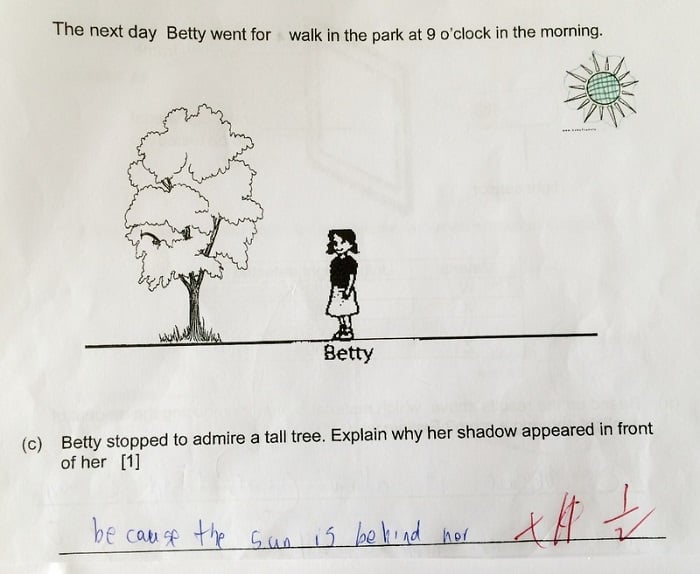
    Do you know how a shadow is formed? Here’s one student’s answer to a puzzle that has tickled the intellect of many an ancient Greek philosopher.

    The complete answer is ‘Because the sun is behind her and she is blocking the path of the light’. You know what this obsession with ‘complete’ answers will do to our kids? They’ll never be able to complete their paper on time because they’d want to add details like ‘because light travels in straight lines and Betty is an opaque human being and she will generate a penumbra and umbra depending on the angle and intensity of the sunlight’. Just to play safe. Except that some teachers will still mark you wrong for ‘trying to be clever’ when penumbrae and umbrae are not taught until you’re in secondary school. If you mention anything about photons or the particle-wave duality you may be suspended from school altogether.

    But back to the seahorse question. If I were grading the student I’ll not only let it go, I would also give her BONUS marks for using her imagination and drawing a figurative analogy between ‘hard skin’ and ‘armour’. By our school standards, this paper published in the rather obscure ‘Acta Biomaterialia’ journal is pure BULL. Its title?Highly deformable bones: Unusual deformation mechanisms of seahorse armor(Porter et al).

    All this nitpicking over ‘key words’ will not only kill our children’s love for science, but also restricts how individuals grasp concepts, punishing those who, well, ‘think outside the box’. A student who sees beyond 4 legs and digs deeper into the taxonomic characteristics of mammals vs birds is given zero marks vs another who memorises ‘key words’ because his tuition teacher said so. Flowery language, like ‘armour’, is not ‘scientific’ and has no place in a science paper, they say. Well try describing DNA to laymen without ‘unscientific’ analogies like zippers and enzyme/cell receptor interactions without using ‘lock and key’.

    Final question: What’s the difference between a robot and a typical Singaporean Science student?

    Answer: The robot needs electricity to recharge but the student does not need electricity to recharge.


    Source: http://everythingalsocomplain.com

  • Eugene Tan: Do Away With Race-Based Annual Academic Data

    Eugene Tan: Do Away With Race-Based Annual Academic Data

    Every year, the Ministry of Education (MOE) publishes data on how Singaporean students fared in the previous year’s national examinations; that is, for the Primary School Leaving Examination, and the GCE O- and A-Levels.

    The data demonstrates the significant progress of Singaporean students over the past two decades. Last year, 95 per cent of the 2003 Primary One cohort proceeded to post-secondary education after 10 years of schooling.

    Before last year, the annual releases were titled Performance by Ethnic Group in National Examinations. They are now titled 10-Year Trend of Educational Performance. However, the data remain primarily organised and broken down according to the Chinese-Malay-Indian-Others (CMIO) racial classification.

    Raising academic standards is a collective national effort. We should not allow success or failure to be perceived in racial terms when other factors such as socio-economic status are playing a larger role.

    Such a routine public release of annual data on the major ethnic groups’ academic performances is likely to have the unintended consequence of reinforcing racial stereotypes, especially of the minority groups.

    The MOE should replace the current practice of annual reporting of such data with periodic reporting every five or 10 years. As the ministry stated in its 2014 data release earlier this month, “year-to-year fluctuations are to be expected as each batch of students is different, so it is more meaningful to focus on longer-term trends over 10 years”.

    In November 2012, I asked in Parliament whether the objective of providing feedback to the communities on their students’ academic performance can be achieved by a limited release at five- or 10-year intervals, when comparisons and analyses can be more meaningful and productive.

    The MOE’s Senior Parliamentary Secretary Hawazi Daipi replied that the annual release of data “enables the respective communities to monitor the effectiveness of their educational programmes, and recognise and celebrate their children’s achievements. There is also value in providing such information so that the community, ethnic self-help groups and the public can study the data and discuss areas for improvement”.

    If ethnic self-help groups need the information annually to assess and tweak their programmes, the MOE can easily provide the data directly to them away from the public glare. But circumspection is needed with annual data, since such programmes take time to raise academic standards and performance.

    PROVIDE DATA BASED ON SOCIO-ECONOMIC STATUS

    To be sure, the data is of some use in examining educational performance trends. Yet, in presenting trends, such data are not necessarily better if they do not provide meaningful information, and this undermines the primary purpose of releasing it.

    For example, the data show that Malay students, despite making the biggest improvement in mathematics, still do not fare as well as their non-Malay counterparts.

    In 2004, 67.8 per cent of Malay students passed O-Level mathematics. The figure has hovered at around 70 per cent since 2009. The comparative figures for Chinese and Indian students were 93 and 80 per cent, respectively, last year. But these statistics do not tell us why some groups perform better than others.

    This is not to mollycoddle some groups or to massage the facts of educational performance of the various races. Instead, greater attention and care should be put on the type and regularity of the information released, and how to release it in a measured way that will strengthen the efforts and self-esteem of groups that do not do so well.

    How about publishing data on how students perform according to their socio-economic status (using proxies such as housing types and household income), which is more relevant than race in explaining and uplifting educational performance?

    Is it not more likely the case that a non-Chinese student who needs help in mathematics would have more in common with his Chinese counterpart who also needs help in the same subject than with a fellow non-Chinese student who is doing well in mathematics?

    Research has shown that academic performance is not simply a function of actual ability. It is affected by the shared beliefs that people hold about the performance and abilities of their own and other social groups, whether it is race, religion or gender.

    Stereotypes are beliefs people have about different social groups, and how these beliefs affect our attitudes and abilities. Stereotype threat occurs in situations where people fear that their poor performance, when judged by or treated in terms of their race, fulfils a negative stereotype about their group. When people perceive a stereotype threat, they tend to underperform, thereby conforming to the stereotype.

    Context matters, too, and affects how we view presented data. We have long imbibed the dominant meritocratic discourse, which often equates academic success with one’s individual ability and effort. Hence, education successes and failures are commonly framed and seen as resulting from factors originating outside our well-regarded education system.

    The data are organised along race, but do particularistic factors such as race explain why a group lags behind academically, never mind the significant progress made?

    In educational psychology, the cultural deficit model posits that some groups underachieve vis-a-vis the dominant majority group because their culture is disadvantaged in important ways — in skills, knowledge, and behaviour — which contributes to poor school performance generally.

    At a time when the CMIO racial classification is less relevant with more inter-racial and international marriages, we must do away with racial stereotypes or notions of cultural deficits, because they undermine the very students we seek to help. Only then can our students develop to their full potential, unencumbered by the stereotypes and baggage of race, religion and language.

    ABOUT THE AUTHOR:

    Eugene Tan is associate professor of law at the Singapore Management University School of Law and a former Nominated Member of Parliament.


    Source: www.todayonline.com

  • Government Ministries Refuse To Hire 60 Year Old Retirees

    Government Ministries Refuse To Hire 60 Year Old Retirees

    The Government is trying very hard to extend the employment of those aged 60 and above.

    However, the effort seems focused on those already in employment at the age of 60, then continuing on to 62 or 65.

    Various schemes in place are not meant for those in their early 60s who retired earlier and now want to get back to work after a gap of one to two years.

    I retired last year at age 59 and, having turned 60 this year, decided to get back into the workforce.

    I tried applying for positions in various ministries and government agencies.

    There was usually no reply, except for a handful of rejections, even for positions such as administrative assistant.

    I have more than 30 years of experience working in a multinational company in the oil industry and have done some lecturing at a polytechnic recently.

    Yet, when I applied to be a relief teacher, I received a rejection from the Education Ministry.

    I didn’t even get a shot at an interview.

    Perhaps the Manpower Ministry could look at how to get the “young elderly” aged 60 to 65 employed.

    Surely it shouldn’t exclude those who have retired and later want to work again and are willing to accept lower wages.

    Lui Chiew Yee


    Source: www.allsingaporestuff.com