Tag: Mufti Menk

  • Komentar: Isu Banning Mufti Menk

    Komentar: Isu Banning Mufti Menk

    I have told myself to avoid commenting on specifics with regards to Islam in my posting but the recent resurfacing of the ban on Mufti Menk made me decide to do otherwise.

    Firstly, Mufti Menk comes from Zimbabwe, a majority (87%) Christian country where he is the chosen Muslim leader recognized by the Government of the country and the majority Christian masses. Surely, if he is intolerant towards Christians as the ban seems to imply, he would not have continued as the Mufti of that majority Christian country.

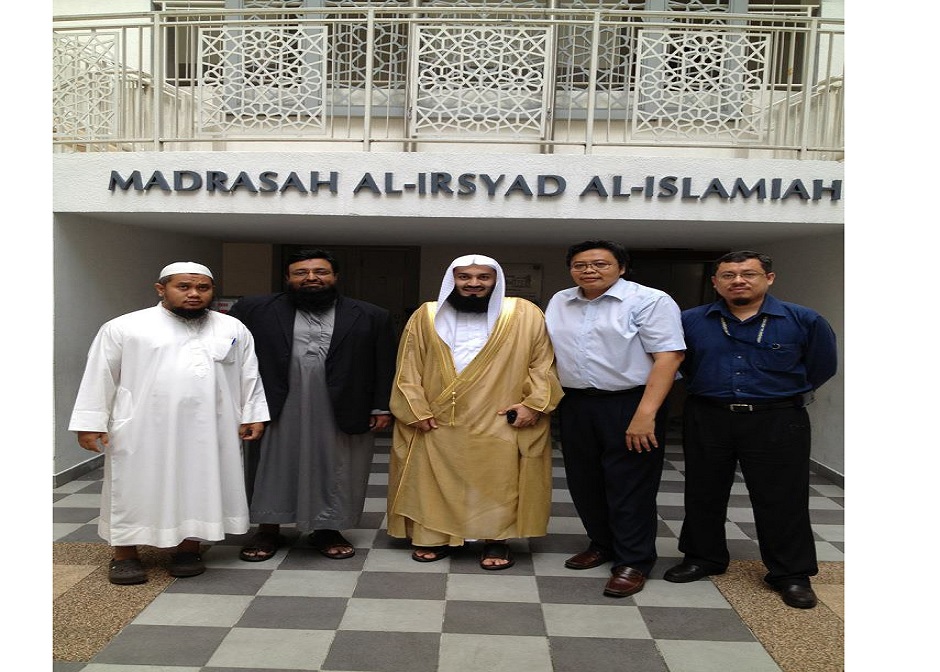
    I have personally met Mufti Menk when he visited and spoke in Singapore before. Personally i have never heard him prior to that chanced meeting although i have heard about him from others. He paid an unplanned visit to Irsyad while i was still working there. He was all praise for Singapore then. In fact he gave some advice to us to be grateful for having our Government. In his opinion the Government is just and have the people’s interest in mind. He was most impressed liked many visitors do of our physical landscape, its upkeep and cleanliness. These things he commented are more reflective of the real Islamic values being lived by collectively here and that most Muslim countries sadly failed miserably from doing likewise.

    I was told by friends that his banning was supposedly driven by some minority Muslim groups who seemed more interested to demonise him for their own personal sectarian interest rather than about the issue of wishing Christians Merry Christmas during Christmas. That was just a convenient alibi.

    It is really sad the the Government resorted to banning a well known popular Islamic preacher like Mufti Menk that i can confidently say majority Muslims in Singapore admired with his beautiful eloquent English language and respectful tolerant preaching, which many non-Muslim too who attended his talks can testify. By the way, his event here in Singapore was very well attended.

    From what i heard, his advised to Muslims is misunderstood, as we may not want to only wish our Christian friends, neighbours, colleagues, etc., using the words Merry Christmas. This is because the celebration of Christmas for believing Christians is closely associated to the concept of the birth of the Christian deity (God) in the person of Christ which unfortunately goes against the way we Muslim accepts Jesus, only as one of the mightiest Prophets of God.

    Having said this, we are most certainly encouraged to shower best wishes, gifts, etc., of all other kinds and in many more other acceptable ways on that Day to Christians if we chose to do so. I believe any Christian would fully understand, appreciate and not demand of Muslims to only wish them Merry Christmas just as it would be wrong of Muslims to demand non-Muslims to recite the supplication we do for one another invoking the name of Allah on Hari Raya.

    Finally, we must learn to understand and tolerate differences as ultimately fundamental differences between religions do exist just as there are similarities that we would rather talk about. All these are done in the true spirit of respect towards each others freedom and choice of religion. This respect towards other religion is fundamental for Muslims as in Islam there is no compulsion in religion and religious diversity is recognized and we are demanded not to say or act towards other believes disrespectfully.

    With regards to the matter of wishing one another on our own religious holy day, we should be more understanding and tolerant towards those who chooses to just wish us well or the best of health and spirit on that day or even those who chooses to remain silent, and able to live and let live rather than demand of one another to wish only as a believing devotee would.

    May our Government reconsider the ban on Mufti Menk after seeking clearer informations and insights or even having a dialogue with him. May wisdom and reason prevail over shallow thinking and misguided parochial advise.


    Source: Damanhuri Abas

  • Shanmugam Calls On US And World To Pay Attention To Radicalism In SEA

    Shanmugam Calls On US And World To Pay Attention To Radicalism In SEA

    Singapore’s Minister for Home Affairs, K Shanmugam, has called on the United States (and the world) to pay attention to the rise of “political Islam” and radicalism in Southeast Asia. Mr Shanmugam, who was delivering a keynote speech in Washington DC on Wednesday at the Johns Hopkins University School of Advanced International Studies, said the international community must come together and go beyond focusing on “downstream consequences” of the issue and address “the underlying philosophy and the underlying causes.”

    Mr Shanmugam has been sounding the alarm on the problem in Southeast Asia especially in recent years, pointing out terrorists’ activities in Malaysia, Indonesia and the southern Philippines for particular concern.

    Below is his speech in full:

    The Conflict in Syria and Radicalisation in Southeast Asia

    The underlying point I want to make is this. To deal with Islamic State (IS) in the Middle East, Syria and Iraq, assuming there is a kinetic solution, it will be a continuum and there is going to be much more because the ideology is not dead, and it is going to get on to other places.

    It has seeped into the rest of the world, and they are just going to look for more opportunities to convert other areas, going there and look for new converts, new areas to radicalise.

    Why do I say that? Because I come from a region, South-east Asia, (that) has arguably the largest Muslim concentration in the world, and it has been an area of particular focus for IS. Al-Qaeda probably is also building up its strength. They are not making many aggressive steps, but the sense is they are building up. But certainly IS has targeted, and has said that it is targeting, South-east Asia.

    What is IS’ strategy? You know they want to establish caliphates in many places, although they are a little bit under pressure right now. They have to go to the second ring of conflict, and this second ring of conflict will be South-east Asia.

    They have said publicly the places they want to establish a caliphate, which is Indonesia, Malaysia, parts of southern Philippines. There are about a thousand fighters from the region who have travelled to Syria and Iraq to fight, forming their own combat unit.

    I think IS has become much more effective in reaching out to this region.

    One of the things I want to say to the American audience is, what has all this got to do with America?

    If the Middle East is giving you a lot of problems already, and you take South-east Asia, what you are seeing is a replay of what is happening in other parts of the world.

    At first it is not urgent, it is not immediate, there is no kinetic activity.

    You had Afghanistan and during Soviet times, fighters and people who were trained, they go there, they fight and then they go back, and you have radicalisation coming up.

    You see what has happened as a result of that in Pakistan and other places. Today in Syria and Iraq, history is repeating itself.

    People are going there, they are learning, they are trained in the latest techniques, and then they are going to go back to various parts of the world, including South-east Asia.

    Meanwhile, the way in which political Islam is rising in South-east Asia makes the ground much more fertile for radicalisation.

    Political Islam rises for a variety of reasons — such as the availability of online material; money from the Middle East that goes to fund kindergartens, schools and so on; preachers who are schooled in a very different school of thought, contrary to the very moderate way in which Islam is practised, or has been practised, in South-east Asia.

    That is really a mirror of what has happened in other parts of the world. So you can see and predict what is likely to happen.

    And when that happens, what the implications would be, not just for countries in the region but for American assets in the region, and America itself.

    There are over 60 organisations which have declared their allegiance to IS, which is a huge number. In the past year or so, the number of terrorist attacks that have taken place has not received the level of attention that I think it should in the rest of the world, but it is quite important.

    IS’ strategy in South-east Asia is very simple. They now have very slick videos in Malay appealing to most of the population. They have got newsletters in Malay, all targeted at the Malay-Muslim population. And since September 2014, when their chief spokesperson set out the strategy on what they should do — lone-wolf attacks; use low-tech like knives, stones, cars, vehicles and so on.

    That was the call, and since then, you have had a whole series of attacks using vehicles, in Nice, Berlin, Westminster. We have had attempts in the region, also using low-tech “weapons”.

    They are quite bold in the way they position themselves. This is what they said in Malaysia in response to arrests. Malaysia has arrested commandos, civil servants, people in the transport sector, airports, about 200 people have been arrested.

    They said: “If you catch us, we will only increase in numbers. But if you let us be, we will be closer to our goal of bringing back the rule of the caliph. We will never bow down to the democratic system of governance and we will only follow Allah’s rules.”

    Essentially, the constitutional system of government elections and so on are not acceptable (to IS) — they want to be ruled in accordance with what they consider (to be) the only rule that applies, to overthrow systems of government and establish the caliphate.

    One area that is becoming a danger zone is the southern Philippines, because it is a very large territory, not fully under the control of the government or the military.

    It is an area that seems to be attracting militants back from the Middle East, those who have not been killed as well as those who have been radicalised within the region, to travel to southern Philippines, get trained and then come back to attack other places.

    And within the Philippines, recently an attack was foiled where the terrorists had moved from the southern Philippines all the way to Bohol. So their ability to move around, their logistics ability and their planning seem to be increasing.

    This year or next year, there will be 200 people being released from prisons in Indonesia. In Indonesia, they do not have the laws that allow them to detain people who are serious threats, and even if they have not been fully radicalised when they are in prisons, they are going to be a risk.

    And that is going to happen in significant ways in the next 18 months. It has started happening.

    And (with) these guys, a lot of the radicalisation takes place in Indonesian prisons, and even attacks outside have been planned from within the Indonesian prisons.

    So you have that, apart from the returning fighters, and prison releasees, that are serious threats.

    I talked about this briefly just now, about how values are changing. Based on some respectable surveys, in Indonesia, a good majority of the population think — this was a survey of high school students, but I think it is reflective of broader attitudes as well — that Syariah law should be imposed.

    About 10 to 11 per cent think that Indonesia should adopt the caliphate system. So if you just project that across a population of more than 200 million, that is a lot of people. Some of them are prepared to go further and take kinetic activity.

    In Malaysia, about 70 per cent of its Malay population are now saying that they should have Syariah law. Under the current Malaysian system, which is a constitutional system, it is not clear how Syariah law will work.

    Maybe they might be able to make it work. But the point I make to many people is that people do not overnight decide to take this up. There is going to be a period when the socio-economic and political environment makes it more likely that people want to take up this course.

    If the population becomes more and more “extremist thinking”, or adopts a version of religion that encourages or creates a climate where a number of people within the population might then be prepared to take further action, that is the main risk that I see happening.

    And the whole climate then changes, and it looks like it is changing. When the changes reach a certain point, after that it is not going to be possible to reverse it.

    On the influence of foreign preachers, Zakir Naik is wanted or banned in some countries but travels freely in the neighbouring countries in South-east Asia.

    He was recently in Indonesia, just before the Jakarta Governor elections. He talked about the nature of Muslims, which was not to vote for someone who was not a Muslim, even if that person was a good person.

    That is the sort of preaching and philosophy that was put forward. And there are political leaders who say he is the model of religious authority. The way he speaks is quite radical.

    Mufti Menk is another such preacher who has been banned from preaching in Singapore. He said: “If a Muslim came and greeted you Merry Christmas, it is the biggest sin and crime, the heavens will open up.”

    If you get this preaching day in day out, what do you think will be the tone of the population? When you get preaching like this, people start saying, “Oh, maybe this is true…” And it has real-world consequences.

    Last year, a Muslim shopkeeper in Glasgow put out a Facebook posting wishing his customers a Happy Easter. The next day a fellow Muslim stabbed him to death. And this is in the United Kingdom, a stable country. This kind of preaching has real-world consequences.

    A lot of countries have focused on downstream consequences. They are very good at taking out terrorist leaders, they dismantle organisations, they deal with their finances.

    But if we do not deal with the underlying philosophy and the underlying causes, in the end, as long as you do not deal with that, as long as you do not deal with people’s views which lead them to be radicalised in the first place, all you will be doing is cutting off their heads and new heads will come up.

    So there has to be a more concerted international strategy to deal with the underlying causes and reasons why these things happen. Why people get into these, how populations are becoming more radicalised.

    I have mentioned people who are returning from the Middle East, and the Afghanistan and Pakistan scenarios replaying in South-east Asia.

    I have mentioned people who were released from prisons, radical preachers, the population as a whole becoming more radicalised.

    The spread of radical ideology is also financed a fair bit by money that comes from the Middle East, goes into kindergarten schools, into schools and mosques, and tied to an exclusivist form of Islam which is alien to the kind of moderate Islam that we have in South-east Asia.

    What we intend to do in South-east Asia (is) we are trying to get together a group of like-minded countries to come together, such as Australia, New Zealand, Singapore, Malaysia, and Indonesia, to try to deal with these issues.

    We may not be able to deal with all of them but at least we have a platform, to start trying and talk about these issues and possible solutions. But America has to get involved, other countries have to get involved.

    At this stage, there is relatively low cost, but it will be a much higher cost later on. At the same time, I want to add a note of caution that as we focus on this, the more you talk about it, the greater the risk of Islamophobia as well. And that, you have got to try and avoid.

    If you get into Islamophobia, it will make your populations feel anti-Muslim, anti-Islam, (and) that just feeds the terrorists. It is a big risk. We need to guard against that, and fight it.

    The vast majority of Muslim populations in most places is moderate and peaceful. So what I wanted to share with you is, there is an area of the world where things are happening but people are not paying enough attention.

    By the time it demands attention, it will be too late. So it is best to try and deal with the problem before it gets to that stage.
     

    Rilek1Corner

    Source: https://publichouse.sg

  • PM Najib Razak Courts Middle-Class Muslim Votes With Welcome From “Controversial” Preacher, Mufti Menk

    PM Najib Razak Courts Middle-Class Muslim Votes With Welcome From “Controversial” Preacher, Mufti Menk

    KUALA LUMPUR — Malaysia has rolled out the red carpet for controversial Islamic scholar Ismail Musa Menk, a move that analysts have suggested could be part of efforts by Prime Minister Najib Razak to burnish his Islamic credentials to appeal to middle-class Muslim voters ahead of the general election.

    “(Mufti) Menk is popular among middle-class Malaysian Muslims … and if this is to be read as a political motive, then this … will boost Najib’s popularity with that group,” Dr Norshahril Saat, a Fellow at the Iseas-Yusof Ishak Institute told TODAY.

    The Zimbabwe-born Mufti Menk has more than 2.3 million Facebook fans and 1.3 million Twitter followers who regularly share his positive quotes on life.

    However, the cleric has flirted with controversy: His strong stance against homosexuality led universities in Britain to cancel his speaking tours in 2013 and he had allegedly advised Muslims against wishing others Merry Christmas.

    He was due to give a talk at a religious conference in Singapore in 2015 but his segment was cancelled for “reasons the authorities did not disclose”, according to the organiser.

    Still, Mufti Menk was in Malaysia over the weekend for an Islamic conference where he was one of the keynote speakers.

    Mr Najib hosted a religious talk attended by the preacher at his official residence on Monday night after meeting the latter on Friday, an encounter that the Prime Minister wrote about in his blog. Photos of them were uploaded on both Mr Najib and Mufti Menk’s social media accounts.

    “Victory only comes to those who are most patient,” Mr Najib quoted the preacher in his blog, noting that those were the words that “struck me the most” in their meeting to discuss about Islam, extremism, as well as the plight and welfare of Muslims around the world.

    The Prime Minister referenced the trials and tribulations faced by Prophet Muhammad and said: “This is one of the reasons why that quote by Mufti Menk struck a chord with me. That has been the way of Rasulullah SAW, and must continue to be the way forward for us Muslims.”

    Malaysia’s national polls are not due until next year but Mr Najib is expected to call for snap polls this year after battling issues surrounding state firm 1Malaysia Development Berhad and overcoming efforts by former Malaysian prime minister Dr Mahathir Mohamad to remove him.

    Throughout last year, Mr Najib’s ruling party, United Malays National Organisation (Umno), increasingly played up the racial and religious cards in a bid to retain the support from the Malays and Bumiputras — a key voting bloc for his party.

    Mr Asrul Hadi Abdullah, a director with political risk consultancy BowerGroupAsia, told TODAY that Mr Najib’s association with Mufti Menk is in line with Umno’s political Islam narrative to capture the Malay community’s votes, as the scholar is popular with the Malay electorate.

    Mr Asrul’s views were echoed by Mr Adib Zalkapli, a political analyst at political risk advisory firm Vriens & Partners, who noted that any association with Mufti Menk is “definitely a vote winner”.

    “Najib is not the first politician to employ this strategy and he won’t be the last. (Former opposition leader) Anwar Ibrahim used the same strategy by getting support from Yusuf Qaradawi when he was on trial for sodomy in 2014,” he said in reference to the renowned Islamic scholar and the head of the Qatar-based International Union for Muslim Scholars.

    Anwar was convicted and jailed for sodomising a former aide, a charge he describes as a politically-motivated attempt to end his career.


    Source: www.todayonline.com

  • Masagos Zulkifli: Religion Must Be Practised Based On Local Context

    Masagos Zulkifli: Religion Must Be Practised Based On Local Context

    Religion must be practised in context and Muslim scholars here understand how certain religious teachings should be taught in Singapore’s context, said Minister for the Environment and Water Resources Masagos Zulkifli.

    In an exclusive interview with Malay-language current affairs programme Bicara, Mr Masagos discussed the threat of terrorism in Singapore as well as the danger of preachers who impart divisive teachings. Mr Masagos was speaking in response to Minister for Home Affairs and Law K Shanmugam’s recent speech on the issue of terrorism and security of Singapore.

    Q: Minister Shanmugam’s speech on the issue of terrorism and security of Singapore – among other things – also raised the issue of the Muslim community growing somewhat more distant from the others, which is viewed as one of the threats to Singapore. As former Second Minister of State for Home Affairs, can you help to clarify what does the Government mean by this?

    Masagos Zulkifli: If we examine the speech, we know that Minister Shanmugam recognises that the Singapore Muslim community is a model community that we can be proud of. This is an important context of the speech, that he recognises the Malay/Muslim community has been able to live together with other communities through thick and thin without causing any conflicts, though they may arise from time to time. This is an important context which we have to bear in mind of the speech.

    But today, there are new external threats, especially the Islamic State ideology that has influenced many of our young people – through social media – to do one or two things. First, to join them to form an Islamic State in Syria, Iraq, and if they are not able to go there, then they can cause mischief or perform some killings to create troubles by doing whatever they can in their respective countries.

    So, we are concerned, in case Singaporeans do not understand about these new threats which may influence some people easily. They might be influenced to undertake violent acts without understanding that we have been able to live with each other in harmony.

    If you look at the threats in the last two years, they have become bigger over time. In the past, it was only radical ideology that the radicals wanted to spread to their friends, whether through social media and so on. Today we see a situation where acts of violence are becoming more common in cities – like the Paris attacks, and more recently, the attack on our neighbours in Jakarta. And we should not rule out the possibility that it could happen here.

    We have already arrested several young men who had been influenced and wanted to go to Syria or Iraq to join the fight with Islamic State, but they obviously wanted to conduct acts of violence including on our Prime Minister and the President. This shows that radical ideology has been able to sow the seeds of violence that can be used to manipulate a minority in the community to conduct the acts of violence which can undermine the harmony in our country.

    Q: Speaking of the “seeds of violence”, the Government has also picked up on some young Muslims who now think it is wrong to greet others by saying “Merry Christmas” or “Happy Deepavali”, as they consider it un-Islamic. We are also told there are also those who believe that it is wrong to recite the National Pledge or sing the National Anthem. Surely these are just symptoms of a problem. What is the larger problem here?

    Masagos Zulkifli: The Malay/Muslim community has all along been guided by our local scholars. Despite the various problems that arise from time to time, we can solve them by taking into account the interest of our society, our religion and at the same time, we can build a developed country together with other people.

    Now we begin to see influences that can come to our country through social media and so on, and this has been widespread in our society. If we look at some of the features of these influences which are disturbing, among those is the belief that we should create a situation or environment which is so pure and perfect, resembling utopia. And this is something imposed on us to implement it hastily.

    For example, if in the past we can have a meal together with others without thinking of what to eat, now some of us begin to isolate ourselves – they do not want to eat with other people because they do not eat halal food. But, thank God, through the guidance of our local scholars, we know that this is not right.

    Similarly, on the issue of the threats of radical ideologies that have come through social media and have influenced some of our young people, we need our local scholars to address them so that the young people know what to accept and what to reject.

    Q: How effective are our local religious scholars in tackling negative foreign influences?

    Masagos Zulkifli: We are fortunate that we are able to produce our own scholars through our local madrasahs. This is important. If they come from foreign countries, even from Mecca or Medina, they may also carry contexts or cultures that may not be suitable for the life and needs of the Muslims here.

    Religion must also have its contexts and many of our scholars from the local madrasahs and guided by other local ulamas, they understand better how certain religious teachings should be taught in our context.

    Among other things: How we highly value the harmony with other people, how we have to respect the rights of others who have their own practices and how we should tolerate the religious practices of others and do not see them as something that should be banished. This is the context most suitable to us, which is now being threatened by views coming from places that are now being fought by Islamic State.

    BANNING OF FOREIGN PREACHERS

    Q: Recently, the Singapore Government also firmly stated that it would ban foreign missionaries, who are intolerant to the situation here, from preaching in this country. Is there a particular trend that the Government is worried about, concerning foreign preachers gaining attention in Singapore?

    Masagos Zulkifli: Actually, this is a long-standing practice and does not only apply to Muslim preachers. It applies to all religions and anyone who comes to Singapore and rakes up issues concerning language, religion or race which can cause unhappiness among the different races and lead to racial unrest. We have been able to eradicate and prevent all this.

    So, if anyone who says wonderful things while in Singapore, things that are appropriate to our religion, but in their own country or through social media, they say things that can sow the seeds of terrorism or intolerance towards other religions, including forbidding “Merry Christmas” greetings and so on without taking into account its context, without taking into account the teachings of our religious scholars that allows it, and they reject our religious scholars – this is very dangerous.

    If we cannot trust our own religious scholars, who else can we trust? We have to rely on our religious scholars, we must trust our religious scholars who understand the context of living as a minority in Singapore so that we can continue with our right to practice our religion, as a Malay, as a Muslim.

    Q: We would like to get a full clarification from you as a Cabinet Minister. Lately, we have been seeing a lot of discussion on the Internet that Mufti Menk of Zimbabwe, for instance, has been banned in Singapore because of – among others – his opinion that Muslims should not wish others “Merry Christmas” and so on, and such attitudes are quite contrary to the spirit of religious and racial harmony in Singapore and because of that, he is not allowed to preach in this country. What is your response? 

    Masagos Zulkifli: We have the guidance of our local religious scholars who allow and even encourage us to develop the spirit of harmony and be compassionate to other communities. In fact, when we wish others “Merry Christmas”, we know that we are not Christians and will not become Christians by saying “Merry Christmas”.

    So, this is important and we do not need opinions which are not only contrary to what we uphold but can also create a situation that is not harmonious. As I have said earlier, the ban on foreign speakers is not just applicable to Muslims. This applies to all, whether they are Christians or Buddhists and so on.

    We recognise that the Government wants to create a harmonious, peaceful environment for everyone. Anyone who threatens it, whether they are in this country or overseas, we will stop it.

    THE TUDUNG ISSUE

    Q: What is your response to calls by two Malay Members of Parliament in recent Parliamentary debates for bigger spaces on the discussion of identity and religion, including the wearing of the tudung, and whether the Government can be more flexible on the issue?

    Masagos Zulkifli: I have two comments. Firstly, religion, language and race are very sensitive matters. We may feel that the time is right for us to discuss it among ourselves or with the other races. But it can also easily lead us to open old wounds that can instigate riots, and we do not want this to happen.

    Just look at what happened to our neighbour. Our neighbouring country (Malaysia) saw the Bersih demonstration being held as a protest against an issue. But incidentally, due to the presence of many Chinese, it nearly ignited a racial problem over there because of those images. Therefore, when a rather sensitive matter is being debated openly, those who are speaking, as well as those who are listening, may not be rational. If emotions have been rattled, people can do something unthinkable.

    Secondly, we should also see that – as I have said earlier – religious matters belong in the domain of scholars. These scholars not only possess deep knowledge, but they also practise and impart religion wisely. This happens in all religions. When we teach our children, we know that there are certain levels that are suitable for their age, suitable for their level of maturity and it will not be forced upon them. The same goes for religion – we need to do things gradually, and in any religious issue, religious scholars know the best solutions.

    I think that some people like to interfere in such matters, especially if they can politicise it. This will turn a particular issue into something more complicated than what it was initially.

    Q: What are your thoughts on MP Zaqy Mohamad’s call to see the wearing of tudung as part of a new normal, and whether the Government can re-look its approach on religious issues within the context of this new normal?

    Masagos Zulkifli: In any social change within society that happens to a particular community, we must be careful because it not only impacts that community, but also society’s perception of that community.

    This happens not only for the tudung issue, but we can also look at how the Government views the gay issue, for instance, or sexual relations between people of the same gender. The Government also did not budge on this matter. If we begin to budge, we know that there are groups who still cannot recognise the consequences of having the freedom to do whatever they want, just like the other religions.

    Therefore, we should not just be concerned with what we want. We should also know that every community wants its rights to be met. But, we also know that in Singapore – as mentioned by DPM Teo Chee Hean – we have remained as a harmonious society not because every community is given its rights, but because each community has sacrificed something that is very precious to them for the sake of that harmony, and this is something that we truly hold dear.

    Hence, I hope that in all these matters, we must be wise, we must think long and hard, we must go with those who are learned in these matters. What is the religious issue, its impact on religion, its social impact, its impact on society and so on? Think it over carefully because when we solve an issue, and if the issue is a complicated one, we must tread lightly.

    Q: So are there any developments in the discussion about the tudung, religion or race?

    Masagos Zulkifli: All matters pertaining to any religion are often discussed in the Cabinet and we do look at ways to lead society to be more open, more accepting – but we are careful in doing this.


    Source: www.channelnewsasia.com