Tag: Muslims

  • Ustaz Abd’ Al-Halim: Layak Mengajar Agama Kerana Ilmu Atau Sijil ARS?

    Ustaz Abd’ Al-Halim: Layak Mengajar Agama Kerana Ilmu Atau Sijil ARS?

    AsSalaam’alaikum!

    Saya rasa ramai di Singapura perlu fikirkan – jika seseorang guru agama yang sekian lama mengajar tentang Islam tetapi tiada sijil ARS (Asatizah Recognition Scheme) maka tidak dibenarkan mengajar dimana-mana institusi keagamaan di Singapura, adakah ini bermakna ilmunya itu sudah hilang? Adakah bermakna dia sebenar-benarnya tidak layak lagi untuk mengajar? Dan jika pensijilan ARS bergantung kepada menghadirkan diri di program-program MUIS atau mana-mana program yang diluluskannya, adakah ini bermakna seseorang guru agama itu yang tidak sering menghadirkan diri tiba-tiba kehilangan ilmu agamanya?

    Tidakkah kelayakkan utama seseorang guru agama yang berhak mengajar ialah berdasarkan keilmuannya?

    Ya, mungkin juga yang bersijil itu juga berilmu TETAPI jika benar yang berilmu boleh dinafikan pensijillan maka timbul persoalan; adakah kamu mahu belajar daripada yang bersijil ataupun yang sebenarnya berilmu?


    Source: Abd’ Al-Halim

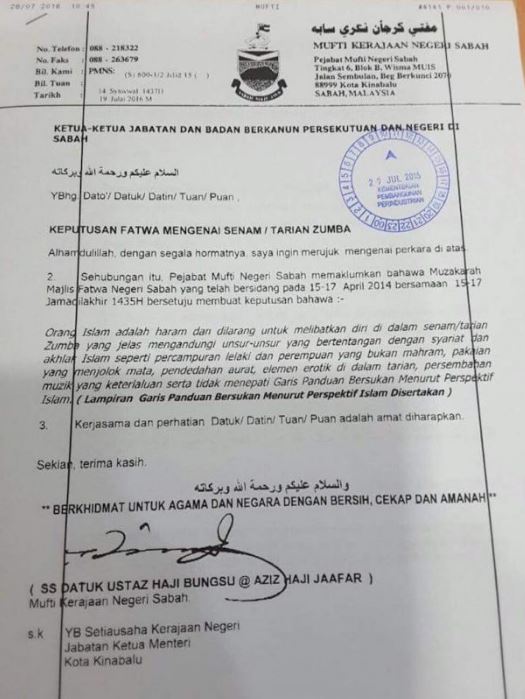
  • Mufti Keluar Fatwa Senaman Zumba Adalah Haram

    Mufti Keluar Fatwa Senaman Zumba Adalah Haram

    Mufti Sabah tampil kembali memberi peringatan kepada umat Islam khususnya, bahawa aktiviti tarian dan senamrobik yang diiringi muzik rancak atau lebih dikenali sebagai senaman zumba adalah haram.

    Peringatan itu dikeluarkan dalam satu kenyataan bersurat khas yang dikeluarkan bertarikh 19 Julai lalu.

    Tindakan surat peringatan itu dibuat berikutan senaman zumba kini semakin popular dan disertai umat Islam khususnya di Sabah.

    Dalam surat pekeliling itu, Datuk Bungsu @ Aziz Jaafar menggesa umat Islam menjauhi senaman tersebut kerana terdapatnya unsur-unsur yang bertentangan syariat dan akhlak Islam.

    “Antaranya seperti percampuran lelaki dan perempuan bukan mahram, pakaian menjolok mata, pendedahan aurat, elemen erotik dalam tarian dan persembahan muzik yang keterlaluan,” katanya

    Pada April 2014, Mufti Sabah pernah mengeluarkan fatwa rasmi bahawa senaman zumba itu adalah haram.


    Source: Bin Usrah

  • Can’t Blame Non-Muslim Businesses For Own Ignorance: Islamic Scholars In Malaysia

    Can’t Blame Non-Muslim Businesses For Own Ignorance: Islamic Scholars In Malaysia

    Muslims have the obligation to know the halal status of the food they want to consume and cannot blame non-Muslim businesses for their own ignorance, Islamic scholars in Malaysia said.

    Former Terengganu Mufti Datuk Ismail Yahya and member of PKR’S Islamic Council Wan Ji Wan Hussein believe if non-Muslim outlets have made it clear that their food is non-halal, they should not be held responsible if Muslim consumers failed to observe the notice.

    “Both parties must be responsible. The shop must make it clear that it is not halal,” Mr Ismail, now a legal adviser for progressive Islamic NGO Sisters in Islam, told Malay Mail online.

    “And if the outlets have (put a notice of its non-halal status), it is the responsibility of Muslims themselves to know not to eat there,” he added.

    Mr Wan Ji, on the other hand, said non-Muslim businesses have the right to sell whatever product without having to placate Muslim consumers.

    The young independent preacher added Muslim themselves must educate themselves about the choices they make, and cannot accuse non-Muslim businesses of attempting to confuse Islam’s followers if the non-halal status of their products were made clear.

    “Non-Muslims have the right to sell whatever product they want and say a Muslim entered the premise and mistakenly consumed a food that make up the core product of the company then you can’t blame the company can you?”

    Controversy struck fast food outlet Ninja Joe following complaints over its decision to name one of its burgers “P. Ramly”, a move that drew accusations by some Muslim consumers of attempt to confuse.

    Ninja Joe is known as a non-halal fast food chain company that specialises in pork burgers, even among Muslims.

    But Mr Ismail also said that the company was inviting trouble by choosing a Muslim’s name for a pork burger.

    While stressing that Muslims should have already known that the outlet sells pork burgers, naming a product with a Muslim name would definitely draw controversy.

    “If the company had made it clear they sell pork burgers then Muslims should have known not to enter..but maybe the company could have avoided (controversy) if they didn’t name something non-halal with a known Muslim’s name,” he said.

    Ninja Joe said it named the burger “P Ramly” as a homage to popular local burger makers Ramly Burger, a product it said was iconic to the Malaysian identity.

    But Mr Wan Ji noted some revered Islamic scholars, including the esteemed Yusuf Qaradawi, had deemed it permissible for Muslims to consume food offered by non-Muslims if they were unaware that the food are not halal.

    “In fiqh, cited even by Yusuf Qaradawi, Muslims are not obliged to decline food offered if their eyes did not see how the food was prepared.

    “Even during the Prophet’s (Muhammad) time, he did not question how the food that were offered to him by the Christians and Jews were prepared,” the PKR leader said.

    Ninja Joe could face action after the Selangor Islamic Religious Department (Jais) and its Negri Sembilan counterpart, JHEAINS, opened investigations against the company for what they alleged to be an attempt at confusing Muslims, in addition to confiscating several items from its store.

    The Domestic Trade, Cooperative and Consumer Affairs Ministry has since said that it will take action against Ninja Joe if any wrongdoing is found.


    Source: TODAY Online

  • Syed Farid Alatas: Against The Grain – Arabisation And The Malay Identity

    Syed Farid Alatas: Against The Grain – Arabisation And The Malay Identity

    *This article first appeared in Forum, The Edge Malaysia Weekly, on October 24 – 30, 2016.

    There has been much resentment expressed recently towards what is perceived as the Arabisation of Malays. This Arabisation is said to be manifested in a number of ways, the most common being the adoption by Malays of Arabic words in their vocabulary and the donning of Arabic dress such as the thobe, an ankle-length garment similar to a robe.

    In the past, for example, Muslims in Malaysia, Singapore and Indonesia would use the term “buka puasa” for the breaking of the fast during the month of Ramadan. These days, however, the Arabic word, iftar, is often heard.

    After the end of the fasting month, the common greeting among Muslims was Selamat Hari Raya Aidilfitri, but this has increasingly given way to the Arabic eid mubarak.

    More and more male Muslims in the region are using the Arab thobe rather than the sarong or kain pelikat. In fact, a variety of thobes originating from the United Arab Emirates, Oman and other countries in the Arab world can be seen in our mosques and at religious functions.

    Many have lamented the fact that things Malay have been substituted by things Arab and fear that this is the beginning of a trend of the Arabisation of the Malay identity and culture. Indeed, this phenomenon of Arabisation must be properly understood and distinguished from an earlier process of the Islamisation of the Malays, when Islam arrived in the Malay world of Southeast Asia.

    When a religion spreads from one region to another, it is quite normal that elements of the culture of the society of origin of that religion would be adopted by its new adherents. This can be said to have happened with the spread of Islam to the Malay world.

    When the Malays adopted Islam as a religion and way of life, the Malay language was influenced in significant ways. Not only was the Arabic script in a modified form adopted by the Malays, but many Arabic words also found their way into the Malay language. This was the case not only with religious vocabulary but also with words used in other areas of social, cultural and political life.

    Some words in Malay are obviously of Arabic origin. Examples are tadbir (administer), had (limit) and mustahil (impossible). Other words, however, are less obviously of Arabic origin. Examples are kuat (strong), derived from the Arabic quwwah, and pasal (paragraph, section), derived from the Arabic fasl.

    This process of acculturation is something normal that takes place whenever there is contact between two different cultural areas. Aspects of the Arabisation of the Malays that had accompanied the Islamisation of the Malays since the early days of the coming of Islam to the Malay world must be distinguished from what is being referred to as Arabisation today.

    What is referred to as Arabisation today is in fact a worrying trend. This is because the adoption by some Malays of certain elements of Arab culture would result in the gradual erosion of Malay culture and practices. If more and more Malay men were to adopt the thobe, this would mean the marginalisation of the kain pelikat and baju Melayu and their possible demise as a cultural artifact. Indeed, it is already the case that there is hardly a Malaysian kain pelikat industry to speak of, as this is dominated by a few Indonesian manufacturers.

    An even greater concern as far as the trend of Arabisation is concerned is the adoption of a way of life that is not only contrary to Malay culture but is also inappropriate for our society. The example I have in mind is the adoption of the niqab, the part of the hijab that covers the face. The niqab is a tradition of many Arab societies but is foreign to Malay culture. Still, it is increasingly seen on the streets of Kuala Lumpur, Singapore and Jakarta.

    Arabisation in this sense is really a reflection of the influence of certain understandings of Islam originating from the Arab world. For example, there is the phenomenon of Malaysians and Indonesians going to the Hadhramaut region in Yemen to study and returning home with Hadhrami Arab practices such as the donning of the niqab, gender segregation and so on.

    Those Malays and Indonesians who adopt such ways perhaps imagine that they are practising a more authentic version of Islam. In doing so, they set themselves apart from the larger Malay society, contribute to the erosion of Malay traditions and practices, and could be a party to the infusion of extremist interpretations of Islam.

    When Islam arrived in the Malay world centuries ago, it adapted itself to the culture of the region and did not marginalise the culture of its people. Take the zapin, a musical and dance genre. Zapin (Ar. zafin) was introduced to the region from Hadhramaut centuries ago.

    In each part of the Malay-Indonesian archipelago, zapin was indigenised to suit local conditions. Among the Malays of Sumatra and the Malay Peninsula, for example, the language of the song-text of zapin became Malay and the dance was not gender-segregated, unlike in Hadhramaut.

    Furthermore, the introduction of zapin throughout the region did not result in the marginalisation of the music and dance genres that were already thriving in the Malay world. This is unlike the situation in Malaysia today in which some Malay music and dance genres, such as wayang kulit (shadow puppetry) and mak yong (dance drama), are said to be unIslamic and proscribed.

    If elements of Arab culture blend in with Malay traditions and practices without eroding or eliminating things Malay, then such “Arabisation” can be said to be a creative process.

    On the other hand, if Arabisation is founded on the idea of the greater Islamic authenticity of Arab culture, it would result in the erosion and marginalisation of Malay culture and the adoption of inappropriate practices.

    It is this sense of Arabisation that has come under attack in Malaysia recently. The same can be said of the influence of any other culture such as Westernisation.


    Syed Farid Alatas teaches at the National University of Singapore’s Department of Sociology


    Source: www.theedgemarkets.com

  • Puak Houthi Tembak Peluru Berpandu Ke Arah Makkah, Perbuatan Dikutuk Keras

    Puak Houthi Tembak Peluru Berpandu Ke Arah Makkah, Perbuatan Dikutuk Keras

    Enam anggota Majlis Kerjasama Teluk (GCC) menerajui kutukan keras terhadap serangan peluru berpandu Khamis lalu (27 Okt) dilancarkan kumpulan militan Houthi Yaman ke kota suci Makkah.

    Saudi Gazette melaporkan GCC menyatakan serangan Houthi terhadap Makkah adalah “bukti penolakan mereka untuk mematuhi masyarakat antarabangsa dan keputusannya”.

    Menteri Ehwal Luar Amiriah Arab Bersatu (UAE) Sheikh Abdullah Bin Zayed, seorang anggota pakatan Arab dan GCC, menyalahkan Iran, yang menyokong Houthi.

    “Rejim Iran sedang menyokong kumpulan pengganas yang melancarkan roket ke Makkah. Adakah ini rejim Islam seperti yang didakwa?” katanya melalui Twitter.

    Bahrain juga mengutuk perkara itu semalam (28 Okt) melalui satu kenyataan dihantar ke Al Arabiya News Channel dengan menyatakan “menyasarkan tapak suci itu melambangkan penghinaan secara langsung kepada golongan Muslim merata dunia dan melahirkan kebencian dan jenayah agama bagi kumpulan militan.

    Qatar juga memberi respons dengan menyatakan pelancaran serangan peluru berpandu ke Makkah itu menghalang usaha untuk meleraikan krisis Yaman secara aman.

    Laporan Saudi Gazette menambah Majlis Shura Saudi turut mengutuk serangan peluru berpandu itu.

    Presiden majlis itu Sheikh Abdullah Al-Asheikh berkata serangan yang disokong ejen-ejen rejim Iran di Yaman adalah pencabulan kesucian Tempat Ibadah Allah.

    “Tindakan jenayah ini menyakiti perasaan lebih satu bilion Muslim merata dunia,” katanya sambil menambah tindakan sebegitu akan memperkukuhkan keazaman Kerajaan Arab Saudi itu untuk mengekang dan mengenal pasti sesiapa yang cuba untuk menyerang keselamatan negara dan rakyat negara itu.

    Pakatan Arab yang berjuang di Yaman menyatakan pada Khamis lalu bahawa ia memusnahkan peluru berpandu itu 65km dari bandar suci tersebut sebelum ia dapat menyebabkan sebarang kerosakan, dan membalas serangan itu di tapak pelancarannya di Yaman, menurut kenyataan tersebut yang ditukil Saudi Press Agency.

    Saudi Gazette menambah Houthi mengesahkan melancarkan peluru berpandu Burkan-1 ke Arab Saudi dalam satu kenyataan menerusi agensi medianya, tetapi menambah ia disasarkan ke Lapangan Terbang Antarabangsa King Abdulaziz di Jeddah.

    Source: Berita MediaCorp