Tag: National Service

  • Good NS Performance Will No Longer Be Taken As Mitigating Factor For Sentencing Defaulters

    Good NS Performance Will No Longer Be Taken As Mitigating Factor For Sentencing Defaulters

    How well a national service (NS) defaulter performs in his duty when he eventually serves should have no bearing when deciding his punishment.

    This was made clear yesterday by the High Court as it laid down fresh sentencing benchmarks for NS dodgers.

    The benchmarks also “amplified” punishments for those who default for longer periods since it affects their fitness for service and the time they can serve as reservists.

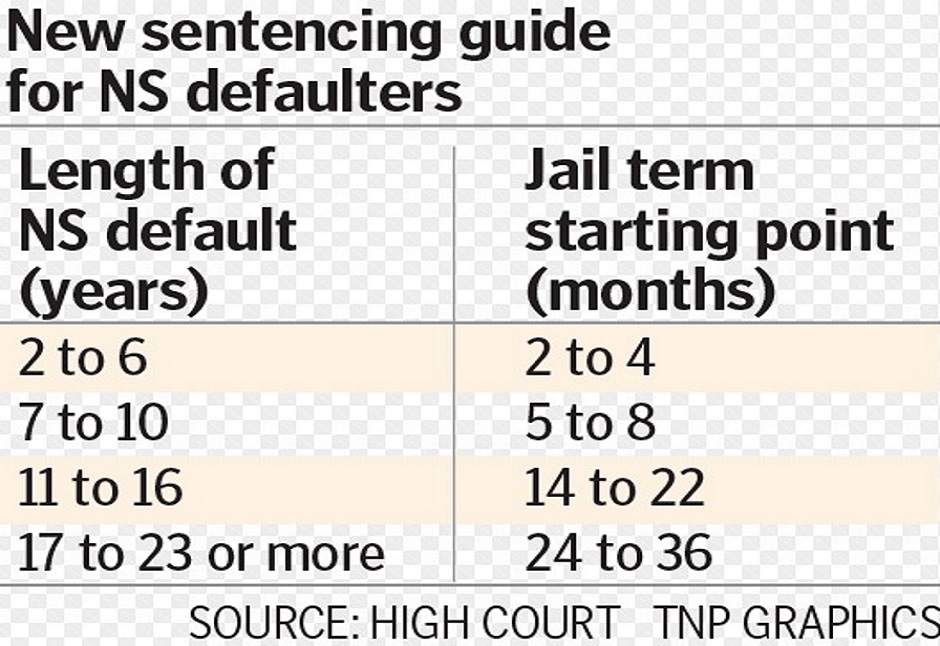
    The three-judge panel, led by Chief Justice Sundaresh Menon, set out four sentencing bands based on the length of default.

    For those who evade NS for two to six years, the starting point is two to four months’ jail; for seven to 10 years, it is five to eight months’ jail; and for 11 to 16 years, it is 14 to 22 months’ jail. For cases involving those who evade for 17 to 23 years or more, the default jail term kicks off from two to the maximum of three years.

    The grounds of decision were related to the cases of three defaulters, who were given heavier sentences in April after the prosecution appealed.

    Explaining its decisions yesterday, the panel rejected key parts of the sentencing benchmarks laid out by Justice Chan Seng Onn in February last year, when he sentenced a 25-year-old to three months in jail for defaulting for more than six years, and then gave a 1½ month discount for his good performance in NS.

    The panel agreed with Justice Chan that the main factor in determining an NS dodger’s culpability is the length of time he defaulted, and that anything over two years should mean a jail term. This, the court said, is because he would start serving only after his peers had completed their duty.

    But, among other things, the court disagreed that the sentence should be calibrated based on whether the defaulter has a substantial connection to Singapore, that a discount should be given on the accused pleading guilty instead of claiming trial, and that exceptional NS performance should be a mitigating factor.


    Source: www.tnp.sg

  • LTC (NS) Ridzuan Bin Ismail Aims To Impart The Importance Of National Defence To His Men

    LTC (NS) Ridzuan Bin Ismail Aims To Impart The Importance Of National Defence To His Men

    When he first enlisted, LTC (NS) Ridzuan Bin Ismail did not care much for National Service. It was only after disrupting and coming back 4 years later that he started appreciating the importance of NS.

    A deep sense of purpose drove him to extend his NS cycle in 2010 and the 45-year-old director at the Public Utilities Board is now the Chief of Staff of 12th Singapore Infantry Brigade. His greatest goal? To impart the importance of national defence to his men and to make sure that they are trained and always ready for battle.

    Citing the example of how he could not tell the difference between his Operationally-Ready National Servicemen and the Regulars during exercises, he said: “This shows that the SAF has trained us well. We may have our own careers, but we are ready to face any missions thrown to us just like a regular unit.”

  • How To Show Appreciation To NSmen When Pioneer Generation Malays Were Discriminated In Or Excluded Altogether From National Service

    How To Show Appreciation To NSmen When Pioneer Generation Malays Were Discriminated In Or Excluded Altogether From National Service

    The NS50 nationwide campaign has revived painful memories to many Malays of my generation.

    How do we take part in this campaign to show our appreciation of National Servicemen when many of us were not called up; and of the small minority that were selectively called up, many also faced all kinds of invisible barriers during their service!

    Some were shunted to the cook house, others diverted to the transport section and became drivers, while a handful were deployed as physical instructors, as meritocracy and equality were thrown overboard..

    The first ten years were the worst as tens of thousands were left in limbo, in the twilight zone, unwanted by NS and because of that, they were not able to get jobs, leading to widespread unemployment within the Malay-Muslim community.

    I know so many of these people had to go to Mindef and begged to be taken into NS or to get a letter of exemption; most of their requests were ignored as callousness towards the community was then the order of the day.

    Those were the cruel days for the community until the top leaders see the light and gradually adjusted policies to make life easier for the community.

    But the discrimination against the community in NS and in the uniformed services, both subtle and otherwise, continues till today.

    To dismiss all this pain as just a perception, as a Malay Minister did recently in Parliament, is perhaps the unkindest cut of all.

    It is tantamount to rubbing chilly on wounds – despite the passage of 50 years – that have not yet completely healed.

    The current appreciation campaign, however, gives the government a golden opportunity to make amends.

    Surely it is not beyond the ability of the present star-studded scholar-leaders to think of some way to assuage the hurt of the past.


    Source: Ismail Kassim

  • ‘Nomad’ Takes On National Service To Become Singapore Citizen, Achieves Golden Bayonet

    ‘Nomad’ Takes On National Service To Become Singapore Citizen, Achieves Golden Bayonet

    By 16, he had lived in four different cities.

    But even then, Kyle Brendan Coughlan, an Irish-Singaporean who held dual citizenship, was certain he wanted to become a Singapore citizen.

    He did, two years later.

    Like all Singaporean men, Mr Coughlan, who turned 20 last week, went on to do national service.

    He did so well that he was posted to the Specialist Cadet School after Basic Military Training (BMT) and graduated with a Golden Bayonet award yesterday. The Golden Bayonet  is awarded to the top 10 per cent of all Specialist Cadet trainees.

    Explaining his decision to become a Singaporean, he told The New Paper: “I really like the food and I’ve assimilated well to the culture here. I also have many close ties in Singapore.”

    Mr Coughlan, who has plans to study in the UK, said he never really had a place to call home. His family moved around a lot because of his father’s work as a hotelier.

    Born to an Irish father and a Singaporean mother in Singapore, he moved to Hong Kong with his family when he was about seven months old.

    The family went on to live in Macau and Bangkok, before returning to Singapore about five years ago, when Mr Coughlan enrolled in United World College of South-east Asia.

    “I’m kind of like a nomad,” he joked. “Wherever I go, I make the best of it.”

    He added that as a sports lover – he plays football, rugby and does track and field – the local climate suits him, compared to Ireland’s, where he visits relatives often.

    His outgoing personality also meant he could adapt easily. During BMT, fellow recruits were initially hesitant to approach the only “international recruit” in the platoon but he initiated conversations and quickly struck up friendships.

    Mr Coughlan, who was the top cadet in the Combat Service Support Command (Transport), said he felt “truly honoured and humbled” to receive the award. He is now a Third Sergeant.

    He credits his family for being his pillar of support.

    Mr Coughlan has a younger brother.

    “My parents did not influence my choice of citizenship. They were very open and supportive of my decision.”


    Source: http://www.tnp.sg/

  • Some Netizens Not Happy NS Recruits Can Now Cool Down With Ice Water During Fieldcamp

    Some Netizens Not Happy NS Recruits Can Now Cool Down With Ice Water During Fieldcamp

    Those of you who have gone through national service will know how “siong” (tough) a field camp is. It is one of those experiences which leave a lasting impact on you, along with lots of memories for later years to reminisce about.

    Field camps are tough because they last several days, such as what Leopard Company at the Basic Military Training Centre (BMTC) went through earlier this month. In such trainings, it is important to follow the TSR, or “Training Safety Regulations”.

    In Singapore, especially, the weather can be a challenge, even for civilians who are under comfortable shelter, let alone soldiers in the field under the blazing sun and unforgiving heat.

    It is perhaps because of this that the recruits of Leopard Company were allowed to cool down with buckets of ice water as “an additional measure” to make sure they do not get heat stroke.

    BMTC posted a photo of this on its Facebook page on Monday.

    The photo drew some laughs and ridicule.

    “Wow the buckets are so nice now and the ice water so much cleaner,” said James Lce.

    “War time where to find lce water?” asked Bronson Teo.

    “What the f*** why we got no ice water to cool down one?????” asked Gustav Yap Puay Tong.

    “Wa so good now ah? Got ice cold water during field camp,” said Lim Wee Liang.

    Some were envious, saying the recruits have a “good life”, while others ridiculed them as “snowflakes”.

    But let’s give the boys a break. NS is tough business, and our kind of weather doesn’t help. Whatever keeps them safe, let’s support.

    Stay safe, guys!


    Source: www.theindependent.sg