Tag: PAP

  • Resident Disappointed As WP Takes MacPherson SMC Challenge Lightly

    Resident Disappointed As WP Takes MacPherson SMC Challenge Lightly

    Dear Editor,

    I would like to relate the sentiments of “Macphersonians”, having served and retired in this ward since the time of Encik Othman Eusofe to the useless Matthias Yao and the current embattled Tin Tin and her adventures with Rosemary.

    I rejoiced initially when I heard WP is coming to contest here and Marine Parade GRC but this joy slowly turned to disappointment, yet again as my grassroot friends who are still serving in MacPherson were told to heave a sign of relief as WP only takes Marine Parade seriously and is plucking an unpopular feather weight candidate from the defunct Moulmein-Kallang as a token contest in MacPherson!

    I wonder if anyone really cares about the welfare of MacPherson as we merely seem to be a pawn in the ball game of the bigger boys, be it the PAP, WP or even Nicole Seah Party. The latter pledged to still care for MacPherson with her crocodile tears and even made several empty promises which she never fulfilled before achieving her set out target for fame and glamour.

    Tin Tin on the other hand, was sent here to tame GCT and gang into submission to LHL’s lieutenants as they understand the ground data well that her presence will not affect MacPherson (as many elderly are ignorant of social media) but a deliberate intent to pull down votes from the more affluent Serangoon, Geylang Serai and Kembangan-Chai Chee.

    So now that after all targets are fulfilled, we are once again kicked out and left on our own when GCT threw a ruckus about his “legacy” in Joo Chiat Marine Parade being in tenterhooks should the WP choose to run in his constituency.

    Now residents of both wards should carefully judge and put pressure on both parties if they are genuinely here for our long term interest or another round of tactical move on their political chessboard. If so, then I think we should look beyond a 2 party system as it is no longer working for the good of this country.

    N. Ultraman
    A.S.S. Contributor

    Source: www.allsingaporestuff.com

  • #SG50: A Changing Singapore Questions Its Miracle

    #SG50: A Changing Singapore Questions Its Miracle

    The red and white flags are everywhere. Military planes form the number 50 in the azure skies above the magnificent Marina Bay Sands. The Merlion proudly stands as tourists and locals snap the obligatory selfie on this special occasion. It is Singapore’s birthday, but not everyone is on party mode.

    “We work, work, work. Very stressed. Everything expensive, nothing free lah. This island is for rich people, not poor people,” said one “uncle,” the term Singaporeans use to refer to taxi drivers and elderly men.

    It is a creeping sentiment that contrasts with the splashy parade and fireworks on the city-state’s 50th independence day on Sunday, August 9. As Singapore’s government trumpets the third-world to first-world catchphrase, some of its citizens point to inequality, glitches in the train system, and the growing competition with foreigners for jobs and space. (READ: #SG50: Foreign workers less welcome in Singapore?)

    Along with the celebration is an anxiety that the success that drove the Southeast Asian nation to the top of global economic rankings will gradually taper off.

    While the late strongman Lee Kuan Yew’s Singapore valued economic growth, a younger, well-heeled generation of Singaporeans is questioning the same policies that brought the country prosperity, and the costs of its fairytale-like transformation. Where is this shifting Singapore headed?
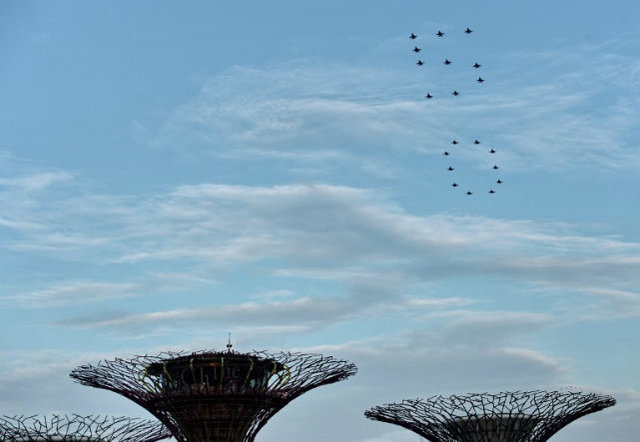
    GRAND CELEBRATION. The Republic of Singapore Air Force fighter jets fly in a 50 formation over the Garden by the Bay's Supertrees during a preview for the 50th Singapore National Day celebration on August 1, 2015. Photo by Roslan Rahman/AFP

    GRAND CELEBRATION. The Republic of Singapore Air Force fighter jets fly in a 50 formation over the Garden by the Bay’s Supertrees during a preview for the 50th Singapore National Day celebration on August 1, 2015. Photo by Roslan Rahman/AFP

    Generation gap

    The Singapore of the 21st century is often referred to as a victim of its own success.

    After the immigrant city was expelled from Malaysia in 1965, its founding fathers headed by Lee led its transformation into a modern metropolis. Obsessed with vulnerabilities like the lack of land and water, a central, paternalistic government prioritized economic security by providing public housing, education, and infrastructure.

    Yet this model focusing on material wellbeing led to more sophisticated demands.

    Kenneth Paul Tan, vice dean at the Lee Kuan Yew School of Public Policy, partly attributes the discontent to a generational gap.

    “An earlier generation might have felt very grateful, maybe more compliant but younger Singaporeans did not grow up like that. They were born into more affluent situations. The efficiency, sanitation were there. They don’t compare ourselves to cities doing badly. They compare ourselves to cities doing very well. So expectations are high for this government.”

    Despite being in a wealthy, high-tech metropolis, Singapore’s workers rank as the unhappiest in Asia, and have one of the longest work hours in the world. The hub for finance is also the most expensive in the globe, with a rising cost of living.

    Economist Donald Low, also with the Lee Kuan Yew School, said that social mobility is a key concern as the population ages, and as export-oriented economies like Singapore stagnate.

    “The questions that consume the minds of Singaporeans are: Do people feel their children have the chance to improve their standing in society? If I’m in the middle class, will my kids have a chance to be in the upper middle class?”

    “It’s harder for us to achieve the same levels of social mobility that we achieved in the first 30 years when Singapore progressed very rapidly from a poor nation to a rich nation,” Low told Rappler.
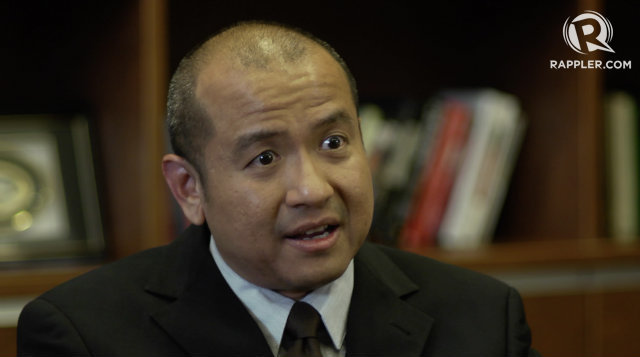
    GREATER EXPECTATIONS. Kenneth Paul Tan, vice dean at the Lee Kuan Yew School of Public Policy says the more educated, globally exposed younger generation of Singaporeans has greater expectations of the government. Photo by Adrian Portugal/Rappler

    GREATER EXPECTATIONS. Kenneth Paul Tan, vice dean at the Lee Kuan Yew School of Public Policy says the more educated, globally exposed younger generation of Singaporeans has greater expectations of the government. Photo by Adrian Portugal/Rappler

    Engaging while clamping down

    Part of what observers call this “new normal” is a more contested political landscape.

    While most political parties will celebrate getting 60% of the vote, Lee’s People’s Action Party (PAP) considered the result its worst setback in 2011. One of the world’s longest ruling parties, the PAP will vie for elections expected later this year or early 2016 where it might lose more seats to the opposition.

    PAP’s Tan Chuan-Jin, minister for social and family development, said the ruling party is adjusting to a more active electorate. (Read and watch: #SG50: Rappler Talk: Singapore after LKY – legacy, leadership, and change)

    “People appreciate the fact that ‘I had a role to play. I am not marginalized. I am not just a cog in this whole machinery that is Singapore but I have a stake.’ There’s a purpose. It’s a very different sense of being a citizen. That engagement is important. We definitely need to do a lot more of that,” he told Rappler.

    Yet some things never change. In an effort to get students more involved in social activities, the minister said the government is requiring them to do “voluntary outreach work.”

    He caught himself and quipped: “It’s kind of horrific if you think about it that way.”

    Part of the government’s adjustment is dealing with social media. While it has direct or indirect control of mainstream media and sued opposition politicians and foreign news outlets, it does not have the same hold over Facebook, Twitter, and other platforms in one of the world’s most wired cities.

    Singapore’s leaders tried to rein in expression online through lawsuits, and alicensing scheme for news websites.

    The government often justifies harsh controls on free expression as essential to fostering economic growth and social cohesion in a multicultural, multiracial society.
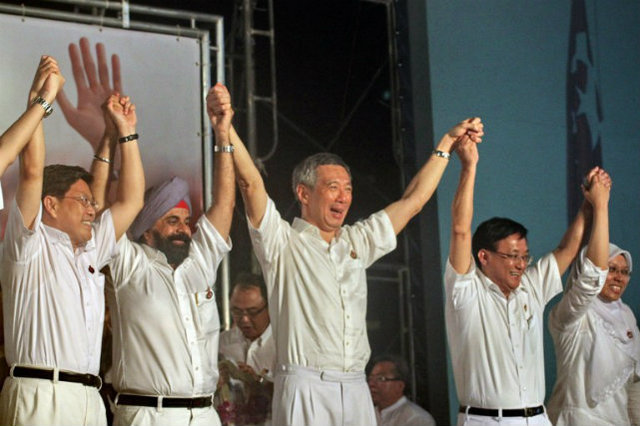
    WORST RESULT. One of the world's longest ruling parties, Singapore's People's Action Party again won the 2011 elections but suffered its worst setback. File photo by Mohd Fyrol/AFP

    WORST RESULT. One of the world’s longest ruling parties, Singapore’s People’s Action Party again won the 2011 elections but suffered its worst setback. File photo by Mohd Fyrol/AFP

    The cost of censorship

    Alex Au, a dissident blogger who has been forced to apologize and pay fines to the government for critical articles, said that the clampdown on free speech is counter-productive. He was convicted of “scandalizing the judiciary” for blogging about how the court handled LGBT cases.

    Au also cited the case of 16-year-old Amos Yee, jailed for 53 days for posting a video criticizing Lee and Christians. Au said the government went “totally overboard.”

    “A substantial number of Singaporeans has become restless, and are able to see through the relatively self-serving nature of these thin-skinned rules. There is a constant drumbeat of criticism on social media about these rules. The cost of self-censorship, the closing of minds far outweigh any benefit you could possibly gain from social harmony,” Au told Rappler.

    Even in the arts, the government has stuck to old practices like prohibiting critical content.

    To Singapore with Love, a film featuring political exiles made to mark the 50thanniversary, was banned.

    Vice Dean Tan, also chair of the Asian Film Archive, said that censorship hurts the development of the arts as well.

    “The real meaning of jubilee is forgiveness for past sins. If we took our jubilee in that spirit, it sets a stronger foundation for Singapore to go forward, and we should let the artists, people dealing with the soul of Singapore, contribute to that effort,” Tan said.
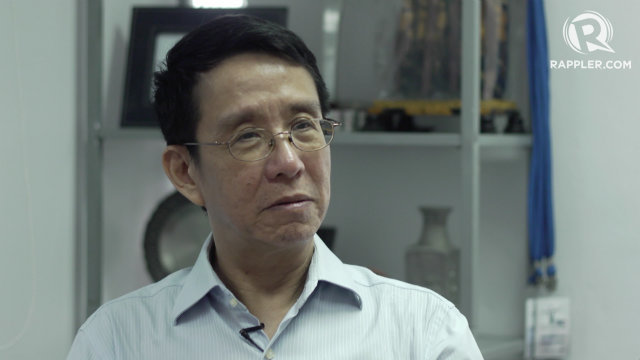
    BEYOND INFRASTRUCTURE. Dissident blogger and political commentator Alex Au says Singaporeans must demand for greater freedoms, not just better infrastructure. Photo by Adrian Portugal/Rappler

    BEYOND INFRASTRUCTURE. Dissident blogger and political commentator Alex Au says Singaporeans must demand for greater freedoms, not just better infrastructure. Photo by Adrian Portugal/Rappler

    ‘Creative rethinking’

    As the festivities die down and Singapore’s workers head back to their swanky offices, the future of the city-state is not as clear as the golden jubilee’s laser shows.

    Experts said the government is right in stressing the importance of maintaining Singapore’s economic dynamism. Yet with a changing demographic and more critical voices, the Lion City must rethink how it achieves that.

    “We have to reimagine various policies and institutions in Singapore,” said Low. “For a successful organization, creativity and innovation are not natural. My fear of the Singapore government is not so much complacency but failing to question the need to alter the very policies that have given us success.”

    For Au, Singaporeans must also go beyond questioning the breakdown of trains and traffic lights.

    “The engineering here will be good because people have no patience with poor engineering. But on the other front, when it comes to the environment, animal protection, human rights, poverty alleviation, treatment of migrants, there isn’t enough satisfaction.”

    He said the changing sentiment does not necessarily signal Singapore’s decline.

    “If you are not dissatisfied with the present, you can never progress or get to the next step. You have to be unhappy where you are.” – Rappler.com


    Source: www.rappler.com

  • Chee Soon Juan: Will Lee Hsien Loong Be The Leader That Singapore Needs

    Chee Soon Juan: Will Lee Hsien Loong Be The Leader That Singapore Needs

    Observers will undoubtedly note that Mr Lee Hsien Loong’s decision to call for a general election two years ahead of time is a clever one. How can it not be? The celebration of our 50th National Day, itself a significant milestone, allows the Government to hand out goodwill packages in various guises that will usher in the feel good factor for the PAP.

    Add to this a system awash with anti-democratic practices – the continued use of the print and broadcast media to constantly churn out welcome news for his administration, the redrawing of electoral boundaries behind closed doors, the introduction of the GRC system in the 1980s to hobble opposition efforts, the crackdown on the online media, the employment of HDB upgrading as punishment or reward, the dishing out of financial packages just before elections, the use of state-funded organisations for political purposes, the imposition of impossibly short campaign periods – and it is not difficult to see how the next polls will again end up in overall victory for the PAP.

    It is a system that does not, indeed cannot, admit of democratic progress.

    As I said, it may be politically clever to craft such a system. But cleverness is not what Singapore needs right now – especially at this stage of our country’s development. There is not any doubt that Mr Lee’s continued adoption of such tactics will help his party secure another five years in power, as it has done so for the last 50. But he should be reminded that, in the fullness of time, such an approach has not been looked kindly upon.

    The PAP may insist, as it is wont to do, that its mandate to govern is derived from the majority of voters in regularly held elections. But it is also aware, I am certain, of the difference between elections held in undemocratic systems and genuinely free and fair elections held in democratic ones.

    Strongman-type systems led by autocrats like Suharto and Ferdinand Marcos held regular elections to legitimise their rule and, for a time, few questioned their right to govern. Whether their legacies endured the stringent test of time is another matter.

    In undemocratic states, it is not the majority’s opinion at the polls that rulers should be worried about. It is the minority, rather, the one which watches – and gets increasingly agitated at – how the system is being manipulated to buttress the status quo at which rulers should cast their nervous glance. For is there ever any doubt that it is this segment of the population that brings about change? History is replete with instances where a significant minority calls for, works towards and, ultimately, brings about political reform. These movements are especially potent when frustration and resentment with the ruling clique’s intransigence crosses the threshold.

    At home, anger at the current political situation is palpable and some have resorted to action (seehere). If the PAP is content to label this group of citizens as the ‘noisy minority’, then it should re-read the preceding paragraph. For these people, the prospect of being unable to bring about political change through the ballot box only makes the PAP’s claim of legitimate power sound dangerously vacuous.

    It will be undoubtedly (autocratic) politics-as-usual after the next election. The country will continue to hum along. But this is predicated on the assumption that circumstances in and around Singapore remain unmolested.

    It is, however, a big assumption. Socio-economic developments within our shores point to a future fraught with difficulty and uncertainty: An expensive city with limited opportunity especially for the youth, an ageing population with retirees having little or no income, an economy with wide income disparity, a crowded city set to become even more congested, and a people increasingly feeling alienated from their country of birth.

    Developments farther afield are not more encouraging. Economic uncertainty in Europe and China will not leave Singapore unscathed. The spat over claims on some islands in the South China Sea by China and her neighbours in the region is another flash point.

    When a crisis envelops Singapore, as one will sooner or later, how will the people react? More important, will Singaporeans continue to accept placidly the PAP’s undemocratic rule especially if they feel that the situation is caused, or at least exacerbated, by the party in the first place?

    On the bright side, the problem is not intractable. The Prime Minister is in a unique position rarely accorded to people. He stands at a political crossroads: He can open up the system in Singapore and seal his legacy as an enlightened statesman, or he can continue the ugly spectacle of winning elections through undemocratic means.

    I can think of two other persons who were in a similar position but who took their countries on very dissimilar paths: Taiwan’s Chiang Ching Kuo and Syria’s Bashir Al-Assad. Both became their countries’ leaders following their fathers’ rule: Chiang Kai-shek and Hafez Al-Assad. While the younger Chiang opened the door by instituting political reforms (albeit in a limited manner) for Taiwan to develop into a vibrant democracy that it is today, Bashir Al-Assad continued with his father’s dictatorial rule which eventually met with sustained rebellion and reduced his country to rubble.

    It is said that politicians think about the next elections, leaders think about the next generation. Will Mr Lee be the leader that Singapore needs?


    Source: www.cheesoonjuan.com

  • Teo Chee Hean Slams WP Over Town Council Issue

    Teo Chee Hean Slams WP Over Town Council Issue

    The gloves are off.

    Deputy Prime Minister Teo Chee Hean unleashed some of the sharpest verbal attacks in the election season so far when he took aim at the Worker’s Party handling of Aljunied-Hougang-Punggol East Town Council (AHPETC).

    It was meant to be a Meet-the-Media session before the “sound and fury” of the election overwhelms the fundamentals of choosing a candidate to secure Singapore’s future.

    But the Minister of Home Affairs delivered some of the fury himself when he was asked about what his People’s Action Party (PAP) would do if it wins back Aljunied GRC.

    The first priority for the PAP, if elected, would be to “go in and sort out the mess in the town council”, said Mr Teo.

    The PAP’s first assistant secretary-general noted that under the PAP previously, Aljunied GRC and Punggol East SMC were running healthy surpluses before they were amalgamated into AHPETC.

    Mr Teo said: “Now the whole AHPETC is in deficit. How did that happen? How did a large surplus turn into deficit? Where did the money go?”

    Mr Teo even took a swipe at AHPTEC chairman Sylvia Lim for her recent Instagram post, which fuelled rumours of her possibly running in Fengshan SMC.

    The photo showed Ms Lim sampling fried oyster omelette with the caption “The taste of Fengshan – heavenly! #reasontowin”.

    Mr Teo said: “Now we see the chairman of the town council saying that Fengshan SMC looks quite delicious. What’s going to happen? You’re going to swallow up Fengshan? For what purpose? To serve the residents of Fengshan? Or is Fengshan delicious because you want to add it to the pot? And help the town council with the deficit?”

    RISKS

    Political analyst Eugene Tan said: “These potshots are clear indications that the gloves have come off even before the word go.

    “PAP is clearly going on the offensive. Essentially, it is going for WP’s Achilles’ heel, which is the AHPETC issue.”

    Added the associate law professor at Singapore Management University: “It appears that PAP will keep hammering home this matter… And this may instead be perceived to be patronising to voters.”

    Meanwhile, Institute of Policy Studies senior research fellow Gillian Koh said this was an ongoing issue that will be brought up constantly throughout the hustings period.

    “It is just inevitable that after four years, this issue will crop up, especially since PAP values accountability, transparency and honesty.”

    Party veteran Emeritus Senior Minister Goh Chok Tong was also in a fighting mood during a speech last night. (See report above.)

    On the selection of MPs, he said: “At the very least, they must be able to run a town council in a transparent, accountable and responsible manner.”

    Mr Teo said there is a difference between individual mistakes and major lapses in financial accounting. Armed with the Auditor-General Office report on the issue, he said it was a “blanket assessment that their financial accounts can’t be relied upon. That’s quite serious.”

    That was why he could not leave it alone, he said.

    When asked if voters would be turned off by PAP’s overly critical comments, he replied: “Well, I think it is an important issue and a fairly fundamental one. You want to say you are setting yourself up as an alternate government. You must be at least able to run a town council… We should not keep quiet about it.”

    It is not only about competence, but also about integrity when choosing MPs, he said.

    In the wide-ranging session, the DPM was also asked about WP leader Low Thia Kiang’s thinly veiled criticism when he asked if the departure of Transport Minister Lui Tuck Yew was because he “has not been supported by his Cabinet colleagues”.

    Mr Teo dismissed it as “crocodile tears”

    He said: “I think it’s very characteristic of Mr Low to squeeze the most political mileage out of anything. I’m sure if his party had contested where Mr Lui stood, he wouldn’t be saying nice things about him.”

    Recognising that the electorate would want opposition voices, he noted that the Constitution provided for nine opposition members in Parliament. He said: “Make sure you vote for a candidate and a party whom you really want to place your future in the hands of. Make sure they’re the ones you want to manage your money and your town council.”


    “These potshots are clear indications that the gloves have come off even before the word go. PAP is clearly going on the offensive. Essentially, they are going for WP’s Archilles heel, which is the AHPETC issue.”

    – Political analyst Eugene Tan, who warned that this tactic may backfire on the PAP


    Source: www.tnp.sg

  • Amrin Amin Azan Untuk Perjuangkan Masyarakat Melayu Islam

    Amrin Amin Azan Untuk Perjuangkan Masyarakat Melayu Islam

    Calon Melayu/Islam Parti Tindakan Rakyat (PAP) yang baru, Encik Amrin Amin, bertekad untuk memperjuangkan masyarakat Melayu/Islam sekiranya dilantik menjadi Anggota Parlimen.

    Encik Amrin, 36 tahun, antara dua calon baru bagi GRC Sembawang yang diperkenalkan hari ini untuk Pilihan Raya Umum akan datang.

    “Perjuangan saya ialah untuk menyumbang, membina masyarakat Melayu/Islam, baik dari segi pendidikan, kewangan, dari segi amalan Islam, dan juga masyarakat yang menjunjung budaya dan bahasa kita,” ujar beliau.

    Encik Amrin, peguam korporat di firma guaman Joseph Tan Jude Benny, sudah berkhidmat di pelbagai jawatankuasa akar umbi seperti Jawatankuasa Perundingan Rakyat (CCC) dan Jawatankuasa Pengurusan Kelab Masyarakat.

    SERTAI POLITIK UNTUK BANTU GOLONGAN MEMERLUKAN

    Encik Amrin berkata beliau terpanggil untuk menyertai politik kerana ingin membantu golongan yang memerlukan.

    Beliau sudah melakukan kerja-kerja kemasyarakatan sejak 2004 di Chong Pang dan kemudian di Marsiling pada 2013 dan yang terbaru, di Woodlands pada 2014.

    Having received so much from my family and the community, it’s time for me to pay it forward.

    Posted by Amrin Amin on Thursday, August 13, 2015


    “Jumaat lalu, saya telah bertemu dengan keluarga yang kurang kemampuan. Ibunya sakit, malah lima anaknya juga kurang sihat. Saya berbual degan mereka, dan semasa berbual, saya dapat tahu yang abang lima beradik itu menjimat wang ‘recess’nya supaya dapat meringankan beban ibunya.

    “Saya amat tersentuh mendengar cerita itu. Dan ini menguatkan lagi azam saya untuk menolong keluarga-keluarga kurang berkemampuan, supaya mereka mendapat peluang baik untuk meningkatkan mutu kehidupan mereka, supaya mereka dapat mendapat pekerjaan yang baik, pendidikan yang baik dan sebagainya,” ujar Encik Amrin.

    Amrin Amin di sebuah acara kemasyarakatan. (Gambar: Facebook/Amrin Amin)

    LATAR BELAKANG SEDERHANA, FAHAM KESUSAHAN PENDUDUK

    Encik Amrin berkata latar belakangnya yang sederhana, membolehkan beliau memahami kesusahan yang dialami penduduk.

    Beliau membesar di flat HDB tiga bilik dan mendapat pendidikan di sekolah-sekolah kejiranan di Singapura.

    Dari 2004 hingga 2006, Encik Amrin merupakan penolong perundangan kepada Menteri Undang-Undang merangkap Ehwal Luar K Shanmugam. Beliau bertugas sebagai peguam korporat di New York dari 2007 hingga 2010 selepas tamat pengajian di Universiti Columbia.

    (Gambar: Facebook/Amrin Amin)

    “Latar belakang saya membolehkan saya memahami kesusahan yang dialami penduduk. Contohnya, semasa di sesi bertemu penduduk, kadang-kadang saya terdengar cerita tentang ibu bapa yang mungkin diberhentikan kerja, dan saya fikir, jika ia berlaku kepada saya, semasa saya kecil dahulu, pasti amat payah, amat sukar bagi saya melanjutkan pelajaran saya dan mendapat peluang-peluang yang ada.

    “Dan ini adalah satu azam bagi saya, selepas saya meraih banyak manfaat daripada masyarakat kita ini, untuk menabur jasa untuk sama-sama menjayakan masyarakat kita, supaya generasi akan datang, supaya mereka yang berada di dalam situasi yang sama, dapat peluang-peluang yang saya ada.

    “Saya rasa inilah tanggungjawab semua yang telah mendapat pendidikan yang baik, yang meraih manfaat dari sistem kita, untuk sama-sama berjasa kepada negara, berbakti kepada masyarakat supaya kita sama-sama pay it forward untuk beri peluang kepada generasi masa hadapan,” ujar Encik Amrin.

    PEMBANGUNAN BELIA PENTING

    Encik Amrin juga berpendapat bahawa pembangunan belia itu penting lebih-lebih dalam masyarakat Melayu/Islam Singapura, yang katanya, mempunyai bilangan belia yang lebih banyak berbanding masyarakat lain.

    Justeru, beliau merancang untuk bekerja dengan badan-badan akar umbi untuk mendekati belia.

    “Buat masa ini saya ingin bekerja dengan badan-badan akar umbi untuk sama-sama menjayakan program-program yang ada. Kita sudah ada banyak program-program belia yang menumpukan belia untuk membangunkan belia, contohnya 4PM, LBKM, saya bergiat dalam LBKM, dan baru-baru ini kita telah memperkenalkan program duta belia.

    “Dan inilah satu cara untuk kita mendekati belia, memberi mereka ownership yang mereka, walaupun VWO kita, walaupun badan-badan Melayu/Islam kita, sudah lama ada, masih ada tempat untuk belia untuk menyumbang, dan memberi idea mereka untuk memperkayakan usaha-usaha yang telah ada sekarang ini.

    “Ini adalah satu peluang keemasan untuk masyarakat kita untuk membangun dan meraih peluang-peluang yang ada,” kata Encik Amrin.

    Selain Encik Amrin, satu lagi calon baru yang diperkenalkan bagi GRC Sembawang ialah Encik Ong Ye Kung, Pengarah Kumpulan Strategi di Keppel Corporation.

    Mereka akan menggantikan Setiausaha Parlimen Kanan Hawazi Daipi dan Presiden Persatuan Tenis Meja Singapura, Ellen Lee, yang kedua-duanya tidak akan bertanding dalam Pilihan Raya Umum akan datang.

    Encik Hawazi yang juga Setiausaha Parlimen Kanan Pendidikan merangkap Tenaga Manusia akan bersara dari politik selepas 19 tahun berkhidmat di GRC Sembawang.

    Kelima-lima calon yang akan bertanding di GRC Sembawang ialah Menteri Pembangunan Negara Khaw Boon Wan, Encik Vikram Nair, Dr Lim Wee Kiak, Encik Ong Ye Kung dan Encik Amrin Amin.

    Source: http://berita.mediacorp.sg

deneme bonusu