Tag: peace

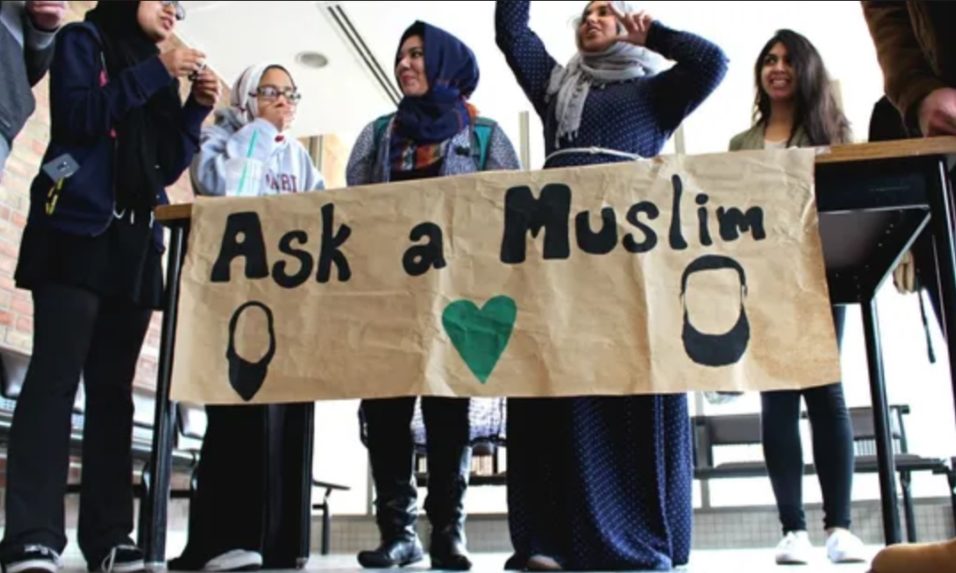
  • “Visit a mosque, ask a Muslim.”

    “Visit a mosque, ask a Muslim.”

    In the media, you were told that Muslims are violent.
    In the media, you were told that we are taught to degrade women and to be promiscuous and marry 4, force them into marriage, to beat them.
    In the media, you were told that Islam is barbaric and bad things are implied about our prophet Muhammad (peace be upon him).
    In the media, that is ruled by the people who hates Islam, because they cannot fathom the idea, that there is a way of life, growing exponentially and quickly, threatening to destroy the ideas of their corrupt worldly desires.

    The hate for Islam and Muslims who are portrayed as blood thirsty, intolerant and extreme. However, the media fails to portray that that is the ideology of a small fraction of a fragmented outcast who only claim they are Muslims, using misinterpreted, incomplete Qur’anic scriptures to their political advantage. The media fails to report that the majority of us, 1.6 billion of us, do not subscribe to those disgusting ideologies. The rest of us, were taught from young that our prophet taught us to be loving; to love another human being, as how we love ourselves. We were taught that our prophet declares anyone who creates harm towards their neighbour as disbelievers. We were taught to treat plants and animals with care and compassion. We were taught in Islam to pray for peace upon whomever we meet, which becomes our daily greetings. Long before the Geneva Convention and such, almost 1400 years prior, our prophet has taught us that even in a time of war, we cannot kill children, women and elderly, no tree should be harmed, no animals to be killed unless for food, no place of worship to be destroyed, we should not play dirty, to uphold treaties, to be fair to our opponents, to treat our prisoners of war with respect and dignity, what food we eat is what they should have, to not harm an opponent who has surrendered. Islam teaches us to live and let live, and religion cannot be imposed upon unwilling hearts because matters of the heart is between the person and God. Islam teaches us to do good and be fair to everyone, even the very people who hurt us.

    Islam is the religion which restricts us to marry of 4 maximum, at a time when a man can have unlimited wives. This is to increase the responsibility of the men towards women and their children. Islam teaches that if a man cannot be responsible for one wife, he shall not marry more than one. Islam brought women to a higher level, teaching us that wives are to be shareholding partners in a matrimony instead of being the lesser being to the men. Islam raised the rights of women to have rights in property and inheritance, in a time where women had no rights to them. Islam encourages women to have education. Islam protects women against the sexual objectification of women. Islam asks women to cover up and men, too, to lower their gaze; women are precious beings in Islam, a mother is mentioned thrice as the priority when one of the companions of the prophet asked him whom we must respect of all people in the world, before the father. Islam decrees that a women can object to marrying a man she does not want to marry, at a time when forced marriages were in most if not every culture in the world. In fact, in Islam, it is the bride’s custodian (father or brother), with her permission, who proposes to the groom during a marriage. The prophet himself treated his wives with respect, never did he mistreat them nor injure them. The prophet did the household chores, played with them, fed them, treat them with love and compassion at all times. The shariah law rules that if we injure our wives (no, we are not allowed to beat our wives in that manner unlike what you’ve heard) or even to go as close as to destroying their belongings, she has every right to ask for a divorce in court.

    What if I tell you that the very people you are hating upon due to the misinformation, are the same people who are against terrorism as much as you? What if I tell you, in the main mosques around the world, messages of peace and love for all is always being emphasized? What if I tell you, that we pray to Allah, the One True God, who is the same One True God who Abraham, Moses and Jesus pray to, albeit when you call Him a different name?

    Think. Learn.

    Visit a mosque, ask a Muslim.


    Credit: Syaheer
  • Studying At Oxford Helped Me Love The Quran And Change My Life For The Better

    Studying At Oxford Helped Me Love The Quran And Change My Life For The Better

    I’m known to many as an erratic, somewhat scatty individual. I’ve always found peace quite hard to come by, even though my troubles pale in comparison to others. I always found small thoughts would become seeds of anxiety that would haunt me for weeks, months and in some cases years. As a Muslim, I was always very narrow-minded and found myself unwilling to take advice from people I perceived to be ‘unlearned.’ As a result, I isolated myself from the wider Muslim community in a forlorn attempt to protect my own faith. This isolation had only served to destroy friendships and proved to be somewhat counter-productive.

    Although I would try to carry out the ritualistic aspects of my faith, pray when I could and fast during the month of Ramadan, some of my practices become lax and I found myself compromising on some of the core tenants of Islam. If I missed a prayer I typically wouldn’t be too bothered unless it was during the month of Ramadan. I only read the Quran when asked to read particular surahs (chapters) by my parents. When I would attempt to read on my own account, I couldn’t sustain my efforts and, eventually, the reading would cease completely. After a series of unfortunate/fortunate events, I found myself studying for a DPhil at the University of Oxford. This was the first time in my life I had to be completely independent. Being away from home proved very difficult and I was barely managing to have set meals, let alone carry out my other worldly obligations. These challenges made me question my choices, and I almost left Oxford and my DPhil in fear of it being detrimental to my physical and mental health.

    When I started reading for my post graduate degree, I did engage a little with the Islamic society. I was struck with how different Oxford ISOC was to my previous encounters with ISOC communities, and I found Oxford ISOC to be tolerant, inclusive and largely welcoming. The general community was very interested in Islam and I was fortunate enough to meet many scholarly individuals who have the skills, knowledge, and wisdom to potentially become the future leading lights of our religion. Their views were less ‘extreme’ and it felt more brotherly than what I was used to. Thankfully, this environment eventually helped to soften my heart. I soon got to see first-hand how diverse, broad and tolerant Islam really was, something I hadn’t really experienced growing up in predominantly Pakistani Muslim community on the outskirts of London. I was being exposed to a plethora of opinions and ideas that challenged my understanding of the religion. I realised how little I actually knew about Islam and this compelled me to self-reflect and re-think my view of Islam. I slowly began to make more of an effort to practice Islam. I started with the bare fundamentals and re-learnt or revised everything I had ever been taught. Yet I still felt uneasy about Oxford and whether I could continue. At this point, I still hadn’t given much focus to the Quran.

    The one major redefining moment was a Friday at Jummah in the prayer room, when a brother delivered a khutba (sermon) on our relationship with the Quran. I had heard many talks like this before but never really acted on them, and thought that one day I’d magically be able to read the Quran every day, especially since my dad seemed to be able to recite it daily so easily. He began by discussing how the Muslims of today seemed to have abandoned the Quran and this immediately struck a chord with me. When was the l last time I had read the Quran? I was suddenly filled with guilt, and as he went on I began to seriously reflect on what he was saying. He advised people who had difficulty to start by reading only a few ayahs a day, then building up to read more. He also discussed how it was more important to make reading the Quran habitual and consistent rather than trying to read a lot of chapters and stopping, as Allah like acts which are recurring.

    You may have all heard the Hadith about the Quran testifying for or against us on the day of resurrection, but this hadith had never really registered with me until that day (truly “God guides to his light whom he wills”). I was afraid of what would happen if I didn’t read the Quran, and it was all I could think about for the rest of the day. When I arrived home, I immediately made wudu and began reciting the Quran. I told myself that from then on, I would read the Quran regularly even if it was a single ayah every day. It sounds simple enough, but at the beginning, I would still miss a day here or there (but at least I was reading more regularly). I was soon consistently reciting a couple of pages every night and progressing through the first few chapters. I suddenly found myself becoming stricter with salah as I was reminded we don’t have many excuses not to pray when we are in good health. The company I kept slowly began to change and this had a profound effect on me. I was accounting for prayer times when I would go out or making sure there was always somewhere to pray. I had even asked one of my younger cousins studying hifz to help me brush up on my recitation.

    All too soon, reciting the Quran became the highlight of my day.

    I eventually tried to read a few pages after every salah and could complete a chapter every couple of days. I also wanted to learn more about each of the surahs I was reading. Life began to feel less stressful, my physical health improved and I was coping better with work. At this point, I recite the Quran every day, typically after every Salah and actually during any free time that I have. The Quran has become a shining light in a time of darkness. Anytime if feel pressured or stressed I simply recite the Quran and I’m instantly calmed. My friend circles are now predominantly practising Muslims who I keep for the sake of Allah. By Allah’s grace, I hope that I can continue to recite the Quran and learn more about our religion. My parents and siblings have noticed a positive change in my character too. I would never have imagined such a change could happen over such a short period of time. I’m much less erratic and a more controlled version of myself, although I am very much still a work in progress.

    I would encourage anyone who feels they have something missing in their lives to take up reciting the Quran more often and I hope that it will help you in the same way it has helped me. We must always remember that it was the Quran and the character of the Prophet Muhammad (peace be upon him) which changed the hearts of the companions, and by strengthening our relationship with the Quran and implementing the Sunnah, maybe we can also influence those around us and guide one another to the straight path.

    “And We reveal of the Quran that which is a healing and a mercy for believers” (17:82).


    Source: The Muslim Vibe

  • Netanyahu Tosses Hamas Policy Paper On Israel Into Waste Bin

    Netanyahu Tosses Hamas Policy Paper On Israel Into Waste Bin

    Israeli Prime Minister Benjamin Netanyahu on Sunday symbolically tossed into a bin a Hamas policy paper published last week that set out an apparent softening of the Palestinian Islamist group’s stance toward Israel.

    In a document issued last Monday, Hamas said it was dropping its longstanding call for Israel’s destruction, but said it still rejected the Jewish state’s right to exist and continued to back “armed struggle” against it.

    The Israeli government has said the document aimed to deceive the world that Hamas was becoming more moderate.

    Netanyahu, in a 97-second video clip aired on social media on Sunday, said that news outlets had been taken in by “fake news”. Sitting behind his desk with tense music playing in the background, he said that in its “hateful document”, Hamas “lies to the world”. He then pulled up a waste paper bin, crumpled the document into a ball and tossed it away.

    “The new Hamas document says that Israel has no right to exist, it says every inch of our land belongs to the Palestinians, it says there is no acceptable solution other than to remove Israel… they want to use their state to destroy our state,” Netanyahu said.

    Founded in 1987 as an offshoot of the Muslim Brotherhood, the banned Egyptian Islamist movement, Hamas has fought three wars with Israel since 2007 and has carried out hundreds of armed attacks in Israel and in Israeli-occupied territories.

    Many Western countries classify Hamas as a terrorist group over its failure to renounce violence, recognize Israel’s right to exist and accept existing interim Israeli-Palestinian peace agreements.

    Outgoing Hamas leader Khaled Meshaal said Hamas’s fight was not against Judaism as a religion but against what he called “aggressor Zionists”. Ismail Haniyeh, Hamas’s leader in the Gaza Strip, was named on Saturday to succeed Meshaal.

    Netanyahu concluded his clip by saying that “Hamas murders women and children, it’s launched tens of thousands of missiles at our homes, it brainwashes Palestinian kids in suicide kindergarten camps,” before binning the document.


    Source: www.reuters.com

  • Yaacob Ibrahim: There Cannot Be Double Standards When Dealing With Issues That Touch On Race And Religious Harmony

    Yaacob Ibrahim: There Cannot Be Double Standards When Dealing With Issues That Touch On Race And Religious Harmony

    This incident involving Imam Nalla of Jamae Chulia mosque has been a trying one for the community. Imam Nalla has realised that he is in the wrong and that his words have caused tension and disquiet. His apology over the weekend was a meaningful gesture to reconcile with friends from other faiths. I thank our non-Muslim friends for accepting the apology. Their willingness to forgive reflects the Singapore way, where we uphold mutual respect and harmony for our common good.

    Earlier, I mentioned that there cannot be double standards when we deal with issues that touch on race and religious harmony. Our laws preserve the freedom to practise one’s faith, and protect all communities, regardless of race or religion, from being denigrated. The authorities have done the right thing by applying the law firmly and fairly, as this is in the best interest of all communities.

    As Muslims, we are called to radiate rahmah (compassion) and spread peace. Words matter and words that cause mistrust and apprehension among the various communities have no place in Singapore. Similarly, a case such as this should always be directed to the relevant authorities as and when they arise. It would be irresponsible and reckless to sensationalise such issues on social media.

    This has been a difficult episode. But it is also a timely reminder of how words uttered insensitively can undermine our social cohesion. Let us learn and reflect from this episode, unite as one people and focus on the future we hope to build as a society. Wherever we are, including spaces like our places of worship, we must safeguard the values we hold and cherish as Singaporeans – mutual respect, unity and social harmony. The unity of our nation depends on this.

    #yaacobibrahim


    Source: Yaacob Ibrahim

  • Benjamin Netanyahu Slams John Kerry’s Speech, Thanks Donald Trump For Friendship

    Benjamin Netanyahu Slams John Kerry’s Speech, Thanks Donald Trump For Friendship

    Israeli Prime Minister Benjamin Netanyahu took parting swipes Wednesday at the Obama administration, calling John Kerry’s earlier speech “unbalanced” but saying he had “no doubt” the alliance between the countries would endure despite disagreements.

    Earlier Wednesday, Secretary of State John Kerry defended the Obama administration’s decision to abstain from voting on a U.N. resolution condemning Israeli settlement activity in areas Palestinians seek for a state. Allowing it to pass was seen by some as a slap to Israel. He questioned Netanyahu’s commitment to Palestinian statehood, which has been the basis for serious peace talks.

    “If the choice is one state, Israel can either be Jewish or democratic, it cannot be both, and it won’t ever really be at peace,” Kerry said.

    Kerry’s speech came amid the final days of an administration that has had tense relations with Israel. President-elect Donald Trump has vowed to repair the relationship. Trump has condemned Obama for allowing the resolution to pass and said Wednesday that the current president has put up “roadblocks” for Trump’s transition.

    Trump’s comments on U.S.-Israeli relations clash with past precedent in which presidents-elect did not comment on foreign policy until they took office.

    Netanyahu on Wednesday thanked Trump on Twitter for his “warm friendship” and “clear-cut support for Israel” after the president-elect tweeted that Israel should “stay strong” as his administration approaches.

    Netanyahu said Kerry’s speech was “almost as unbalanced” as the U.N. resolution, which he harshly criticized. He said that peace will not be achieved through speeches or U.N. resolutions but through direct talks.

    “Israel remains committed to resolving the outstanding difference between us and the Palestinians with direct negotiations,” Netanyahu said.

    He also contended that Kerry spent “most of his speech blaming Israel for the lack of peace.”

    In his speech, Kerry stressed that Obama’s commitment to Israel has been as strong as previous presidents, giving assurances that the Obama administration is not planning any other parting shots at Israel and saying it would not recognize Palestinian statehood. He did not focus only on Israel’s failings in the peace process, criticizing Palestinian leaders’ “incitement” of violence.

    Obama has expressed frustration about the growth of Israeli settlements, and Israel’s government has argued that curbing them should not be a precondition to peace talks.


    Source: www.cnbc.com