Tag: pioneer

  • Victim’s Account: SMRT Train Collision At Joo Koon

    Victim’s Account: SMRT Train Collision At Joo Koon

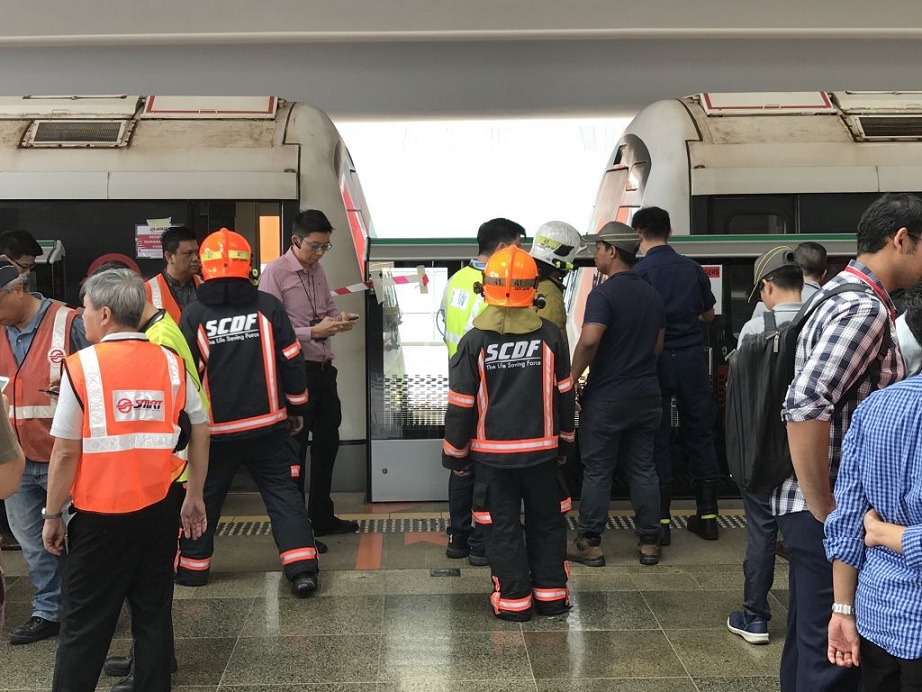
    15 November morning, I was riding the MRT towards Joo Koon from Pioneer. I was at the front cabin of the train that almost reached Joo Koon MRT. At exactly 8.20 am, there was a loud bang, and a violent shaking threw everyone onto the floor. The lights also suddenly went out. I almost thought we were about to fall over.
    From the pilot cabin, we could hear the Driver speaking on the radio. He spoke to the control center that the train behind had collided with the train behind.
    A Bangladeshi or Indian man could not get up. He hit his head in the collision. A Caucasian man (possibly from Europe), rendered assistance.
    I tried pressing the comms button, but there was no response. The Caucasian man spoke to the driver through the opening of the door, informing that there is an injured person on board.

    An SMRT staff came from the other side to check on the casualty. He probably came from the rear of the train. We asked him if it was possible to open the train door to let the injured person out. The staff said that if the train door was opened, then all the train doors would be opened at the same time, which would endanger passengers walking on the electrified tracks. I asked him if it was possible to just open only a single door. He replied they cannot control it like that.
    After a long time, the front door from the driver side was opened. 2 passengers helped the injured man to his feet and got him out first. The rest of us then followed outside. It was 8.50, half an hour since the collision.

    At the control station of Joo Koon, people were forming a long queue. They were queuing to get the excuse sheet, as well as to cancel the overstay status, as they cannot tap out with their EZ Link cards. To my dismay, I realized that the gantry of Joo Koon was still deducting fares. The one thing that never breaks down. I approached the staff, explained the fare deduction should be cancelled. She told me that she has no power to make such a decision, and just referred me to another staff. After approaching 3 staff, the male SMRT staff opened one gate with no fare deduction. I told him the fare waiver should be for the whole station, not just one gate, but he said this was the best he could do.

    It was a bad experience, but I could say I was lucky enough to get away with just a few bumps. Others weren’t so lucky. This has already become the norm. And you can see the resilience of Singaporeans from the way we tap on our phones even as we were stuck on board.
    I would like to thank Mr Khaw for such an experience, because every time he opens his big mouth, an incident is never far behind. More to come. Maybe better not say what next or else our loved ones may be trapped inside. The families of the top ‘unaccountability’ not involved bcos they are elitistically and affluentably chaffeured !!!!!😎😎😎😎😎


    Source: Chen GJ

  • E-cigarette regulation good news for vapers

    E-cigarette regulation good news for vapers

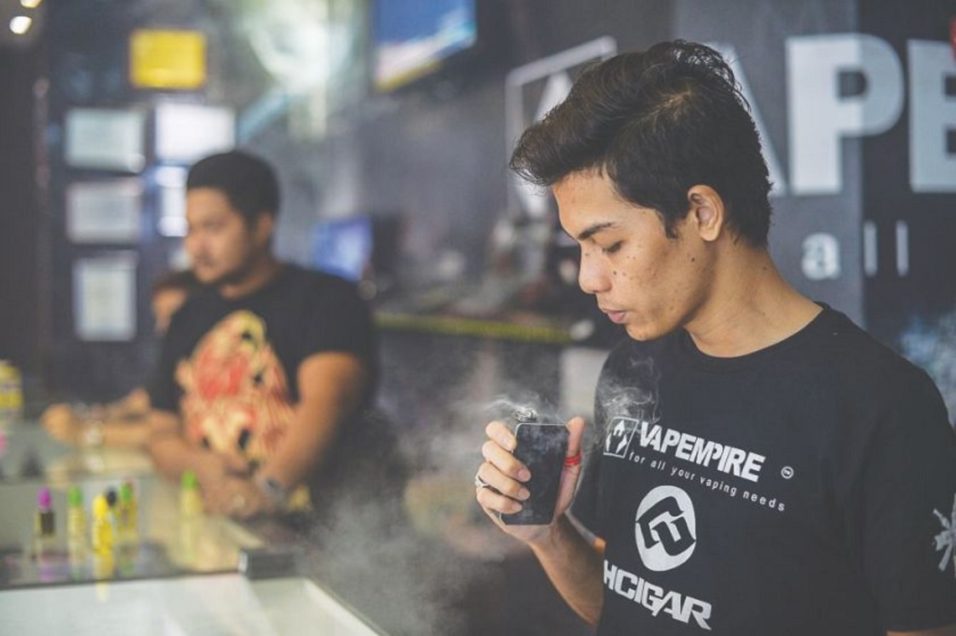
    PETALING JAYA, Jan 3 — The Cabinet’s decision to entrust three ministries to regulate the use of electronic cigarettes and vaping is the answer vape aficionados nationwide were looking forward to.

    Vape Operators Association of Penang president Muhammad Hafidz Adnan, however, said there were suggestions the authorities could consider before finalizing the rules and regulations.

    He proposed electronic cigarettes be sold in stores registered with the Domestic Trade, Cooperatives and Consumerism Ministry to ensure the devices’ were not compromised.

    “With this announcement, it is our hope the ministries would curb the sale of electronic cigarettes online as it would be tricky to regulate. Safety of vapers comes into play here and sales should only be allowed via licensed stores,” he said in a statement.

    He said the association was looking forward to work with state executive councillor for health Dr Afif Bahardin and the local government in obtaining business licences for vape shops in Penang.

    “This engagement is much needed to allow the association become a communication platform between vape shop operators and local authorities,” he said.

    Malaysian E-Vaporisers and Tobacco Alternative Association president Rizani Zakaria called on the government to speed up the issuance of business licences for vape operators as it had been a long waiting game for industry players.

    “Our long-awaited request is finally answered. We hope they speed up giving licenses to operators to conduct business with an easy mind,” he said.

    Rizani said all five states — Penang, Kedah, Johor, Kelantan and Terengganu — which imposed a ban on vape should consider lifting the prohibition to grant opportunities for shop operators who have been in the business for years.

    “Most traders are experienced and conduct their businesses in accordance to the rules. The relevant state authorities should perhaps consider giving them a chance to operate once the new legislations were in place,” he said.

    Malaysian Organisation for Vape Entity (Move) secretary Syamsul Reza Mohd Mokhtar said the decision put Malaysia on the map as one of the first few countries to regulate the vape industry.

    “We will be known as the one of the pioneers and this will definitely get a cheer and applause from vapers around the world,” he said.

    He said the much-anticipated decision would convince vapers to swap their tobacco cigarettes for electronic cigarettes instead, and subsequently boost the local vape industry.

    On Wednesday, the Cabinet tasked the Domestic Trade, Cooperatives and Consumerism Ministry with regulating and enforcing safety standards for electronic cigarette devices and batteries and vaping devices under the Consumer Protection Act 1999 (Act 599).

    It would also regulate and enforce the marking and labelling of electronic cigarette devices and nicotine-free liquid and vapes through the various Trade Descriptions Acts.

    Under the new act, the licensing, production, distribution including import, export and sale of electronic cigarette devices, nicotine-free liquid and vapes would be monitored by the ministry.

    The Health Ministry would regulate the sale of e-liquid containing nicotine under the Poisons Act 1952 and Sale of Drugs Act 1952, which only permit licensed pharmacies and registered medical practitioners to sell preparations containing nicotine for medical treatment.

    The Science, Technology and Innovation Ministry, through the Department of Standards Malaysia, would develop standards for e-cigarettes batteries and devices and the packaging of nicotine-free, e-liquid and vapes under the Standards of Malaysia Act 1996.

    Following the decision, the Health Ministry will draft a new law to replace the Tobacco Control 2004 Regulations, while the Domestic Trade, Cooperatives and Consumerism Ministry would draft a new law relating to the control of electronic cigarettes and vaping within the next two years.

    Source: TheMalayMailOnline

  • Syakir Hashim: Singaporean Elders Deserve Rest, Not More Work

    Syakir Hashim: Singaporean Elders Deserve Rest, Not More Work

    As I walk into Changi Airport today at about 7 a.m, I saw many workers of old age either cleaning or moving the trolleys around.

    I was reminded of an incident back when I was in year one in NUS. I went for lunch with my project groupmates in Utown. Three of them to be exact. All of them are foreign students.

    We all went to get our meals separately. I was the first to be back at the table followed by two others. We asked each other where the 4th person went. We waited for a few minutes and she was still nowhere in sight.

    Soon I walked around and I saw her helping an old lady clearing up tables. She was trying to help the lady pick up cups and rubbish from some of the tables, making the old cleaner lady discomforted.

    I asked my friend what she was doing and she said that she felt bad seeing the old lady working so hard. Where she came from, no elderly has to work that hard.

    That moment hit me hard. The fact that elderly workers are so common in foodcourts, malls and our airport, we sometimes forget to ask if its right to keep them working till that ripe old age.

    Can’t we as a developed country think of ways to give our elderly the peace of mind and rest they deserve after serving the country and its economy over four or five decades? I’m sure if our leaders put their mind to it, innovative policies can be formulated to help our elderly, here in singapore.

    Can you imagine your parents at the age of 70 having to work 8 hours a day clearing and cleaning at a foodcourt?

    Just food for thought.


    Source: Syakir Hashim

  • A Resilient Pioneer: 75 Year Old Retired Teacher Wants Job, Refuses Financial Assistance

    A Resilient Pioneer: 75 Year Old Retired Teacher Wants Job, Refuses Financial Assistance

    It was almost 12 am by the time we finished tending to our 106th resident who came to seek our assistance at the meet-the people session in Marsiling. It was a very long night indeed as we started our MPS at 7pm. Although I was dead tired, one case stuck in my mind. A 75 year old retired primary school teacher came to appeal for a HDB rental flat. She is currently living in one room, which she rented from the open market, with her low IQ daughter and grandson, both of whom she’s supporting.

    She had been re-employed after her retirement by the school until recently when they no longer needed her services. Without an income, she can no longer afford the market rental and is eligible for a public rental flat. I told her that I would appeal for her but also asked her whether she needed financial assistance. She declined but asked me instead to write to another primary school that she had worked for before to enquire whether they had a vacancy for her.

    I was quite astounded by the reply of this 75 year old as I have, on a few occasions, received requests from able bodied, younger men who refused to work but was expecting financial assistance which is really meant for the needy who cannot work or support themselves. Although she had politely declined, I will still proceed to secure financial assistance for her as she deserved it. It is cases like this that gives meaning to our work.


    Source: Halimah Yacob

  • Pioneer Estate Now A Ghost Town

    Pioneer Estate Now A Ghost Town

    Singapore’s first 10-storey flats, colloquially known as “chap lau chu” in Hokkien, are seven blocks of brown and beige-coloured flats in Commonwealth Drive.

    Built in the early 1960s, this pioneering “mini estate” introduced Singaporeans to the concept of a self-contained “public housing precinct” with several tall housing blocks next to a food centre.

    Decades later, the once-bustling neighbourhood lies vacant.

    After the area was earmarked for redevelopment in 2008, residents of blocks 74 to 80 and businesses cleared out by early last year.

    The abandoned estate has sat in limbo since, awaiting the wrecking ball which is expected to strike later this year.

    Entrances to the stairways of flats are gated and padlocked to keep away loiterers.

    An eerie silence hangs in the aisles of shuttered provision stores and the odd childcare centre or barber shop below the blocks.

    In the courtyard lies a worn-out playground and pavilion that were once a distraction to children and their elderly caregivers on many an afternoon.

    “It has an eerie vibe, especially when night falls and you see the leaves scattered all over the desolate streets,” said Mr Jason Seow, 45, a former Tanglin Halt resident who returned to photograph the place before it is torn down.

    As the nation relentlessly renews itself, more housing estates have been left deserted.

    These are curious places, caught in between yesterday and tomorrow, with everything intact but its inhabitants gone.

    Over the last decade, 19 projects have been completed under the Housing Board’s Selective En bloc Redevelopment Scheme. This means that residents in all these 19 areas have vacated their flats.

    However, the old blocks of flats in seven of these sites are either still in various stages of demolition or set aside for interim use or conservation today.

    The ghost town in Commonwealth Drive has become a spot for some to linger.

    On a warm weekday evening, two Chinese construction workers cut through the blocks to get groceries from the supermarket across the road.

    On the way back, they went to sit on the concrete floor at the fringe of Block 76, shelling peanuts and drinking rice wine.

    They later used a small sandy track that winds through the dense vegetation to get back to their nearby worksite.

    Security supervisor Tong, who declined to give his full name, found himself early for his night shift that same evening and sat down at a stone table for a rest.

    “This is a special place because there’s no one here and the quiet clears my mind,” said the 65-year-old.

    After 20 minutes, he left via another shortcut that office workers use to pass through the empty estate to get to Biopolis and Commonwealth MRT station.

    Hollowed-out neighbourhoods like these can also become hot spots for crime. In April, a researcher was slashed in the dim and derelict shortcut at night.

    Her employer, the Agency for Science, Technology and Research (A*Star), has advised staff against using the public footpath.

    Surveillance cameras have since been installed there by JTC Corporation. The Housing Board said it conducts inspections every day to “deter unauthorised entry into the vacated site”.

    The seven blocks are part of the authorities’ biggest housing redevelopment project to date, with 3,480 flats in 31 blocks in Tanglin Halt Road and Commonwealth Drive slated for demolition.

    Affected residents have the option of moving to new flats in the nearby Dawson estate.

    Residents said the abandoned estate’s destruction seems inevitable, given that its once-distinctive “10-storey” look is now overshadowed, literally, by modern skyscrapers with futuristic names such as Galaxis, Sandcrawler and Fusionopolis.

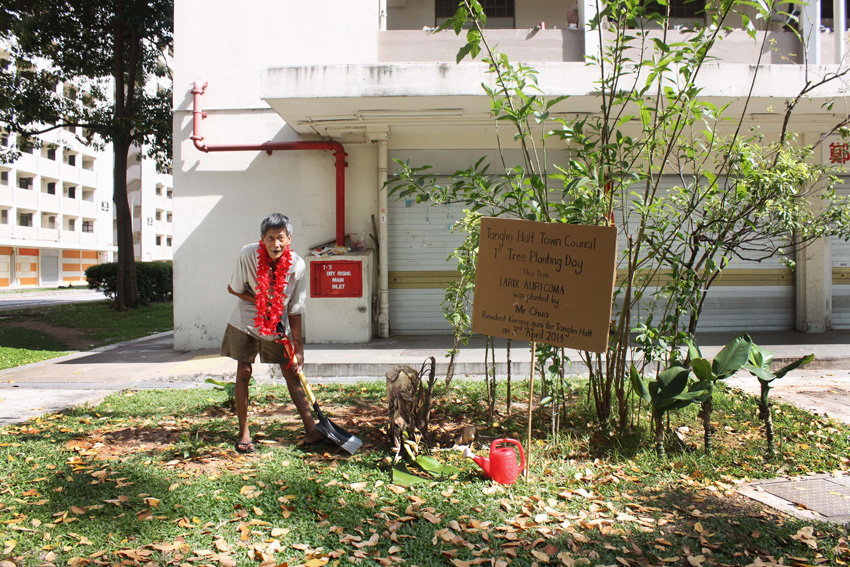
    Yet one stubborn presence continues to haunt the forlorn corridors – karung guni man Chua Thiam Seng, 62.

    The long passageways below the flats are strewn with cardboard boxes and cans that he collects from occupied flats and coffee shops across the road.

    “This is my office,” he said with a toothless grin. Mr Chua has been a rag-and-bone man in the neighbourhood for the past 20 years.

    He claims to have taken up HDB’s offer of a new flat nearby after the relocation exercise, but he still sleeps in a little corner on cardboard beneath his former block on most nights.

    He added that it was for convenience, but reporters have spotted him cleaning up at a nearby market many mornings.

    The bachelor reminisced about the old days when the close-knit community would gather in coffee shops or outside the lottery shop to exchange gossip.

    He lamented: “They don’t construct flats like these any more and though my neighbours have moved nearby, they are not as close as before.”


    Source: http://news.asiaone.com