Tag: politics

  • Chee Soon Juan: Singaporeans – A People Cut Adrift

    Chee Soon Juan: Singaporeans – A People Cut Adrift

    I STOOD ON the balcony of the school block and surveyed the campus of the Anglo-Chinese School at Barker Road. I had not been back there since I graduated some four decades ago (I was accompanying Shaw Hur to buy his textbooks during the year-end break as he prepared for secondary school).

    I searched for a familiar landmark – any familiar landmark – of the place I had spent ten years of my school life. I couldn’t. Every inch of the grounds had been razed and, in its place, new buildings erected.

    Gone were the open spaces and lawns (more like sandy patches from our constant trampling) that afforded students the space to play before and in between classes. And play we did: football, marbles, spider-catching, chatekkuti-kuti, hantam bola… We invented our own games and laid down our own rules. We found our own fun – lots of it. And when you sat quietly in the afternoons, you could hear the crickets chirp.

    My mind returned to the present and it dawned on me how much the multi-storey buildings, squished up against one another, resembled the HDB jungle. The school field, where many a scrape and bruise was inflicted, was missing, replaced by a carpark that shouldered a swimming pool above. A boarding school for foreign students was even jammed into the premises. Every square foot of real estate was manicured, exquisitely engineered for maximum capacity.

    What does all this do for (or to) students? Sure, the AV equipment was state of the art, the auditorium outfitted with cinema-like plushness, and the driveways pristinely landscaped. But how does the environment facilitate play? How do students find their own leisure? Where do they go to do that? Yes they are studying, but are they learning?

    If all this sounds depressingly familiar, that’s because the campus reminds us of the country itself. The island is blanketed with residential blocks built ever closer and stacked up ever higher. It teems with inhabitants, the number of which this city has never seen.

    But fast as it was, construction on the island was always one step behind a burgeoning population whose explosive growth, ignited by lax immigration laws, meant that the infrastructure would be overtaxed.

    With the mass influx of foreigners came the escalation of the cost of living. At the same time, wages for the locals were put under downward pressure. Retrenchments and unemployment have risen. Leisure has become a scarcity and where there was once spacious greenery, there is now only bodies and concrete. Stress and work-related psychological disorders, as one might expect, run high. For the average Singaporean, the quality of life has deteriorated.

    That wasn’t all. The school’s wholesale makeover also meant that there was little I could relate to my son. There was nothing to share with him about how I grew up in a place in which he was now going to grow up. The past-present dislocation was as rude as it was complete.

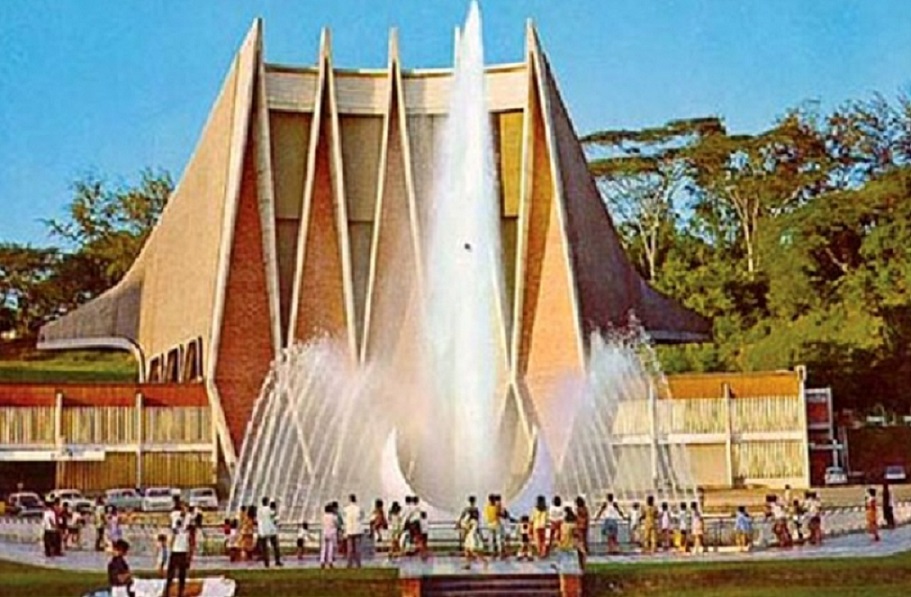
    Again, the situation is evocative of present-day Singapore. Anything and everything that served to remind us of days gone by – the National Theatre (photo above), Bugis Street, Satay Club, the National Library, Kallang Park – have been demolished and replaced by shopping centres, expressways and golf courses.

    When the break between past and present is so abrupt and comprehensive, we become unmoored from our own history. What, then, binds us to our roots? Need it be said that an undeveloped sense of belonging erodes our national identity?

    But can this country, one may be tempted to ask, afford to indulge in idle reminiscence? Why hanker for a past that would have impeded economic progress?

    These are wrong questions to ask. Progress and the retention of our collective past don’t have to be mutually exclusive; national development can proceed even as we preserve our history. What is needed to achieve a seemly balance are enlightened and dedicated planners. Japan and Europe, to cite but two examples, have done admirably in pushing the boundaries of modernisation while retaining their proud traditions and heritage.

    If we insist on hanging a price-tag on everything, as this country’s officialdom is wont to do, then what value do we put on places that tell the story of where we came from or where we’ve been? What amount of money do we place on Singaporeans emigrating because they don’t know what being Singaporean is anymore? What price do we figure for citizens living disengaged lives, tethered together only by that national creed that ‘No one owes us a living’ or its variant ‘What’s in it for me’?

    Even if we accept that nostalgic sentimentality has no place in the kind of hard-nosed pragmatic thinking needed for economc success, it is entirely appropriate to question what all the upheaval and change has brought us. A more genteel and less stressful lifestyle? A sustainable economic structure that ensures financial security for our retirees? A future that promises hope and opportunity for our youth? A system that can still deliver the Singapore Dream for our workers?

    When we cast our eyes ahead and see only ominous clouds, what conjures even more disquiet is to look behind and see that we’ve been cut adrift.


    Source: www.cheesoonjuan.com
  • Goh Meng Seng: Singaporeans Are Politically Illiterate Because Of PAP

    Goh Meng Seng: Singaporeans Are Politically Illiterate Because Of PAP

    Thought of the Day – Political illiteracy

    I had a nice chat with an alumni of my Alma Mater today over lunch.

    He told me that many of the Singaporeans he came into contact with are basically politically ignorant. He gave me an example that two of his close associates did not think that it is wrong that PA or Town Council under PAP’s control refusal to let opposition party use the facilities is wrong. The reasoning given was that these “belong” to PAP and it is purely politics that PAP should not allow opposition parties to use these facilities.

    But when they were corrected that these facilities were built using taxpayers’ money and do not belong to PAP, they raised doubts about it!

    Such political ignorance is really deep rooted all thanks to PAP’s deliberate effort in blurring the lines between itself and PA. Opposition controlled TC is expected to allow PAP to use whatever premises in their town via “grassroot organization” like PA or RC or CCC. But PA has all rights to allow PAP to use its facilities for whatever activities disguised as “grassroot events” while opposition parties were banned from using its facilities by using the excuse of “PA’s premises should not be politicized”!

    And you may wonder how could well educated Singaporeans who are graduates or diploma holders, actually agree and even support such blatant abuse of tax payers’ money for partisan interests!

    The conclusion my friend has made, most Singaporeans are not “Politically Educated” and PAP is very happy to maintain such Political illiteracy for Singaporeans. This I will have to agree. Do our schools teach our students on what is Democracy? Rule of Law? Separation of Powers? Judiciary Independence? Freedom of Speech and Expression? Well, only on some “abstract Highfalutin” National Pledge which PAP didn’t even believe in nor respect!


    Source: Goh Meng Seng

  • Chee Soon Juan: Singapore Is Ailing, PAP Serving Her Poison

    Chee Soon Juan: Singapore Is Ailing, PAP Serving Her Poison

    Dr Chee Soon Juan, the Secretary-General of the Singapore Democratic Party (SDP), wrote an article on the condition of the country stating that Singapore economy is living on borrowed time and innovation is the only antidote.

    “It is what we desperately need for economic regeneration. Welcoming the unknown, taking risks, making mistakes, embracing failure, encouraging derring-do – isn’t this what being innovative is all about?” he said.

    Pointing that countries around the world are changing so drastically politically while Singapore continues to follow its old ways, being “disastrously out-of-sync with rapidly changing times.”. Cocooned in its comfort zone, unaware that Singapore is sinking deeper into dysfunction and mediocrity and passed by societies ready and willing to change.

    This is what he wrote in full :

    THE WORLD is in upheaval. South Koreans throng the streets demanding the removal of their president; Malaysians clash as they profess their love or loathing (depending on whether you don red or yellow apparel) for their prime minister; pro- and anti-Beijing Hong Kongers do battle over whether two young lawmakers should be disqualified from parliament; Pinoys and Pinays elected a Pope-cussing-Obama-hating-gun-happy politician as their national leader; the Brits up-ended order of every conceivable kind when they voted to leave the European Union; and now, half of Americans elected as their president someone whom the other half cannot find enough expletives to hurl at.

    All this is enough to make Singaporeans want to quicken the search for another habitable planet to fly to.

    Cue PM Lee: “In Singapore, we watch all this with concern and we have to ask ourselves how we can prevent ourselves from going in that direction. For 50 years we’ve been very lucky. We are still united, still proud of the country, still moving forward…So be aware that the risks are there, and you have seen what can go wrong in other countries.”

    Translation: Singaporeans are lucky to have the PAP. So shun disruption, stick with the familiar. We may not be able to change the government but that is a good thing because citizens cannot be trusted to make the right decisions – just look at the other countries. The PAP will decide for us and protect us from the world’s madness.

    This is what Singaporeans hear and have been hearing for half-a-century. The thinking has been baked into our national DNA.

    It is also one that will ensure our country’s demise. It is this fear of the unfamiliar, fear of getting things wrong, fear of taking chances that will be Singapore’s undoing. For nothing in such an outlook fosters an innovative culture.

    Welcoming the unknown, taking risks, making mistakes, embracing failure, encouraging derring-do – isn’t this what being innovative is all about?

    The truth is that our economy is living on borrowed time. The dependence on multinationals to transfer skills and know-how, a hard-working and cheap labour force ready to work even harder and cheaper, and a bewildering bevy of government companies controlled by the Prime Minister’s wife is a model that may have worked in the past but is disastrously out-of-sync with rapidly changing times.

    As it is, our economy, teetering on the brink of a recession, has been ailing for the last couple of years – this taking place despite the absence of a major world crisis. The danger is that it may signal the beginning of something protracted.

    Innovation is the anti-dote. It is what we desperately need for economic regeneration. For this, change – including political change, especially political change – is necessary.

    I can do no better than quote Steve Wozniak, Apple’s co-founder, who pointed out that a company like Apple could not have emerged from a place like Singapore: “Look at structured societies like Singapore, where are the creative people?…All the creative elements seem to disappear.”

    It is a tragedy that Singaporeans are unable to see that Americans, Hong Kongers, or Britons are unafraid to take political chances, stand up to injustice – perceived or otherwise, and be their nation’s boss. So what if Brexit fails or China cracks down on Hong Kong or Donald Trump’s tenure turns out to be a disaster? They’ll learn, course-correct and improve their political systems in the long run.

    What about us? We continue to be afraid of change because the PAP breeds and feeds the fear of change. We are cocooned in our comfort zone, unaware that we are sinking deeper into dysfunction and mediocrity and passed by societies ready and willing to change.

    It has become a cliche, but still no less true, that this island on which we inhabit has precious little natural resources; nothing to mine for, drill at or grow on. This is why it is so troubling that those in power are strangulating the very thing that will ensure our survival and progress – the minds of our people.

    What fertiliser does for crops, political freedom does for innovation. The messiness and seeming chaos that accompanies democracy must not be seen as societal threats to be bleached from our system. In our desire for peace and security, let us not inadvertently celebrate the peace of the cemetery and the security of the serf.

    Political disruption (unfortunately, to many Singaporeans, this includes the simple act of electing a few more opposition MPs) is needed to energise the human spirit and provide that impetus for positive change.

    May wisdom and courage prevail.


    Source: www.theonlinecitizen.com

  • Goh Meng Seng: Robust Political System With Institutionalised Separation Of Power Key To Democratic Survival, Progress

    Goh Meng Seng: Robust Political System With Institutionalised Separation Of Power Key To Democratic Survival, Progress

    Thought of the Day

    Folks, it is NOT END OF THE WORLD to have President Trump! Unlike Singapore, US has a more ROBUST Democratic political system with Separation of Powers institutionalized and embedded to effect REAL Checks and Balances. No matter how moronic or idiotic the President is, he or she will be checked and prevented from doing too much bad!

    An idiotic or moronic President may not do much good, but at least for the next 4 years, he or she won’t do too much bad as well. 4 years later, if he could not perform or basically screwed up, the voters will just kick him out!

    So instead of feeling devastated for Trump victory, we should learn something from this saga: It is more important to build a robust political system which has Separation of Powers institutionalized to effect Real checks and balances instead of betting on the hope that we could always choose wise and good guys into government!


    Source: Goh Meng Seng

  • Singaporeans Prefer To Be Fooled by PAP, Good Jobs Go to Foreigners

    Singaporeans Prefer To Be Fooled by PAP, Good Jobs Go to Foreigners

    In PAP’s elitist eyes, Singaporeans are fools and are therefore treated as such. No one should blame PAP.

    For years, Singaporeans have been fooled by PAP’s creation of “good” jobs for citizens, which is of course another half truth. We don’t bother, or are afraid, to ask the government point blank to list all the good jobs it has created. Well, there’s likely to be only a handful and that’s about it because most of the “good” jobs go to foreigners.

    Whether a job is ‘good’ is relative: it’s dependent on our living costs.

    To a foreigner degree holder from India, any job paying between $2000 and $3000 a month is a good job. Damn good in fact for he would be earning only a fraction of this amount back home and could also have been periodically unemployed. In 15 to 20 years, he would have sufficient savings to enjoy an early retirement back home, not eating at hawker centres but restaurants.

    For a local diploma graduate, a $2000 starting salary won’t get him far if he is considering marriage and having kids. Our high cost of living, inflated by PAP through property prices, is a killer and there is little prospect of retirement, even if one eats at a hawker centre every day.

    One would have thought that after 26 years of prostituting Singaporeans for GDP growth, PAP must have created hundreds of thousands of well-paying jobs. So how come PAP is unable to provide a breakdown of good jobs in the various industries created for SINGAPOREANS?

    In a self-insulting statement, DPM Teo insisted PAP was unable to provide “a more detailed breakdown because it may not be in our interests to do so”. “Our” of course refers to “PAP”, not Singaporeans. PAP has resorted to obfuscating the truth by lumping PRs and citizens together. There would be public outrage and all hell will break loose should relevant employment statistics be publicly disclosed.

    The majority of Singaporeans appear to be sleepwalking and don’t seem to be aware that government-linked companies are totally dependent on hundreds of thousands of foreigners to mitigate high rental and labour costs. Profit driven PAP will always enact legislations in GLCs’ favour.

    (Besides GLCs, there are PAP-affiliated companies – SMCs set up by PAP grasslooters – whose employees are mostly foreigners.)

    Sleepwalkers should wake up and take a look at Changi Airport, SATS, SBS Transit, SMRT, NTUC, etc. Still cannot see the hundreds of thousands of jobs created for foreigners?

    With the opening of Jewel Changi Airport in 2019, what is the ratio of good jobs created for foreigners vs locals? Of course there are good management positions but don’t they all go to PAP cronies?

    Even GLCs in the security industry such as Certis CISCO and AETOS employ at least 80% of foreigners to lower business costs. (AETOS was recently transferred to Surbana Jurong)

    If PAP wasn’t profit driven and had focused on improving productivity, it would not have set up an entire business park in Changi for foreigners, mostly Indians. And guess which nationality some of the Indian companies employ. PAP creating good jobs for Singaporeans? Or are we expected to believe that Singaporeans are so choosy that few want good jobs with good pay?

    Where is PAP’s ‘blueprint’ for job creation for Singaporeans? How come got no figures?

    The business model of most GLCs rely 100% on cheap labour, without which they would have gone ‘pock kai’ years ago. PAP has created hundreds of thousands of jobs which pay peanuts and they do not benefit Singaporeans. PAP has not been creating good jobs for locals.

    Singaporeans are supposed to be an educated lot but what’s the point of a ‘good’ education when we choose to go down the same path after being repeatedly fooled?


    Source: https://likedatosocanmeh.wordpress.com