Tag: poverty

  • Commentary: Horrible Advert, Terribly Dismissive And Reductionist Campaign That Makes Fun Of Poverty

    Commentary: Horrible Advert, Terribly Dismissive And Reductionist Campaign That Makes Fun Of Poverty

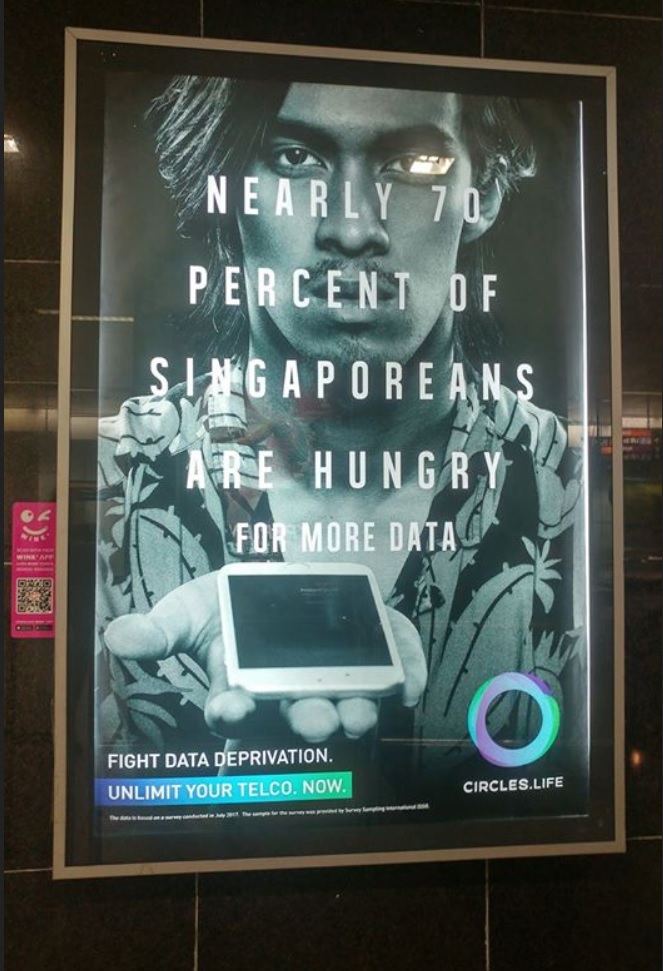
    Just saw this horrible ad at Dhoby Ghaut MRT ( there were 2 other equally horrible ones, but there were people resting on them and I did not want to intrude on their privacy with my anger by taking photos). Anyways I was so so pissed that I sent a message via FB messenger to their customer service representative. Received a reply that my concerns will be forwarded but I think it’s just standard speak for ok oversensitive member of the public we hear you k thanks bye. Posting my rant in full so that those of you (especially Circles.Life users) can also send them a message and get this terribly dismissive and reductionist ad campaign that makes fun of poverty!!!! taken down.

    “I saw this at Dhoby Ghaut MRT and I would just like to state my extreme displeasure at the insensitivity of this ad! I’m flabbergasted that no one flagged this as a terrible idea. Yes, not having enough data is a problem, but to liken it to issues of global poverty which people actually die from? I mean guys seriously way to be insensitive and dismissive of a real global problem, especially when juxtaposed with what can clearly be seen as a first world problem. I understand that you’re just a frontline officer and this was most probably created by an ad agency and okay-ed by your bosses. But seriously can we take it down please? I am just so horrified and shocked by this! Who do I reach out to??”

    The ad in question:


    Source: Hazirah Mohamad

  • Cardboard Uncle Hit By Taxi More Concerned About His Biscuits Than His Injuries

    Cardboard Uncle Hit By Taxi More Concerned About His Biscuits Than His Injuries

    A man who collects cardboard for a living was hit by a taxi at the junction of Yishun Avenue 3 and Sembawang Road at about 2.30pm on Thursday (Nov 3).

    Mr Wong Kum Chew, 63, was crossing the road with his trolley when a taxi which was making a left turn, hit him. The impact left Mr Wong lying on the road near his trolley stacked with cardboards. He was covered with cuts, grazes and blood all over his body.

    When passers by rushed to his aid, Mr Wong asked, “Where is my trolley? Where is my trolley? I have two packets of biscuits inside.”

    A lady, Ms Irene Lim said it was heart-breaking to see Mr Wong in that state. A Singapore Armed Forces officer, Lieutenant Colonel (Dr) Timothy Teoh checked Mr Wong’s injuries and noted that nothing was fractured.

    Mr Wong lives with his wife and son. His son is the family’s sole breadwinner and earns about $1,000 a month. Mr Wong earns $6 to $7 a day from collecting cardboards.

    After Mr Wong was conveyed to Khoo Teck Puat Hospital, Ms Lim’s husband helped to push Mr Wong’s trolley back to his home.

    Source: www.allsingaporestuff.com


  • Why Low-Income Families Make ‘Poor Choices’

    Why Low-Income Families Make ‘Poor Choices’

    For three years, I have been researching the lives of low-income people. I visit families in Housing Board rental flats once or twice a week and talk to them about their routines, worries and aspirations.

    My research has taught me important things. First, everyone makes bad and good choices, but the conditions and outcomes of those choices are not equally bad or good for everyone. Second, parents in low-income situations are deeply invested in their children’s well-being.

    Everyone makes bad decisions sometimes. Most people also make some good decisions. People with low incomes have made both. But they do not always have access to good options. For example, many “choose” to leave school early because no one can support them. This seems obviously a bad “choice”, but may be the best among various poor options.

    “Choices” have long-term effects. People with extra money and social capital can mitigate the consequences of “bad” choices, but people without those buffers face severe consequences over time.

    One woman I met had moved here from another country after marrying a Singaporean man. She had not immediately applied for her daughter to be a Singapore citizen, perhaps partly out of uncertainty about where they should live for the long term. Soon after, she was widowed, and several attempts to secure citizenship failed. Her daughter Jen (not her real name) has been living in Singapore for most of her life and knows no other home. Jen’s mother encouraged her in her studies and she has just completed her A levels. Their limited income and Jen’s lack of citizenship, however, means that she has accumulated arrears in school fees. Unless she pays, her certificate will not be released, barring her from university. The few thousand dollars owed seem insurmountable and the “bad choice” of not applying for citizenship immediately means the vast difference between upward mobility and stasis.

    My second point is about parents’ investment in their children’s well-being, in a society where “investments” that do not involve money are valued less than investments that do.

    The women and men I spoke to for my research talked endlessly about their children – their likes and dislikes, quirky habits and talents – as well as the trials of parenting. These parents are deeply invested in their children’s physical, emotional and social well-being. Contrary to stereotypes, low-income parents care for their children in ways no less profound than better-off parents. They include parents who have been drug addicts, incarcerated, or divorced.

    Their devotion to their children is more difficult and requires more of them than my devotion to mine. Many have long, inflexible work hours in physically taxing jobs. They have multiple dependants, heavy burdens of housework, and additional labour due to being low-income (for example, going to the post office weekly to top up their utilities credit). Parents face great financial stress, worrying about food, clothes and shelter. While the better-off in Singapore complain about children having excess tuition and enrichment classes, low-income parents lack resources to provide those things, which are not only necessities for succeeding in the school system, but also keep children occupied. Most poignantly, low-income parents need their children to listen to them at the same time that they tell them “don’t be like me”.

    As we gain awareness about inequality and poverty, how we look at problems has a real impact on the solutions we craft.

    There is a tendency to paint low-income parents as more likely to be neglectful or abusive. This happens for several reasons. First, accounts of the low-income too often focus only on cases that have surfaced as “problematic”, which are then over-generalised as representative. Second, comparable actions are judged differently across class: A child may be left alone at home after school, or left with a grandparent or domestic worker. In both the low-income and better-off cases, the situation arises because parents need to work, but the former is quickly judged as neglect while the latter is acknowledged as necessity.

    Certainly, there are parents who are neglectful or abusive, but this is no less true among higher-income ones. Caricatures of low-income parents cannot be the starting point for public discussions of poverty and social inclusion.

    A recent article (“Lifting families out of poverty: Focus on the children“; last Thursday) admonishes society to pay attention to children in poor households while implying that they are innocent of the “poor choices” their parents make. This narrative that “children are innocent” and therefore particularly worthy of assistance is powerful.

    Yet, it does not accurately reflect the general realities of low-income families’ lives. Most of those parents are doing the best they can – at work and at home – under difficult circumstances. It is not “bad choices” per se that are the problem. They have limited options and face especially negative consequences when they make missteps.

    We cannot detach the well-being of children from that of adults. We would find this approach unfathomable for middle- to high-income families – there is no good reason to imagine that low-income families are different.

    Better-off Singaporeans should care about low-income people because they are a part of our society. I am not from a poor background, but I meet people like my respondents every day – when I pay for my groceries, get petrol, or use any public facility that requires cleaning. Like me, they are people with hopes, joys, needs and disappointments. They work hard and make mistakes, as I do. They deserve respect and dignity, no less than I. The deep social gulf between us negates our shared well-being. I want my child to grow up in a society where she has the same opportunities as their children, not more – a society that truly values hard work, equality and justice.

    • The writer, Teo You Yenn, is an associate professor in sociology at Nanyang Technological University.


    Source: www.straitstimes.com

  • A Third Of Students Go To School With No Pocket Money To Buy Lunch?

    A Third Of Students Go To School With No Pocket Money To Buy Lunch?

    Record No. of needy students helped.

    I refer to the article ”ST School Pocket Money Fund helps record number of needy students” (Straits Times, Oct 10).

    It states that ”Pocket money is given to students whose families meet the eligibility criteria of not more than $560 in monthly gross household per capita income.”

    Why not only for Singaporeans?

    According to the SPMF’s web site – “To qualify as a beneficiary receiving pocket money, the child/youth must be:

    A Singapore citizen or permanent resident”.

    I understand that almost all other financial assistance schemes are for Singaporeans only. So, why are PRs eligible? (“Fee hike for international students and PRs attending local schools“, Straits Times, Oct 1).

    If the assistance is confined to Singaporeans – perhaps the criteria may be less restrictive, such that more Singaporeans may qualify.

    Most restrictive criteria amongst all schemes?

    As to “Pocket money is given to students whose families meet the eligibility criteria of not more than $560 in monthly gross household per capita income” – I understand that last year’s criteria was “(the child must be) from a family whose per capita net monthly household income is not more than $450″, compared to the $560 gross income now.

    If this is the case – typically the net income after deducting say 20 per cent employee CPF contribution may be $448 ($560 gross income less 20 per cent CPF).

    SPMF’s criteria may be the most restrictive, of probably all the financial assistance schemes?

    For example, ComCare’s criteria is “Families with a monthly household income of $1,900 and below, or a per capita income of $650 can also qualify for assistance if they meet all other criteria”.

    So, why is SPMF’s criteria ($560) – $90 less than ComCare’s $650 per capita income?

    Only help for 2 years?

    As to “STSPMF is committed to helping children and youth who meet the eligibility criteria by providing them with school pocket money for 2 years” – in the previous year it said “providing them with school pocket money for at least two years. In exceptional cases requiring additional help, SPMF will extend the financial assistance to up to four years”

    – Why is it that the term of assistance is only for 2 years – is it still up to 4 years in exceptional cases now?

    From my experience doing volunteer work in financial counselling over the last decade or so – I have come across many cases of financial stress when SPMF assistance is terminated after 2 or 4 years.

    Since a child generally goes through about 13 years of education – why do we have this “2 years” restriction?

    Previously, some criteria don’t make sense?

    In fact, the criteria previously was arguably even more strange – “Secondly, post-secondary students who wish to receive aid in the past needed to have either tapped on the fund previously or have a sibling who is drawing on the fund. In future, all who meet the income criteria can qualify. This change will benefit new applicants and those from single-child families”.

    Why was there a need for either to “have a sibling who is drawing on the fund” or “to have either tapped on the fund previously”?

    Were those who did not “”have a sibling drawing on the fund”, or “tapped on the fund previously”, less deserving – until only recently with the changes announced?

    Number needing assistance increase more than 3 times?

    Notwithstanding the increase in financial assistance (probably to cover inflation) and the widening of the scope of cover – don’t you find it rather alarming that for a developed country like Singapore – the number of students helped increased from 3,375 in 2001 to almost 14,000 now?

    In this connection, Professor Tommy Koh said that “About a third of our students go to school with no pocket money to buy lunch” (“Three wishes for the New Year”, Straits Times, Jan 3).

    The assistance disbursed increased from $0.9 million in 2001 to the $7 million for this year, as reported in the subject news report.

    How much reserves?

    Its accumulated fund is $17.9 million.

    SG50 give $300,000 only?

    As to “We were fortunate to receive $300,000 from the Government through its Care and Share programme launched to celebrate Singapore’s 50th anniversary” – don’t you think that the Government should contribute more?

    Reciprocate trust with more transparency?

    Since the people have given their trust and mandate – shouldn’t we reciprocate by spending more to help Singaporeans.

    Leong Sze Hian

    * Submitted by TRE reader.


    Source: www.tremeritus.com
  • Switzerland Considering Paying Citizens $2,600 A Month For Doing Nothing

    Switzerland Considering Paying Citizens $2,600 A Month For Doing Nothing

    Update: According to ​the folks behind the Basic Income campaign, Switzerland’s government will start discussing the proposal in spring 2015, with the public vote likely to take place by fall 2016.

    Switzerland could soon be the world’s first national case study in basic income. Instead of providing a traditional social net—unemployment payments, food stamps, or housing credits—the government would pay every citizen a fixed stipend.

    The idea of a living wage has been brewing in the country for over a year and last month, supporters of the movement dumped a truckload of eight million coins outside the Parliament building in Bern. The publicity stunt, which included a five-cent coin for every citizen, came attached with 125,000 signatures. Only 100,000 are necessary for any constitutional amendment to be put to a national vote, since Switzerland is a direct democracy.

    The proposed plan would guarantee a monthly income of CHF 2,500, or about $2,600 as of November 2014. That means that every family (consisting of two adults) can expect an unconditional yearly income of $62,400 without having to work, with no strings attached. While Switzerland’s cost of living is significantly higher than the US—a Big Mac there costs $6.72—it’s certainly not chump change. It’s reasonable income that could provide, at the minimum, a comfortable bare bones existence.

    The benefits are obvious. Such policy would, in one fell swoop, wipe out poverty. By replacing existing government programs, it would reduce government bureaucracy. Lower skilled workers would also have more bargaining power against employers, eliminating the need for a minimum wage. Creative types would then have a platform to focus on the arts, without worrying about the bare necessities. And those fallen on hard times have a constant safety net to find their feet again.

    Detractors of the divisive plan also have a point. The effects on potential productivity are nebulous at best. Will people still choose to work if they don’t have to? What if they spend their government checks on sneakers and drugs instead of food and education? Scrappy abusers of the system could take their spoils to spend in foreign countries where their money has more purchasing power, thus providing little to no benefit to Switzerland’s own economy. There’s also worries about the program’s cost and long term sustainability. It helps that Switzerland happens to be one of the richest countries in the world by per capita income.

    The problem, as with many issues economic, is that there is no historical precedent for such a plan, especially at this scale, although there have been isolated incidents. In the 1970s, the Canadian town of Dauphin provided 1,000 families in need with a guaranteed income for a short period of time. Not only did the social experiment end poverty, high school completion went up and hospitalizations went down.

    “If you have a social program like this, community values themselves start to change,” Evelyn Forget, a health economist at the University of Manitoba, told The New York Times.

    Similar plans have been proposed in the past. In 1968, American economist Milton Friedman discussed the idea of a negative income tax, where those earning below a certain predetermined threshold would receive supplementary income instead of paying taxes. Friedman suggested his plan could eliminate the 72 percent of the welfare budget spent on administration. But nothing ever came to fruition.


    It’s what makes the potential experiment in Switzerland so compelling. Developed countries around the world are struggling to address the issues of depressed wages for low-skilled workers under the dual weight of automation and globalization.

    For German-born artist Enno Schmidt, one of the founders of the proposal, a living wage represents continued cultural progress along the lines of women’s suffrage or the civil rights movement by providing dignity and security to the poor, while unleashing creativity and entrepreneurial spirit.

    “I tell people not to think about it for others, but think about it for themselves,” Schmidt told the Times. “What would you do if you had that income?

    @sfnuop

    Source: http://motherboard.vice.com/blog/what-would-you-do-with-2800-a-month-no-…


    Source: www.therealsingapore.com