Tag: primary schools

  • Primary School In Selangor Under Fire For Segregating Drinking Cups For Muslims, Non-Muslims

    Primary School In Selangor Under Fire For Segregating Drinking Cups For Muslims, Non-Muslims

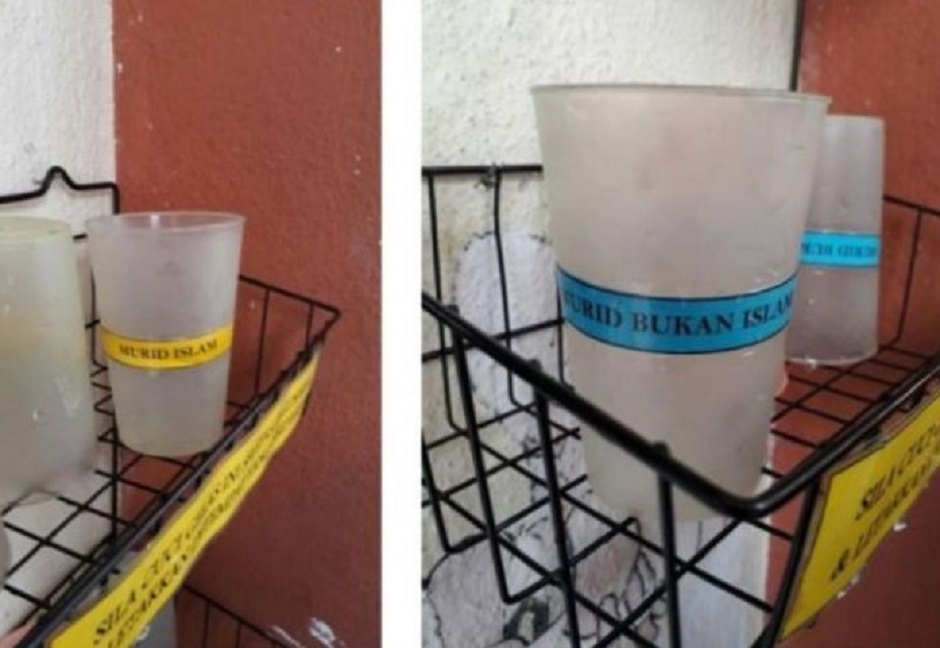
    A primary school in Selangor has come under fire for segregating drinking cups for Muslim and non-Muslim students.

    The school – Sekolah Kebangsaan Taman Puteri – in Hulu Langat has cups labelled “murid Islam” (Muslim students) and “murid bukan Islam” (non-Muslim students) placed next to a water dispenser, according to Malaysian media reports.

    A school canteen operator said the labelled cups have been used since last year, under the previous school principal who has since been transferred, Free Malaysia Today reported. But school authorities refused to comment, the news portal said.

    Reports on the practice have gone viral in Malaysia, with authorities, parents and netizens criticising the school.

    Perak Mufti Tan Sri Harussani Zakaria said the practice was discriminatory and could lead to hatred of Islam, according to Free Malaysia Today.

    “This should not have happened. We should know the ruling. Don’t be too rigid that others would begin despising us. Islam pays importance to human relations,” he was quoted as saying.

    He said there was no basis to separate utensils even if Islam prohibits its followers from consuming certain kinds of food.

    “Even if one consumes pork, that does not mean his lips are unclean.

    “We can use cups used by non-Muslims. We can use cooking utensils used by non-Muslims,” he said. “This practice is an insult. Don’t do it.”


    Parent Action Group for Education Malaysia (PAGE) founder Datin Noor Azimah Abdul Rahim said the school should reverse the ruling.

    “If there are certain quarters who have an issue with it (drinking from cups used by others), they can ask their children to bring their own cups and drinks.

    Noor Azimah felt that imposing one’s religious values on others is not the way forward, especially for children.

    The MCA Religious Harmony Bureau called on the Education Ministry to immediately order the school to stop the practice, accordiing to The Star.

    Its chairman Datuk Seri Ti Lian Ker said the current head or administrator of the school must apologise to all students and parents for the “discriminatory” practice.

    “Schoolchildren do not know racism. Such prejudices are inculcated by adults during a child’s formative years. If necessary, suspend the former principal from all duties that involve interaction with the public,” he said.


    Source: www.straitstimes.com

  • Primary, Secondary Schools And Neighbourhood Colleges Affected By Mergers In 2019

    Primary, Secondary Schools And Neighbourhood Colleges Affected By Mergers In 2019

    Fourteen primary schools and six secondary schools will merge in 2019, due to smaller cohort sizes and changing demographics across housing estates, the Ministry of Education (MOE) announced on Thursday (Apr 20).

    The changing demographics have resulted in an uneven distribution of students across primary and secondary schools, the ministry said at a briefing.

    Demand for Primary 1 places in mature estates has fallen, resulting in surplus places and low enrolment in some schools. But at younger estates, new schools may need to be built to accommodate a higher demand for school places there, MOE said.

    The primary schools being merged are:

    –  East View and Junyuan Primary, to be located on the site of Junyuan Primary.

    –  Balestier Hill and Bendemeer Primary, to be located on the site of Bendemeer Primary.

    –  Da Qiao and Jing Shan Primary, to be located on the site of Jing Shan Primary.

    –  Damai and East Coast Primary, to be located on the site of Damai Primary.

    –  Coral and White Sands Primary, to be located on the site of White Sands Primary.

    –  Casuarina and Loyang Primary, to be located on the site of Casuarina Primary.

    –  Cedar and MacPherson Primary, to be located on the site of Cedar Primary.

    A new primary school in Sengkang, Fern Green Primary, will begin operations in 2018. MOE said this is to meet the high demand for school places in the estate.

    The secondary schools to be merged are:

    –  Yuhua and Shuqun Secondary, to be located on the site of Yuhua Secondary.

    –  East Spring and East View Secondary, to be located on the site of East Spring Secondary.

    –  Hong Kah and Jurongville Secondary, to be located on the site of Jurongville Secondary.

    For the first time, eight junior colleges will also be merged, making this is the largest school merging exercise in the past decade.

    The eight government junior colleges that will be merged in 2019 were selected because of the need to ensure a good spread of JCs across the island, said the Ministry of Education (MOE) at a press briefing on Thursday (Apr 20).

    This is partly why even schools with high entry requirements such as Anderson Junior College (AJC) – which had an entry score of eight and nine points for the science and arts courses respectively in 2016, lower than schools such as Catholic Junior College (CJC) – will have to be merged.

    AJC will take in Serangoon JC, which has also steadily climbed up the ranks since it opened in 1988. In 2016, it had an entry score of 11 points for both science and arts courses, compared to 20 when it started out. The new school will be located at AJC’s Yio Chu Kang site to serve the north-east area.

    In 2019, Jurong and Pioneer JCs will also be merged to form a JC in the west; Innova and Yishun JCs in the north; and Tampines and Meridian JCs in the east. These schools will be located at the latter-named sites. These sites were chosen based on the quality of infrastructure, and their accessibility to transport, said the MOE.


    Sources: www.channelnewsasia.com, www.straitstimes.com


  • Niche Schemes In Primary School To Be Phased Out

    Niche Schemes In Primary School To Be Phased Out

    The niche scheme was introduced 10 years ago to help every school develop excellence in a particular field but it has attracted its fair share of controversy. And schools are now starting to move away from the achievement-oriented scheme.

    Parents had in the past voiced concerns about children being barred from taking part in activities because they are deemed not good enough to participate competitively. A co-curricular activity (CCA) could also be sidelined for not bringing in awards for the school.

    Now, primary schools are moving away from this scheme, TODAY has learnt. Instead, the schools are shifting towards creating an environment that will allow every child to try his hand at a sport or activity regardless of ability.

    In response to queries, the Ministry of Education (MOE) confirmed that as of last year, primary schools here have begun transiting from the niche scheme — also known as the School-Based Excellence initiative — to develop the Learning for Life and Applied Learning programmes, which MOE had unveiled in 2013 for secondary schools to create “a colourful landscape of distinctive schools to choose from”, as Education Minister Heng Swee Keat had put it.

    This means that over the next few years, the niche scheme will be gradually phased out from the entire education system here.

    Learning for Life programmes are meant to instill life skills and socio-emotional competencies, and could be in the areas of sports or the performing arts. Applied Learning programmes teach students to apply learning in real-world settings and schools can focus on areas such as logical thinking or problem-solving.

    The MOE said the programmes will “provide all students with more varied and authentic learning opportunities”. With these initiatives, schools can consider learning opportunities for all pupils, intended student outcomes and the quality of initiatives.

    The niche scheme was introduced in 2005 for schools to build their brand in an area such as the sports or the arts through a maximum S$100,000 grant yearly for primary schools. One of the evaluation criteria for fundings was the “strength of the school in the proposed school-based excellence”.

    However, this has resulted in schools having to chalk up awards to maintain their niche status. Educators also shared that this led to schools concentrating their resources on a relatively smaller portion of talented students.

    With the new programmes, educators also pointed out schools will now be evaluated primarily based on the pervasiveness of their programmes instead of achievements alone.

    The MOE said 176 out of 187 primary schools currently have at least one Learning for Life, Applied Learning programme or a niche and all primary schools will eventually move towards the Learning for Life and Applied Learning programmes.

    Some could have one of each type of programme, while others may choose to have two Learning for Life programmes.

    EXPOSURE, NOT ACHIEVEMENT, THE FOCUS

    Parents interviewed felt that children should be exposed to a range of activities regardless of their abilities, to discover new interests and skills.

    Mr Jack Kang, a father of two boys, pointed out that some children may only show their potential in later years but they should have a chance to try different activities. “They may just be playing the sport for fun but they may acquire a hobby and not only sitting in front of the computer all the time,” he said.

    Mountbatten Member of Parliament (MP) Lim Biow Chuan, who chairs the Government Parliamentary Committee (GPC) for Education, said giving every student a chance to participate alleviates concerns of parents who felt their children are disadvantaged because they lack talent in that activity.

    He, however, cautioned that schools must still ensure that different interests are being catered for through CCAs, for example.

    Tampines GRC MP Baey Yam Keng, who also sits on the GPC, welcomed the shift in primary schools. “It is a good move as it is additional exposure for the student without necessarily having the pressure to achieve awards,” he said.

    Primary school leaders interviewed also applauded the change. Concord Primary principal Tonnine Chua said: “In the past, to prove our strengths in a niche area, the most tangible way would be through results such as achievements. But now, we will instead submit a report explaining how we develop every child and the distinctive features of our programmes.”

    West View Primary vice-principal Quek Swee Nee agreed it means “not only helping the talented students achieve, but also exposing the whole student population to the various educational experiences”.

    Instead of striving for results in competitions, schools can focus on the learning process. In the case of West View’s Learning for Life programme in brass band, the school looks at helping students appreciate music. “For the majority of the student population, the message is they may not be good at the activity now, but because of the exposure in primary school, they may eventually pursue it as a hobby or even a career,” added Mr Quek.

    Nanyang Primary School principal Lee Hui Feng said the new programmes allow schools to pay more attention to character development.

    Echoing a point made by other school leaders, she said the new focus does not mean pupils who show talent in a particular area will be neglected, as CCAs are still a channel for students to specialise and build their strengths.


    Source: www.channelnewsasia.com