Tag: products

  • Halal Scanner; Singapore-made app to know if a product is halal or not just by scanning

    Halal Scanner; Singapore-made app to know if a product is halal or not just by scanning

    Azman Ivan Tan, CEO, and Salehin Amat Kamsin, chief operating officer of WhatsHalal say their app can tell if a food product is halal or not, just by scanning its barcode, ingredients list, or product image.

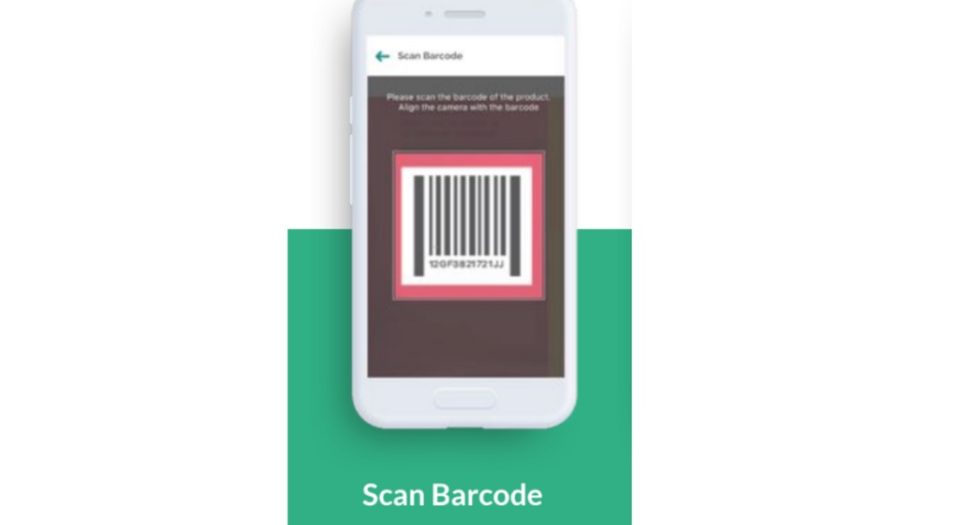
    The new tool, which is set to launch at the end of April, can supposedly tell users if a food product is likely to be halal or not – just by scanning its barcode or ingredients list.

    The Halal Scanner will be integrated into the existing WhatsHalal app, which was designed as a halal food guide for consumers, businesses and enterprises.

    The WhatsHalal app was launched in February last year, around four months after entreprenuers Azman Ivan Tan and Salehin Amat Kamsin first co-founded the tech company.

    Although the app offers four other key services to consumers – a halal restaurant listing, food delivery, takeaway food orders and restaurant reservations – only the listing service is available now due to a revamp of the app.

    A beta version of the upcoming Halal Scanner is expected to be launched in all of WhatsHalal’s available countries – Singapore, Malaysia, Indonesia and Australia.

    In an interview with Business Insider, Azman, who is now CEO, and Salehin, who serves as chief operating officer, said that they are expecting at least 50,000 products to be scanned in the first few months after the launch.

    During this phase, the WhatsHalal team will identify scanned ingredients which require halal verification. According to Salehin, about 150,000 potential ingredients are expected to surface for validation.

    How it works

    The scanner has three identification methods – product image, barcode and ingredients list – and all of them work based on community-driven data collected over time.

    Users first take a photo of a product in the app. If WhatsHalal’s back-end team is able to verify that the product’s packaging contains the Islamic Religious Council of Singapore (Muis) logo, it will automatically accept that the product is halal.

    The data is then stored in WhatsHalal’s system and the next time a user scans a barcode of the same product, the app will immediately indicate that it is halal.

    In cases where a product does not bear a Muis logo, its ingredients list come into play. After a user scans the ingredients list on the app, WhatsHalal automatically conducts an optical character recognition (OCR) on it.

    “If it doesn’t have a Muis logo, what we do is we let the system learn over time. By default, the system knows – if there’s salt and sugar, the system will flash ‘halal’ and ‘halal’. Only when they see pork, it will immediately say ‘not halal’. Very clear cut,” Azman, who has 20 years of experience in technology and business management, said.

    But for ingredients that are in the grey area, more information will be shown so the consumer can make a more informed choice. One such ingredient is gelatin, which can be from different sources such as fish or beef.

    “You can click on that, and we’ll show you a little bit of information, such as gelatin from (a certain country) is likely halal, and (if it’s) from China then it’s likely non-halal,” the 42-year-old said.

    If a significant number of users were to raise their concerns on a particular product, WhatsHalal will engage certified, external halal consultants to conduct thorough checks on whether its ingredients are likely halal or not.

    “So if this (a product) comes from XYZ company, and, say, this company has been certified by a proper certifying body, we’ll take it as yes – our halal consultants don’t need to check all the way. But if it’s not certified they’ll check with manufacturers,” Azman said.

    Salehin, 32, said that while the aim of the Halal Scanner is to verify as many products as possible, there is also a need to be practical by recognising operation constraints.

    “We must put things into perspective – there’s a small number of Muslims in Singapore, but millions in Indonesia and Malaysia,” he said. It is hence not practical to expect the WhatsHalal team to be able to check every single product scan that comes in.

    And that’s where the WhatsHalal database will shine.

    “The more people scan, the more we build up product database,” he said.

    The company is even looking at incorporating a translation feature within the scanner, so that users can scan products bought from other countries and still collect the information they need to make a decision.

    Helping Muslim customers make better decisions faster

    With the Halal Scanner, Azman and Salehin hope to help customers make decisions more quickly by speeding up the halal food identification process.

    “When we go to a supermarket, the first thing we do is look at the ingredients list. As a Muslim, we’re sure that some ingredients are halal, but not so sure of others. So we’ll check online, and that’s a lengthy process sometimes, given that each product has, say, 10 ingredients,” Azman said.

    “So what happens with our system is we actually just speed up the process and make it easy. All the information is at your fingertips,” he added.

    But Azman emphasised that the Halal Scanner is not created to dictate a user’s decision. Rather, it serves as a guide for informed decision-making.

    “We will not be able to tell you that something is 100 per cent halal… we leave it to the end user to make the decision. We are only helping you to map,” he said.


    Source: BusinessTimes
  • Circulation Of Kwong Cheong Thye’s Sze Chuan Style Spicy Hot Bean Paste With Misleading Cooking Recipe (Photos)

    Circulation Of Kwong Cheong Thye’s Sze Chuan Style Spicy Hot Bean Paste With Misleading Cooking Recipe (Photos)

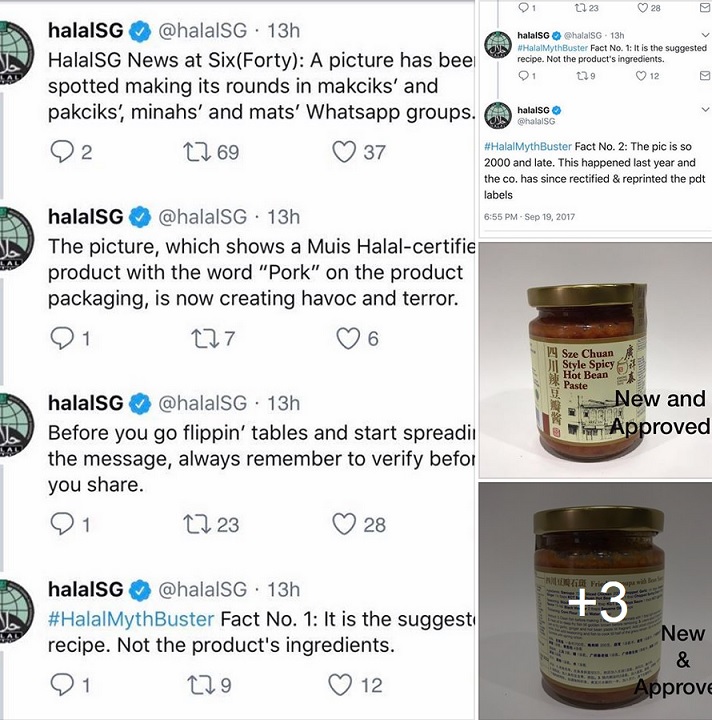
    EDIT: Attached are also screenshots from halalsg twitter account – Official account of the Islamic Religious Council of Singapore (Muis) on Halal food & certification queries.

    P.S. MUIS do routine and random spot checks on manufacturers in Singapore.

    Dear Customers, we understand that there is a circulation of photos of Kwong Cheong Thye’s Sze Chuan Style Spicy Hot Bean Paste with a misleading cooking recipe that were not conforming to the MUIS standard for Halal food. Our product did not contain any Non-Halal ingredients, however the label containing a recommended cooking recipe was not acceptable by MUIS. It was due to our carelessness that this happened, and we would like to extend our deepest apologies to our Muslim friends.

    We have since done corrective actions in February 2017

    1) Kwong Cheong Thye recalled all Sze Chuan Style Spicy Hot Bean Paste from all supermarkets on 16th February 2017

    2) Kwong Cheong Thye submitted a new label for Sze Chuan Style Spicy Hot Bean Paste to MUIS, conforming to the high standard

    3) Upon approval from MUIS, Kwong Cheong Thye’s Sze Chuan Style Spicy Hot Bean Paste were all back on the shelves of Supermarkets in Singapore by the week of 27th February 2017

    Attached in this post are 2 photos of our product with the new label that are available in the market now.

    Attached in this post are also 2 circulated photos of our product in the old label, which are discontinued wef February 2017.

    Customers who are still holding on to the old bottles of Kwong Cheong Thye’s Sze Chuan Style Spicy Hot Bean Paste may approach us immediately, and we will do a 1-to-1 exchange with you.

    Please be assured that our products do not and will not contain pork.

    We seek your kind understanding in this incident. Kwong Cheong Thye strives to serve our customers in Singapore and globally with products of the highest quality.

    We appreciate if you would share this post with your friends for clarification purposes.

    Thank you.


    Source: Kwong Cheong Thye – KCT

  • Far East Hospitality Chief Executive: Service Standards In Singapore Have Dropped

    Far East Hospitality Chief Executive: Service Standards In Singapore Have Dropped

    Service standards in Singapore have fallen sharply, said Mr Arthur Kiong, chief executive of Far East Hospitality, the largest hospitality chain here, leaving industry players and policymakers worried at a time when the sector is hit hard by a labour crunch and dwindling tourist arrivals.

    Expressing his dismay over the state of affairs, Mr Kiong told TODAY: “Is it that we don’t get it or are business owners not really convinced that service is related to keeping customers and (to) profitability? The disproportionate response to this major issue from business owners is shocking. Many are so financially driven that they refuse to look at the larger picture.”

    Taking no comfort in data showing productivity gains, he added: “Yet overall, our productivity has actually improved. Clearly, that is not real. It is because we can’t find people. There are fewer people doing the same job, so productivity looks to have gone up, but the quality has fallen.”

    Prime Minister Lee Hsien Loong said earlier this week at the Singapore Service Excellence Medallion awards that while service standards here have been raised over the past 10 years, there is still much room for improvement.

    “Ask any tourist or even a Singaporean which country has good service, (and) I don’t think Singapore comes immediately to mind. In Singapore, I don’t think our culture and DNA are naturally service-oriented, but we, too, can learn from Hong Kong and other countries and transform our service industry,” he said.

    Mr Kiong said the productivity push is also taking a toll on Singaporean workers. “We are trying to squeeze productivity, but Singaporean workers are feeling the heat as they realise that they have to do much more work at a comparatively lower pay increase. They originally thought their salaries will be better if there were no foreign workers. Now, fresh talent refuse to join the hospitality sector, looking at the hard work,” he said.

    He added that Singapore should stop borrowing from other countries and instead reinvent itself, as he seeks to promote a unique “Singapore Hospitality” defined by three key attributes: Comfort without excess, aesthetics without ostentation, and attention without pretention.

    “There is place and relevance today for this Singapore-inspired hospitality, both in terms of our strategy and the evolving new generation of travellers who are redefining service standards. They want comfort, but do not want to pay more than they should. Also, we need to understand well that they are in Singapore to enjoy the destination and not the hotel. The hotel is a small component, so we should be less arrogant about ourselves.”

    Come July, with a focus on its key markets including Australia, Indonesia, Malaysia, Japan, the United Kingdom and India, Far East Hospitality will launch two year-long campaigns: Heritage Food Trail, which will focus on local food; and Far More Singapore, which will showcase the Singaporean way of life.

    With its portfolio of brands, the hospitality giant is targeting the mid-tier market. “We have different brands catering for different psychographic categories and are the first to do this. Others go by demographic, segregating products by price points,” Mr Kiong said. The psychographic approach targets consumers according to their attitudes and aspirations.

    Far East Hospitality operates nine brands of hotels, serviced residences and apartment hotels, including Adina Apartment Hotels, Medina Serviced Apartments, Marque, Oasia, Quincy, Rendezvous, Travelodge Hotels, Vibe Hotels and Village.

    After Chinese New Year next year, it will launch several new properties in Singapore.

    Far East Hospitality is a 70-30 joint venture between Far East Orchard, a company under Far East Organization, and The Straits Trading Company. It operates a combined portfolio of more than 13,000 rooms across 80 hotels and serviced residences in eight countries — Australia, China, Denmark, Germany, Hungary, Malaysia, New Zealand and Singapore, with more in its development pipeline.


    Source: www.todayonline.com