Tag: religion

  • Youths In Singapore Shunning Religion

    Youths In Singapore Shunning Religion

    The Department of Statistics’ General Household Survey 2015 report released earlier this month found that those who said they had no religious affiliation constituted 18.5 per cent of the resident population last year – up from 17 per cent in 2010.

    Of this group, many were young. About 65 per cent were aged between 15 and 44, and about 23 per cent between 15 and 24, compared with 14.6 per cent among residents aged 55 and above.

    The religious composition as a whole remained relatively stable – 43.2 per cent of the resident populace identified as Buddhists or Taoists, 18.8 per cent as Christians, 14 per cent as Muslims and 5 per cent as Hindus. The number of Christians increased marginally, while other religions experienced slight declines.

    FACTORS BEHIND GROWTH IN THE NON-RELIGIOUS

    Academics and religious leaders The Straits Times spoke to said the trend of non-religious affiliation is in tandem with an increasingly educated populace, some of whom might move away from religion if it does not connect with their lives and needs.

    The Institute of Policy Studies’ senior research fellow Mathew Mathews said this is more common for individuals who grew up in families where religion was already nominally practised.

    The Catholic Church said traditional religions have also been slow to engage young people and help them appreciate their faith.

    Singapore Buddhist Federation president Seck Kwang Phing believes the youthful face of the non- religious group ties in with a change in attitudes among the young, who have become more independent in their thinking.

    He said: “They ask and argue and do not simply allow their parents to select their faiths on their behalf.”

    Young people today are also exposed to a range of ideologies, which results in a spectrum of views within the non-religious category. The segment therefore includes atheists and agnostics; humanists and secularists; as well as free-thinkers and other individuals who might not necessarily be anti-religion.

    National University of Singapore political science undergraduate Bertrand Seah, 21, grew up Christian in a Methodist school environment, but began doing his own research on religion in junior college.

    He became influenced by religious critics and scientific scepticism advocates such as American Sam Harris.

    Like the other youth The Straits Times spoke to, Mr Seah said he believes in a “rational” approach. “I don’t think I need divine guidance to make a right or wrong decision. Reason alone can guide such decision-making,” he said.

    Experts said the relative stability of a country also means there is less concern about the future because the present is “non-threatening”.

    When this is the case, there is less incentive to look to religion for divine intervention or for security.

    Young people might also be doing their own research before eventually committing to a particular faith, experts said.

    Some suggested that the multi- religious make-up of Singapore and the open-door policy of religious institutions here facilitate “shopping” for a religion.

    Some young people could also be identifying more with liberal ideologies that clash with religious teachings on topics such as homosexuality.

    Social anthropologist Lai Ah Eng of the National University of Singapore (NUS) said this group might therefore find religions “variously limiting, irrational, oppressive, unreasonable and unscientific”.

    Youth and religious experts interviewed noted the high-profile failures of institutional religions to uphold their credibility as a moral voice, which may also have turned some people away from religion.

    Some cited high-profile incidents such as the City Harvest case, where church leaders were found guilty of misusing around $50 million in church funds.

    POSSIBLE IMPLICATIONS

    Several religious leaders said they are concerned about the shift.

    Reverend Father Jude David, co-chaplain of the Catholic Church’s Office for Young People, believes that without religion “Singapore would certainly lose a part of her soul or spirit”.

    Reverend Dominic Yeo, the general superintendent of the Assemblies of God of Singapore, agreed. He said religion teaches its followers to be moral, adding: “We need to guard our nation, our children and the next generation against moral decadence.”

    Others are concerned about solidarity in households where the parents or grandparents are deeply religious. NUS sociologist Paulin Straughan said disparities in religious ideology could result in intergenerational fault lines and a widening gap “because religion, when it is functional, pulls families together”.

    Ultimately, the consensus among the various groups is for the need for more dialogue to understand “mutual concerns and find ways to negotiate potential tensions”, said Dr Mathews. They said this should be backed by more research to understand the specific make-up of Singapore’s non-religious segment.

    Communication channels already exist. For instance, the Humanist Society – set up to represent Singapore’s non-religious population – has been involved in discussions organised by the Inter-Religious Organisation of Singapore and the Inter-Racial and Religious Confidence Circles.

    Executive committee member Pearl Lin said the society’s role is to provide a voice for the non-religious, whom she said tend to be excluded and forgotten.

    But the Buddhist Federation’s Venerable Seck is not worried about the growing pool of non-religious Singaporeans. To him, good values and morals are more important.

    He said: “As long as there is moral education and the ability to differentiate between what is right and wrong, there will always be common ground among the religious and non-religious.”


    Source: www.straitstimes.com

  • Amos Yee Granted US Asylum

    Amos Yee Granted US Asylum

    CHICAGO — A US immigration judge in Chicago on Friday (March 24, US time) granted asylum to a Singaporean blogger, saying he was persecuted for his political opinions in the Republic.

    Amos Yee, 18, who had been jailed twice in Singapore, qualifies as a political refugee, according to a 13-page opinion by the US immigration judge.

    Amos is immediately eligible for release after having been held in US immigration detention since Dec 16, 2016, according to his attorney, Ms Sandra Grossman, who is based in Bethesda, Maryland.

    The Singapore Embassy in Washington could not be reached for comment after business hours on Friday evening.

    Judge Samuel Cole ruled Amos’ prosecution, detention and maltreatment at the hands of the Singapore authorities “constitute(s) persecution on account of Amos’ political opinions”, and called him a “young political dissident”.

    “The evidence presented at the hearing demonstrates Singapore’s prosecution of Amos was a pretext to silence his political opinions critical of the Singapore government,” Mr Cole wrote.

    The US Department of Homeland Security had opposed Amos’ asylum application, claiming the Singapore government legitimately prosecuted Amos.

    Ms Grossman said the judge’s decision supported the right of individuals to criticise their government.

    “The right to free speech is sacred, even when such speech is considered offensive,” she said in an email. “The decision timely underscores the vital need for an independent judiciary in a functioning democracy.”


    Source: www.todayonline.com


  • SPH Radio Fined $7000 For Offensive Comments By Kiss92FM Morning Show DJs

    SPH Radio Fined $7000 For Offensive Comments By Kiss92FM Morning Show DJs

    SPH Radio has been slapped with a S$7,000 financial penalty by the Infocomm Media Development Authority (IMDA) for breaching the Free-To-Air Radio Programme Code.

    On Jan 11, deejays on Kiss92FM were discussing about the study on the sleeping patterns of Singaporeans during their on-air morning segment. In the process of interpreting the findings obtained from the study, the deejays voiced remarks which “stereotyped certain races”. These remarks were deemed offensive by some listeners.

    In a statement on Tuesday (March 21), the IMDA said: “As a free-to-air broadcaster, SPH Radio is expected to comply with the Free-To-Air Radio Programme Code which seeks to ensure that radio programmes maintain a standard that is acceptable to the community.

    “A key obligation under the Code is for broadcasters to avoid racial and religious stereotyping and ensure that content which denigrates or is likely to offend the sensitivities of any racial or religious group in Singapore is not aired.”


    Source: www.todayonline.com


  • Science Backs Islam’s Logic Of Eating Halal Meat Instead Of Haram

    Science Backs Islam’s Logic Of Eating Halal Meat Instead Of Haram

    Islam, considered to be the perfect religion, has always provided reasons for the dos and don’ts in its properties. Just as science backs Islam’s logic of declaring pig haram and how praying 5 times a day helps a person stay healthier, there is also a specious logic behind eating halal meat (where the animal is slaughtered) instead of chopping its head off directly, which makes it haram.

    Source: thenation.com

    Source: thenation.com

    Muslims all over the world abstain from eating meat that has been slaughtered in a haram manner, or through mechanical slaughter. Here’s how science backs the logic with proper reasoning.

    WHAT MAKES MEAT HALAL OR HARAM?

    Haram slaughter

    Source: Muslimvillage.com

    The blood that does not drain out of the animal’s body, contaminated the meat completely, be it in a chicken, cow or a goat. This clotted blood ruins the freshness of the meat and becomes the cause for multiple illnesses when the humans eat it.

    The butchers, who slaughter the animal in a haram way, which is also known as the ‘Jhatka’ – chop the head off the animal completely, especially a chicken. This results in discretion of the brain and heart; which makes the heart stops pumping and beating blood in a jiffy. With no driving force left to push the blood out of the body, the blood stagnates in the veins and arteries, contaminating the blood and causing it to affect the meat.

    Science proves that blood is the most capable medium of bacterial growth. This contaminated meat makes the human body more vulnerable to infections and considerable pain in the joints, due to the rising uric acid level in the blood.

    WHY MUSLIMS PREFER HALAL MEAT AND ITS PROPER WAY

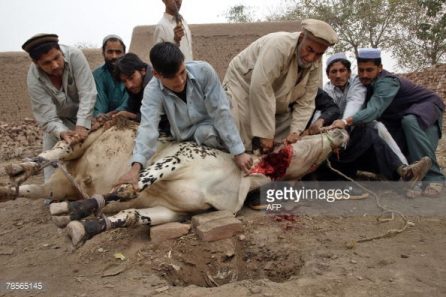
    Halal slaughter

    Source: gettyimages.com

    Muslim butchers who serve Halal meat do not chop the animals head off. Instead, the main jugular vein of the animal is cut, which holds the venous blood in high pressure. Due to the cut, the blood is directed out of the animal’s body, which is connected to the atrium of the heart without any irregularity.

    This method of slaughtering the animal preserves the link between heart and brain of the animal, allowing the animal to breathe out naturally. With this method, the heart keeps pumping until all the blood from the body is drained out and only meat is left, without any contamination, leaving the meat pure and Halal.

    THE FAMOUS QUESTION OF WHY FISH IS CONSIDERED HALAL WITHOUT BEING SLAUGHTERED

    Epiglottis of fish

    Source: shmoop.com

    Many non-Muslims have asked this question, that why the fish has been declared Halal without being slaughtered. The answer too, lies in science.

    Allah Almighty created everything in perfect balance. The moment the fish is taken out of the water, the entire blood of the fish redirects and moves into a part called the epiglottis, which is in its mouth – draining the blood from the whole body and leaving the meat pure and Halal.

    Thus, Science too backs Islam’s logic of heating Halal meat instead of Haram.

    BY: S.K PAKISTAN


    Source: Parhlo

  • Sangeetha Thanapal: Chinese Allies Must Be Clear – Any Racism Is Unacceptable

    Sangeetha Thanapal: Chinese Allies Must Be Clear – Any Racism Is Unacceptable

    I want to say a little about Chinese allies in Singapore, given some recent events and experiences.

    By and large, I find myself deeply disappointed with them. I see a lot of Chinese allies like and share my work, but who do not actually call out Chinese racists. It does not escape my attention then when I am attacked, it is minorities who come to my aid, i.e. the people who are already disenfranchised.

    Chinese people are mostly unwilling to use their privilege and power to make clear to other racists that racism is unacceptable. That task inevitably falls back onto my shoulders, and other minorities.

    Still, many Chinese people I know (yes, many of you on reading this now) consider yourself allies.

    Firstly, ally is not a term you give yourself. It is not a calling card. It has to be given to you by minority communities, and only when you have proven yourself to be one; meaning when you have earned this by actually doing something, not just by talking a good game and posting anti-racist things on your social media once in a while.

    Chinese allies in Singapore really need to step up their game, because to a lot of you, not being racist or not saying racist things is enough. It is not. It will never be.

    Meeting the minimum standards of decency is not enough to be seen as not racist, let alone be considered an ally.

    Until you are actively giving money, access to power and opportunity to minorities, do not pat yourself on the back. Your Chinese allyship means nothing without the transfer of resources and structural power.

    A lot of the ‘good’ Chinese people become incredibly defensive the moment you point out that something they might have said or done is problematic. Instead of thinking of it as an attack on your Good Chinese Ally status, Chinese people need to understand that they are socialized into this, that they will mess up every now and then, and to simply listen when minorities tell them something makes them uncomfortable.

    In this climate, Cher Tan’s approach to writing about Chinese privilege was so refreshing. When she spoke to me, I told her that her ability to even write about it and be paid for it, is something no one has ever given me.This in itself is a function of her privilege.

    She then offered to either not write it, or have me write it instead.

    I want to point out how rare this is. I want to point out that a Chinese person willingly giving up access to opportunity to a minority, and a minority woman at that, is so extraordinarily uncommon, that even this most basic of gestures was appreciated tremendously by me, because it is more than most Chinese people have ever been capable of.

    She went on to write a piece that addressed Chinese people, from the point of view of a Chinese person, and she made sure she included many minority voices speaking for themselves.

    This was then referred to as Chinese guilt by some people, which is mind boggling to me. So a Chinese person doesn’t talk about racism and that’s not okay, but they do and that’s not okay as well? Here is a Chinese person using her privilege by centering minority voices and opinions, but that’s apparently just an issue of her exercising her guilt to you? Even if it was though, so what? Guilt as a position is useless to me, but using your Chinese guilt to address racism in Singapore is a valuable exercise of this guilt.

    Chinese people ask me everywhere I go what they can do to combat Chinese privilege. This is an example. Visibility and access to opportunity are the main starting points of being an ally. Do you have the ability to vacate a space you have or have been given for a minority? You should do that. You should be constantly aware of how much of what you have is because of your privilege.

    Use your privilege for good. Challenge the people around you. Remember that whatever repercussions you may face, you will never be on the receiving end of as much hatred and ignorance as those talking about this without the safety of their privilege.

    Be suspicious of everyone who takes easy positions. Be wary of the people who speak out against racism when it is easy and convenient, when it costs them nothing and nets them social capital. Be especially careful of those who perpetuate racism on a regular basis by stealing our words and ideas, passing it off as theirs and then being invited to write and speak about that which they have no understanding or experience of.

    “Allyship is active. Discomfort is necessary.” — Kat Blaque

    Are you uncomfortable? Good. That’s a start. Now go do something about it.

    Sangeetha Thanapal

    Source: https://medium.com