Tag: Singapore

  • Two Hit-And-Run Drivers Arrested

    Two Hit-And-Run Drivers Arrested

    A 30-year-old man was arrested yesterday on suspicion of driving an Audi car that spun out of control in Simei Avenue on Tuesday morning – crashing into seven other vehicles and causing a 1½-hour jam along the three-lane road.

    The driver, who has not been named, was seen running away from the scene after the 9.15am pile-up near the Institute of Technical Education College East campus.

    A 65-year-old woman, a passenger in another car involved, suffered pain in her stomach and back after the accident and was warded at Changi General Hospital.

    Police said yesterday that the accident “occurred when the driver of a silver saloon car failed to exercise proper control of his vehicle”.

    The Traffic Police established his identity through “intensive investigations” and he was arrested in the vicinity of the National University Hospital. His driving licence will be suspended and police are continuing their investigations.

    Witnesses said the driver had been speeding and was overtaking when his car collided with other vehicles and swerved towards the road divider. Mr Rajan Shirodkhar, 48, a vice-president of technology at OCBC Bank, said he was driving to work when the silver Audi hit the rear wheel and side of his car.

    “His act yesterday (Tuesday) did not look like what any normal person would have done,” he said. “A fair trial should be held to see how we can be compensated fairly.”

    Meanwhile, the police have arrested a 29-year-old man on Tuesday who was believed to have also fled on foot after causing an accident in Jurong Town Hall Road two weeks ago.

    He had allegedly been driving a white Honda multi-purpose vehicle (MPV) on the afternoon of July 31, when it collided with a motorcyclist, causing him to be flung onto the road.

    The MPV then crashed into the rear of another car, causing it to jerk forward, hitting the rear of a van.

    The motorcylist had to be taken to hospital.

    “It was established subsequently that the MPV that caused the accident was affixed with a false number plate,” the police said.

    The Traffic Police managed to identify the driver and arrested him in the vicinity of Hougang Street 21 for both traffic and drug offences, in a joint operation with the Central Narcotics Bureau.

    Under the law, motorists involved in an accident in which a person or animal is injured, or where another vehicle or structure is damaged, have to stop their vehicles. They must also render the necessary assistance.

    If the vehicle owner is not present at the scene, the motorist should take reasonable steps to inform him of the accident, such as by leaving a note on the damaged vehicle’s windscreen.

    The motorist should also lodge a police report as soon as it is practical to do so and within 24 hours, unless he is able to establish contact with the vehicle owner.

    The penalty for hit-and-run accidents is a fine of up to $3,000 or up to 12 months’ jail. Repeat offenders face a fine of up to $5,000 or up to two years’ jail.


    Source: www.straitstimes.com

  • DPP’s Chia Ser Lin: I Will Give Up My Business In China To Become Full-Time MP If Elected

    DPP’s Chia Ser Lin: I Will Give Up My Business In China To Become Full-Time MP If Elected

    A potential new Opposition candidate at the coming General Election said he will give up his corporate career, which sees him shuttling in and out of China, to be a full-time MP if elected.

    Mr Chia Ser Lin, 46, was introduced by the Democratic Progressive Party (DPP) during a Bishan-Toa Payoh walkabout on Tuesday evening (Aug 11). He runs a chain of F&B companies in China, where he is based, and returns to Singapore once a month to his wife and two kids in Toa Payoh, where he said he has lived all his life.

    “He is one of the anchor persons in our team to compete in Bishan-Toa Payoh and run the town council if we win,” said DPP secretary-general Benjamin Pwee, who described Mr Chia as someone who “feels for and understands local municipal issues in Toa Payoh very keenly”.

    Mr Chia gave the example of what he said were dirty monsoon drains and possible mosquito breeding grounds – a dengue fever threat – in the neighbourhood were not attended to by the Town Council, which he said deflected queries to the National Environment Agency instead.

    “There have been persistent issues like this over the last five years. You write to MPs and you don’t really get a response from them,” he said, calling it “a disconnect on the ground”.

    In a separate, earlier interview with Channel NewsAsia, Mr Pwee said the DPP “has been with Bishan-Toa Payoh residents since the last GE till now, and knows the issues on the ground … that have not been dealt with by the current team”.

    THE CHINESE CHALLENGE

    The Bishan-Toa Payoh Group Representation Constituency is held by the People’s Action Party, which on Wednesday announced the retirement of three MPs from the current GRC Team, including former Deputy Prime Minister Wong Kan Seng. The PAP also unveiled their replacements.

    This new-look PAP team will square off at the coming General Election against an Opposition partnership made up of DPP and Singapore People’s Party members in Bishan-Toa Payoh.

    With DPP not laying claim to any Single Member Constituency, Mr Chia, Mr Pwee and party chairman Hamim Aliyas are in the running for this joint team, whose final five-man lineup will be jointly decided by SPP and DPP leaders by the end of the week.

    When asked why he wanted to run in the GE, Mr Chia said “it felt important to stand up, take a stand and support Ben against the idea of one-party rule”.

    “It’s important there are certain checks and balances in the system,” he added.

    A former schoolmate and fellow scout with Mr Pwee at Raffles Institution, Mr Chia said issues such as overcrowding and the job market concerned him. Also close to heart for the China-based executive was the issue of Singapore’s prospects over the next five to 10 years, in the face of competition from the “more aggressive” China market.

    “We are all too protected in many ways. I’ve worked in China for so many years, I know what they’re up to and I’m very worried,” said Mr Chia, who has managed the China-based operations of multi-national corporations including Coca-Cola, OSIM and Asia Pacific Breweries for nearly two decades.

    Asked if being based overseas would prove a problem during his campaign, Mr Chia said: “If Ben decides I should join him, if he wins the GRC, then it should be a full-time thing. I don’t believe in part-time MPs drawing allowance and having a full-time job and holding meet-the-people sessions once a month. I think that’s not the way.”


    Soure: www.channelnewsasia.com

  • Mat Saleh Foreign Talent Criticise Singaporean For Complaining About MRT Reserved Seats

    Mat Saleh Foreign Talent Criticise Singaporean For Complaining About MRT Reserved Seats

    Dear ASS,

    Sara Moore, Internal Sales Manager at Reliant Global Supplies Pte Ltd, a foreigner felt it was befitting to berate a local Singaporean woman and her 6 year old child regarding their unfortunate train experience.

    Sara’s malicious tirade was laced with expletives(“b*tch”, “f*cking trains”), referring to local Singaporean families as “sh*t families” and insulting name calling (“racist cow”).
    http://www.allsingaporestuff.com/article/foreign-workers-lack-civic-mind…

    Are these the type of uncouth ‘talents’ that Ministry of Manpower approve of and MNC’s such as Reliant attract and hire?

    Sara Moore: “why didn’t you stand to let the old man sit? ever think that the Philipino maid works her ass off 6 days a week for shit money and shit families and this might be the only time she gets to sit and enjoy time to herself she is human after all maybe she needed to sit down.

    now some bitch needs to complain on the internet cause she doesn’t have the guts enough to use her voice at the time in public. sorry but get over yourselves you won’t be bothered to do the jobs the these foreigners do for the pay they get because you think it is beneath you.

    If you are so mad about foreingers [sic], teach your boy that he needs to learn how to work in the toilets, construction and all other very hard working jobs that these people do so scum like you can enjoy life. who do you think made the fucking seats and the train and the house that you live in?? huh???

    think before your type your pointless crap online you racist cow totally make yourself look like an idiot. so i ask again why did you not stand up or even say something if it pissed you off so much or is it only foreigners must stand and give up their seats to singaporeans [sic]???”

    Singaporeans may raise your concerns about Sara Moore to Reliant Global Supplies (+65 6848 4352), 40 Ubi Crescent #01-04 Ubi Techpark.
    Reliant Oilfield Products – Mr. David Moore, President & CEO: +65 9830 1828,[email protected]
    Reliant Technology Solutions – Mick Moore, Vice President: +62 813 1757 3480,[email protected]
    Reliant Inspection Services – Steven Moore, Vice President: Hp: +65 9655 5911,[email protected]

    Kueh Lupis
    Concerned True-Blue Singaporean

    #AngMohVeryKayPohandRude #MindYourOwnBusiness #WhoIsTheRacistCow

    http://www.allsingaporestuff.com/article/foreign-workers-lack-civic-mind…
    https://www.facebook.com/pages/Reliant-Global-Supplies-Pte-Ltd/167011183…
    http://www.reliant.com.sg/contact-us/

    Source: www.allsingaporestuff.com

  • Deconstructing Arguments Of Young Singaporean Elitist

    Deconstructing Arguments Of Young Singaporean Elitist

    ‘Elitism’ can be good for society

    It’s very interesting to me whenever a teenager thinks that he has something important or meaningful to say about society. I used to blog about social issues as a teenager myself, and it wasn’t too long ago– so I like to think that I relate to the civic-minded young ones. [1]

    The first and most important thing we need to remember about young teenage thinkers is that they’re most probably dependent on their parents.

    This does not automatically discredit their perspective, but it does shape it tremendously. [2]

    Or, to look at it from another point of view, there’s a lot about society you simply don’t know about until you start paying for the roof over your head and the water coming out of your taps.

    How does this play out in Russell’s argument?

    He claims that “equity is better than equality”, but he has no proposal for actually increasing the net amount of equity in Singapore.

    So all he’s really saying is that the status quo works well for him, and he’d like things to be kept that way, thank you very much.

    Which is quite rational from his perspective. Why should commoners get access to the privilege that HE inherited?

    (Actually there’s a good reason: because it’s a step towards increasing the net amount of equity in Singapore. But he avoids talking about this, probably because he’s a teenager who isn’t actually accountable for anything yet.)

    Let me go through Russell’s argument, bit by bit:

    In recent years, we seem to have collectively confused equity with equality.

    Well, maybe. Let’s see.

    Equality is making everyone stoop down to the lowest common denominator of society – everyone does the same thing and all are given equal probabilities.

    Straw man! We’re conflating equality of opportunity here with a sort of imposed collectivism. Imposed collectivism typically leads to the shittiest kind of equality, AKA “we’re all equally miserable”.

    Also, “Making everyone stoop down to the lowest common denominator” implies some sort of Down to the Countrysidemovement. Like we’re deliberately weighing people down so that they can’t be excellent (see: Vonnegut’s Harrison Bergeron).

    Vonnegut’s story demonstrates “making everybody stoop down”, where people are literally policed and maimed. Giving the disenfranchised access to education is a totally different thing.

    Equity entails everyone doing what their abilities allow them to do, and everyone being given equal opportunities to succeed; only the most outstanding grab those opportunities.

    That’s the end goal that pretty much everybody agrees is a good thing.

    The challenge is that we often disagree about how to get there.

    If we take a modern society and reduce it back to an agrarian one, where everyone puts in equal effort, we achieve equality but not equity – because we are taking people with the capability to be, for instance, lawyers and doctors, and making them do the same menial tasks as everyone else.

    What is up with the “reduce modern society back to an agrarian one” motif?

    Also, what are these horrible menial tasks that everybody does except lawyers and doctors? Washing their own underwear? The horror.

    It is a natural consequence that students from affluent backgrounds get into better schools because their parents are likely more well-heeled and can afford better-quality education for them.

    Oh man, that’s not even half of it. Parents from affluent backgrounds also are likely to read more, read to their kids more, have more thoughtful conversations at the dinner table, have better connections and so forth. Check out this great comic: On a plate
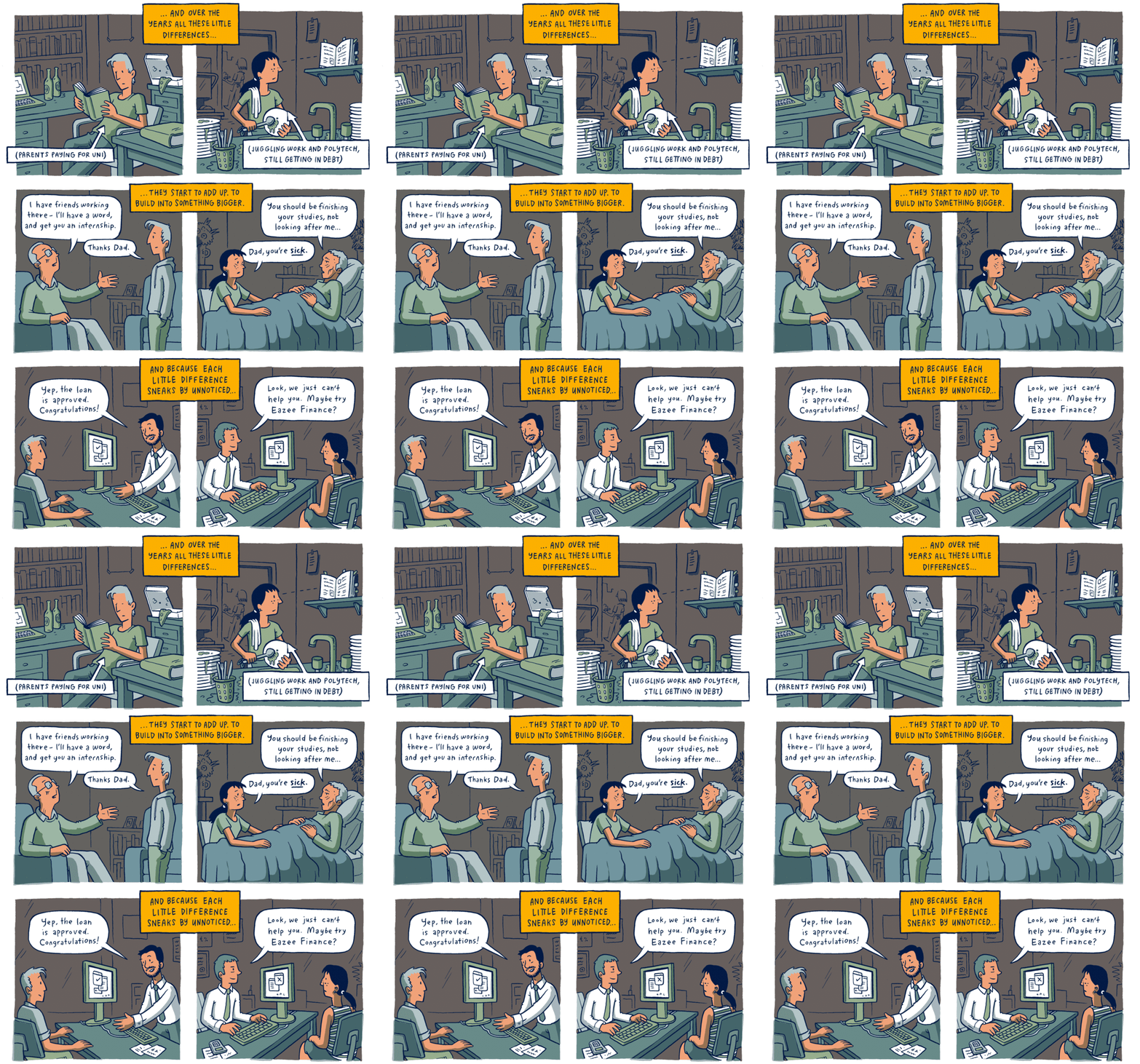
    differences

    There is no point aiming for equality for the sake of equality, and giving up equity.

    Ah, but you see, the point is to GAIN equity by reducing inequality. The point is to GAIN more high-quality doctors and lawyers from the people who don’t currently have access to opportunities.

    Did you seriously think that the Principal of RI is saying “let’s give up equity for the sake of equality”? Equity bad, equality good?

    […] when we stream students according to their abilities, it is only natural that students whose families can afford better quality education make it to better institutions.

    Try to avoid “it is only natural” statements, because they’re actually non-arguments. It’s only natural for a 17-year-old to write things like this. It’s only natural for people to desire and persue equality.

    Everything is only natural, ergo it’s redundant to talk about it.

    A natural consequence that stratifies society does have its own purpose for the well-educated, critical minds to mingle together to build Singapore up to greater heights.

    Don’t pretend that “natural phenomena” has noble intentions. It only seems to because it serves your interests.

    The idea that a country will be brought to greater heights by a circlejerking elite is a romantic one, but it’s BS.

    Intelligence is an asset; and we cannot allow ourselves to prioritise equality over intelligence and equity.

    Again, the idea that equality takes precedence over equity here is utterly mislaid.

    The fundamental point that you’re missing is that addressing inequality is a necessary step towards creating more equity. We don’t need to send doctors and lawyers to the countryside. We need to give rural children the opportunity to read and write.

    RI is often touted as a factory for future leaders – why would we want to draw resources away from the nurturing of our future leaders, or worse still, level the playing field?

    Oh, that’s a pretty simple one. Because leaders aren’t made better by throwing more resources at them, or by putting them on a pedestal.

    Leaders need perspective. Leaders need empathy. Leaders need to see the big picture. Leaders need to mingle with everybody, not just the equity-laden, menial-task-avoiding elites. Leaders are nurtured in difficulty and struggle, not with silver spoons.

    You see, Russell, you fundamentally misunderstand the pursuit of maximizing equity for a society, and you fundamentally misunderstand leadership.

    We should relook the way we go off the well-trodden path, and ensure that we do not shake up the status quo just for the sake of doing so.

    The status quo will get shaken whether you like it or not. What you should actually relook, though, are the assumptions in your own thinking.

    Here are a couple of quotes worth ruminating on:

    Elizabeth Warren: “There is nobody in this country who got rich on their own. Nobody. You built a factory out there – good for you. But I want to be clear. You moved your goods to market on roads the rest of us paid for. You hired workers the rest of us paid to educate. You were safe in your factory because of police forces and fire forces that the rest of us paid for. You didn’t have to worry that marauding bands would come and seize everything at your factory… Now look. You built a factory and it turned into something terrific or a great idea – God bless! Keep a hunk of it. But part of the underlying social contract is you take a hunk of that and pay forward for the next kid who comes along.”

    Lee Kuan Yew: “The successful have forgotten that without the peace and stability that made their education, their job or their business opportunities possible, they would never have made it. But having made it, they think they made it on their own. Some students from the top schools like Raffles Institution or Hwa Chong, they go abroad and they think that they had done it on their own. They don’t owe the government or society anything. They are bright chaps, but how did they make it? Because we kept a balance in society. With peace, stability, we built up our education system and enabled the brightest to rise to the top.”

    _____

    [1] If you’re bored enough to dig into my archives, you’ll find that I too was a presumptuous little twit who thought he had a valuable perspective that the world ought to know about. What changed? I moved out, bought a flat, and pay my own bills. Lol.

    Incidentally, I think it’s very important to remember that news sites are uniquely incentivized to publish incendiary letters. If a letter published on straitstimes.com sparks outrage, that means a lot of traffic for straitstimes.com. It’s not hard to imagine the editors sorting through the letters and laughing amongst themselves, saying, “Wah, this one damn jialat, publish this one!”

    [2] One of the easiest ways to “win aguments” as a teenager is to just use bigger words and talk longer than everybody else. (You’ve got all the time in the world, and no bills to pay.)

    People will eventually find it too tedious to engage with you, and their disengagement means you’re the one left standing. Hooray, you win!

    ____

    Update: Got a great comment about this on Facebook:

    “I think your argument could be summarised into a “equity good not equals equality bad” essay rather than a slightly tedious point-counterpoint.

    Also, the only part I slightly disagree with is precisely the part you quoted above. I think you’re both arguing on a false dichotomy. More resources do to a certain extent allow for the development of better leaders. It can pay for programmes that stretch the capabilities and capacities of participants beyond what normal programmes allow. It can also create opportunities for experiences that are beyond a smaller budget. The problem is that those things are easy to programme, but what we’re missing is the perspective and empathy that you’ve rightly pointed out. We need to be doing more of that, which doesn’t necessarily mean we have to scrap the other good developmental programmes that are already in place.”


    Source: www.visakanv.com

  • Walid J. Abdullah: Discourse On Voting Need To Move Beyond Fear-Mongering And Red-Herrings

    Walid J. Abdullah: Discourse On Voting Need To Move Beyond Fear-Mongering And Red-Herrings

    Often, when people say ‘yes the PAP is not perfect, but what alternative do we have?’, you get the sense that they either do not comprehend our political system or they are setting up a false dilemma. This time, like previous years, we are not voting for which party will serve as government: in all likelihood, the PAP will remain as our government. With that in mind then, the questions that should be asked automatically become different. Perhaps the following questions, amongst others, would be more pertinent:

    1) Do we believe there is a need to have checks and balances in Parliament against any one party?

    2) Since 2011, with more opposition parliamentarians, has the government become more responsive to the desires of the electorate?

    3) Has the Workers’ Party lived up to its claim of being a ‘responsible opposition’ party?

    4) Are the individual opposition candidates and their respective parties ‘credible’ enough for us, however we define it?

    I personally believe that in any other situation, most people would loathe the idea of giving any one person or party near-absolute control over their affairs, so I am not sure why people make exceptions in the case of Singapore politics. At the same time, I cannot say that the performance of WP – both in and outside Parliament – has been so stellar in the past 4 years that they would immediately deserve my vote. That would be my personal dilemma.

    Ultimately, each of us would have our own standards in choosing which party to cast our vote for. Hopefully as our society matures politically, the discussions on voting, politics and societal issues would be centered on genuine considerations rather than fear-mongering or red herrings.


    Source: Walid J. Abdullah

deneme bonusu