Tag: Singaporeans

  • Singaporean Forced To Leave Company Staffed With 90% Foreigners, Face Legal Action For Breach Of Contract

    Singaporean Forced To Leave Company Staffed With 90% Foreigners, Face Legal Action For Breach Of Contract

    Dear Mr Goh,

    My name is Johnny.

    I’m having a dispute at the moment with my employer regarding my training bond agreement which I have to pay when I breached the contract. Mr Chandra, my neighbour has recommended me to you.

    I recently made the decision to leave because I was forced to.

    It all started when I had a Italian manager from England. He had so many problems with us and the team can’t take it.

    As I was there on my assignment, I reached out to my ops manager and ops executive for advice.

    After hearing me out, they asked me to write a letter and get people who agree to sign and then submit it to the management. In the end, I’m punished for doing that and my ops manager has since return to England.

    90% of my head office are all foreigners.

    They work together as a “team” and are trying to break our rice bowl. I was eventually given an option to leave if I felt that the company is not suitable for me or stay and prove that I can deliver.

    This was delivered to me by my Taiwanese ops manager.

    After considering for a month, I decided to take my leave but I won’t pay a single cent for my bond.

    The level of stress and depression they have given me because of this is not worth it. Till today, they still say that I have to answer to my wrong doing.

    But I was advised wrongly – by a management member – should I be punished for it?

    Now I understand that they want to take legal action against me. I will need to seek legal advice too.

    Please help and advice me.

    Yours sincerely,

    Johnny

    Editor’s note: we have forwarded the mail to our legal advisor. Note also that the middle management jobs all go to foreigners. If you do not want your children to work under foreign imports, you know what to do during the next election.


    Source: www.transitioning.org

  • Singaporeans Need Visas To Enter These Countries

    Singaporeans Need Visas To Enter These Countries

    Potential visitors to the United States have been stymied by an ongoing computer glitch that prevents officials from making visas and conducting security checks.

    An average of 50,000 applications a day have reportedly been piling up since June 8, with the visa system not expected to be restored till next week.

    Fortunately, Singaporeans were largely unaffected – those on business or tourism for less than 90 days do not need one in the US as they are allowed to travel under the country’s Visa Waiver Program.

    The Singapore passport, in fact, is one of the most widely accepted in the world, offering unrestricted access to 170 countries (out of 219). It was also ranked fifth – alongside New Zealand and Switzerland – in last year’s annual global ranking based on freedom of travel.

    Here are some notable countries, however, where Singaporeans still need a visa.

    Belarus

    A visa application must be submitted no fewer than three business days before a traveller’s date of arrival to this landlocked Eastern European country.

    It is then issued on arrival at Minsk International Airport. Seventeen countries – with varying periods of stay – enjoy visa-free entry.

    Bhutan

    The world’s most reclusive country, nestled in the Himalayas, grants unfettered access only to visitors from India, Bangladesh and the Maldives.

    Singaporeans require a valid visa and must also book their holiday through a Bhutanese tour operator, who will make the necessary arrangements.

    India

    Only citizens from Bhutan, the Maldives and Nepal are exempted from visa requirements.

    Those travelling to India on holiday must obtain an e-Tourist Visa (introduced last year), which is valid for 30 days. An application must be made at least four days before the date of arrival.

    Marshall Islands

    The island country near the equator in the Pacific Ocean, which has a population of over 60,000 spread out over more than 1,000 islands, is open only to the US and two other island nations – Palau and the Federated States of Micronesia.

    Besides the usual supporting documents, an applicant’s letter stating the purpose and duration of visit, a police record and a health clearance (both dated within the last three months) certifying that a person is free from HIV and Aids are required.

    Myanmar

    Citizens from six South-east Asian countries (Brunei, Cambodia, Indonesia, Laos, the Philippines and Vietnam) have visa-free access up to 14 days.

    Singaporeans will need a visa for travel to the country. An eVisa system solely for tourism was launched last September. Singaporeans with a visa are allowed a 28-day stay but arrival must be via the airports in Mandalay, Naypyitaw or Yangon.

    Paraguay & Venezuela

    Both South American countries have strict visa policies. Venezuela, for instance, requires visitors to present proof that they have enough money to last during their stay, and documents are also needed to show the traveller’s next destination.

    As there is no Paraguayan embassy in Singapore, those wishing to visit the country will need to contact the nearest embassy in Jakarta, Indonesia, for more information on how to apply for one.

    Saudi Arabia

    If you are not a citizen of a country belonging to the Gulf Cooperation Council (Bahrain, Kuwait, Oman, Qatar and UAE), you need a visa.

    The country is a popular destination for Singaporean Muslim pilgrims, who must register and apply for a separate visa through the Islamic Religious Council of Singapore (Muis) when performing the annual Haj to Mecca. A new visa centre at Anson Road was set up last year to expedite the application process. Singapore’s official Haj quota is 680.


    Source: www.straitstimes.com

  • IDA: Beware Of SingPass Phishing Emails

    IDA: Beware Of SingPass Phishing Emails

    The authorities have put up a security advisory online warning unsuspecting SingPass users not to fall prey to a phishing e-mail, which has apparently been making its rounds.

    Phishing is a fraudulent process used by hackers to get users to divulge sensitive personal information such as their user identities and passwords.

    On its Facebook page, the Infocomm Development Authority (IDA) posted this morning: “A number of users have received an e-mail titled ‘SingPass account security info verification’ from SingPass Government [mailto:[email protected]] informing recipients that their SingPass PINs have been suspended and to click on a link to confirm their e-mail address.”

    IDA continued: “Please be informed that this is a phishing e-mail and IS NOT sent by SingPass. Should you receive this e-mail, do not click on the link, simply delete it.”

    SingPass grants Singapore residents access to 340 e-government services, and is due to be revamped next month to further tighten security after more than 1,500 SingPass accounts were breached a year ago. Three of the accounts breached were used to make fraudulent applications for work passes.


    Source: www.straitstimes.com

  • Don’t Hope Of Getting Back All Your CPF Money At 55 As Long As PAP Has Parliamentary Majority

    Don’t Hope Of Getting Back All Your CPF Money At 55 As Long As PAP Has Parliamentary Majority

    Dear CPF members

    With PAP in power, you should not hope for a miracle to happen and somehow you will be able to spend any/much of your hard-earned CPF before you meet your maker. Do not continue to rely on sacrifices from fellow citizens like Roy to help you get back YOUR money. It’s about time you help yourself.

    Do read up on CPF issues and question/discuss all that you have read, including this post. It is likely that you will be convinced PAP has abused the CPF scheme for its own benefit. There will be more delaying tactics to prevent full CPF withdrawal. Learn to read the ‘right’ things instead of propaganda fed to you by PAP’s mainstream media.

    What I have written is based on information from various government websites. If I were merely speculating, PAP could have provided counter arguments and put all ‘speculators’ to shame. (Not necessary to resort to legal threats) The fact that PAP has not been able to do so confirms most of what I have written to be factually accurate.

    1 You need to realise that:

    – CPF is YOUR hard-earned retirement savings and no political party can have more say than you. You should not allow PAP total control over YOUR CPF through frequent policy tweaks.
    – Many of you NEED your CPF at 55 but somehow keep supporting PAP, a political party whoseobjective is to retain increasing amounts of our CPF. Perhaps you have bought into PAP’s propaganda but it’s not too late to realise this and stop victimising yourself.

    Ignorance is not bliss.

    2 CPF was used by the PAP to fund the construction of HDB flats, infrastructures and the set up of profitable government companies which were subsequently transferred to Temasek Holdings below market value. After tasting their ‘success’, PAP had proposed to delay the CPF withdrawal age from 55 to 60 in the Howe Yoon Chong report 31 years ago. The clear rejection of this proposal is evidenced by theunprecedented 12.9 % vote swing at the 1984 GE.

    Without parliamentary checks, PAP has become more brazen and progressively increased the withdrawal age to 65 by 2018. The MS of almost $200,000, including Medisave, is senseless because the majority of CPF members do not even have this amount.

    CPF members were unhappy with PAP in 1984 for attempting to retain our CPF and we are unhappier now because the withdrawal age has been increased by 10 years instead of 5 years.

    3 CPF appears to be the mother of all Ponzi schemes. A Ponzi scheme entices ‘investors’ with the promise of high short-term returns; CPF scheme promises low long-term returns.

    The “guarantee” of low CPF interest rate by the PAP government is a joke at our expense. CPF members are also taxpayers and when the “guarantee” comes from taxpayers (government), we are effectively guaranteeing ourselves. PAP has fooled many in the past and it’s about time you reject the role of being a fool by reading the ‘right’ things in order to break free from PAP’s BS.

    4 PAP has effectively hijacked public monies into a private company called GIC. Once our CPF is privately managed, PAP owes no one any explanation as to how or where our CPF is invested.

    Since GIC was formed in 1981, it has never disclosed any absolute figures such as it profits,losses, dividends, etc. Without a proper set of accounts, GIC’s real performance is concealed from CPF members. It does not even disclose the tens of million$ paid to its directors or hundreds of million$ to fund managers. All the percentage figures disclosed are meaningless to its stakeholders.

    GIC has been concealing relevant information from its stakeholders for 34 years. A functioning government needs trust from the people but citizens are not stupid to trust a government which insists on concealing information for decades.

    If you are a scholar with stellar academic results from Harvard, would you conceal the information? So if GIC has indeed been a fund manager par excellence, why has it chosen to conceal information for 34 years?

    One can only logically assume such information could embarrass the PAP if disclosed. Many have alsospeculated GIC has made huge losses which necessitates the retention of larger amounts of CPF.

    We have now been forced into a pay-until-you-die CPF installment scheme by the PAP because the government lacks the funds to return a lump sum payment to CPF members at 55.

    PAP has the propensity to cook up ridiculous justifications and you should not rule out PAP increasing the withdrawal age to 80 or even 90 from 65.

    5 Like you, I used to be impressed by the GIC reported in the mainstream media. But after some research the last couple of years, I believe Singaporeans have been fooled.

    Investment losses are inevitable but massive losses could have been avoided if only GIC had a game plan. Holding on to bad investments after fundamentals have changed confirms GIC has no discipline.

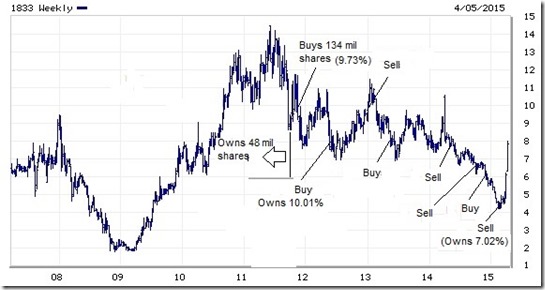
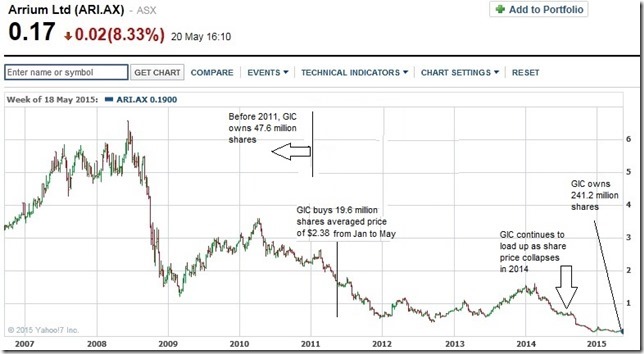
    By becoming a substantial shareholder in many companies with no track record, GIC is merely speculating on capital gains. GIC has no margin for error in its judgement as any mistake will wipe out the investment. And GIC has lots of these wipeout investments. Here are a few:


    Link


    More details on GIC’s China Coal Energy here.

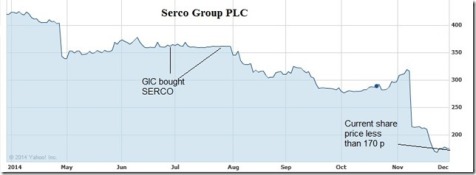
    Less than a year ago, GIC invested in Serco Group PLC in what appears to be ‘bottom picking’. But the bottom has since fell out and Serco’s shares are now worth one third of GIC’s original price.

    intime5.jpg?w=1000&h=

    More details on GIC’s investments at this link.

    There are of course many more such investments.

    6 GIC will never learn from its mistakes because there has been no accountability. Not even after Citigroup or UBS. There are simply too many bad investments which confirm GIC has not conducted due diligence.

    Since a steady stream of about $20 billion CPF is being channeled into GIC every year, it can sit on every underwater investment. It is like our local punters who ‘cold storage’ a collapsed penny stock and then hope for the best in the next bull cycle.

    GIC’s investment ‘strategy’ does not provide for a lump sum withdrawal by CPF members.

    7 Last year, DPM Tharman revealed in Parliament that “In eight out of 20 years, GIC’s returns were lower than the rate promised to CPF members, but the Government absorbed the losses”. GIC claims to have made annual real return of 4.1% over a 20 year period.

    Although Tharman’s statement appears to have revealed little, it has actually confirmed GIC’s mediocre performance.

    It would be fine if GIC’s return was lower than CPF rate for a couple of years but it did so 40% of the time.

    “Lower than the rate promised to CPF members” could also mean GIC had made losses in a number of years. And when PAP is unable to state factually its underachievements, rest assured it must be an embarrassing number.

    It could also be due to GIC’s mediocre performance that it is unable to return a lump sum CPF to members at 55.

    8 GIC has disclosed its 20-year rate of return in Singapore dollar since 2001. It was only after the financial crisis in 2007/2008 that GIC suddenly reported this in US dollar.

    GIC’s 20-year rate of return in Singapore dollar
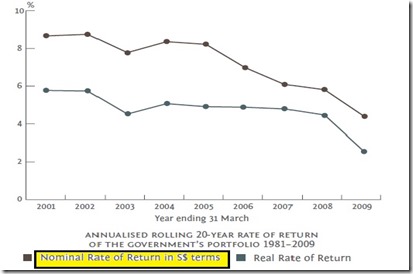
    If GIC had reported in Singapore dollar, its real rate of return would have been much lower – between 2% and 3%.

    GIC’s profits were impacted by forex losses due to the appreciation of our currency
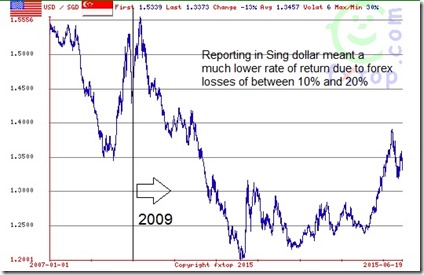
    (Sing dollar strengthened against every major currency except the Swiss Franc during the last decade)

    Reporting in Sing dollar after 2009 would have meant a disastrous performance for GIC. The sub par performance was masked by the change from reporting in Sing dollar to US dollar. Should Sing dollar depreciate, rest assured the reporting currency will be reverted to Sing dollar.

    There have been too many attempts to project GIC’s ‘superior’ performance. If GIC’s client and board of directors isn’t the Singapore government, it would have folded years ago.

    Do you think GIC has the funds to pay every CPF member a lump sum at 55?

    9 By admitting that “the Government absorbed the losses”, Tharman must have meant our reserves were used to pay CPF members for 8 years. If so,why was this not highlighted in Parliament?

    Since GIC had to resort to using our reserves to pay CPF interest on 8 occasions during a 20-year period, does this not confirm it did not have the funds to make lump sum payments to CPF members?

    10 CPF is not invested in foreign companies with strong earnings which are able to pay regular dividends. GIC has taken excessive risks by speculating for capital gains. If this is factually inaccurate, GIC could quell speculation by simply producing a complete list of its investments.

    GIC could have been as transparent as Norway’s GPFG and easily provided FULL disclosure. (2014 GPFG annual report)

    PAP has no reason to invite unnecessary speculation on GIC but why does it continue to conceal basic information of CPF investments?

    11 It is obvious GIC does not have sufficient funds to return all CPF monies to CPF members at 55 or 65. Perhaps it’s time you query your MPs but don’t get your hopes too high – chances are they know only as much as you do.

    redwire-singapore-janil-sleep.png
    Image credit: Redwire Times

    Conclusion

    Your CPF belongs to you, it is YOUR money but how you spend your hard-earned savings is nowdictated by PAP.

    The CPF scheme the mother of all Ponzi schemes. A Ponzi scheme promises high returns to attract investors whereas CPF legislates low returns.

    GIC does not seem to be managing our investments, appears to be speculating and does not have an exit plan when market fundamentals have changed. If due diligence has been conducted, there is no reason for investments to lose half their market value in a year, wiped out within 2 years.

    PAP should not expect CPF members to trust an organisation managing more than $1/4 trillion of our retirement savings when it has not produced a proper set of accounts for 34 years.

    There are obvious question marks all over our CPF scheme but PAP has repeatedly refused to provide relevant answers.

    The original contract for the government to return our CPF at 55 was amended by PAP because Singaporeans voted for a PAP majority in Parliament. The only way to undo this self-created problem is to deny PAP its 2/3 parliamentary majority. There is no alternative.

    Without any checks on the PAP, all your hard-earned CPF will never be returned to you at 55.


    Source: https://likedatosocanmeh.wordpress.com

  • Heng Swee Keat To Lead Task Force Probing Complaints By Residents Of DBSS Development Centrale 8

    Heng Swee Keat To Lead Task Force Probing Complaints By Residents Of DBSS Development Centrale 8

    Following a petition signed by owners of more than half of the units at Centrale 8, a taskforce surpervised by Tampines GRC Member of Parliament Heng Swee Keat will be formed to look into the residents’ grouses.

    Buyers of almost 400 of the 708 units in the Design, Build and Sell Scheme (DBSS) project had endorsed the petition to extend their year-long warranty. They also want compensation for alleged “inferior quality of materials” used and poor design that compromises their space, safety and privacy.

    Tampines Town Council chairman Baey Yam Keng told TODAY that Mr Heng had asked him to reply on his behalf, after residents emailed their petition last Friday (June 19) to the project’s developer, Sim Lian Group, and looped in the Housing and Development Board (HDB), Ministry of National Development and Tampines MPs.

    Mr Baey said the task force will be led by senior grassroots leaders, with Mr Heng supervising the team personally. The task force could include representatives from Sim Lian, HDB, the Building and Construction Authority and the town council.

    “We want to help residents by bringing the relevant people together so that we can all talk things over together,” he said.

    “Once we get the composition settled I think we should have the first meeting as soon as we can, because the residents are anxious.”

    Mr Baey added that the outcome “would have to be a balance between the wishes of the residents as well as the contractual obligations of the developers”.

    A developer has to rectify any defect in the units within a year after handing over the keys, but residents are worried other defects may surface after that. They are creating a document to highlight issues faced, and will be presenting it to the task force. They hope to have a dialogue by early July.

    In 2011, Centrale 8 made the headlines for the wrong reasons after its developer asked for S$880,000 for the five-room units – a record indicative asking price which was on par with the cost of suburban condominium units. This prompted a public outcry which led Sim Lian to slash the asking price to S$778,000. As the controversy brewed, National Development Minister Khaw Boon Wan weighed in and said that consumers who thought the prices were too high should give the flats a miss. Soon after, the Government announced the DBS scheme was under review and subsequently, the sale of land for DBSS projects was suspended.

    According to earlier reports, Centrale 8 homeowners were upset about defects such as faulty locks, cracked tiles and burst water pipes.

    But they told TODAY they have bigger issues with the design of their homes and estate. For example, some toilet windows face the common corridor, which means windows cannot be opened. The entrance to the estate as well as the carpark meet at a cross junction, increasing chances of accidents, said residents, who are calling for another entrance and exit to be created.

    A resident who wanted to be known as Mr Cher said the main power switch for the aircon compressor is located outside the flat. “If I want to turn it off, I have to climb out onto the (aircon) ledge, which is very dangerous,” he said.

    Another resident, Ms Evelyn Soo, 46, found sanitary pipes taking up usable space in the service yard. When she told Sim Lian about it, the developer responded that the location of the pipes was “to meet with (PUB’s) requirement”.

    TODAY understands the national water agency sent a strongly-worded email to the developer calling such statements “wrong and misleading” as PUB “does not mandate that sanitary stacks be located at the service courtyard or AC (aircon) ledge of residential units”.

    Sim Lian clarified that the sanitary stack pipes located in the service yards of some unit types are there to meet PUB’s technical requirement, which states that the length of a discharge pipe connecting to the discharge stack pipe cannot exceed its maximum length of 2.5m.

    The developer also said it is common for architects to place sanitary stack pipes in wet areas including bathrooms, service yards or the aircon ledges of residential units.

    Another resident, who declined to be named, cited another “very awkward” design element where his main gate opens from the right, while the main door opens from left. Half of the master bedroom door protrudes into bedroom space when open. “We paid a premium price but we never got the premium value,” he said.

    A Sim Lian spokesman confirmed it has received the residents’ petition and “will continue to attend to their concerns on a one-to-one basis”.

    The developer said it remains committed to rectifying reported defects in accordance with the Sale and Purchase Agreement and will “also review subsequent requests for rectification works on a case-by-case basis” after the year-long Defects Liability Period expires.

    Sim Lian is working with HDB, Tampines Citizens’ Consultative Committee, Tampines Town Council, the People’s Association Residents’ Committee and grassroots representatives to facilitate the process.


    Source: www.todayonline.com

deneme bonusu