Tag: Singaporeans

  • Overnight Mass Fish Deaths Hit Changi Farmers Hard

    Overnight Mass Fish Deaths Hit Changi Farmers Hard

    Thousands of fish have died in coastal farms off Changi, in a repeat of last year’s nightmare for farmers.

    Farmers woke up yesterday morning to the sight of their fish floating belly up – the mass deaths had occurred through the night, so they had no opportunity to try to save their fish.

    Dead fish were also seen along the Pasir Ris shoreline.

    The Agri-Food and Veterinary Authority of Singapore (AVA) attributed the deaths to gill damage caused by plankton. Lab tests conducted so far did not detect biological toxins in the fish, and fish from local farms remains safe to eat, an AVA spokesman said.


    Source: www.straitstimes.com

  • Rote Learning Is Not The Way To Learn Science

    Rote Learning Is Not The Way To Learn Science

    From ‘Only one right answer to science questions?’23 Feb 2015, article by Amelia Teng and Pearl Lee, ST

    EXPLAIN how the hard, bony body of a seahorse could be an advantage. The right answer, according to one Primary 6 science teacher, is: “It protects the seahorse from injury and reduces the chances of predators successfully feeding on it.”

    But the child who wrote “It acts as an armour that protects the seahorse from predators” was told that her answer was wrong. This was one of several examples thrown up by parents, who have complained recently that primary school science teachers are too rigid in marking open-ended questions, and are emphasising rote learning over the understanding of concepts.

    This, despite schools having shifted to an inquiry-based learning approach in science since 2008. With the approach, pupils are encouraged to ask questions, analyse data and come to their own conclusions.

    Several parents wrote to The Straits Times Forum page earlier this month, calling for schools to be more flexible. Most said their children were unduly penalised for answers that had the same meaning as the correct ones, but did not contain the right “key words”.

    The children had been told by teachers to stick to key phrases and words found in textbooks, in order to get full marks in assignments or tests.

    Here’s another Primary 3 head-scratcher for you:

    What is the difference between a bird and a lion?

    If you said the ‘bird has feathers but the lion does not’, you’re wrong. You’re also wrong if you said ‘The bird can fly but the lion can’t’, ‘birds evolved from flying dinosaurs but not lions’, or even ‘birds poop on cars but lions poop on the ground’ (assuming the question involves you staring at a picture of a bird and a lion). The correct answer, according to a parent complaining to the ST Forum earlier this month (‘Good science=Poor English’, Feb 5 2015) is ‘The bird has feathers but the lion does NOT HAVE FEATHERS’, which basically means the same damn thing as your original answer, except annoyingly repetitive. (Well if you want to be even more specific: a bird has feathers but a lion has fur, not feathers).

    Clearly, the student knows what he’s talking about, that a lion does not have feathers, but the science teacher here doesn’t give a hoot about your ‘understanding’ if it does not fit into the template answer scheme, even if the same statement in a composition about bird and lions would make your English teacher squirm in her seat, and accuse you of trying to make up the 500 word quota with redundancies. The parent summed it up perfectly in his letter: “Is there rigidity in the teaching of science? It would certainly appear so (that there is rigidity in the teaching of science)”. Take that, Rigidity!

    Not convinced that teachers can be anal about science answers? Here’s another puzzler on animals.

    You could be thinking of the following possible answers:

    1) Both the bull and the lion give birth to their young
    2) Both the bull and lion poop and pee
    3) Both the bull and lion can kill you
    4) Both the bull and lion are mammals

    ALL OF THE ABOVE ARE WRONG. (The answers are ‘4 legs’, ‘have hair’, or ‘similar body shape’ i.e something you can actually see from the illustration). The thing that you should be staring hard at isn’t the actual drawing, but the phrase ‘STUDY the animals BELOW’. Gotcha.

    Let’s up the ante with a dreaded multiple choice question about the properties of a light bulb.

    Now read the last option carefully before you make your choice. If you chose ‘all of the above’, you are interpreting D as ‘the bulb lights up only when electricity passes through it’. If you chose ‘A, B and C’ you read it as ‘light energy is the only energy that is given off when electricity passes through it’. The correct answer happens to be the latter. Answer D, in the spirit of the other animal questions, happens to be the grammatical equivalent of the rabbit/duck gestalt optical illusion. Given the ambiguity of this shitty question, no student should be penalised for seeing a rabbit when the answer scheme says duck.

    Do you know how a shadow is formed? Here’s one student’s answer to a puzzle that has tickled the intellect of many an ancient Greek philosopher.
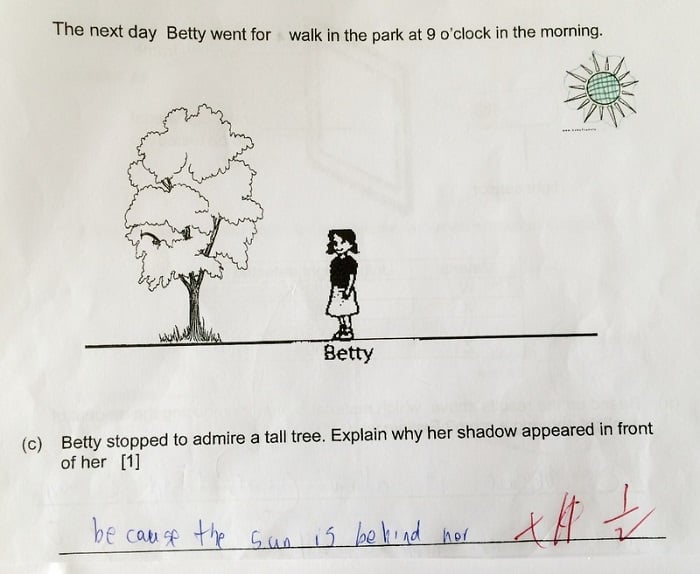
    The complete answer is ‘Because the sun is behind her and she is blocking the path of the light’. You know what this obsession with ‘complete’ answers will do to our kids? They’ll never be able to complete their paper on time because they’d want to add details like ‘because light travels in straight lines and Betty is an opaque human being and she will generate a penumbra and umbra depending on the angle and intensity of the sunlight’. Just to play safe. Except that some teachers will still mark you wrong for ‘trying to be clever’ when penumbrae and umbrae are not taught until you’re in secondary school. If you mention anything about photons or the particle-wave duality you may be suspended from school altogether.

    But back to the seahorse question. If I were grading the student I’ll not only let it go, I would also give her BONUS marks for using her imagination and drawing a figurative analogy between ‘hard skin’ and ‘armour’. By our school standards, this paper published in the rather obscure ‘Acta Biomaterialia’ journal is pure BULL. Its title?Highly deformable bones: Unusual deformation mechanisms of seahorse armor(Porter et al).

    All this nitpicking over ‘key words’ will not only kill our children’s love for science, but also restricts how individuals grasp concepts, punishing those who, well, ‘think outside the box’. A student who sees beyond 4 legs and digs deeper into the taxonomic characteristics of mammals vs birds is given zero marks vs another who memorises ‘key words’ because his tuition teacher said so. Flowery language, like ‘armour’, is not ‘scientific’ and has no place in a science paper, they say. Well try describing DNA to laymen without ‘unscientific’ analogies like zippers and enzyme/cell receptor interactions without using ‘lock and key’.

    Final question: What’s the difference between a robot and a typical Singaporean Science student?

    Answer: The robot needs electricity to recharge but the student does not need electricity to recharge.


    Source: http://everythingalsocomplain.com

  • McDonald’s Named Best Employer In Singapore!

    McDonald’s Named Best Employer In Singapore!

    SINGAPORE – Fast food giant McDonald’s Restaurants was named “Best of the Best” employer in Singapore in global HR management and consulting firm Aon Hewitt’s ranking of the best employers here for 2015.

    American Express International, Hongkong Land and Tan Tock Seng Hospital were among those named “Best Employer Singapore 2015” in an awards ceremony and learning conference on Friday.

    — PHOTO: AON HEWITT

    There were also awards for categories in hotels, and small and medium enterprises (SMEs). Goodrich Global clinched the title of best employer in the SME space, for instance.

    Aon Hewitt said its 3 criteria for Best Employer are:

    1. The organization inspires strong commitment and superior performance from its people;

    2. It drives business results through effective people practices; and,

    3. It manages its business in ways that build long-term success and sustainability.

    “Best employers clearly achieve better business results compared to market,” said Mr Jeremy Andrulis, South-east Asia’s chief executive for Aon Hewitt Consulting. “We found that (the) best employers in Singapore achieve significant higher growth in their income profits when compared to market average.”

    “This makes becoming a ‘Best Employer’ a business agenda and not just an HR agenda,” he added.

    McDonald’s Restaurants was named Outstanding Best Employer in the firm’s 2011 study.

    Aon Hewitt said its Best Employers study was first conducted in Asia in 2001, to learn about companies that are creating real competitive advantage through their people, find out what makes a workplace of choice and to identify the best employers in the region.

    — PHOTO: AON HEWITT

    It is run in 12 markets including China, Singapore, and New Zealand, and conducted over a nine-month period.


    Source: www.straitstimes.com

  • Siting Flats Away From City Centre May Widen Singapore’s Social Divide

    Siting Flats Away From City Centre May Widen Singapore’s Social Divide

    With less public housing being built in Singapore’s city centre than in the past, a paper published recently by the National University of Singapore’s Lee Kuan Yew School of Public Policy (LKYSPP) raised the question of whether this may lead to “enclaves” of wealth and social stratification.

    In the paper, titled How Should Singapore Improve Spatial Diversity and Equity In The City Centre, author Wu Wei Neng asked whether there is a need to build more public homes in central districts to foster social cohesion and promote social mobility in the population.

    “There is a risk that relegating new HDB estates to the outlying areas of Singapore, while planning a glittering array of architectural gems, luxurious residences and material offerings for the well-heeled in the city centre, could alienate a large part of the population,” wrote Mr Wu, who added that the paper is not intended to “suggest correct or incorrect handling of the situation depicted”.

    The issue made headlines earlier this week, when a participant at the Real Estate Developers’ Association of Singapore (REDAS) mentorship programme for students asked Social and Family Development Minister Chan Chun Sing if the Government would consider increasing interaction among social classes by building Housing and Development Board (HDB) flats on prime land such as Marina South.

    The paper, published on the LKYSPP website, noted that in the past, HDB flats were built in central areas such as Tanjong Pagar and Chinatown. This has helped stave off challenges such as low-income or ethnic minority ghettos and other “extreme forms of spatial segregation”. However, the last batch of flats in the central area were completed in 1985 at Rowell Court and Rowell Road. Since then, public housing has been sited further from the city.

    Mr Wu cited 2013 figures from the authorities, which showed that around 71 per cent of the completed housing in the central area were private housing units, compared with 22.7 per cent elsewhere. While there have been efforts to develop the outskirts, such as Woodlands and Tampines, high-paying jobs will still be concentrated in prime commercial hubs such as the Marina Bay Financial Centre, he wrote.

    Plans to develop business hubs in the south such as Alexandra and Pasir Panjang may further tilt commercial activity towards the central region. Firms may relocate lower-end jobs elsewhere because of high land costs. As people tend to seek jobs near their homes, this widens household income differences and spatial segregation, he said.

    Having a high concentration of private residences in the city may lead to the formation of exclusive communities for the well-heeled and declining social mobility as mixed-income spaces provide equal access to opportunities, he added.

    However, building HDB flats in the city would mean sacrificing revenue earned from selling land to commercial developers. State intervention also interferes with market forces and may lead to depressing prices of nearby private properties. Locating public housing in pricey city-centre locations also “creates undeserved windfall gains for a select few” when these units are sold, Mr Wu noted, pointing to Pinnacle@Duxton — where resale units may fetch S$1 million and more.

    Mr Chan echoed this point, saying that building HDB flats in prime locations would see buyers enjoying a windfall when they sell their homes at a high price in resale markets at the expense of taxpayers.

    Mr Wu also noted that the majority of Singapore’s resident population live in HDB estates outside the central area and these estates are socioeconomically mixed.

    Property analysts were mixed on having more public housing in the city. Mr Chris Koh, director of property consultancy Chris International, felt public housing estates at the fringe of the city centre, such as Toa Payoh, already caters to a degree of social mixing. He suggested building a better transport network to ensure accessibility to the city centre, while plans to create more jobs across the island will help lift other segments of society.

    But Mr Colin Tan, director of research and consultancy at Suntec Real Estate, felt there is a need for a mix of housing types in every area.

    NUS sociologist Tan Ern Ser felt siting HDB flats in prime areas would “incur more social and economic costs than social benefits”, such as resentment when those able to obtain these flats make large profits when they sell their homes. Schools and religious activities are other ways to bring different social classes together, he said.


    Source: www.todayonline.com

  • Safuwan Baharudin Scores His First A-League Goal In Melbourne City’s Comeback Win

    Safuwan Baharudin Scores His First A-League Goal In Melbourne City’s Comeback Win

    Safuwan Baharudin scored his first A-League goal for Melbourne City since joining on a three-month loan from the LionsXII last month, as the Singapore defender sparked a 3-1 comeback win at their AAMI Park home ground over title hopefuls Adelaide United.

    Safuwan, 23, started at right wingback after being left out of the team’s 0-0 draw with A-League leaders Perth Glory last week.

    He had played the whole of City’s 0-0 draw away at Wellington Phoenix at right back the week before, and lasted 60 minutes in the centre of midfield during the 3-0 local derby defeat by Melbourne Victory two weeks ago.

    The home side started the match brightly but fell behind to Pablo Sanchez’s goal in the 32nd minute.

    In search of a way back into the game, City coach John van’t Schip then tinkered with his line-up at the break and Safuwan began the second 45 minutes on the left side of a four-man defence.

    What a masterstroke it turned out to be.

    Just seven minutes into the second half, Safuwan scored the crucial equaliser for City when he swept home a loose ball at the back post past Adelaide’s Australian international goalkeeper Eugene Galekovic.

    The goal rejuvenated City, and they scored a second through Josh Kennedy three minutes later.

    The home side made sure of the three points in the 87th minute when substitute Iain Ramsay finished from close range after good work from David Williams and Massimo Murdocca.

    The only blight on Safuwan’s game was a yellow card he picked up in the dying minutes of the game as City defended their lead.

    But chances are he won’t be too worried about the booking after putting up a solid performance which had match commentators touting him as a candidate for Man of the Match.


    Source: www.tnp.sg

deneme bonusu