Tag: Singaporeans

  • SingFirst’s $6 Billion Social Safety Net Will Not Bankrupt Singapore

    SingFirst’s $6 Billion Social Safety Net Will Not Bankrupt Singapore

    SingFirst’s social safety net package is not prepared overnight but is the outcome of several years of research and discussion. It started with the S$60 billion economic plan outlined in the 2011 essay “Creating Jobs and Enterprise in a New Singapore economy – Ideas for Change” by Tan Jee Say, our Secretary-General.

    Our proposal has now been updated following discussions in the last few years with international experts in Finland, Norway, Berlin, Oxford and Harvard. It has also been discussed and debated internally over several months. We took into consideration what the Minister of Finance told Parliament about the use of returns on investment of Singapore’s national assets.

    To help our readers understand our approach, we have decided to use simple illustrations and graphics, rather than post a long article. We believe these simple messages will help to communicate our proposal more effectively and clearly.

    1. The ISSUE – Rising Social Inequality

    Economic growth in Singapore has created a large gap between the rich and poor, leaving a big segment of society behind. Inflation and technology has widened the income gap. Singaporeans have also become the most stressed, unhappiest and least emotional people in the world.

    According to an article in The Economist on 7 March 2014, Singapore is presently the most expensive city in the world as housing, education, healthcare and transport costs are rising day by day.

    ” It has been a long time coming, but Singapore, a tiny city-state of about 5m people, has finally made it: to being the most expensive city in the world. According to the Economist Intelligence Unit (EIU), a sister organisation of The Economist, after a decade of steadily climbing up the table from 18th place, Singapore now occupies the position usually reserved for the Japanese capital, Tokyo. Paris is now the second-most expensive, ahead of Oslo in Norway”.

    – The Economist (article here)

    Singapore has the biggest income gap among developed countries, as indicated by the Gini co-efficient, an international standard of measure of income inequality. The higher the Gini, the greater the inequality.

    gini1

    Singapore’s economic inequality is highest because its public spending as a percentage of GDP is the lowest among the developed countries.

    gini2

    2. Our PROPOSAL – Social Spending and Social Investment

    SingFirst wants to increase social spending and reduce social inequalities with

    a. Social Safety Net   (S$6 billion per annum)

    b. Social Investment  (S$8 billion per annum)

    This will be funded by the returns on our investment of national assets

    • GIC, MAS, Temasek Holdings etc generate huge investment returns
    • These huge investment returns are more than SingFirst’s proposed social spending amount
    • Principal sum (capital) of national assets WILL NOT be touched.

    2.1 The Government’s existing framework on NIR (Net Investment Return)

    • Returns on investments (R)     : from GIC & MAS
    • Investment income (I)              : from Temasek Holdings
    • R + I = Net Investment Return (NIR)
    • average annual NIR is about S$16 billion

    2.2  The Government’s existing framework on NIRC (Net Investment Return Contribution)

    • ½ R + ½ I = Net Investment Return Contribution (NIRC)
    • In last few years, NIRC has been estimated as S$8 billion
    • Balance ( NIR minus NIRC) = S$8 billion
    • Currently, this balance is RE-INVESTED into GIC & Temasek Holdings

    nirc 2

    To emphasize the above illustration, investment return contribution from GIC and MAS assets is STABLE, is based on expected long term real rate of return and is NOT AFFECTED by year to year fluctuations in actual returns (similar formula used by Norway and Yale University).

    That means the total NIR of S$16 billion is a stable amount year after year.

    In last few years (see illustration below), annual NIR is estimated at S$16 billion. NIRC is estimated at S$8 billion. So the balance for re-investment is S$8 billion on the average.

    nirc

    In the past 4 years, NIRC hovered around S$8 billion per year. So SingFirst proposes to use the NIRC for funding our S$6 billion social safety net package.

    As we are only using S$6 billion per year (75% of NIRC), this is SUSTAINABLE.

    There is a healthy surplus of S$2 billion per year (25% of NIRC) that is not used.

    3. PROPOSAL 1 – Social Spending

    The table below illustrates our social spending to defray the current high cost of living for all Singaporeans.

    safety net

    3.1 Monthly Benefits for Singaporeans

    A simple illustration below of how our social spending will benefit a family with 2 elderly parents, 2 parents and 2 young children on the monthly basis.

    family

    3.2 Tax Restructuring – to phase out GST

    1

    2

    3

    4

     4. PROPOSAL 2 – Social Investment

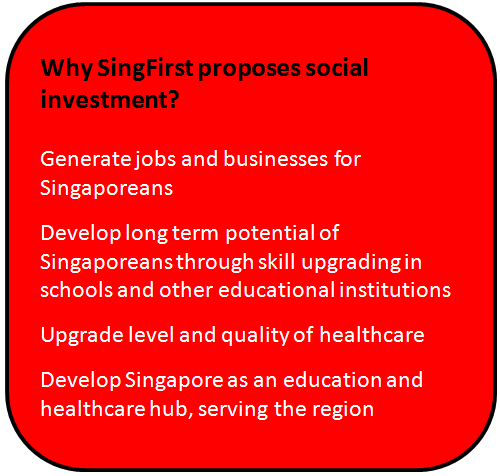
    Presently, the Ministry of Finance has re-invested approximately half of the net investment returns back into Temasek and GIC which are then used for Portfolio Investment. SingFirst proposes to broaden re-investment to include social investment (eg hospitals, schools). NOT only back into Temasek or GIC.


    5

    6

    7

     4.1 Our Proposed Initiatives

    9


    4.2 Reserves are not RAIDED by our proposals

    4.3  Pro-growth Social Package

    Our package is not wasteful consumption but will give a strong boost to the local domestic economy. We will create a strong, stable and diversified economy that benefit local businessmen and families.

    • Social safety net                          $ 6 billion
    • Social investment                        $ 8 billion
    • Healthcare (from defence)         $ 5 billion     (over 5 years)
    • Consumer (from GST)                $ 9.5 billion  (over 5 years)
    • Re-investment per year over 5 years   $14 – 28.5 billion

    4.3  Fair Society, Strong Families and Esteemed People

    With this package, SingFirst will deliver

    11

    In Conclusion: Our difference from the PAP

    At the Forbes Global CEO Conference on 28 October 2014, Prime Minister Lee Hsien Loong said that he wanted Singaporeans to always be paranoid about someone else stealing their lunch.

    05slide1

    “Looking forward beyond the 50th anniversary, I think that is what Singapore needs to do – to be aware, to be paranoid so you always know that somebody can take your lunch away…”

    While PM Lee wants Singaporeans to be paranoid (“kiasu”), SingFirst prefers to put esteem into Singaporeans. Do you want to feel inferior and be “kiasu” or do you want to stand tall and be esteemed?

    You have a choice. Choose wisely.

    Stand tall. Vote SingFirst.

    SF_LOGO


    Source: http://singfirst.org


  • LBW Structurally Certifies HDB Flats In Own Ward

    LBW Structurally Certifies HDB Flats In Own Ward

    Khatib Court is a HDB BTO project launched in September 2013 [Link]. It is sited next to the Khatib MRT station. The development consists of two 14-storey residential blocks and offers 310 units of Studio Apartments and 3-room flats. The expected completion date is in 2nd quarter of 2017.

    Specifically, it is located at Yishun Neighbourhood 8, part of Nee Soon South ward. Nee Soon South generally encompasses Yishun Neighbourhood 8 (Khatib), part of Neighbourhood 7 and private residential areas along Sembawang Road (near Sembawang Army Camp).

    Nee Soon South used to be an SMC but was absorbed into Ang Mo Kio GRC in 1997 after SDP narrowly lost there in 1991 GE. It remained in Ang Mo Kio GRC till 2011 GE when it was merged together with other wards in Yishun to form the present Nee Soon GRC.

    The PAP MP specifically in-charge of Nee Soon South is Er Dr Lee Bee Wah. She is also the grassroots adviser there [Link].

    The reader who forwarded the information on the BTO project at Khatib highlighted that the C&S (Civil and Structural) engineering service has been awarded to LBW Consultants LLP, a consultancy owned by MP Lee Bee Wah [Link]:

    LBW Consultants LLB

    Ms Lee was a Malaysian before she became a Singaporean MP. Her consultancy firm, LBW Consultants, provides “civil, structural, project management and golf course design services” while her other company, LBW Engineering, provides turnkey solutions and product distribution for satellite communications.

    In fact, her companies have a lot of experience participating in numerous residential, commercial, industrial and institutional projects in Singapore [Link]. They even include military ones:

    • Proposed Airport Emergency Services (AES) Training / Live-Fire Fighting Facilities at Paya Lebar Airbase
    • Proposed Upgrading of Khatib Camp
    • Proposed Upgrading of Kranji Camp
    • Proposed Upgrading & Renovation of Hangars in Sembawang Air Base
    • Proposed Upgrading of School of Ammunition in Rifle Range Road Camp II
    • Proposed Upgrading of Airfield Ground Service Section in Sembawang Air Base

    Last month, it was reported that she intends to set up 50 more designated public spots in Nee Soon South, where smokers can smoke (‘More light-up shelters to curb second-hand smoke’, 28 Jan). It was reported that the decision was made, “following a successful year-long pilot scheme”.

    Six shelters for smokers have been erected during the pilot. The shelters were funded by NEA with the objective of reducing second-hand smoke in Nee Soon South.

    To see how “successful” the pilot scheme has been, TRE sent a correspondent to Nee Soon South to take a look at the smoking shelters during lunchtime on 3 Feb. It didn’t appear to be as “successful” as what Ms Lee had told the media, observed the correspondent (‘Countering LBW’s claim smoking shelter scheme works‘).

    In any case, it should be comforting for the new residents of Khatib Court to know that their HDB flats are structurally being certified by their very own MP, Lee Bee Wah.

    UPDATE:

    Since last year (2014), Ms Lee’s consultancy has been merged with Meinhardt Group International:

  • NSP: For Benefit Of Residents, Do Not Politicise Town Councils

    NSP: For Benefit Of Residents, Do Not Politicise Town Councils

    The National Solidarity Party (NSP) has called on the government not to penalise residents Aljunied residents, tighten the framework of the Town Council Act and to depoliticise town councils so that it does not hinder the ability of MPs to serve as the people’s representatives.

    The remarks were made in a statement issued by NSP’s new secretary-general Mr Tan Lam Siong, in the wake of the parliamentary debate on the financial audit by the Auditor-General’s Office (AGO) on Aljunied Hougang Punggol East Town Council’s (AHPETC) accounts.

    NSP called on the government not to withhold the service and conservancy charges (S&CC) grant to AHPETC in the light of the adverse findings by AGO, but instead to continue disbursing the grants to let AHPETC pay for essential services.

    “As it is, the collection of S&CC charges from residential and commercial units is insufficient to cover all town council expenses and hence a government grant is required,” wrote Mr Tan. “Any withholding of the S&CC grant amounting to S$ 7 million per year will therefore affect residents if AHPETC is unable to pay for essential services.”

    NSP also supported the move to enforce greater standards of accountability and governance, but said that this should not lead to a penalty framework in the management of town councils that would impact on town councillors who are, first and foremost, Members of Parliament.

    “A MP’s fundamental duty is to represent his constituents who elected him or her and to participate in the functions of Parliament,” said Mr Tan. “This duty cannot and should never be subjugated to any other duty. By putting in place a penalty framework in relation to town councillors who are also MPs, the concern is whether such a framework would lead to their secondary role as town councillors overshadowing and undermining their primary role as MPs.”

    NSP also noted that the constant accusations of an un-level playing field and political bias, which opposition MPs have often raised against the government.

    “NSP hopes that the government will re-examine the political wisdom of the notion that the competency of political parties aspiring to form the national government can be tested through their management of town councils,” said Mr Tan. “Such a notion has no empirical basis. The ability to manage a town council and the ability to govern the country have no correlation whatsoever. Any suggestion of a correlation would imply that the best people to govern the country are town planners and estate managers, which cannot be true.”

    Mr Tan recalled that the first generation of government leaders were “fully capable of governing the country” although they were by no means managing town councils, and they have depended on a politically neutral civil service to fulfil that task.

    “NSP urges the government to consider allowing town councils to be managed by a statutory board or a centralised agency instead,” said Mr Tan, “so that residents will not only benefit from a seamless continuation of all services when there is a change of town councillors who are MPs from a different political party but also from lower S&CC charges because of economy of scale.”

    “Residents will be spared the vagaries of a political change in what is essentially a municipal function that can be performed by those equipped with the knowledge and skills to manage estates. If the management of town councils continues to be politically charged, public confidence in our political system will continue to be eroded.”


    Source: www.theonlinecitizen.com

  • Is Singapore Truly Home?

    Is Singapore Truly Home?

    SINGAPORE, Feb 8 ­— The other day I was talking to a good friend of mine. Sitting with glasses of wine in an open, airy café next to Punggol Waterway with our husbands by our sides and a dog at our feet — it was idyllic. Yet, like so many others of my generation, we found ourselves bemoaning the state of Singapore.

    The complaints were the usual — some valid some not: an out-of-touch government, the daily rat race, the general rudeness.

    Like many of my peers, the friend in question is an intelligent, well-travelled middle class Singaporean. Educated at a local university but with experience working and studying abroad.

    Now with a foreign husband, she has returned to Singapore to build a life but is finding it hard to accept the daily frustrations of this city.

    On a recent visit back to her husband’s home in North America, the couple found themselves shocked at their own surprise when a barista at a café greeted them heartily, the person ahead of them in line insisted they go first while he pondered his order and another customer opened the door and wished them a good day on their way out.

    A neighbour, she says, had walked over and brought a basket of apples. It was easy. People were relaxed and life was better-paced.

    “I don’t want to keep living here, it’s a bubble and I want to live with space and less pressure,” she explained matter-of-factly.

    Later that evening, my husband who isn’t Singaporean as well (why do we all marry foreigners? But that is another question for another day) asked me what I thought of my friend’s desire to leave. He said, this is your only home, you have no other — why not work to change it?
    And I paused.

    Is Singapore our only home? My friend is of Chinese descent and I of Indian descent. Did we belong to this island more than an Asian American in North America? Was Singaporean an identity that existed outside of the country’s borders?

    If my friend and I had and raised children abroad entirely, would those children still be “Singaporean” simply because they had Singaporean mothers? Or was Singaporean an experience — one you could choose to walk away from in favour of another?
    With SG50 plastered everywhere, it has become blasphemous to suggest anything other than undying devotion to the Singaporean identity but this is increasingly hard.

    Singapore is a great city, it’s wealthy and filled with opportunities but it is a city. An economic experiment fuelled by the industry of immigrants – and as more and more immigrants stream in, this notion of indigenous people becomes harder to grasp.

    And it breaks my heart. I am Singaporean. What else can I be? It was with this very friend I celebrated Aug 9 years ago when we were both marooned in New York City — singing National Day songs we all know by heart.

    And though my state perpetually classifies me as “Indian,” I am confounded by India — it is incredible and interesting but it is so intrinsically foreign.  I suspect my friend has similar feelings about China and yet when someone asks why not stay, why not fight to change this country, it is hard not to suppress a shrug.

    Is it because Singaporeans just don’t care enough – that this place isn’t worth it? It would seem so; many people are not interested in changing Singapore because if you don’t like it you simply leave and many do.
    So who or what is to blame for this rootlessness?

    A lot of it has to do with the fact that this is a city-state — a unique entity in the modern world as neither Hong Kong nor Dubai are truly states. For the last few centuries, people have belonged basically to nations. They are Americans or Japanese or Thai. Cities are places you move to for opportunity and when a better opportunity arises you move somewhere else.

    I think that’s part of the dilemma and within this parameter, Singapore has done well in trying somehow to be both a city and a nation. But we’ve also got some things wrong. Somewhere along the way it seems our nation building efforts began to unravel.

    In my next column, I would like to explore why.

    * This is the personal opinion of the writers or organisation and does not necessarily represent the views of Malay Mail Online.


    Source: www.themalaymailonline.com

  • How Do Singaporeans View National Security?

    How Do Singaporeans View National Security?

    “Protecting the Singaporean Way of Life” is the objective of Total Defence, a day that was commemorated last Sunday. Implicit is the understanding that total defence or national security is about protecting national sovereignty.

    But can it be assumed that this is what all Singaporeans invariably understand national security to be about? Could it also depend on what security might mean to the individual at a given point in time?

    A concern often voiced is whether younger Singaporeans, who did not live through political turbulence in the nation’s early years, would continue to believe the “vulnerability” narrative — that there are intractable security concerns endemic to Singapore’s small size and the geopolitics of the region, which require a long-term commitment to a strong defence.

    The peace and prosperity they were born into could lull them into believing that this vulnerability is a myth. In fact, some even wonder if the Singapore Armed Forces’ (SAF) capabilities are viewed as a threat to the region, rather than a deterrent.

    Seeing that Singapore has become an important global trading hub and a respected member of the international community, younger Singaporeans could be led to believe that the country’s defence is inherent in its importance to the world, especially the West, which would not allow it to fall. Hence, some might argue that Singapore need not allocate as much as it does to defence.

    Such a view, however, rests on complacent assumptions that afford Singapore little agency and leave too much to chance and the goodwill of allies. It is also short-sighted, premised on current favourable circumstances. Rather, a long-term view measured in generations has to be adopted.

    This entails a policy of sustained investment in a strong SAF that gives the island-state a range of autonomous options for any national security crisis, including even so-called non-traditional ones such as a pandemic.

    DOES ECONOMIC SECURITY TRUMP DEFENCE?

    The cost of protecting the Singaporean way of life is indeed steep. The Defence Ministry’s allocation of the annual budget has consistently been the largest. The value of the Singaporean way of life and what it represents to the individual — a high standard of living, law and order, peace, stability and so on — ought to sufficiently justify this.

    Surveys suggest that Singaporeans still generally appreciate the need for a strong defence in the long term. But this may carry less weight in the short term, especially during periods of economic uncertainty. Credit Suisse’s Youth Barometer 2014, which covered a wide range of topics from politics to economics, showed that financial worries dominate Singaporean youth concerns.

    In the absence of any obvious vulnerabilities or threat, the long-term need to actively maintain a strong defence posture can be displaced by immediate concerns of self-actualisation and individual economic achievement. Here, security may no longer be understood within the context of protecting national sovereignty.

    While the Singaporean way of life has always been a fundamental reason for defending Singapore, the daily difficulties experienced by Singaporeans in achieving this way of life during economic downturns could cause individual insecurity, at least in the short term.

    It then becomes not so much a concern about merely having a life in Singapore that is safe from threat to its sovereignty, but personally achieving the Singaporean way of life and all that it materially entails.

    The effect of such a shift, subtle but still noticeable, in how security is understood could be twofold. Apart from pressure on the Government to channel resources away from national defence to social welfare measures that enhance an individual’s economic security, the traditional pillars of defence might ironically seem to worsen it. For example, some who had to do National Service feel less economically competitive than those who did not have to do it. The enemy then is not an indeterminate national threat, but the more immediate threat to employment prospects.

    Some Singaporeans may thus be more worried about threats to their own economic well-being and personal aspirations instead of threats to Singapore’s sovereignty or a terror attack here in the global struggle against Islamic extremism.

    Arguably, a nascent national security challenge is convincing these Singaporeans that the nation is inherently vulnerable and needs to be ever vigilant precisely to safeguard Singapore’s achievements and position in the world.

    If protecting the Singaporean way of life is the key national security concern, what security means to the state and to individual citizens could be complicated; if the sovereignty of the state is unsecured, individual economic security would be moot. Yet, if the average Singaporean has difficulty in personally achieving the expected Singaporean way of life, a sense of individual insecurity will trump national security. In fact, if Singapore as a nation begins to collectively feel this, it becomes a de facto national security issue.

    However, it is not a choice between two mutually exclusive positions. Those who hold the latter view need to be convinced that economic security grows out of national sovereignty, which is most visibly guaranteed by a strong SAF.

    A strong defence posture cannot be assumed to be unnecessary in times of peace, even if its contributions are indirect and unquantifiable, for defence cannot be disentangled from Singapore’s economic prosperity.

    On the other hand, those who give priority to national defence need persuading that long-term security concerns cannot unconditionally eclipse immediate and real bread-and-butter concerns, especially when they are a source of insecurity. As the economist John Maynard Keynes once said: “In the long run we are all dead.”

    In commemorating 31 years of Total Defence, it may be timely to revisit what “total” security means to the nation and how each of the five pillars of Total Defence is best applied to that conception of national security.

    ABOUT THE AUTHOR:

    Ho Shu Huang is a PhD candidate with the Department of War Studies, King’s College London and an Associate Research Fellow at the Institute of Defence & Strategic Studies, S. Rajaratnam School of International Studies, Nanyang Technological University.


    Source: www.todayonline.com

deneme bonusu