Tag: soldiers

  • 2 SAF Soldiers Rendered Aid Effortlessly, Trying To Keep Injured Motorcyclist Stay Conscious

    2 SAF Soldiers Rendered Aid Effortlessly, Trying To Keep Injured Motorcyclist Stay Conscious

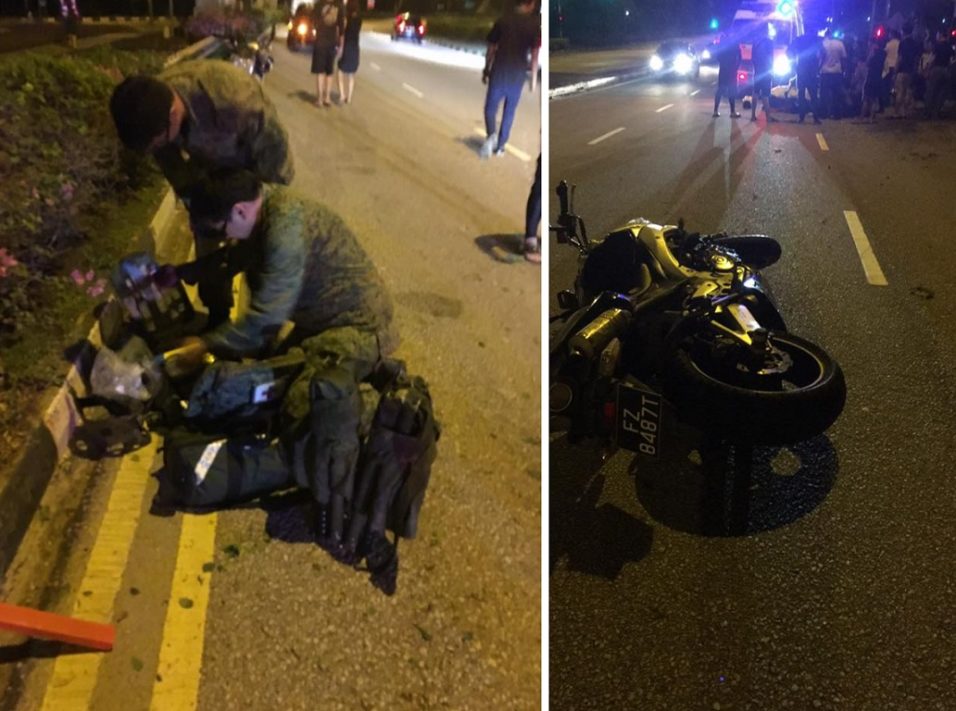
    I was about to make a turn from Mandai Road towards SLE/KJE, when I saw this happened. The time was at that moment , 11:20PM

    I came abit too late but only managed to direct traffic as the others was busy trying to keep the seriously injured rider to stay conscious.

    Amongst the many I saw around helping by are two “Abang” motorcyclists and the man of the match that caught my eye are these two Soldiers rending their aid effortlessly trying to keep the seriously injured motorcyclist stay conscious as well. They were quick to act as a paramedic before the Singapore Civil Defence Force arrived at scene to take over.

    These two soldiers tried their very best and means to keep the injured rider safe with the best of their knowledge and have came out away from their line of duty to render assistance.

    These two soldiers are the heroes not only to protect during time of war crisis (if prevail) but even at such unforseen incidents they stopped their military vehicle, and provide aid in terms of frontline medical needs to the victim.

    I’m very honored to see such acts when nobody even notice of thier presence because was too shocked to witness the victim lying down somehow motionless.

    Kudos and my sincere salute to this Men in Green for being good Samaritans as they had just completed their exercise and heading back towards Khatib Camp.

    These two NSF soldiers are

    2nd LTA Tan Hae San (AI TFC , Khatib Camp)

    LCP Chung Jing Kai (MMI, Khatib Camp)

    Please spread this message to the Singapore Armed Forces. They deserved to be commended and recognised !


    Source: Mohamed Klazick

  • SAF Tells Singaporeans To Think Twice About Using HALPS’ Concierge Services

    SAF Tells Singaporeans To Think Twice About Using HALPS’ Concierge Services

    The Singapore Armed Forces (SAF) on Friday (May 19) advised caution about a proposed new cleaning, storage and packing service for reservists, although a spokesperson for the business idea said it seeks to enhance rather than hinder operational readiness.

    Called Helping Arms in ICT’s Laundry, Packaging & Storage (HALPS), the service – conceived by a group of Operationally-Ready National Servicemen (NSmen) themselves during an in-camp training (ICT) – will work by picking up the NSman’s uniforms and equipment like field packs outside his camp on the last day of training.

    All of this will then be cleaned and stored at a warehouse before being prepared and sent for collection outside the camp gates come the next ICT.

    “It is vital for all SAF servicemen to ensure that they are operationally ready,” said the SAF’s Chief Supply Officer Colonel Terry Tan. “All SAF servicemen are responsible for the safekeeping and maintenance of their Personal Equipment (PE), and to ensure that they are able to report at the stated time to the stated location with their PE for in-camp training or when mobilised.”

    “Operationally Ready National Servicemen should consider carefully whether any third-party service provider is consistently able to deliver the agreed services on time, so that their operational readiness is maintained.”

    But earlier this week the HALPS spokesperson said: “Such ‘concierge’ services that we are aiming to provide only seeks to enhance and streamline administrative processes for our soldiers.”

    “Let’s assume a mobilisation exercise has been triggered in the middle of the day and a soldier is out from home,” he explained. “Rather than having him travel back to his home to change into his uniform and retrieve his ‘barang barang’ (Malay for personal belongings), would it be more effective if he proceeds to the camp directly, where our team will be waiting to enable his ‘transformation’ from civilian to soldier within a matter of minutes?”


    NOT MAKING ‘LESS OF SOLDIERS’

    Pricing for the service has yet to be confirmed “but should fall around the range of S$360 per annum”, said the spokesperson, adding that HALPS also “should be able to give to our clients a sizable rebate on any group signups within the same unit or camp”.

    So far, around 80 NSmen have signed up based on interest expressed over email and Facebook. Once it has a “good gauge of the demand after firming up pricings”, HALPS will be registered as a business.

    Online reactions to the service have been mixed. Said Max Li on the Facebook page of TODAY, which was first to report on HALPS: “Sign me up for this! No more stupid time wasting packing stuff you’re not going to even need in the long run. People who don’t see the benefits to this are really just unable to see how many useless things we do in the army.”

    But one Wee Teck Ong commented: “Packing and maintaining the field pack is every NSman’s personal responsibility. No one is going to help you pack your field pack when a war comes.”

    “This is wrong in every sense of the word,” said Samad Saif on Facebook. “We want our NSmen to be responsible, self-reliant, independent and capable of being organised. This is not helping but spoiling our NS men.”

    In reply, HALPS said: “Our SAF (Singapore Armed Forces) has evolved over the years. The bunch of us still remember how we had to pick up spent bullet cartridges one by one at the firing range, in the sun or rain… Nowadays, soldiers shoot in air-conditioned ranges with automated retrieval of the cartridges. Does this change make our men less of soldiers?

    “Our core services are targeted at NSmen who are, well, civilians. By taking on the administrative processes such as NS kit maintenance on their behalf, our NSmen can focus on other roles that they have to play.”


    Source: www.channelnewsasia.com

  • We Didn’t Have Willing Fighters: A WWII Survivor Remembers How Singapore Fell

    We Didn’t Have Willing Fighters: A WWII Survivor Remembers How Singapore Fell

    In Mr Ishwar Lall Singh’s Yishun home, the fragments of his military past have lost their shine. A faded peak cap sits on a worn coffee table, sharing the space with long service medals, epaulettes and an old sword caked in rust. But while parts of his uniform have faded, the 87-year-old’s memories of Singapore’s fall to the Japanese remain fresh.

    (Photo: Kenneth Lim) 

    “I was a young 12-, 13-year-old boy,” Mr Ishwar said. “There was a lot of shelling and bombing, a lot of destruction of property, a lot of people being killed – I saw some dead people, with worms crawling in them. I saw that myself.”

    Mr Ishwar is a survivor of World War II and part of a group of 61 former veterans and national servicemen who share their experiences regularly with students and active servicemen, as part of a Ministry of Defence programme. Since the programme began in early 2015, the group has reached more than 12,000 individuals, including students from more than 80 schools as well as more than 8,000 people in the Singapore Armed Forces.

    “We had to queue up for a few rations of corn bread (which was) difficult to eat, rice and some vegetables,” said Mr Ishwar. “This was given on a whim and fancy – it was not a regular thing. Sometimes we queued up and waited for the ration truck to come, and it never came.”

    But for him, the Japanese Occupation was about more than going without food.

    “We lost our independence; we were not able to do what we wanted when we wanted. We lost that,” Mr Ishwar said. “The Japanese restricted us from doing quite a lot of things. For example, if you wanted to go to a cinema, there was a fear that if you went to a cinema, you may not come back.”

    According to Mr Ishwar, Japanese soldiers would pack cinema audiences into trucks at the end of the shows, driving them to Bahar in Johor.

    Mr Ishwar showing old photos from his collection. (Photo: Kenneth Lim)

    “We were under British rule, who were not actually looking after us at that time,” he said. “The Japanese were able to force themselves into Singapore because we were not willing fighters. We did not have Singaporeans who were fighting to defend their own country.”

    But Mr Ishwar was not one of them. He joined the Indian National Army in 1943. Years later, after working as a trishaw rider, storeman and laundry clerk, he joined the Singapore Volunteer Corps, known today as the People’s Defence Force.

    “We kept growing,” he said of the Singapore Armed Forces’ predecessor. “We kept getting better, we started to build camps, we had our National Day Parades, which were very obvious to show that the people were united. We realised the importance of being a free people.”

    This year marks the 75th anniversary of Singapore’s fall. And today, the father of three and grandfather of seven said his fight is against complacency, or making sure Singaporeans do not forget “the price of freedom”.

    “I am afraid that people in Singapore are not yet aware of this – partly I blame the Government,” he said wryly. “Because we have been at peace for 50 years – that’s the Government’s efficiency, the Government’s effectiveness, but this has made people (assume) that nothing is going to happen.”

    “WE WILL HAVE TO UNITE”

    While Mr Ishwar regularly shares his story as part of the engagement programme, this is only the beginning for the retired major.

    “My hope for Singapore is that it will grow, (that) it will grow peacefully, it will be allowed to grow,” he said. “We will not be bullied, we will not accept bullying – we will have to unite.”

    He said one way to do so is to ensure racial harmony truly exists in Singapore.

    “The word ‘Singaporean’ must be understood by everybody,” he said, citing weddings or festivals as one way people of different races could get to know each other better.

    “We should look at each other as that – not as Chinese, Malay or Indian. This is something we need to understand, to raise our children to think along those lines. If we can begin to understand these things, we will begin to respect each other’s religion. We will begin to respect each other’s race; we will begin to respect each other’s doings.”

    “We must always remember that a little spark in the wrong time at the wrong place can cause a lot of problems for Singaporeans,” he added. “And we don’t want that peaceful time that we’ve had for 50 years to be shattered.”


    Source: CNA
  • Soldiers Will Be Roped In To Assist In Major Train Disruptions

    Soldiers Will Be Roped In To Assist In Major Train Disruptions

    Soldiers will be roped in as marshals to give directions to stricken commuters in the event of a massive train breakdown, The Straits Times has learnt.

    The Land Transport Authority (LTA), which is beefing up its contingency plans, has approached the Singapore Armed Forces (SAF) to explore deploying the men in green to give directions and manage crowds. They will be tapped only during large-scale disruptions.

    LTA said that personnel from the police, Public Transport Security Command (Transcom) and the Singapore Civil Defence Force are already helping LTA and the public transport operators in managing such incidents.

    An LTA spokesman told The Straits Times that it “will also work with other agencies like the Defence Ministry (Mindef) to provide additional manpower resources if necessary”.

    When contacted, Mindef confirmed the move, saying that SAF will work with LTA in the event of a major disruption, “while maintaining our primary responsibility to safeguard our security environment”.

    The latest move comes on the back of a spate of major incidents involving Singapore’s rail system.

    The most recent was the massive July 7 breakdown of the North-South and East-West MRT lines, which affected some 250,000 commuters during the peak hour.

    When trains broke down around 7pm, there were accounts of people not managing to reach home until close to midnight. Some walked all the way.

    A review was conducted in the wake of the incident, said Senior Minister of State for Transport Josephine Teo in Parliament on Monday.

    It was found that the contingency plans of rail operator SMRT were “not adequate” to handle the scale of the breakdown, she added.

    As a result, trunk bus services calling at MRT stations hit by delays or breakdowns will be ramped up to provide alternative travel options for commuters, said Mrs Teo.

    Transport expert Park Byung Joon said that tapping on the military during massive disruptions makes sense, as soldiers can be called up and deployed at short notice and “can channel commuters to the right places as quickly as possible”.

    The adjunct associate professor at SIM University said using the military as “an alternative backup manpower” during such incidents is not unheard of.

    He pointed out that some special force troops in the South Korean army learn how to operate trains, to ensure train services continue in the event of a strike by train drivers.

    Alex Yam, deputy chairman of the Government Parliamentary Committee for Defence and Foreign Affairs, said deploying SAF personnel at MRT stations is not entirely new as soldiers are already put in key installations like Jurong Island and Changi Airport to conduct patrols.

    They also have experience in crowd control during major national events like the National Day Parade.

    Mr Yam added: “Transcom already has a sizeable pool of officers, so activating military men will not be the first course of action. It is a last resort.”


    Source: http://news.asiaone.com