Tag: sovereignty

  • China Wants This Malaysian Port To Rival Singapore

    China Wants This Malaysian Port To Rival Singapore

    The Straits of Malacca have been a gateway for China for centuries in its quest for power.

    A story blended from Malaysian history and folklore says an emperor sent a princess called Hang Li Poto marry the Sultan of Malacca in the Ming Dynasty, offering a ship filled with gold needles. He also sent a blunt message. “For every gold needle, there is a subject. If you can count the number of needles, you will learn the true extent of my power”, the emperor reportedly said in a letter.

    Hundreds of years later, China is again seeking influence in Malaysia as it spreads its economic and military clout through South-east Asia. It is investing billions in a US$7.2 billion (S$9.8 billion) redevelopment that will see Malacca, long the haunt of Chinese traders, become a new deep sea port.

    It is also providing funds for infrastructure projects down the eastern seaboard of Malaysia, key heartland areas for Prime Minister Najib Razak ahead of an election that could be held this year. New roads and bridges may help him woo ethnic Malays, but the money could come at a long-term cost.

    “The closeness with China is an Achilles heel for Najib,” said Dr Mustafa Izzuddin, a fellow at the ISEAS-Yusof Ishak Institute in Singapore. “While investment coming in will balloon government coffers and boost the economy, the opposition is using the China card to criticise the government for becoming too close to China and accusing it of selling Malaysia’s sovereignty.”

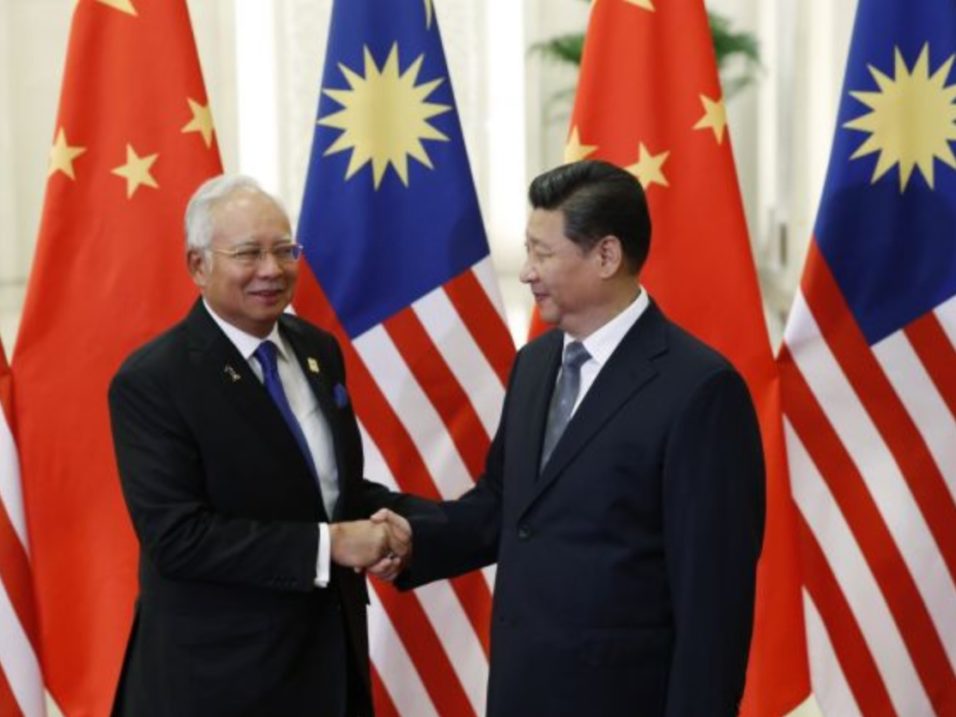
    China’s investment in Malaysia has risen since Mr Xi Jinping took power in 2012, with the president describing ties with Mr Najib as the “best ever”. Beijing is readying a state visit by Mr Xi to Malaysia in the coming months, according to three people with knowledge of the plans who asked not to be identified given the sensitivity of the discussions.

    China has committed to import goods worth US$2 trillion from Malaysia over the next five years (a nearly eight-fold jump from 2016 imports over that period), invest up to US$150 billion in the country and offer 10,000 places for training in China.

    Mr Najib brought home US$33.6 billion in deals when he visited China in November — the biggest haul yet between the countries — plus an agreement to buy four patrol boats from China.

    China has been Malaysia’s largest trading partner since 2009, displacing Singapore, with two-way trade last year valued at US$83.4 billion. China is Malaysia’s biggest export market.

    Malaysia, like Singapore, has strong historical links to China. About a quarter of its population is ethnically Chinese, and traders for centuries stopped at ports in Malacca and Penang to sell silk, tea and porcelain while buying cinnamon and nutmeg. There is even a fusion cuisine based on Chinese and Malay ingredients, called Peranakan or Nyonya.

    Chinese companies accounted for 8 billion yuan (S$1.6 billion) in construction projects in Malaysia in 2015, DBS analyst Chong Tjen-San said in an April report — nearly half the total value of projects clinched by foreign contractors.

    “We are going to be drawn into the economic gravity of China,” said Mr Steven CM Wong, deputy chief executive of the Institute of Strategic and International Studies Malaysia, at a conference on Mr Xi’s Belt-and-Road trade project in Kuala Lumpur last month. “Just as if you are in North America, you are drawn into the economic gravity of the United States,” he said. “This is not what we want or we don’t want. It’s just the way things are.”

    Still, the money risks being caught up in domestic politics. Mr Najib’s critics, including former premier-turned-opposition leader Mahathir Mohamad, say the country will need to cede influence to China in exchange for its money, and that local businesses will lose out.

    “Much of the most valuable land will now be owned and occupied by foreigners,” Dr Mahathir wrote on his blog in January. “In effect they will become foreign land.”

    Mr Najib, in an article published in May in the South China Morning Post before a visit to China, said that he made “no apologies for wanting to build world-class infrastructure for Malaysia that will, with local ownership being preserved, open up huge swathes of our country”. His office did not respond to requests for comment.

    Some analysts said Najib risks being painted as too close to China. While the countries both claim parts of the disputed South China Sea, for example, Malaysia has been mostly quiet on China’s military build up in the region.

    “There are perceptions that Najib is being bought by the Chinese,” said Professor Bridget Welsh, a political scientist at John Cabot University in Rome and author of The End of UMNO? Essays on Malaysia’s Dominant Party.

    “Within Malaysia, China’s interventions have the potential to bring about greater ethnic tensions and political instability, as well as affect Malaysia’s relationships with its neighbours,” she said.

    The Malacca Strait already has sufficient port facilities, according to opposition Selangor state legislator Teng Chang Khim. “Why can’t you make use of the present ports?” Mr Teng said at the Belt-and-Road conference.

    Deputy Secretary General for Trade Isham Ishak said the government would seek to balance its relationship with China.

    “We want to make sure that there’s fair value in terms of investments from China into Malaysia,” he said at the same conference. “It’s not only about Chinese products coming in, Chinese money coming in, and Chinese foreign workers coming in.”

    Investment in infrastructure is good for Malaysia whether it comes from China or the US, according to Mr Xu Bu, China’s ambassador to the Association of South-east Asian Nations.

    “Whoever comes to power that really doesn’t matter,” he said in a July interview. “Whoever comes to power in Malaysia, the leaders or the people in Malaysia they need investment.”

    Mr Harrison Cheng, a senior analyst with Control Risks in Singapore, said there were signs of unease in some quarters of Mr Najib’s United Malays National Organisation about Chinese investments.

    Still, UMNO’s core voters are more interested in bread-and-butter issues, he said. “There has yet to be any strong signs of a serious backlash within UMNO and the public.”


    Source: http://www.todayonline.com

  • Revealed: Malaysia “New Evidence” In Pedra Branca Row Against Singapore

    Revealed: Malaysia “New Evidence” In Pedra Branca Row Against Singapore

    Malaysia’s “new evidence” that it has sovereignty – and not its southern neighbour Singapore – over the rocky outcrop called Pedra Branca comprise a letter by Singapore’s top colonial official in 1958, a naval incident report the same year, and a map of the Lion City in 1966, This Week in Asia has learnt.

    These three documents would likely overturn the decision by the International Court of Justice in 2008 to award sovereignty to the disputed island to Singapore, Malaysia claimed in court documents filed on February 3.

    “This application is not an appeal against the 2008 judgment. On the contrary, it draws to the court’s attention what has only recently become known to Malaysia, namely, that even after the 1953 correspondence, and at a point at which Singapore had become a self-governing colonial territory, Singapore, at the highest levels of its government, did not have the view that it had sovereignty over Pedra Branca/Pulau Batu Puteh,” said court documents seen by This Week in Asia.

    “Singapore subsequently carried this appreciation into its federation as part of Malaysia in 1963, and, as it necessarily follows, that appreciation remained controlling on Singapore’s independence in 1965,” the documents said.

    “It is Malaysia’s contention, informed by a close reading of the judgment in 2008 and its accompanying opinions, that the court would have been bound to reach a different conclusion on the question of sovereignty over Pedra Branca had it been aware of this new evidence.”

    Malaysia on February 3 filed for a revision to the International Court of Justice’s ruling in 2008 that the isle of Pedra Branca, a football-field sized rocky outcrop, belongs to Singapore.


    Source: www.scmp.com


  • Sovereignty And Loyalty In Malay Governance

    Sovereignty And Loyalty In Malay Governance

    As previously discussed, the Malay concept of citizenship/ subject is based on participation within a society and allegiance to a ruler. The concept of land and country is secondary (and almost alien for the latter).

    When someone migrates to the Alam Melayu, whether internally (such as from Sulawesi to Sumatra) or externally (GuangZhou to Singapura), their migration is understood as an application to be a part of the Malay society, acceptance of Malay customs and laws and allegiance to the Malay ruler.

    Sovereignty then, is not vested in the land or country, but with the Malay ruler. In Malay, sovereignty is understood through the concept of daulat.

    Daulat can be described as sovereignty with a supernaturally imbued character (Soenarno, 1960, p. 1).

    The recognition of the ruler’s daulat and the model of the Malay-ruler relationship is probably found in the sumpah (oath) between Sri Tri Buana and Demang Lebar Daun.

    Demang Lebar Daun, who became the father in law to Sri Tri Buana committed his service and those of his descendants to Sri Tri Buana and his successors. In return, he requested his ruler to treat them fairly and even if they were to commit grave error and receive the capital punishment, to not humiliate them:

    “Tuanku, segala anak cucu patek sedia akan jadi hambalah ke bawah Duli Yang Dipertuan; hendaklah ia diperbaiki oleh anak cucu tuanhamba. Syahadan jika ia berdosa sebesar-besar dosanya sekali pun, jangan ia difadhihatkan dan dinista dengan kata yang jahat jahat; jikalau besar dosanya dibunuh, itu pun jikalau patut pada hukum Syar’a”

    Sri Tri Buana accepted Demang lebar Daun’s request and in return asked for loyalty from Demang Lebar Daun’s descendants even when their King is oppressive and cruel:

    “hendaklah pada akhir zaman kelak anak cucu bapa jangan durhaka pada anak cucu hamba,jikalau ia zalim dan jahat pekertinya sekalipun”

    Both of them agreed to the conditions and made an oath that if either of them breaks the agreement, may Allah destroy their households.

    “Maka keduanya pun bersumpah-sumpahanlah, barang siapa mengubahkan perjanjiannya itu dibalik Allah subhanahu wa ta’ala bubungan rumahnya ke bawah kaki tiangnya ke atas. Itulah sebabnya maka dianugerahkan Allah subhanahu wata’ala kepada segala raja-raja Melayu: jikalau sebagaimana sekali pun besar dosanya, tiada diikatnya dan digantungnya dan difadhihatkannya dengan kata yang jahat. Jikalau ada seorang raja memberi ‘aib (seorang hamba Melayu) itu alamat negerinya akan dibinasakan Allah subhanahu wa ta’ala.”(Windsted, 1938)

    Relationship between ruler and subject

    The responsibility of the subject, who bears allegiance to his ruler, is to obey regardless whether it serves his interests, whether he agrees with his ruler’s decision or whether he find it oppressive. A subject cannot agree to act when it benefits him or reject his ruler when he disagrees.

    For the ruler, he commits to treat his subjects with grace and not to humiliate them.

    The only higher law that the Malays refer to, is the Hukum Syara’ or the Syariah.

    In discussing the relationship between the ruler and the people, Kratz notes:

    we find that the ruler, important as he may be, is nothing without a people, and that it is the people and their traditional leader(s) who choose their ruler, and who decide freely to whom they want to offer their total obedience…

    loyalty and respect are qualities which have to work in both directions, to and from the ruler, in order to affect positively the well-being of state and society. (1993, pp. 76-77)

    References:

    Kratz, E. U. (1993). Durhaka: The concept of treason in the Malay” Hikayat Hang Tuah”. South East Asia Research, 68-97.

    Soenarno, R. (1960). Malay Nationalism, 1896–1941. Journal of Southeast Asian History, 1(01), 1-28.

    Windsted, R. O. “The date, author and identity of the original draft of the Malay Annals.” Journal of the Malayan Branch Royal Asiatic Society 16.part 3 (1938): 27-34.


    Source: Almakhazin SG

  • Indonesia Prepared To Return Australia Tsunami Aid

    Indonesia Prepared To Return Australia Tsunami Aid

    Jakarta. Vice President Jusuf Kalla said on Monday that Indonesia was prepared to return the $1 billion in aid that Australia provided following the 2004 Boxing Day Tsunami.

    The comments were in response to a reminder from Australia’s Prime Minister Tony Abbott, who last week mentioned the relief when making a plea for two Australian drug traffickers on death row in Indonesia.

    “I have explained that we understood during the tsunami, there was humanitarian aid from 56 countries, including from Australia,” Kalla said on Monday. “If it was not considered humanitarian aid, we will return it.”

    Abbot’s comments have struck a raw nerve with many Indonesians, and in some major cities protests and theatrical coin collections have started.

    Twitter and Facebook have been flooded with messages under the hashtag #CoinsFor Australia — a campaign to repay Australia and a demand its neighbor respect Indonesia’s legal system.

    Since making the comments, Abbot has claimed they were not a threat but instead the aid referred to the strength of the two countries’ bilateral relations.

    Kalla said he had been communicating with Australian Foreign Minister Julie Bishop and he had explained that the execution of Australians Myuran Sukumaran and Andrew Chan — ringleaders of the so-called Bali Nine heroin trafficking group — was not a decision made solely by President Joko Widodo.

    “She appreciated the explanation. She understands Indonesian law and I have told her it wasn’t the president who decided on the death penalty but an independent and objective court,” Kalla said.

    Sukumaran, 33, and Chan, 31, were caught trying to smuggle heroin out of Bali in 2005. They are among the next group of inmates to be executed by a firing squad.


    Source: http://thejakartaglobe.beritasatu.com

  • Ambassador-At-Large: Being Small Is A Problem For Singapore

    Ambassador-At-Large: Being Small Is A Problem For Singapore

    In a speech at the Institute of Policy Studies’ annual Singapore Perspectives conference on Monday (Jan 26), Mr Bilahari Kausikan, Ambassador-at-Large and former permanent secretary at the Ministry of Foreign Affairs, explained why being a small country in South-east Asia is not as simple as it sounds for Singapore.

    Mr Kausikan’s full speech is below:

    What does “sovereignty” mean to a small country such as Singapore? We did not seek independence, but had independence thrust upon us. I have been told that Mr Lee Kuan Yew once said “small island states are a political joke”.

    I cannot trace the source of that quote and if anyone can help I would be very grateful. But even if apocryphal, it implies a concept of sovereignty based on which our founding fathers sought independence within Malaysia rather than alone.

    I suspect it was difficult for that generation to even conceive of Singapore apart from what was then called Malaya. Obviously, and thankfully, that concept of sovereignty proved mistaken or was rendered mistaken by the Herculean efforts of our pioneer generation.

    The concept of sovereignty is constantly evolving. Rather than try to define the elephant, I propose to take its existence for granted and instead consider what sovereignty means to Singapore by deconstructing a single sentence: “Singapore is a small state located in South-east Asia.”

    This seems straightforward, but is it really? What do we mean by “small”? We are, of course, a physically small country. A moderately athletic person could without too much difficulty walk across it in a day. But as a trading centre, as a logistics hub, as a port and airport and as a financial centre we are far from “small”. In trade, connectivity and finance, among others, we loom quite large internationally, far larger than our physical size may lead one to expect.

    Sir Stamford Raffles established modern Singapore as a trading centre in 1819. Some recent archaeological studies suggest we may have been a significant trading centre since the 14th century, even before the concept of sovereignty in its current form existed.

    Trade requires connectivity, logistics and finance. Of course, we today perform these functions at a far higher level of sophistication and complexity than in the past. But the point is that they are essentially similar functions and we have performed them as a British colony, as part of Malaysia and only in the past 50 years — which is but the blink of an eyelid in the sweep of history — as a sovereign and independent country.

    There is, therefore, no reason to assume that sovereignty and independence are necessary conditions for us to perform such functions. We could conceivably do so even if our independence and sovereignty comes, by some blunder of policy, accident of politics or malicious whim of the gods, to be severely compromised.

    SIZE MATTERS

    Size — physical size — matters and small states are intrinsically irrelevant to the workings of the international system. It is impossible to conceive of a world without large countries such as the United States, China, India, Indonesia, Brazil or Russia, or even without medium-sized states such as Australia, Japan, France or Germany.

    But the world will probably get along fine without Singapore as a sovereign and independent country. After all, it has only had to put up with us for 50 years. For small states, relevance is not something to be taken for granted, but an artefact — created by human endeavour, and having been created, preserved by human endeavour. The creation and maintenance of relevance must be the over-arching strategic objective of small states.

    The majority of states are small. Slightly more than two decades ago, Singapore established the Forum of Small States (FOSS) at the United Nations; “small” being somewhat arbitrarily defined as having a population of 10 million or less. It now has 105 members out of a total UN membership of 193 states. The international relevance of many members of FOSS is defined primarily by their vote in the UN. A vote in the UN is only that; not to be sneezed at, but still only one vote. Singapore is exceptional as a small country in that our international identity and relevance is something more than only our UN vote. We have options beyond our single UN vote and that is why we were able to establish FOSS in the first place.

    How do we create relevance? There is no magic formula. What makes us relevant vis-a-vis country A may be irrelevant vis-a-vis country B and, in any case, may become irrelevant to both A and B as well as C in a week or a month or a year or a decade. What is relevant will eventually become irrelevant and must therefore be continually refreshed.

    The world is constantly changing and since the world will not change to suit our conveniences, we will have to constantly adapt to it. Since the future is unknowable, adaptation requires nimbleness of thought and action; and thought and action based on a clinical — some say cold-blooded — understanding of the world as it is and not as we think it ought to be. Even if we hope to change the world we must first understand it as it is because hope, however fervent, is never enough.

    The bedrock of relevance is success. I have always told our foreign service officers that if Singapore’s foreign policy has been successful, it is not because of their good looks, natural charm or the genius of their intellect; the most brilliant idea of a small country can be safely disregarded if inconvenient, whereas the stupidest idea of a large country must be taken seriously. In fact, the stupider the idea the more seriously it must be taken because of the harm a large country can do. If we succeed, it is only because Singapore as a country is successful. Singapore’s success invests our ideas and actions with credibility.

    Success must be defined first of all in economic terms. Will a barren rock ever be taken seriously? I know that it has become fashionable in certain circles to claim that economic success is not everything and that there are other worthy goals in life. I do not disagree as far as individuals are concerned. If any of our compatriots chooses to drop out of the rat race and devote his or her life to art or music or religion or even to just lepak (relax) in one corner, I respect their choice and wish them well.

    But the country as a whole does not have this luxury. A world of sovereign states is in fact a rat race, and often a vicious one, in which the weak go to the wall. There can be no opting out for a sovereign state. And to be crass about it, small countries will always have fewer options than large countries, but rich small countries have more options than poor small countries and that tilts the scales in our favour.

    This is crucial because a small state cannot be only ordinarily successful. If we were no different from our neighbourhood, why should anyone want to deal with us rather than our larger neighbours who, moreover, are well endowed with natural resources? To be relevant, we have to be extraordinary. Being extraordinary is a strategic imperative.

    LOCATION MATTERS

    And that brings me to the second part of the sentence with which I began. Singapore is not just a small country, but a small country in South-east Asia; not the South Pacific or South America or Europe or, thankfully, the Middle East. This seems obvious, but I think is nevertheless insufficiently appreciated, even by those who ought to know better.

    A year or so ago, I was flabbergasted and disturbed when asked — asked in all seriousness and not only to take the mickey out of me, which would have been acceptable — by a Singaporean PhD candidate in political science, why Singapore could not pursue a foreign policy akin to that of Denmark or Switzerland. The question aroused all my prejudices about the academic study of international relations. It makes a vast, and I thought, glaringly obvious difference where a country is situated. That a Singaporean PhD candidate, who presumably knew something about her own country as well as the subject she was studying, could ask such a question made me worry about the future of our country.

    South-east Asia is not a natural region, by which I mean a region that can be defined by something intrinsic to itself, as, for example, Europe can be defined as heir to Christendom and the Roman Empire. The main characteristic of South-east Asia is diversity, which is another way of saying that there is nothing intrinsic to it.

    There are obvious differences of political form and levels of economic development. But the most important diversities of South-east Asia are visceral: Diversities of race, language and religion. These are the roots of political tensions within and between the countries of South-east Asia.

    The Association of South-east Asian Nations (ASEAN) was intended, among other things, to mitigate these diversities to ensure a modicum of order and civility in inter-state relationships in a region where this was not to be taken for granted. ASEAN has been reasonably successful. But ASEAN can never entirely erase these primordial diversities because race, language and religion are the essence of core identities.

    WHAT MAKES SINGAPORE, SINGAPORE?

    Singapore defines itself as a multiracial meritocracy and we organise ourselves on the basis of these principles. We are not perfect — there is no perfection to be found this side of heaven — but we take these principles seriously. They are what make Singapore Singapore. They also make us extraordinary because our neighbours organise themselves on the basis of very different principles.

    This is most obvious in the case of Malaysia. It was the irreconcilable contradiction between fundamentally different political philosophies that made it impossible for us to remain in Malaysia and, no matter how closely we cooperate — and despite occasional spats, we do cooperate very closely in many areas — will make it impossible for us to ever be part of Malaysia again unless Malaysia abandons its basic organising principle. And if you believe that will happen, there is a bridge I can let you have really cheap.

    The essential issue is existential; not what we do, but what we are: A Chinese-majority country with neighbours whose own Chinese populations are typically a less-than-fully-welcome minority and whose attitudes towards their own Chinese populations are too often projected upon us.

    A Chinese-majority multiracial meritocracy that has been extraordinarily successful compared with its neighbours is often taken as an implicit criticism of differently-organised systems. That we are a tiny speck on the map and have hardly any history to speak of is an additional affront.

    The intensity of such attitudes waxes and wanes; it manifests itself in different ways, at different times. But it never disappears, because it is the structural consequence of the dynamic between two types of systems. Being extraordinary does not make us loved, but it is the price we must pay for survival and autonomy.

    In different forms and various degrees, such attitudes exist throughout South-east Asia, and in China, Japan and even in Western countries such as Australia and the US. Examples spring to mind all too readily, but diplomatic prudence does not permit me to elaborate.

    Of course, none of this is intended to imply that we cannot work with our neighbours or any other country; obviously we must, obviously we can and obviously we do and indeed, I dare say, we do so quite well. But these complexities are never going to go away and we ignore or deny them only at peril of compromising our autonomy, that is to say, our sovereignty.

    I believe that matters are going to get even more complicated because the external environment and our domestic environment are both changing, and external and internal complexities will act and react with each other in ways that cannot now be predicted.

    There are already signs of foreign policy being used for partisan political purposes. This is probably inevitable. Domestic debates over foreign policy are not necessarily a bad thing provided they take place within parameters defined by shared assumptions. Otherwise, it is playing with fire. At the very least, it degrades the nimbleness of our responses if we have to argue everything out anew from first principles.

    MORE CRITICAL THINKING NEEDED

    Shared assumptions come naturally, almost unconsciously, to countries with long histories. But with only 50 years of shared history, I am not entirely confident that this is the case in Singapore. There is something of an intellectual vacuum that is being largely filled by nonsense.

    We need to be better at educating ourselves about our own history. We do not, in my opinion, do a good enough job and the recent debates about our own political history are, unfortunately, notable only for their utter vacuity.

    What passes for critical thinking about our history is too often simply crying white if the establishment should say black. And social media exacerbates the situation by conflating information with opinion and treating both as entertainment.

    As our domestic political environment becomes more complex with not only traditional political parties, but civil society organisations and advocacy groups contending in the policy space, opportunities for external influence will multiply.

    Since the beginning of recorded history, states have always tried to influence each other, sometimes by covert means, but also legitimately and openly through diplomacy. The lines are not always clear and likely to get even more blurred. The enthusiasms of some, mainly Western, diplomats to whip the heathen along the path of righteousness have already occasionally led them to cross the boundaries of legitimate diplomatic activity.

    More fundamentally, market forces are creating economic spaces that transcend national boundaries, most notably between China and South-east Asia. This is to be welcomed on economic grounds, but will have political and strategic consequences. It is redefining Westphalian notions of “state” and interstate relations and is stressing ASEAN as powerful centrifugal forces pull members in different directions.

    As the only Chinese-majority country in South-east Asia, it could pose special challenges for Singapore. Already, Chinese diplomats and officials too often refer to Singapore as a “Chinese country”. We politely, but firmly, tell them that they are mistaken. And we will continue to do so. But the implications are worth pondering.
     

    Source: www.channelnewsasia.com