Tag: Special needs

  • Life After Graduation: Special Education Students At Work

    Life After Graduation: Special Education Students At Work

    “Faiz, can you pack all these things into a box and seal it?” asked Mark Maranan, lead cook at the central kitchen of restaurant chain Han’s central kitchen.

    Faiz Muhsin nodded. “One, two, three…,” the 20-year-old started counting while packing the items.

    The task may seem easy to most people, but for Faiz, who has a moderate to severe intellectual disability, it can be quite daunting.

    Faiz has been working at Han’s central kitchen for almost two years. In his final year at the Movement for the Intellectually Disabled of Singapore (Minds) in 2014, Faiz joined the School-to-Work (S2W) Transition Programme which prepares students with special needs to enter the workforce.

    Under the programme, Faiz was trained for about two months by SG Enable – an agency that helps people with disabilities – before he was deployed to Han’s for a nine-month internship.

    After the internship, he was offered a part-time position as a packer at the food and beverage chain. To help Faiz assimilate into the work environment, his supervisor Mr Maranan informed the team about his condition and they accommodated his working style.

    “He’s a quiet person so we need to adjust the way we communicate with him. We need to talk to him a bit slowly and we need to say it in short sentences so he can easily understand what we want him to do,” said Mr Maranan, who also described Faiz as a hardworking person who would often ask questions about his job.

    “Faiz can communicate quite well. Sometimes we also have lunch together. He’s like an ordinary person to me,” he said.

    Faiz’s job scope has also been expanded: He now helps out at the central kitchen, counting and marinating raw pieces of fish or chicken as part of the food preparation process.

    “I like my job. Free lunch, earn money. They (colleagues) are very fun,” Faiz said with a wide grin on his face.

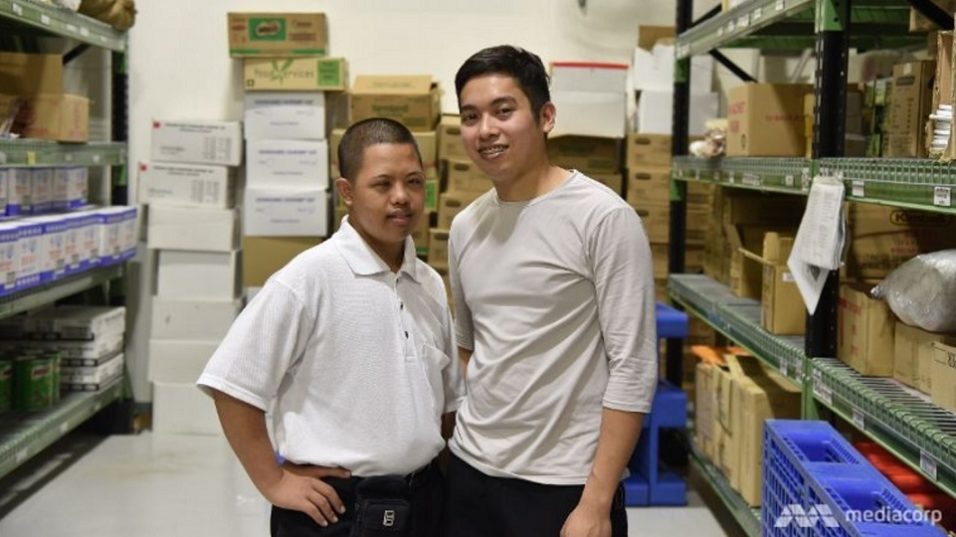
    Faiz’ job scope has been expanded and he is now helping out with the food preparation process. (Photo: Lim Jia Qi)

    Others have not been as fortunate as Faiz. For Grace Cho, who has autism spectrum disorder (ASD) – a condition which hinders communication and interaction with people – there were difficulties in getting along with her co-workers.

    The challenge for the 28-year-old was not about finding for a job, but keeping one.

    After graduating from Mountbatten Vocational School in 2007, Grace took on several jobs before she was referred by an organisation that provides employment services for people with disabilities to work as a vegetable packer at a logistics company.

    Getting along with her co-workers at the company was not easy as she would often be scolded for not being fast enough on her job.

    “There were a lot of vegetables coming in and they (co-workers) started to rush for that. When it got jammed up, the vegetables dropped onto the floor … I was focusing on packing and sealing and I didn’t pick them up. Some of them said to me ‘You didn’t stop and help us pick up, you are not very good’,” Grace recounted.

    “I felt angry. I pushed the boxes and they dropped onto the floor. But they (co-workers) kept repeating that they had enough,” she said.

    Grace eventually left the job after less than a year. Her next job as a packer at a pharmaceutical company did not go well either as she was not clear about the workflow. “I got more things to pack. I don’t have a schedule and I didn’t know which one to do. I got confused,” she said.

    With her mother’s encouragement, Grace sought help from the Autism Resource Centre’s Employability and Employment Centre and she is currently working as a packer at The Green Corridor, where fresh fruits are processed and packaged for the supermarkets in Singapore.

    28-year-old Grace Cho took on several jobs before seeking help at Autism Resource Centre’s Employability and Employment Centre. (Photo: Lim Jia Qi)

    According to the Ministry of Education (MOE), about 300 students graduate from Special Education (SPED) schools each year. About 1 in 3 from each cohort went on to work in different industries including retail, hospitality, medical services as well as food and beverage.

    To help Singaporeans with special needs find employment, MOE has put in place various measures to prepare students in SPED schools for employment.

    These include having a framework for vocational education that guides SPED schools to develop a structured curriculum to help students with special needs gain employable skills.

    Students who obtained either the ITE Skills Certification at Metta School or Workforce Skills Qualification at Delta Senior School may apply for jobs in the open market or attend further training if they meet the pre-requisites for the courses, said MOE.

    President of the Autism Resource Centre Denise Phua said one of the reasons that adults with autism are not able to hold down a job for long could be because many of them were never exposed to the culture of work and what is expected on the job.

    “It is only in recent years that the quality of early intervention and education of students with autism is raised,” said Ms Phua, who is also a Member of Parliament.

    Another reason could also be due to low awareness among employers to put in place autism-friendly worksites, she added.

    While Ms Phua noted that employers have greater awareness than before and the emergence of more dedicated agencies to support people with special needs, more can be done to improve the current situation.

    “It’s about showing models, systems, possibilities and success that employment and work can be done for people with ASD,” she said.

    “It’s also about educating people and employers that there are different models of employment. For example, part time is one of the viable ways for people with special needs to be employed.”

    For Grace, she has been working at The Green Corridor for more than a year. Besides having a job coach onsite to guide her, there are also visual instructions and communication scripts to help her work independently.

    Grace working with her job coach at The Green Corridor located at the Enabling Village. (Photo: Lim Jia Qi)

    “The task that I was given I did it independently. I’m also following given schedule without someone telling me what to do next. I’m happy,” she said.


    Source: CNA

  • Guru Tarik Rambut Pelajar Berkeperluan Khas, Seretnya Di Lantai

    Guru Tarik Rambut Pelajar Berkeperluan Khas, Seretnya Di Lantai

    Seorang guru dilihat menghimpit pelajarnya yang berkeperluan khas ke lantai, menarik rambutnya dan mengheretnya, dalam sebuah video yang dimuat naik ke Facebook.

    Sebuah lagi video yang turut dirakamkan oleh telefon bimbit itu juga menunjukkan guru terbabit, Linda Winters-Johnson, 53 tahun, memukul kepala pelajar perempuan itu dengan termos, lapor Huffington Post.

    Menurut WAPT Channel 16, insiden itu berlaku di Sekolah Tinggi Greenville di Mississippi pada 21 September lalu.

    THIS SHIT JUST PISSED ME OFF THE CHILDREN T GREENVILLE HIGH CAUGHT ONE OF THE SPECIAL NEED STUDENTS GETTING TREATED LIKE THIS YALL SHARE SHE NEED TO BE FIRED licensing@viralhog. com

    Posted by Kesha Williams on Thursday, 6 October 2016

    DIPECAT, DIARAH KE MAHKAMAH

    Winters-Johnson dilaporkan sudah dipecat dari jawatannya sebagai guru pelajar berkeperluan khas pada 17 Oktober.

    Menurut Peguam Negara Daerah Washington DeWayne Richardson, Winters-Johnson sudah dikenakan dakwaan mendera seorang yang lemah dan diarahkan menghadap mahkamah untuk dibicarakan.

    SUPERINTENDAN “TIDAK BERTERUS TERANG TENTANG INSIDEN”

    Sementara itu, lembaga sekolah itu dikatakan mengambil tindakan disiplin terhadap seorang lagi kakitangan, sementara Superintendan Sekolah-Sekolah Awam Greenville, Leeson Taylor II ,diarahkan mengambil cuti berbayar.

    Menurut Associated Press, para pegawai lembaga sekolah itu berkata Taylor tidak berterus terang tentang betapa dahsyatnya insiden tersebut.

    “Kami mendapat notis, namun lembaga tidak diberitahu tentang betapa teruknya insiden itu. Ini sehinggalah video itu tersebar di Facebook,” kata Presiden Lembaga, Loretta Shannon kepada AP.

    Jabatan Pendidikan Mississippi kini dalam proses untuk melucutkan lesen guru Winters-Johnson, menurut Huffington Post.

    Winters-Johnson belum ditangkap dan dijadualkan dihadapkan ke mahkamah pada 13 Disember.

    Jika didapati bersalah mendera individu yang lemah, dia boleh dipenjara sehingga setahun dan didenda sehingga AS$1,000 (S$1,430).

    Source: Berita MediaCorp

  • Son Inspired Mother To Start Special Needs School

    Son Inspired Mother To Start Special Needs School

    Her own experience gave her the drive to help others.

    In 2003, Madam Faraliza Zainal’s firstborn was diagnosed with Asperger syndrome, a form of autism.

    Her son Mohd Ashraf Mohd Ali was three.

    For Madam Faraliza, as with the many other caregivers in her shoes, it was the start of a journey of ups and downs, especially when it came to her son interacting with other people.

    Madam Faraliza told The New Paper of a hurtful incident when her son was six.

    The Cast of Redha Visit MIJ Education Hub

    He had disturbed another child during a visit to the zoo.

    Madam Faraliza, 45, recalled: “The father told me angrily, ‘Can you teach your son some manners?’

    “That was extremely upsetting.”

    Madam Faraliza admitted that the early days were tough for her and her husband.

    During an MP home visit in 2006, Mohd Ashraf spat at the MP.

    But raising a child with autism led Madam Faraliza to realise the importance of education specifically tailored for children with special needs.

    She left her high-flying job with Dow Jones in 2011 to set up My Islamic Journey Education Hub (MIJ).

    It started as a weekend madrasah for students with special needs, aged between five and 30.

    POPULAR

    The school proved popular and it began a full-time English-language holistic programme last year, combining religious education with numeracy, literacy and life skills.

    The weekday programme is endorsed by the Singapore Islamic Scholars & Religious Teachers Association, and it caters to students aged between 17 and 30.

    Before founding MIJ, Madam Faraliza earned an advanced diploma in special needs education, became a certified play therapist, and researched other methods of therapy.

    “Being a mother of an autistic child helps because you need hands-on experience,” said Madam Faraliza, who also provides on-the-job training fir her five full-time teachers and 19 part-time teachers.

    Her son is among those enrolled. They include students with Down syndrome, dyslexia, and attention deficit hyperactivity disorder.

    The school now has 180 students.

    Lessons at MIJ take a more practical approach.

    “We take them to the supermarket and give them a list of things to purchase. They also carry calculators with them to calculate the price,” said Madam Faraliza.

    Other activities include baking, gardening and even self-defence lessons, courtesy of a mixed martial arts studio.

    For MIJ’s special educators, such as Miss Nur Faezah Misngadi, 25, shaping the minds of the students every day is not an easy feat and requires plenty of patience.

    “We need support from all facets of society. There is always talk of help for those with special needs, but how exactly are you helping them? You need to walk the talk,” she said.


    Source: www.tnp.sg

  • SDP Wants Public To Accept Apology From CPF Protesters

    SDP Wants Public To Accept Apology From CPF Protesters

    jufrie12e

    Roy has asked to meet with the children and parents to apologise to them. This is the right thing to do.

    I met Roy several weeks ago. He is a thoughtful individual and no one should believe that he intentionally targeted his or the group’s actions at the children who were performing that afternoon.

    It is important, nevertheless, that both he and Hui Hui offer an apology to the children.

    The danger is that those who are angered by the episode but who, otherwise, would support the Return Our CPF campaign, unwittingly reinforce a culture intolerant of mistakes.

    Throwing labels like “immature”, “inexcusable”, “attention seekers” at the protesters is unhelpful. For even the most experienced activists spend a lifetime making errors and learning from them. Gandhi, himself not immune to mistakes, acknowledged: “Freedom is not worth having if it does not include the freedom to make mistakes.”

    In this vein, let us re-affirm our faith in Roy and Hui Hui as well as in ourselves, who, with all our imperfections and weaknesses, continue to learn and grow in our journey to make our Republic a better place.

    Authored by: Chee Soon Juan

  • Roy Ngerng and Han Hui Hui Are Anarchists, Visceral and Vicious Towards Special Needs Children

    Roy Ngerng and Han Hui Hui Are Anarchists, Visceral and Vicious Towards Special Needs Children

    roy ngerng

    ST photo Roy Ngerng Han Hui Hui heckle special needs kids

    The actions of the ‘activists’ at Hong Lim Park on Saturday betray the anarchic nature of their cause and the demagogic character of the individual actors.

    The anger with which Roy Ngerng and Han Hui Hui spoke was visceral and vicious. What cause have they to speak so incensed? What gross injury is being done to them? One can hold different views on important issues but there are mature and peaceful ways to communicate and debate them.

    Instead these self-styled “champions of the people” choose confrontational methods which play on the emotions surrounding hot button issues. They blow things out of proportion and seek to provide legitimacy for themselves and their cause through “victim-seeking” tactics.

    Their actions to disrupt the YMCA event speak to self-indulgence, social carelessness, immaturity and this is ironical, a disregard for the rights and concerns of other Singaporeans especially those in genuine need.

    But that is not what is fundamentally egregious about these political provocateurs. This is that they are possessed of a mind-set framed by two self-reinforcing features.

    First, the view that Singapore and specifically, its governance, is a grand conspiracy. Everything about the government and all events are construed as being part of a system of control. All and any action but anyone who differs from their extreme views is treated as a co-conspirator. It is this mind-set that explains how they could perceive an event to raise awareness and support for children with special needs as a power-play to stymie their protest.

    Second, they seem to believe, and waive dubious charts and circular arguments to the effect, that they possess some special insight into the truth about public policies. The simplistic and even silly interpretations of complex policy issues makes the propositions of these provocateurs superficially attractive. Instead that they reveal is that the output of being uninformed and uneducated is the conviction that simple straw man arguments have credence because they are asymmetrical to matters which have innate complexity.

    These two mental qualities play into each other into a simple set of motives. First that the government is out to cheat the people. Second, that foreigners are a source of evil. Third, that our social challenges are easy to solve. Fourth, confrontation is the best mode of advocacy.Tools

    Each and everyone of these motives are a nonsense and the twinned frames which make up their mind-set are shoddy construct made up of intellectual drift-wood held together by the creeper vine of ignorance.

    The failure of the official opposition to date to take a strong stand on the behaviour of these provocateurs is reprehensible. But this failure would be a shared one by all reasonable Singaporeans if we do not now take a stand to condemn these provocateurs, see them for what they are – anarchists, and insist on ejecting them from the space for legitimate debate on issues of national importance. This is their McCarthy – Murrow moment.

    Let us stand up for Singapore by demonstrating to ourselves foremost but to all others too, both what we, as a people, are not – we are not stupid, we are not anarchic, we are not gullible, we are not xenophobic and we are not socially careless, and what we are – active, informed, mature, considerate, welcoming and respectful.

    Authored by Devadas Krishnadas*

    *Devadas Krishnadas is the chief executive of the Singapore-based Future-Moves Group, an international strategic consultancy and executive education provider. The views expressed in this Facebook post reproduced in Singapolitics, are his own.