Tag: Straits of Malacca

  • Ten US Sailors Missing After Destroyer USS John S McCain Collides With Oil Tanker

    Ten US Sailors Missing After Destroyer USS John S McCain Collides With Oil Tanker

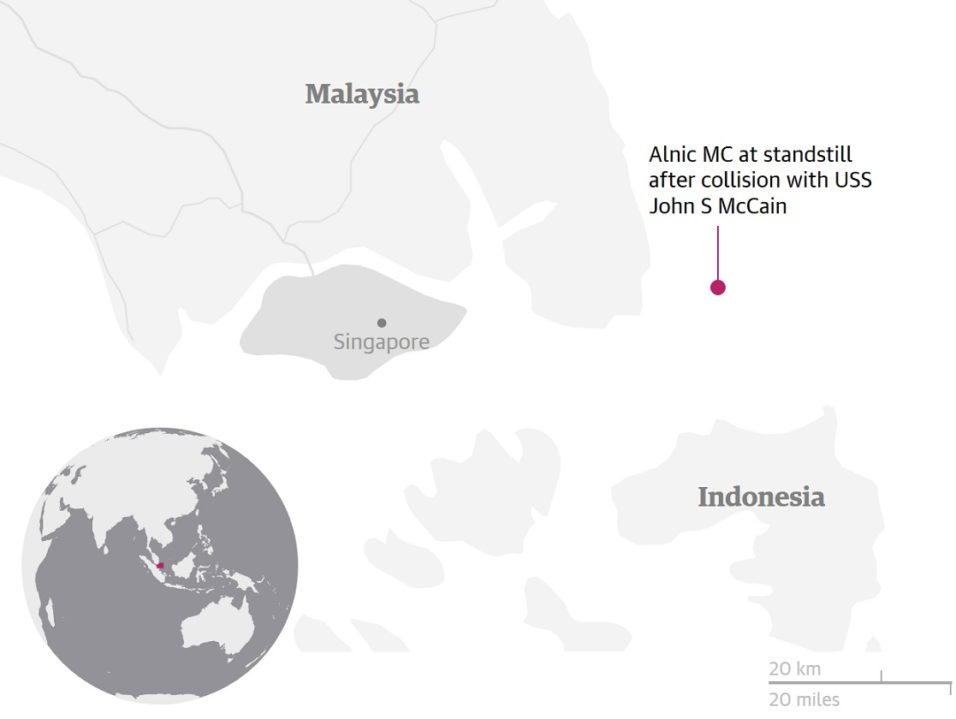
    Ten American sailors are missing and five injured after the guided-missile destroyer USS John S McCain was damaged in a collision with an oil tanker off the coast of Singapore.

    The US navy said the warship had “sustained damage to her port side aft” in the collision with the Alnic MC east of the straits of Malacca and Singapore.

    It is the second collision involving a ship from the navy’s 7th Fleet in the Pacific in two months. Seven sailors died in June when the USS Fitzgerald and a container ship hit each other in waters off Japan.

    “There are currently 10 sailors missing and five injured,” the navy said in a statement posted on the website of the commander of the US Pacific fleet.

    “Search and rescue efforts” were underway in coordination with local authorities after the incident at 5.24am local time on Monday.

    “In addition to tug boats out of Singapore, the republic of Singapore navy ship RSS Gallant, RSN helicopters and police coast guard vessel Basking Shark are currently in the area to render assistance,” it said.

    The US warship was “currently sailing under its own power” to Singapore, the navy statement said, where it had been due for a routine port visit.

    The statement gave no other details about the missing crew. The incident would be investigated, it said.

    The Fitzgerald’s captain was relieved of his command and other sailors were being punished after the navy found poor seamanship and flaws in keeping watch contributed to the collision, it was announced last week. An investigation into how and why the Fitzgerald collided with the other ship was not finished, but enough details were known to take those actions, the Navy said.

    The John S McCain, which has seen service in the 2003 Iraq war, the Korean peninsula and Japan, is named after the father and grandfather of Arizona senator and former naval pilot John McCain, who were both US navy admirals. Senator McCain tweeted that he was praying for the crew.

    President Donald Trump replied “that’s too bad” in response to shouted questions about the McCain from reporters as he returned to the White House after a working holiday at his golf resort in New Jersey, according to pool reports.

    The Fitzgerald and John S McCain are both ballistic missile defence (BMD) capable ships and part of the same Japan-based destroyer squadron. The 7th fleet has six ships assigned to BMD patrols, with half of those out on patrol at any one time.

    Asked whether the US Navy would need to bring forward other ships to maintain its strength amid rising tension with North Korea, a spokesman said it was “way too early to know”.

    The Alnic MC is an oil tanker that sails under the Liberian flag. It is 182m (600ft) long and has a deadweight tonnage of 50,760.

    Ship tracking websites showed that the Alnic was currently east of Singapore. The ship’s data showed it was “ballasting”, meaning that it was not loaded full of oil for cargo.

    The waterways around Singapore are some of the busiest and most important in the world, carrying around a quarter of the world’s trade in goods and oil.


    Source: https://www.theguardian.com

  • Malacca Harbour Plan Raises Questions About China’s Strategic Aims

    Malacca Harbour Plan Raises Questions About China’s Strategic Aims

    A RM43 billion (S$14 billion) harbour being developed in Malacca aims to overtake Singapore as the largest port in the region, but questions are being raised about the need for the added capacity and whether China’s eager participation has to do with good business or its crucial strategic interests in the Malacca Strait.

    For China, not only does most of its trade pass through the Malacca Strait, but so does up to 80 per cent of its energy needs. This prompted then President Hu Jintao to make the “Malacca Dilemma” a key strategic issue as far back as 2003.

    “There is the strategic element of the Malacca Strait. It always starts with an economic presence, which can develop into a naval one, because China will be obliged to ensure the safe passage of its commercial ships,” said Dr Johan Saravanamuttu of the S. Rajaratnam School of International Studies, who studies the Malaysia-China relationship.

    The Melaka Gateway joint venture is part of a wider port alliance between Kuala Lumpur and Beijing to increase bilateral trade and boost shipping and logistics along China’s much-vaunted Maritime Silk Road.

    Chinese firm Guangxi Beibu International Port Group already owns 40 per cent of Kuantan port, which faces the disputed waters of the South China Sea, and 49 per cent of the Kuantan Industrial Park in Pahang, the home state of Malaysian Prime Minister Najib Razak.

    The Malaysian authorities are talking up the game-changing Melaka Gateway deal between little-known KAJ Developments and energy giant PowerChina International, which will form a joint venture and spend RM30 billion to reclaim three islands off Malacca’s coast. The entire Gateway development will be completed in 2025 but the deep-sea port is expected to be ready by 2019. The Malaysian government hopes to attract the bulk of 100,000 vessels, most of them Chinese, that ply the Malacca Strait annually.

    Some industry players have expressed concern about the cannibalising of existing ports along the strait, especially in the light of Singapore’s own port expansion.

    Though the Malaysian government has said a new port is needed because Klang, the country’s most important port, will be full by 2020, studies appear to show otherwise.

    A World Bank study commissioned by the government last year showed a new port on Malaysia’s west coast is not necessary, as existing facilities have yet to reach capacity, according to sources. Both operators at Port Klang – Westports and MMC – have also made expansion proposals that would double the port’s capacity, the sources added.

    “Because there seems to be no logic to the Melaka deal, many are questioning if this has more to do with military rather than commercial interests,” a logistics player told The Straits Times.

    Sources also said the reclaimed islands would be given freehold status and the port granted a 99-year concession – both rare and generous terms. Melaka Gateway did not respond to a request for comment.

    China’s military presence around Malaysian waters has increased significantly since last year. In September last year, all three branches of the Chinese armed forces took part in a six-day joint exercise on “disaster relief” in the Malacca Strait.

    China has also gained access to Kota Kinabalu, a crucial dock in Sabah close to the disputed Spratly Islands, where Beijing’s construction activities have been a source of diplomatic strife in the region.

    A former port authority chief noted that China has made moves to reduce its reliance on the Malacca Strait, such as via port-and-rail or pipeline projects in Pakistan, Myanmar and Eastern Europe, which means “we cannot take Beijing’s commitment here for granted”.

    “If China pulls out her support, the port becomes useless because it has no hinterland, unlike Klang and Penang which serve a big local market. In fact, many businesses prefer to send their goods to Klang by road instead of the existing Malacca or Penang ports because it is more efficient.”

    Critics have questioned Malay- sia’s over-reliance on China, in the light of the huge deals struck during Datuk Seri Najib’s recent visit to Beijing, as well as a whopping RM55 billion loan to build a railway that will eventually link Port Klang on the west and Kuantan port in Pahang and also Terengganu and Kelantan.

    “There is the question of over-dependence, and the diplomatic leverage involved if Beijing were to move in more aggressively. So far, Najib is still hedging, but when it comes to investments, you can’t expect as much from America as you can from China. If you want to go up against Singapore, then this port makes sense, especially when it is in the form of foreign investment, given Malaysia’s fiscal constraints,” said Dr Saravanamuttu.

    Transport Minister Liow Tiong Lai batted away these concerns on his return from Beijing, telling reporters that “with the economy growing, we need more ports”. He said: “The port alliance… has seen results, bringing more competitiveness to our ports and logistic sectors.”


    Source: The Straits Times

  • Four US Littoral Warships To Operate Out Of Singapore From 2018

    Four US Littoral Warships To Operate Out Of Singapore From 2018

    Four US warships designed to fight in coastal areas similar to South-east Asian waters will be operating out of Singapore by 2018, up from one currently, a senior US Navy official said on Tuesday.

    The “rotational deployment” of the vessels, called littoral combat ships (LCS), comes as China continues to flex its muscles in the South China Sea and tensions remnain on the Korean Peninsula.

    “We will soon see up to four LCS here in Singapore as we rotationally deploy Seventh Fleet ships,” said Rear Admiral Charles Williams.

    “We envision four ships here by May 2017 to sometime in 2018… but I think what you have is that by 2018, four LCS ships will be rotationally deployed here to Singapore.” Williams, commander of the Seventh Fleet’s Task Force 73, was speaking to reporters aboard the USS Fort Worth, an LCS on a 16-month deployment to Southeast Asia.

    It replaced another LCS, the USS Freedom, which recently ended an eight-month tour of duty.

    The USS Fort Worth is set to take part in exercise Foal Eagle, a joint military drill with South Korea from Feb 24 to March 6.

    It will also join regional navies in the annual Cooperation Afloat Readiness and Training exercises and the International Maritime Defence Exhibition.

    Fast and agile, LCS vessels can be adapted for specific missions through a system of interchangeable modules and crew.

    The US Navy plans to build 52 LCS vessels at a total cost of US$37 billion (S$50 billion) but the programme has become controversial due to cost inflation, design and construction issues.

    In 2012 the then-US Defense Secretary Leon Panetta announced that Washington would shift the bulk of its naval fleet to the Pacific by 2020 as part of a new strategic focus on Asia.

    China is embroiled in a maritime dispute with four Southeast Asian countries – Brunei, Malaysia, the Philippines and Vietnam – as well as with Taiwan over territorial claims in the South China Sea.

    While not a claimant, the United States has said it has an interest to ensure freedom of navigation in the area.


    Source: www.straitstimes.com