Tag: survey

  • Survey: More Singaporeans Living In Condos

    Survey: More Singaporeans Living In Condos

    In the past five years, more Singaporeans are now living in condominiums, more are taking public transport to work, and more are remaining single until later in their lives.

    These were among the insights revealed by the Department of Statistics’ General Household Survey, released on Wednesday (Mar 9).

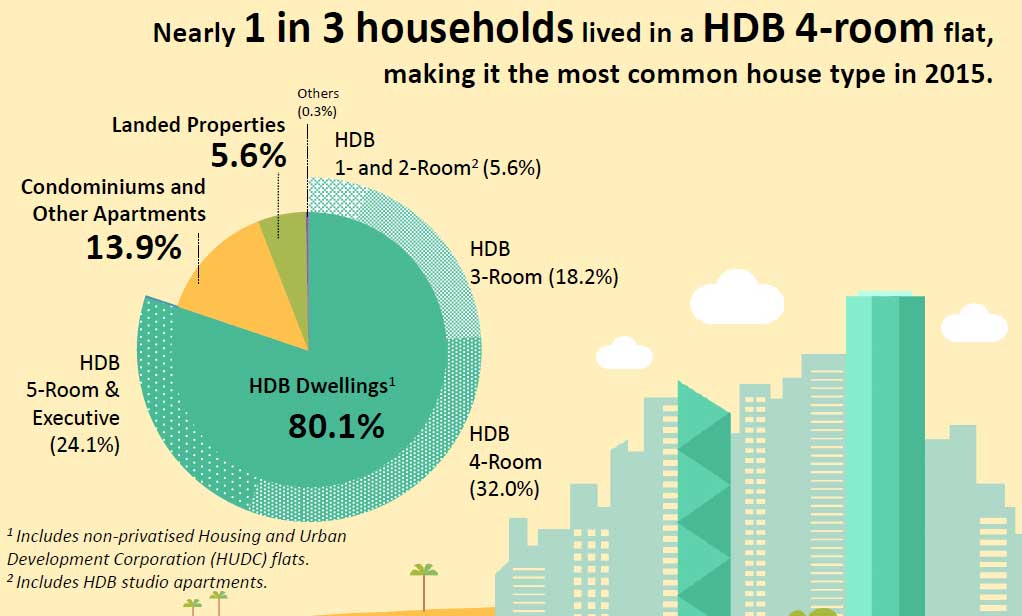
    According to the survey, while 80 per cent of Singaporean households still live in Housing Board (HDB) flats, 13.9 per cent of households now live in condominiums and other apartments, up from 11.5 per cent in 2010.

    However, the number of households living in landed properties inched lower from 5.7 per cent to 5.6 per cent over the same period.

    Among those in HDB flats, nearly three in four households (74.3%) were living in three-, four- or five-room and executive flats. Four-room units were the most common house type.

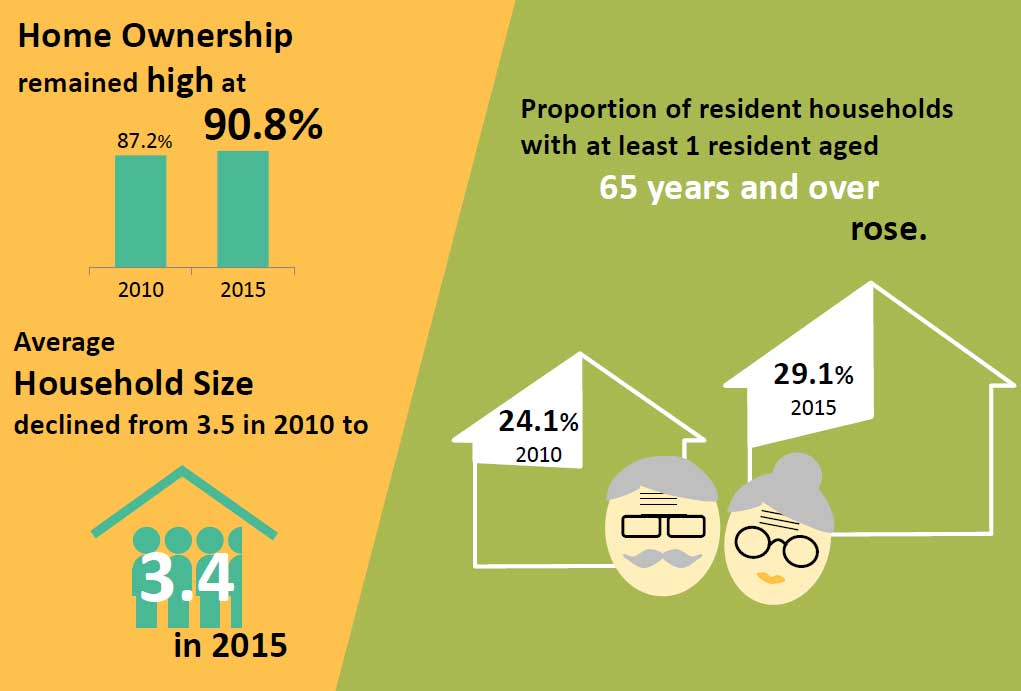
    The survey also found that more than nine out of ten (90.8%) households also own the homes they live in. This is an improvement from the 87.2 per cent home ownership recorded in 2010.

    But over the past five years, the number of households comprising two or three persons has increased, while the number of households with five or more persons have decreased. Four-person households remain unchanged at 23 per cent.

    The upshot is that the average size of households in Singapore has shrunk slightly from 3.5 persons in 2010 to 3.4 persons today.

    According to the report, the shift towards smaller households was most notable among Malay households, even though the community still had larger households on average than their Chinese and Indian counterparts.

    With Singapore’s ageing population being well-documented, it comes as no surprise that the proportion of households with at least one member aged 65 and over has gone up to 29.1 per cent in 2015 from 24.1 per cent in 2010.

    Transport

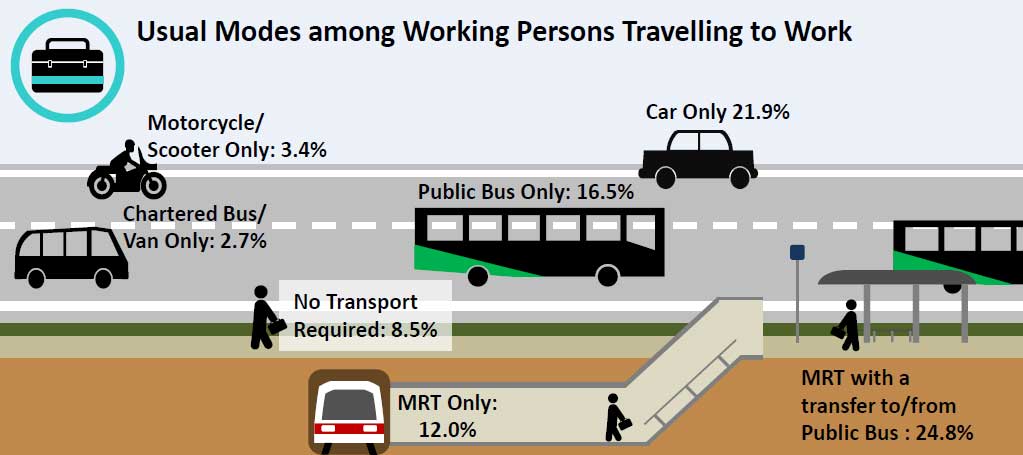
    When it comes to transport, the survey found that public transport remained the most important mode of transport for residents commuting to work.

    The expansion of the rail network in recent years meant that more were taking the MRT to work. Some 12 per cent of residents said they used the MRT only (up from 11.5 per cent in 2010), while 24.8 per cent commuted to work by MRT with a transfer to or from a public bus (up from 17.6 per cent in 2010).

    The number of commuters who only took the bus has dropped from 19.3 per cent to 16.5 per cent, whereas those who only used cars to get to work went down from 24.8 per cent to 21.9 per cent.

    Marriage and fertility

    The General Household Survey also found that even though the majority of Singapore residents aged 15 and over were married, the trend of later marriages was reflected in the increase in porportion of younger singles.

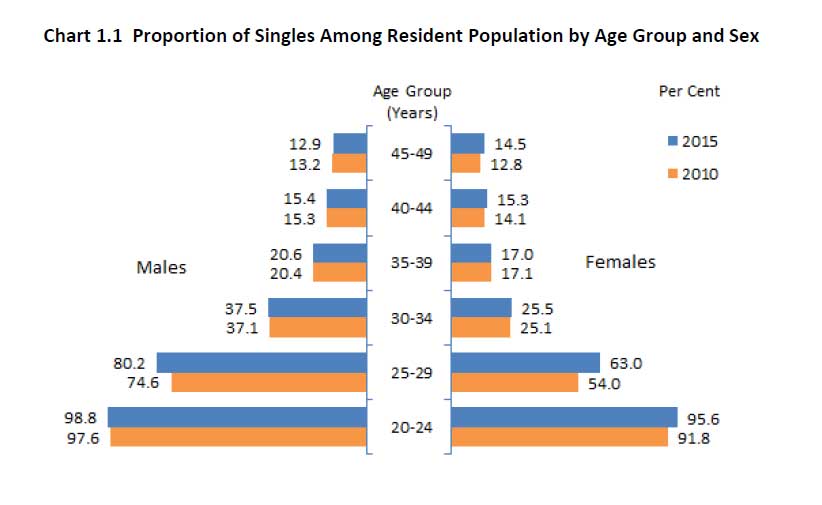
    The number of singles, male and female, in the 20-24, 25-29 and 30-34 age groups have all increased in 2015 as compared to 2010.

    The most significant increase was among those between the 25 and 29 age range. Of these, 80.2 per cent of males and 63 per cent of females reported being single in 2015, up from 74.6 per cent and 54 per cent respectively in 2010.

    Education and literacy

    The overall education profile of residents has also improved in the past five years.

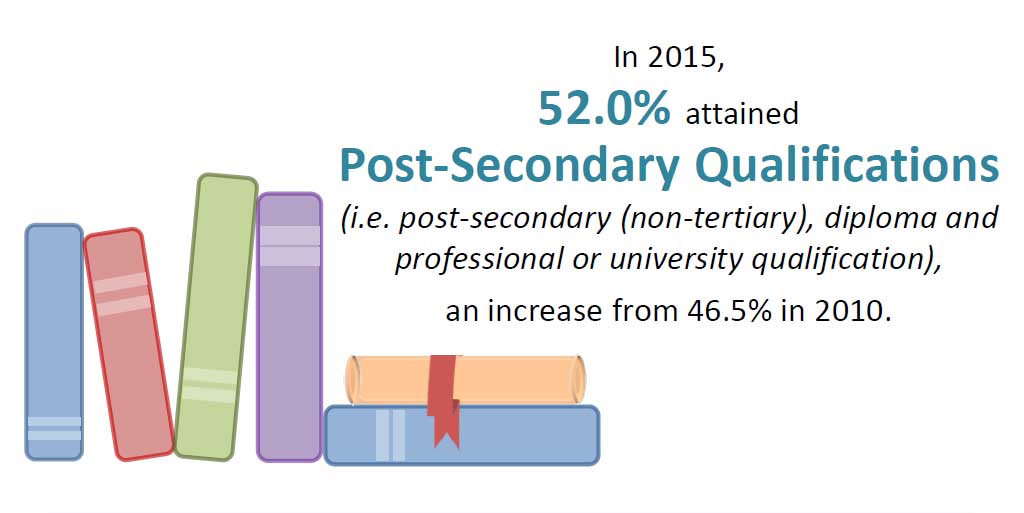
    Among the resident non-student population aged 25 and over, 52 per cent had post-secondary qualifications in 2015, up from 46.5 per cent in 2010.

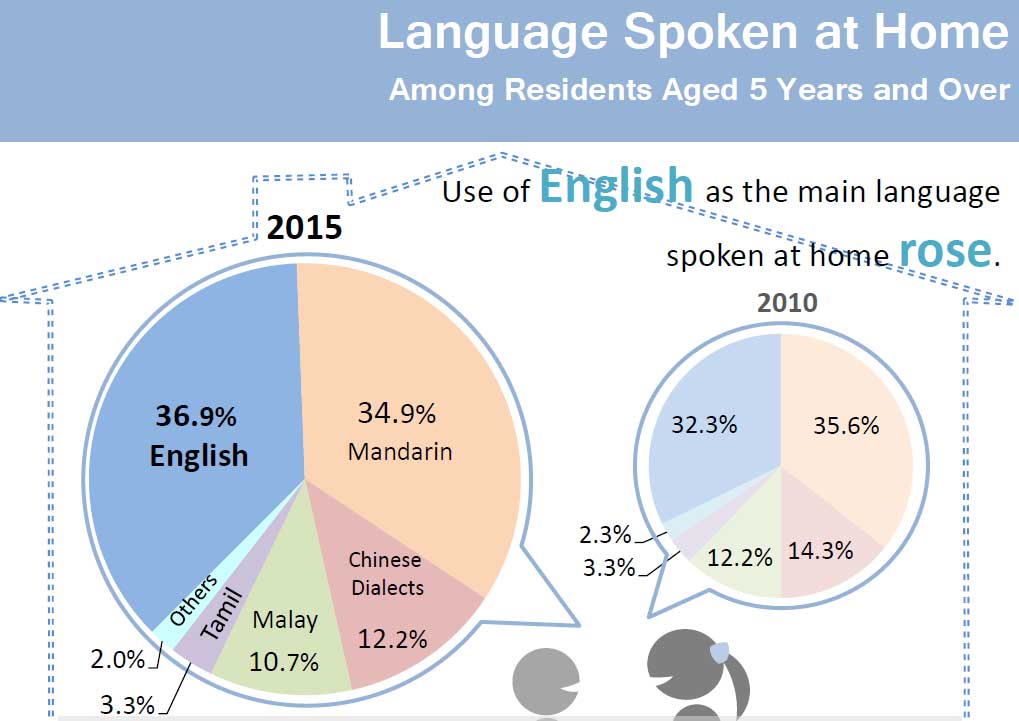
    There was also an increase in the number of households that used English as their main language at home, from 32.3 per cent five years ago to 36.9 per cent in 2015, according to the survey.

    Religion

    The survey also revealed religious composition of Singapore residents has remained relatively stable between 2010 and 2015.

    The most significant increase was among residents without any religious affiliation, rising from 17.0 per cent in 2010 to 18.5 per cent in 2015.


    Source: http://news.asiaone.com

  • My Honest Feedback On Cookhouse Food Not Received Well

    My Honest Feedback On Cookhouse Food Not Received Well

    I am from a camp located in the North. There was this cookhouse survey and I decided to give a ‘bad’ for it. Then there came a guy to tell me to fill in my particulars because I put an lousy.

    The next day, the CO of the unit in charge of the cook house complained to my unit about it and I was called to my OC’s office and questioned for my feedback.

    I could still remember vividly that my OC asked me if my mother was a chef and I was to write a statement about this incident and and explain my action.

    I mean, if you only want ‘good’s or ‘very good’s, then what is the purpose of the survey? And if, after people give their opinion, you start throwing rank because the opinion is not up to your satisfaction, then what kind of image are you portraying as a regular?


    Source: SAF Confessions

  • Survey Finds That Local Muslim Respondents For The Donning Of The Hijab In Schools, Autonomy Of Madrasahs

    Survey Finds That Local Muslim Respondents For The Donning Of The Hijab In Schools, Autonomy Of Madrasahs

    Between 6th to 13th March, we ran a survey to identify Singapore Muslim community perceptions on several socio-political issues. The survey was based on the Suara Musyawarah report, responses to the report and several AMP studies of the Malay community.

    Summary

    The survey indicates strong concerns on the cost of living, perception of discrimination and the community’s legal and education standing.
    Study

    The online survey was published on Almakhazin.com. Surveygizmo.com provided the engine.

    Five broad categories were addressed: socio-legal, Leadership, Foreign workers/ demography, economy and education. Responses are based on the Likert system with respondents indicating on a 5 point scale from “Strongly agree” to “Strongly disagree”.

    This survey is by no means a comprehensive study of the Muslim community. It serves as an indication on several specific issues. Over the next few months, we plan to expand and deepen the understanding of community preferences through with more community surveys. We hope that it will provide a little insight as to how sections of the community perceive various issues.

    We used social media to gather respondents for the survey. Invitations to participate were placed in several Singapore Muslim pages such as Suara Melayu Singapore, Almakhazin SG and Singapore Muslim Students Overseas. None of the groups are based on any political or religious persuasion.

    According to ShareThis count, the survey page was shared 603 times. It was shared through Facebook 578 times, by Twitter 18 times, once by email and Liked 235 times. 6 shares were unaccounted by ShareThis.

    Caveats

    As is inherent in any online survey tool, we rely on respondents’ self identification (religion, gender, age etc) and responses. There is no way to determine if what they declare for themselves are true. However, this is not a unique problem. It exists in online and offline surveys.
    There was also initial concerns of multiple responses from the same person. To minimise the possibility of such behaviour, we filtered responses through IP address. Only the last response per IP address is recognised.

    Responses

    Total number of responses: 334
    After filtering repeats through IP address: 314
    Muslim respondents: 313
    One respondent identified as Christian. Since the survey is on the Muslim community, we had to remove the response.

    Demography
    Age
    The youth age group (defined here for those between 18-35) makes up a slight majority of respondents. However, there was strong representation from 35-54 year olds at 38.7%.

    Gender
    There was an over-representation of male respondents. 2/3 of respondents identified as male. The survey did not seek specifically male or female groups or participants.

    Highest qualifications
    About a third of respondents have tertiary qualifications with Bachelors degree making up a quarter of respondents. A further 34.5% have diplomas.

    Race
    As expected, a large majority of respondents (78.6%) identify as being Malays. 10.2% as Indians.

    Categorisation
    The survey was set up into 5 categories:
    1. Socio-legal
    2. Leadership
    3. Foreign workers and demography
    4. Economy
    5. Education

    In this analysis however, we will recategorise the survey. There are five categories that make up our analysis:
    1. National issues
    2. Community concerns- government
    3. Social contract
    4. Community concerns-Internal
    5. Autonomy

    National issues

    Economy
    In terms of the economy, there appears to be uncertainty in the way the government is managing it even as the respondents tend to believe it is not going very well. There are also concerns with the way the CPF is managed. However, there is a strong concern with the cost of living in Singapore.

    96.8% of respondents are worried about the cost of living in Singapore with 76.4% stating they strongly agree with the statement “I am worried about the high cost of living.”

    However, slightly less than half of the respondents believe the government is not managing the economy well. 30.4% are neutral and about 20% think the government is managing it well.

    62% are concerned about the way CPF is managing their funds with 33.9% indicating they “strongly disagree” with the statement “I am confident with CPF’s management of our funds.”

    Foreign workers
    There appears to be concern on the number of foreign workers and as it relates to the percentage of Malays.

    59% disagree with the statement “I believe the government is right in its foreign worker policies.” 77% feel there are too many foreign workers in Singapore.

    About 63% are “concerned that the number of foreign workers will result in a reduction in the percentage of Muslims in Singapore.”

    Concerns-government
    Policies that affect the community negatively appear to get a strong response.

    There is strong support among the respondents for hijab to be allowed in school and at the workplace. In reference to the ban of hijab in school, 90% of respondents “believe that Muslim students should be allowed to wear hijab in school” with 68.1% saying they strongly agree. 8.6% were neutral to the question. Only 1.3% disagreed and no one strongly disagreed.

    A stronger response was received for question on whether anyone should be denied employment because of hijab. About 98% believe that no one should be denied employment due to hijab with 87.9% believing strongly. 1% were neutral and only 0.6% (even split) believing they can be denied employment due to hijab.

    89% “believe that Muslims should be allowed to enlist in any branch of the armed forces.”

    Further to the concerns of discrimination, 93% “believe that Singapore should enact an Anti-discrimination law to ensure no one is discriminated.”

    Social contract
    Article 152 of the constitution states:
    “Minorities and special position of Malays
    152.
    —(1) It shall be the responsibility of the Government constantly to care for the interests of the racial and religious minorities in Singapore.

    (2) The Government shall exercise its functions in such manner as to recognise the special position of the Malays, who are the indigenous people of Singapore, and accordingly it shall be the responsibility of the Government to protect, safeguard, support, foster and promote their political, educational, religious, economic, social and cultural interests and the Malay language.”

    Signifying the strong sense of the existing social contract 75% of respondents believe in retaining Article 152 of the constitution. Only 3% believed the Article should not be retained.

    About 20% believe the government is living up to its responsibilities as specified in the Article. 34% are neutral about the government’s performance and 43% believe the government has not lived up to it.

    We received several queries in the comment section indicating the respondents’ unfamiliarity with Section 152.

    Community concerns- Internal

    The Malay statistic for imprisonment and educational underachievement has been a disconcerting discussion in the community for some time. Another issue that has received some attention is of the erosion of Malay language use in Singapore.

    With 79% being concerned about the over-representation of Malays in prison, it indicates not only the concern of the severity but also the recognition that the Malays are over-represented.

    Similarly, the perception of Malay educational underachievement is strong with 83% indicating their agreement that it is a concern. Only about 4% are not concerned about the over-representation in NA/NT streams and ITE and the underrepresentation in Universities.

    However, it should be noted that with a growing recognition of the value of ITE education, respondents may have indicated their lack of concern due to their acceptance of ITE as a viable and valuable educational pathway.

    There is also a strong position taken on Malay language. 80% are concerned about the erosion of the language in Singapore. 14% are neutral.
    The concern however may also be due to the greater public statements and campaigns encouraging the use of the language. With enhanced recognition, the belief in its lack and improper use may have become stronger.

    Autonomy
    There is also a strong sense of the necessity of community autonomy from government control. About 80% of respondents believe madrasah should be independent of government control and for the highest Islamic authority to not be appointed by the government. About 63% also believe that community leaders should not be involved in politics.

    Discussion
    There appears to be disenchantment within the community in various government policies. There also is a strong sense of communal concern among respondents. This can be due to the possibility that those who participate in such surveys to already be concerned about the questions asked, that the issues are current and significant or there is a socio-political alignment among those who participate in such community based surveys.

    It may also be due to respondents who participate in social media based discussions to be more concerned about the issues in the survey.

    The demographics indicate a wide variety of respondents. If this can be taken as a cross section of Malay community response, then it indicates a substantial disagreement with current policies especially with regard to community-government relations.

    There appears to be a greater sense of disenfranchisement between members of the community and the government. Discrimination, control and high cost of living apart from community underachievement are real concerns that need to be resolved.

    This survey provided the broad strokes in community perception. We will follow up with surveys that go in depth on the issues discussed above with special attention on community-government relations.

    The survey results can be viewed at:
    http://app.surveygizmo.com/reportsview/?key=345590-4188929-4606949383d247e91eebedc49140b4e8


    Source: http://almakhazin.com

  • Children As Young As 7 years Old Exposed to Porn on Internet

    Children As Young As 7 years Old Exposed to Porn on Internet

    One in two teenagers here has watched or read sexually explicit materials, a poll has found, with some as young as seven when they were first exposed to it.

    And one in three admitted viewing pornography in the past year, whether intentional or accidental.

    The first large-scale survey here to examine children’s exposure to pornography, which polled 836 students aged 13 to 15, was conducted by Touch Cyber Wellness, the main agency that gives online safety talks in schools here.

    Experts say the findings are worrying as such content affects young people’s attitudes and behaviour towards love and sex, and may lead to sexual crimes.

    Dr Munidasa Winslow, an addictions specialist in private practice, called the figures “expectedly horrendous”.

    “Technology is driving a new wave of addictions – whether gaming or pornography – because… now, it is all available at a click,” he said.

    In the survey, 77 per cent of those exposed to sexual content accessed it through smartphones.

    The findings largely echoed those elsewhere. Studies in the United States and Australia found that about 40 per cent of teens and pre-teens visited X-rated sites deliberately or accidentally.

    In the Touch survey, 5 per cent of the teens who had seen porn encountered it first in lower primary levels – at age nine or younger. They were not asked how often they accessed this subsequently. Pornography was defined in the study as images or content, such as anime and erotic novels, that depicted naked people or people having sex.

    Students from three secondary schools were polled, and 24 were interviewed in depth one on one.

    Experts say the results reflected how Singapore has one of the highest rates of mobile phone use, and insufficient adult guidance.

    “I believe it is largely due to the inadequate discussions and lack of guidance from parents, so young people look elsewhere for sex education, of which pornography is a poor teacher,” said clinical psychologist Joel Yang of SIM University.

    Based on the interviews, many boys started viewing sexual content out of boredom or curiosity, said Touch Cyber Wellness assistant manager Chong Ee Jay.

    Asked how they first encountered such materials, half the boys polled said they deliberately sought these online. A third of the girls read these in erotic or romance novels. The rest came upon these by accident or were egged on by friends.

    Experts say the effects of viewing porn may vary by gender.

    “It may lead to pressure on girls to look and act a certain way when they compare their bodies with those online. When boys see the male figures as aggressors or in positions of dominance, they may become disrespectful towards women,” said Mr Chong.

    The obsession with porn affects their studies, self-esteem and interpersonal relationships. Overseas studies have also shown a link between consuming pornography and committing sex crimes.

    Since adult-only materials are readily available, experts say parents should install Web filters on computers and mobile devices. They should also tell their children that porn is not sex education, and where to seek help.

    Sex education teachers should not shy away from the topic either. Mr Chong will be training them on how to broach the topic.

    Dr Winslow said: “For sexual addictions, people are only as sick as their secrets. The more they can talk about them in safe places, the more the addictions lose their hold or power over people.”

    Ms Yap Chai Kian, 43, a manager with a nine-year-old daughter and a 13-year-old son, said she has been having regular conversations about sex and porn with her children since they were two.

    “I try to find opportunities to talk to them, like when crime shows on TV show people sending sexual images to one another, so that it does not feel awkward.”

    “Jie jie, can I sleep with you?” the nine-year-old boy asked a woman he barely knew as he tugged at her shirt.

    Horrified, the Touch Cyber Wellness trainer who visited his school to give a cyber wellness talk referred him to the school counsellor.

    Later, he confessed he had been watching pornography at home and had sexual thoughts throughout the day.

    He first chanced on online erotica in Primary 2, while looking for a photo of a naked aboriginal boy for a project.

    “I was so shocked that I ran off,” he told the trainer.

    But the images captured his imagination, and he looked at them whenever he was alone at home. Soon after, he was looking through such pictures twice a week and touching himself. He said: “I know it is not good as it affects my thinking. But it felt good, and I couldn’t control myself.”

    The counsellor roped in his parents, who installed filtering software in his computer and had more open discussions about sex. After a year of counselling, he has broken free of his addiction and learnt to channel his energies elsewhere, such as sports.

    For a 14-year-old girl, her habit of viewing pornography thrice weekly started a year ago when she searched for it online to satisfy her curiosity.

    She had been avidly reading romance novels, many of which had graphic love-making scenes. Her close friends also often talked about how their boyfriends would watch pornography regularly.

    Watching pornography and masturbation satisfied her, but also left her feeling guilty, ashamed and inadequate. The women she saw online had fuller breasts compared with hers. She searched online for breast enhancement supplements.

    “It affected the way I felt about myself, and I began to feel insecure about my diet and dressing,” she told a counsellor, who then worked with her to create a more positive body image and build up her self-esteem.

    She said: “I used to want so much to look like a porn star. I am slowly learning that that is not how all women look.”

    Source: http://news.asiaone.com/news/singapore/half-teens-here-exposed-pornography-survey?page=0%2C1#sthash.rMRTm99I.dpuf

    letters R1C

    YOUTUBE: youtube.com/user/rilek1corner

    FACEBOOK: facebook.com/rilek1corner

    TWITTER: twitter.com/Rilek1Corner

    WEBSITE: rilek1corner.com

    EMAIL: [email protected]

    FEEDBACK: CONTACT RILEK1CORNER