Tag: syariah law

  • Malaysian Prime Minister Najib Says Barisan Nasional Won’t Push Shariah Bill

    Malaysian Prime Minister Najib Says Barisan Nasional Won’t Push Shariah Bill

    Barisan Nasional will not table amendments to increase Shariah punishments being sought by Pan-Malaysian Islamic Party, Malaysian Prime Minister Najib Razak said on Wednesday (March 29).

    The prime minister and BN chairman said this was decided by the coalition following its supreme council meeting this evening.

    “Therefore it will remain a Private Member’s Bill and if it is presented, it will depend on the Speakers instructions,” he was quoted as saying by the Star Online news portal.

    BN previously said it would take over PAS president Abdul Hadi Awang’s proposal and convert it into a government Bill eventually.

    Wednesday night’s announcement will remove the obligation that would have existed for BN federal lawmakers to support the amendments were these tabled by the government.

    Mr Hadi’s Bill may now fail to even surface in Parliament; he was only able to table the motion for his Bill last year after an Umno minister intervened to elevate it above government matters.

    Aside from Umno, the Bill to raise Shariah sentencing limits to 30 years’ jail, RM100,000 (S$31,588) fine and 100 strokes of the cane has been opposed by BN components.

    Umno has used the issue to court federal opposition party PAS ostensibly for Malay-Muslim unity.

    Mr Najib’s announcement could also prompt changes to the political landscape in which PAS had been drifting away from other opposition parties and aligning itself with Umno, the only party to openly support the former’s ambitions on Islamic laws.


    Source: Today

  • Indonesian Buddhists Caned Under Syariah For First Time

    Indonesian Buddhists Caned Under Syariah For First Time

    Indonesia’s only province to impose syariah law caned Buddhists for the first time on Friday (March 10), after two men accused of cockfighting opted for punishment under the strict Islamic regulations.

    Alem Suhadi, 57, and Amel Akim, 60, both ethnic Chinese and members of the Buddhist minority, were whipped in front of dozens of local officials and residents in the city of Jantho, Aceh province.

    The two men grimaced as they received nine and seven lashes respectively on their backs, a sentence that was mitigated because they had spent over a month in detention since police nabbed them for cockfighting in Aceh Besar in January.

    “When they were arrested, two chickens and 400 thousand rupiah of betting money were confiscated by the police,” said prosecutor Rivandi Aziz.

    Caning is common in Aceh for breaking the province’s strict Islamic laws, for offences ranging from drinking alcohol, to gambling to gay sex.

    In the past, only Muslim residents could be caned but that changed in 2015, when Aceh’s regulations were overhauled.

    Non-Muslims who violate Islamic law can either choose to be tried under the national legal system or syariah.

    The two Buddhists would likely have faced jail under Indonesian nation law.

    “We live in Aceh, so we have to obey the regulation in our region,” Alem told AFP shortly after being caned.

    A Muslim was also lashed seven times for betting on cockfights on Friday, while another man accused of abusing three teenagers was lashed 112 times.

    Aceh, on Sumatra island, began implementing syariah law after being granted special autonomy in 2001, an attempt by the central government in Jakarta to quell a long-running separatist insurgency.

    Islamic laws have been strengthened since the province struck a peace deal with Jakarta in 2005.


    Source: ST

  • Saudi Arabia Quietly Spreads Its Brand Of Puritanical Islam In Indonesia

    Saudi Arabia Quietly Spreads Its Brand Of Puritanical Islam In Indonesia

    When Ulil Abshar-Abdalla was a teenager in Pati, Central Java, he placed first in an Arabic class held at his local madrasa. The prize was six months of tuition at the Institute for the Study of Islam and Arabic (LIPIA), a Jakarta university founded and funded by the Saudi Arabian government. At the end of six months, LIPIA offered him another six. He stayed on.

    After that, it offered him four more years of free tuition to obtain a bachelor’s degree in Islamic law, or shariah. He accepted that too. In 1993, after five years at LIPIA, he was offered a scholarship to continue his studies in Riyadh. He finally said no.
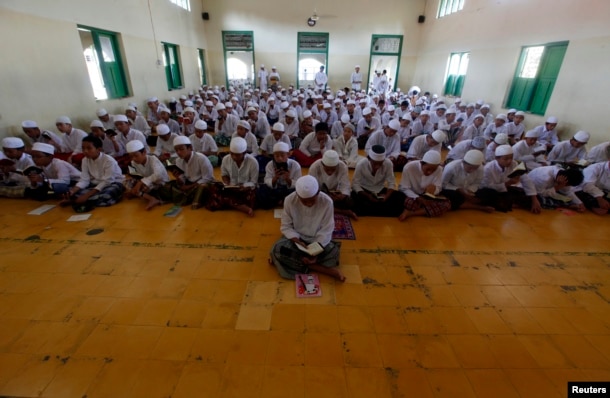
    FILE - Students pray during the first day of the holy month of Ramadan at Al-Mukmin Islamic boarding school in Solo, in Indonesia's Central Java province, August 1, 2011.

    FILE – Students pray during the first day of the holy month of Ramadan at Al-Mukmin Islamic boarding school in Solo, in Indonesia’s Central Java province, August 1, 2011.

    “Once you accept that, you’re on their payroll for life,” Abshar-Abdalla told VOA. “But they made it awfully easy to stick around. I’m from a poor family, and it was quite tempting… I think they managed to pull a few good minds from my generation that way.”

    Since 1980, Saudi Arabia has been using education to quietly spread Salafism, its brand of puritanical Islam, in Indonesia, the world’s most populous Muslim nation. The two main arms of this effort are LIPIA and scholarships for higher education in Saudi Arabia.

    Salafism is an ultra-conservative reform movement that advocates a return to Koranic times. LIPIA teaches Wahhabi Madhab, a strain of Salafi Islam expounded by the medieval Sunni theologian Ibn Taimiyah.

    “Saudi alumni” are now visible in many arenas of Indonesian public life, holding positions in Muhammadiyah, the Prosperous Justice Party, and the Cabinet. Some have also become preachers and religious teachers, spreading Salafism across the archipelago.

    The effects of Saudi Arabia’s massive soft power exercise on the Indonesian citizenry are just starting to become clear.

    ‘The most important post in Jakarta’

    The nexus of Saudi educational diplomacy is the religious attaché, a special office affiliated with its embassy in Jakarta. The office grants scholarships for students to study in Saudi Arabia, although the current attaché, Saad Namase, refused to confirm how many students were involved.

    “We don’t really work with the Indonesian government,” said Namase. “We just try to strengthen cultural ties between our two countries by, for example, holding Quranic recitation competitions.” On the topic of scholarships, he said many countries, including the Netherlands and the U.S. offer scholarships to Indonesian students and the Saudi program was just one among many.

    FILE - A teacher gestures during an Islam personality class during the holy month of Ramadan at the Al-Mukmin Islamic boarding school in Solo, Indonesia Central Java province, Aug. 2, 2011.

    FILE – A teacher gestures during an Islam personality class during the holy month of Ramadan at the Al-Mukmin Islamic boarding school in Solo, Indonesia Central Java province, Aug. 2, 2011.

    “The Saudi religious attaché is the most important post in Jakarta,” said Abshar-Abdalla, who now runs the Liberal Islam Network. “It is the portal for all Saudi efforts to influence Indonesian culture.”

    The attaché’s office also pays the salary of prominent Salafi preachers and supplies Arabic teachers to boarding schools across Indonesia, according to Din Wahid, an expert on Indonesia Salafism at the Syarif Hidayatullah State Islamic University in Jakarta.

    Beyond the attaché’s office, several Saudi Arabian universities directly offer scholarships to Indonesian students.

    One reason the Indonesian government is unlikely to present roadblocks to Saudi cultural expansion is its precarious annual Hajj quota, according to Dadi Darmadi, a UIN researcher who focuses on the annual pilgrimage to Mecca.
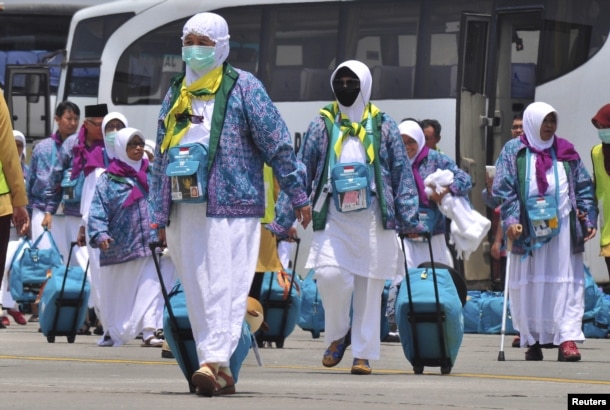
    FILE - Indonesian Haj pilgrims walk towards their flight at the airport in Solo, Central Java province, Indonesia, Sept. 17, 2015, in this photo taken by Antara Foto.

    FILE – Indonesian Haj pilgrims walk towards their flight at the airport in Solo, Central Java province, Indonesia, Sept. 17, 2015, in this photo taken by Antara Foto.

    “We were just granted 10,000 extra Hajj permits this year, which is still a drop in the bucket considering Indonesia’s population of 203 million Muslims,” said Darmadi, “I think Indonesia would hesitate to antagonize Saudi Arabia and prompt cuts to that hard-won quota.”

    Divergent paths

    Hidayat Nur Wahid, a member of Indonesia’s House of Representatives and a leader of the right-wing Prosperous Justice Party (PKS), is one of the most prominent national politicians who have passed through Saudi universities. He studied, through a series of scholarships, for an undergraduate, master’s and doctorate degree in theology and history of Islamic thought at the Islamic University of Medina.

    FILE -- In this July 5, 2013 file photo, worshipers visit the Prophet's Mosque in Medina, Saudi Arabia.

    FILE — In this July 5, 2013 file photo, worshipers visit the Prophet’s Mosque in Medina, Saudi Arabia.

    “The majority of Islamic texts are in Arabic, which is why I wanted to study in Saudi Arabia,” Nur Wahid told VOA. “Plus, the spirit of the Prophet Muhammad animates Medina. I enjoyed my years there.”

    Nur Wahid said he was not exposed to radicalism or “anti-social” teachings in Medina. “We just learned how to be good Muslims. And it’s a misconception that everyone who studies in Saudi Arabia becomes a preacher or religious teacher. Many graduates become officials or politicians like me.”

    “Since it is the place where Islam originated, many students think that Saudi Arabia represents authentic Islam,” researcher Din Wahid.

    Saudi theology had the opposite effect on Abshar-Abdalla, who gradually grew disenchanted with the Salafi movement during his five years at LIPIA.

    “Although I had some short-lived enthusiasm for that simplistic theology, I found it to be puritanical at its core,” said Abshar-Abdalla. Instead, he started to read various other Islamic texts on his own, including Sufi and Shia ones, and eventually founded the Liberal Islam Network (JIL) in 2001.

    Ironically, he himself was once recruited for the student movement that would develop into PKS. “I was invited for a rafting trip in Bogor one weekend at university, and I realized they were trying to get me to join Tarbiyah, the embryo of the current PKS party,” said Abshar-Abdalla. “I sort of ran in the opposite direction.”

    Extremist connection

    Although Saudi-educated preachers in Indonesia might be causing a subtle rightward shift in national ideology, a more immediate concern is whether Salafi teachings encourage terrorism or extremism.

    “By and large, I think not, because official Salafism is quietist, or apolitical, in order to preserve the authority of Saudi royalty in its homeland,” said Wahid. “That being said, when this ideology migrates back to Southeast Asia, all bets are off.”

    One prominent example of non-quietist, or jihadist, ideology is the Salafi-influenced Ngruki pesantren in Solo, Central Java, which has incubated a number of known Indonesian terrorists.

    And Zaitun Rasmin, a graduate of Medina Islamic University, was one of the chief organizers of the hardline demonstrations against the governor of Jakarta in late 2016. “He’s an example of an Indonesian Salafist who is unconcerned with being ‘apolitical,’” said Wahid.

    Wahid’s point is that, for all the resources Saudi Arabia is directing towards Indonesian students, it remains to be seen how exactly Salafi ideology evolves in its new Southeast Asian context. “There are three ‘flavors’ of Salafi ideology: quietist, political, and jihadist. We don’t know what exactly it looks like in Indonesia. All we know is that it’s here, and it’s growing.”


    Source: VOA

  • 52 Ditahan Jabatan Agama, Naik Motor Dengan Bukan Mahram

    52 Ditahan Jabatan Agama, Naik Motor Dengan Bukan Mahram

    Rata-rata daripada 26 pasangan tidak mengetahui menunggang motosikal dengan seseorang yang halal nikah menyalahi undang-undang syariah Terengganu.

    “Saya tidak tahu menunggang dan membonceng motosikal dengan bukan mahram satu kesalahan,” kata mereka selepas ditahan Jabatan Hal Ehwal Agama Terengganu (JHEAT), lapor Sinar Harian.

    Lima puluh dua individu itu, berusia antara 16 hingga 42 tahun, ditahan dalam Op Bonceng di Batu Buruk di sini malam Khamis lalu dengan alasan “berkelakuan tidak sopan di tempat awam”.

    Ketua penolong pesuruhjaya penguatkuasa syariah JHEAT Nik Zulhaiza Ismail berkata mereka ditahan kerana didapati menunggang dan membonceng motosikal dengan bukan muhrim.

    Tambahnya, mereka akan dipanggil menghadiri sesi kaunseling di pejabat JHEAT sebelum diberi amaran dan ditahan selepas ini jika terus mengulangi kesalahan sama.

    Jika ingkar atau masih mengulangi perbuatan sama, mereka akan dikenakan tindakan menurut Seksyen 34 Enakmen Kesalahan Jenayah Syariah (Takzir) (Terengganu) 2001, katanya kepada akhbar itu.


    Source: TheMalayMailOnline

  • Western Control Of Muslims Is Over

    Western Control Of Muslims Is Over

    DURING the Christmas and New Year celebrations, most Western nations were placed on high alert for terrorist activities.
    Only a decade or two ago, these nations celebrated the year-end festivities peacefully.
    Why has this change occurred?
    To understand, one has to refer to conflicts in North Africa and the Middle East.
    That Muslims are fighting back against aggressors was evident from the Russian invasion of Afghanistan in 1979, which was followed by al-Qaeda’s Sept 11 attacks in the United States.
    The West is learning a painful lesson that the days of passive Muslim resistance are over and that they can take on the West.
    The urge in the West to subjugate Muslim nations has stirred up in Muslims their right to defend their religion.
    This has spawned militant groups, the deadliest being the Islamic State terrorist group.
    The IS ideology of setting up a caliphate —a super state ranging from Northern Africa to the Middle East — has found favour with many Muslims, who view that the fragmented Islamic world has triggered Western intervention and that the best weapon is unity with a syariah system in place.
    To Muslims, the caliphate of old is reminiscent of the golden age of Islam, when Muslims were in the forefront.
    IS points out the cause of Islamic decline and that the only way to stop Western interference and dominance is for Islamic countries to unite under a caliphate with syariah as the national law. More than any other religion, Islam has a unique set of laws and is considered a way of life for Muslims.
    Islamic law is second to none in its simplicity, complexity and sense of justice. Hence, Muslim nations have no need for Western ideologies, which are at odds with syariah.
    This concept is opposed by the West, which profits from its divideand-rule policy used against Muslims.
    The West needs to stop its interference via regime change. Left to themselves, Muslim nations will stabilise and adopt a system that works for them and their religion.
    Leave Muslim countries alone and there will be peace in the world, especially in Western capitals.
    The West can offer socio-economic aid as well as humanitarian assistance to Muslim nations but must refrain from interference and domination.
    The age of subjugation is long gone.
    V. THOMAS
    Sungai Buloh, Selangor