Tag: Tan Chuan Jin

  • Today’s Young Singaporeans Will Be In Relatively Good Shape To Retire

    Today’s Young Singaporeans Will Be In Relatively Good Shape To Retire

    Singaporeans who work regularly and make prudent housing choices should have no worries in meeting their retirement needs through the mandatory Central Provident Fund (CPF) system, Manpower minister Tan Chuan-Jin has said, as he told the House that the retirement picture for younger Singaporeans was “relatively healthy”.

    He was addressing concerns that Singaporeans might not save up enough in their CPF accounts to meet the Basic Retirement Sum, now that they will be given more flexibility and options to use their CPF savings.

    Citing the example of a 25-year-old polytechnic graduate earning S$2,200 and assuming this CPF member works 32 out of 40 years, the minister estimated that this worker would have a nest egg of about S$55,000 by the age 65. With compounded interest earned in the Special Account, he would have about S$165,000 at age 65 – three times what was put in.

    “This is not magic – it is just basic mathematics and is a very conservative estimate because I did not account for any wage growth at all and whatever savings he has accumulated in his Ordinary Account after paying off his flat. And if you add those, clearly, he would have even more.”

    As he walked the House through a typical CPF member’s stages in life, Mr Tan said that at age 65, the member would have to decide whether to withdraw up to 20 per cent of his Retirement Account savings in a lump sum.

    The minister also announced that from January 2016, members will need to choose from among the three payout streams to subscribe to under CPF Life from age 65 – up from the current 55. They will also have to decide whether they want to start receiving CPF Life payouts at age 65, or between age 65 and 70.

    The Manpower Ministry (MOM) will also restore the contribution rates for workers aged 50 to 55 to the same level as younger workers, as employment rates for this age band have improved and are almost on par with that of younger workers, he said.

    During Monday’s Committee of Supply debate, MP David Ong suggested raising CPF contribution rates for workers above 55 to the same level as younger workers.

    But Mr Tan said the employment rate for those above 55 was still much lower than those who were younger, so it would not be prudent to raise contribution rates of this group too quickly. The higher rates would also put employers off hiring older workers, he said.

    To encourage the employment of older workers, Senior Minister of State Amy Khor said the government has launched an additional Special Employment Credit (SEC); employers who hire Singaporean workers aged 65 and up and who draw up to S$4,000 a month will receive up to 3 per cent of the monthly wage bill under this SEC.

    This is on top of the current 8.5 per cent SEC for hiring Singaporean workers above 50.

    The government is supporting employers in improving workplace practices so as to attract and retain mature workers, said Dr Khor, who added that the government is putting in place legislation to extend re-employment to 67 in two to three years.

    Employers should also tap existing measures available to put in place age-management practices, so that they can be better prepared to hire older workers, she added.

    Mr Tan urged CPF members to be prudent with their housing purchases, especially when buying or upgrading a property later in life.

    “I think it’s important to pay attention to this because older members may have to take on loans with shorter tenures, higher monthly instalments; they should also factor in any decline in CPF contributions as they age, which may mean that they may need to service their monthly housing instalments with cash on top of CPF.”

    In response to calls for more targeted help for non-working women with low CPF balances, MOM’s support for this group is two-fold, noted Mr Tan.

    Firstly, it has encouraged non-working women to rejoin the workforce, which has led to higher Labour Force Participation Rates (LFPR) among women; as a result, the difference in average CPF balances between men and women have started to narrow, he said.

    Secondly, with families remaining a pillar of support for women, the rules have been tweaked to make it easier for CPF members to transfer their CPF savings to their spouse’s CPF.

    He added that the government is providing attractive interest rates to encourage such transfers: from next year, those aged 55 and above can earn an extra 1 percentage point of interest for the first S$30,000 in their combined CPF balances.

    As for Ms Foo’s suggestion that such transfers be made automatic or require spouses’ joint consent before withdrawals from the Retirement Account, Mr Tan replied that those were ‘very personal decisions” and “best left to couples to decide”, as it would be intrusive for the government to intervene.

    MPs Zaqy Mohamed and Seng Han Thong asked how MOM was communicating the various changes to its members.

    The House was told that, under efforts in this direction, a guided one-to-one retirement-planning service to CPF members would be launched so they can get a better understanding of the various CPF options before making their choices.

    The ministry has completed a three-month trial project and will pilot a retirement-planning service in the second half of the year. The plan is to ramp up the service gradually from next year, with priority given to those turning 55, said Mr Tan.

    In his speech, he stressed that the fundamental principles of CPF will not change and that retirement adequacy remained the scheme’s primary objective.

    And while Singapore’s social safety nets for the vulnerable need to be strengthened, the government and the CPF system alone will not be able to solve all problems.

    “There is a role of collective responsibility – individuals, families, employers, social groups. We all need to step in to provide the assistance and support.”


    Source: www.businesstimes.com.sg

  • Tan Chuan-Jin: Single-shift Drivers Can Earn More Than $3,000 A Month

    Tan Chuan-Jin: Single-shift Drivers Can Earn More Than $3,000 A Month

    Responding to a parliamentary question about the salaries of taxi drivers, Manpower minister Tan Chuan-Jin said that a driver in 2014 earned an average of $3,173 for single-shift drivers while those working double-shifts could earn an average $5,933 a month.

    He explained that about 98,000 Singaporeans held a current Vocational License in December 2014 and about 56,000 were presently registered with taxi companies.

    In terms of the demographics of taxi drivers, over 80% of them were aged over 50 years old. In terms of their educational qualifications, 90% of drivers possessed at least a secondary school education.

    MP Irene Ng had asked specifically about how many were former PMETs but Mr Tan said that they do not have such data.


    Source: www.therealsingapore.com

  • Crane Toppled At Construction Site Near Potong Pasir MRT

    Crane Toppled At Construction Site Near Potong Pasir MRT

    The accident happened at the worksite of the upcoming Sant Ritz condominium in Potong Pasir. No one was injured, says SCDF.

    A large crane toppled at a construction site along Tai Thong Crescent on Tuesday afternoon (Feb 24) and ended up in the front porch of a house opposite.

    The accident happened at the worksite of the upcoming Sant Ritz Condominium near Potong Pasir MRT station.

    Construction workers told Channel NewsAsia the crane went down at about 4.30pm and the boom of the crane hit the gate of a semi-detached house opposite. It was seen lying across the road, when Singapore Civil Defence Force (SCDF) arrived.

    No one was in the crane at the time of the accident, workers said. SCDF said no one was injured.

    A resident from a neighbouring semi-detached unit who identified herself as Ms Huang said: “I was on the phone when I heard a very loud sound – like glass shattered. I came out and I saw the crane toppled next door.”

    Toppled Crane 3 Toppled Crane 1 Toppled Crane 2

    Ms Huang, who is in her 80s, added that no one has been living in that house for a while, but said the owners had visited it recently.

    Two police cars were present when Channel NewsAsia visited the scene at about 6pm. Police said investigations are ongoing.

    A representative from Santarli Construction which is in charge of the Sant Ritz development said an architect has issued a directive for a safety officer to investigate the incident.

    The Ministry of Manpower (MOM) said Santarli Construction has been instructed to stop work at the site.

    “SCDF informed the Ministry of Manpower on Feb 24 about an accident that took place at Santarli Construction’s workplace along Pheng Geck Avenue on the same day,” said an MOM spokesperson. “Officers from MOM’s Occupational Safety and Health Division commenced investigations immediately.”

    Manpower Minister Tan Chuan-Jin also visited the accident site late Tuesday night, and in a Facebook post said that it was “fortunate no injuries occurred”. He added that contractors will be dismantling the crane, and will need to bring in a heavier one to lift the collapsed crane.


    Source: www.channelnewsasia.com


  • Paper Generals Should Be Left Out Of Politics

    Paper Generals Should Be Left Out Of Politics

    The Singapore Cabinet comprises the PM, 2 DPMs and 15 ministers. 5 of them, or slightly more than a quarter, had been generals/equivalent in the military before becoming politicians.

    Another country with many high ranking military officers in the government is North Korea. Myanmar which used to parachute generals into top positions in the government have recently begun a cabinet reshuffle to replace ministerial positions held by the military with scholars. It appears Singapore has regressed – the number of ex generals increased after the last election (ex general George Yeo replaced by Chan Chun Sing and Tan Chuan Jin).

    Military men do not make good leaders in the government for the simple fact that they are used to giving orders. They are not listeners but control freaks. This is evident in Singapore where the mainstream media, grassroots organisations and government bodies continue to be controlled by the PAP.

    Our leader, PM Lee, is himself an ex general, the youngest in Singapore’s history. That PM Lee does not listen is obvious from his ‘solutions’ to our chronic problems ie.

    – Overcrowding/increased cost of living – increase the population to 6.9 million under PAP’s PWP.
    – CPF retirement shortfall – sell HDB homes and downgrade with assistance from HDB.
    – CPF and statutory board failure – edit government web pages and continue to conceal data from the public.
    – High cost of public housing – change the Resale Price Index to make prices look lower.
    – Rat infestation – HDB, town council and NEA not responsible but blame feeding of stray dogs.
    – Foreigners displacing Singaporean employees – employ more foreigners because Singaporeans are overpriced and foreigners help to create jobs for us.
    etc.

    Ten years under ex-general PM Lee’s leadership, Singaporeans have only experienced policy failure after failure. Instead of addressing them, the PAP only masks its failure with the implementation of the PGP, dishing out more grants, shoves its own ‘right’ version of Singapore’s history down our throat, attempts to control online media, silence the CPF ‘noises’ at Hong Lim Park, etc.

    What’s worse about our system is that ALL the generals DO NOT have any combat experience. These paper generals have been fast-tracked because of their stellar academic results and nothing else. What are their real achievements? Transformation of the army by throwing tax dollars at costly state-of-the-art weapons? Introducing pixelised uniforms which have been ditched by the US army? It’s a waste of tax dollars to have about 20 to 30? paper generals on a little red dot.

    SAF/President’s scholars are destined for top jobs in the military since day one. These scholars are ‘untouchable’ and their superiors are acutely aware of their limitations. They simply are not able to understand what the rank and file/ordinary citizens go through.

    The 5 (ex) paper generals in our cabinet are:

    1 (Major General) Chan Chun Sing

    Chan is a PAP MP of Tanjong Pagar GRC which was a walkover in the 2011 election. As such, the popularity or unpopularity of Chan is unknown. Chan has not even spoken at an election rally but from this video, you can be certain he will be a flop without the GRC system.
    Chan has not worked a single day in the private sector and his understanding of local issues is suspect. He served in the army from 1987 to 2011 and was (coincidentally) promoted to army chief during his last year in the army.

    Chan was promoted to Brigadier General (BG) in June 2007. Three short years later, he was promoted to Major General (MG) without accomplishing anything significant. He stayed on as the chief of army and ‘retired’ after only 1 year of service/OJT, wasting precious tax dollars. If Chan had already decided to go into politics, he should have allowed others who would have stayed on to contribute to the army. Or was Chan promoted to look better in politics? Combat experience – zero.

    2 (Brigadier General) Tan Chuan Jin

    Like Chan, Tan also served in the army from 1987 to 2011. Among all the newbie ministers, Tan was the most respected. But from Tan’s handling of the CPF issue and the MOM’s reluctance to address the flawed immigration policy, Tan’s credibility has taken a beating. Tan’s fast-tracked career in the military has disconnected him from ordinary citizens. He has yet to realise PAP’s policy failure and prefers to continue with tweaks.

    3 (Rear Admiral) Lui Tuck Yew

    As an SAF scholar, Lui was fast-tracked to top navy position within 20 years, including his taxpayers-funded studies of course. He was also the CEO of HDB in 2005.

    4 (Rear Admiral) Teo Chee Hean

    Like scholar Lui, Teo’s military career saw him promoted to head the navy within 20 years.

    5 (Brigadier General) Lee Hsien Loong

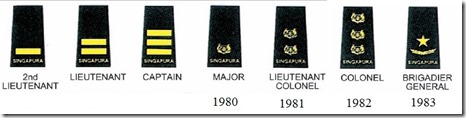
    Lee joined the SAF in 1971 and rose through the ranks to become the youngest BG in 1983 within a mere 13 years. Excluding the 5 years of studies funded by taxpayers, Lee achieved his miraculous promotion within 8 years. According to Dr Michael Barr, Lee “graduated in 1980 …by this stage he had risen to the rank of Major .. despite having only served for about three years on operational duty”.
    The interesting thing is Lee’s final years in the army where he had received a promotion every year from 1981 to 1983 without a single day in combat!

    In other democratic countries, it takes ‘forever’ to be promoted when one is already holding a very high ranking position. Guess our generals are not known as ‘paper generals’ for nothing.

    Lee’s phenomenal rise in the SAF?

    With a military career as smooth as silk, it is not that PM Lee doesn’t want to understand the reality of mere mortals like us but he really can’t.

    The table (below) is a summary of our paper generals.

    NAME ENLIST RESIGN YEARS RANK
    LEE HSIEN LOONG 1971 1984 13 BRIGADIER GEN
    TEO CHEE HEAN 1972 1992 20 REAR ADMIRAL
    LUI TUCK YEW 1983 2003 20 REAR ADMIRAL
    CHAN CHUN SING 1987 2011 24 MAJOR GEN
    TAN CHUAN JIN 1987 2011 24 BRIGADIER GEN

    * Lee Hsien Loong holds the world record for attaining the rank of BG in the shortest time, without any combat experience, in a democratic country. Our military is designed by scholars, for scholars. Every Tom, Dick and Harry scholar will become a general so long as he toes PAP’s line.

    PM Lee and DPM Teo were both born with a silver spoon in the mouth. One shouldn’t expect them to understand the struggles of ordinary/low wage citizens and PAP’s flawed policies confirm their disconnect.

    Real leaders should never be fast-tracked to top positions based on academic results. Currently, all paper generals are not really elected because of our unique GRC system designed to perpetuate PAP’s power.

    Running a government requires a consultative approach while it’s a top-down approach in the military. After years of a top-down approach, it becomes impossible to teach old dogs new tricks. Paper general George Yeo has already paid the price for not listening. Paper generals are failed politicians as is evidenced by their refusal to engage in a meaningful manner with their ‘wayangs’.

    Without a doubt, generals are army-trained and best left in the military. If paper generals can run our country, pigs should be able to fly.


    Source: http://likedatosocanmeh.wordpress.com


  • Hospital Job Applicant Got Turned Down Due to Hijab

    271509_10151256618777550_286369619_o

    lakeridge_health_ad.jpg.size.xxlarge.promo

    Today, I sent an email to the CEO of CGH enquiring on the discriminatory hiring practices employed by them. Hope to get a satisfactory reply.

    ——————————————————————

    Dear Ms Lilian Chew

    RE: DISCRIMINATORY HIRING PRACTICES

    I would like to bring your attention to a recruitment exercise that was conducted by Changi General Hospital on Thursday, 27 March 2014 at Tampines North Community Centre.

    Prior to the recruitment exercise, a seminar was conducted on Tuesday, 18 March 2014 at Northwest CDC Woodlands Civic Centre, by Health Management International and Institute of Health Science in collaboration with Changi General Hospital (CGH), Singapore General Hospital (SGH) and National University Hospital (NUH).

    I was informed by a friend that she had signed up for a Therapy Assistant course during the seminar and subsequently was called up to attend an interview on 27 March 2014.

    What happened next was no doubt an appalling experience no person should be made to go through. The first and only question the interviewer asked her was “Are you willing to remove your hijab?” When she replied no, the interviewer said, “Then there’s no point we continue this interview. You fail immediately.” Not being a confrontational person, she proceeded to leave the interview room.

    Therefore I would like to seek clarifications from you on a few matters;
    1) What is the hospital’s policy regarding recruitment of candidates wearing the hijab?

    2) Was the interviewer acting on his personal whims and fancies or is it the hospital’s policy to exclude and deny enrolment/recruitment to students/candidates wearing the hijab?

    3) Why candidates were not informed during the seminar that anyone wearing hijab is not welcomed to participate? So that potential candidates need not waste time, effort and money attending the interview just to get discriminated on.

    4) Why is the hospital discriminating against people who put on the hijab, the opportunity to learn and to seek knowledge?

    As an established organization that seeks to be a world class healthcare service provider, surely this kind of discrimination should not have existed if any.

    Singapore prides itself on a meritocratic system as highlighted by our prime minister on numerous occasions. To make an unjust or prejudicial distinction in the treatment of people is unacceptable.

    As a public hospital funded by tax-payers, it is in the interest of the public that the hospital make known of its hiring practices.

    I look forward to your reply on the above enquires.

    Thank you.

    Regards,
    Osman Sulaiman

    cc:
    Speaker of Parliament – Mdm Halimah Yacob
    Minister-in-Charge of Muslim Affairs – Assoc Prof Dr Yaacob Ibrahim
    Ministry of Manpower – Dr Amy Khor Lean Suan
    Acting Minister for Manpower – Tan Chuan Jin
    CEO Changi General Hospital – Dr LEE Chien Earn
    Deputy Director HR Management, Changi General Hospital – Darren Lim


    Source: Osman Sulaiman