Tag: Teo Chee Hean

  • WP’s Low Thia Khiang Hits Back At Teo Chee Hean, Calls For ‘Civilised’ Political Engagement

    WP’s Low Thia Khiang Hits Back At Teo Chee Hean, Calls For ‘Civilised’ Political Engagement

    Workers’ Party (WP) chief Low Thia Khiang yesterday (Aug 16) shot back at Deputy Prime Minister Teo Chee Hean’s recent withering attack on the opposition party and its leaders, by asking the public to judge the politics that the People’s Action Party (PAP) practises.

    “With all due respect, (Mr Teo) wanted to comment in that way, let Singaporeans judge and see this is the kind of standard of the PAP in politics. Is this the kind of politics we want in future?” said Mr Low. “What do we want the future of Singapore to be? Do we want to be more civilised in our political engagement? We are not a Third World country.”

    In a media interview last Friday, Mr Teo ripped into the WP for its handling of the financial lapses at its Aljunied-Hougang-Punggol East Town Council (AHPETC), and criticised Mr Low for shedding “crocodile tears” over the stepping down of Transport Minister Lui Tuck Yew.

    “It’s very in character for Mr Low to squeeze the most political mileage out of anything. The reasons that Tuck Yew decided to step down are known to everyone,” Mr Teo had said.

    Mr Low had earlier said that he was disappointed and could not understand why Mr Lui had chosen to leave politics at this point in time.

    Yesterday, he reiterated that his views on Mr Lui, whom he has known for several years from their interactions in Parliament, were authentic and “heartfelt”. Using a Chinese idiom, Mr Low said his comments on Mr Lui were grating to the PAP as “good and honest advice is unpleasant to the ears”.

    Describing Mr Lui as a “hardworking” minister, Mr Low said his departure from politics would be a loss to the Cabinet as he was accountable to Members of Parliament (MPs).

    Speaking to reporters at Chong Pang Market — where party supporters and members were greeting residents and selling its newspaper — Mr Low said: “He (Mr Lui) can even cite you details of very technical matters…(and) he doesn’t try to score political points in answering questions, neither does he try to find a way to try to attack or bully the Opposition.”

    WP chairman Sylvia Lim, who was part of the party entourage, said that the opposition party was “surprised” by Mr Lui’s decision to step down. She added that the WP was looking at the issue of collective responsibility of the Cabinet.

    Responding to Mr Teo’s criticism of the WP’s handling of the AHPETC saga, Ms Lim said it is for residents to decide if they have been taken care of.

    Hougang MP Png Eng Huat, who chairs the town council’s audit committee, said that the town council is seeking to close its financial year 2014/2015 accounts by August 31 – the deadline for all town councils. Any discussion on the town council’s financial position will be “more meaningful after that”, he said.

    Last Friday, Mr Teo pointed out that the Constitution guarantees there will at least be nine Opposition members in Parliament. He also said that the Opposition in Parliament had no bearing on the many policies introduced or refined by the PAP government since the 2011 General Election, as the foundation for these plans had been laid even earlier – a point that was echoed by Deputy Prime Minister Tharman Shanmugaratnam at a separate event.

    In response, Ms Lim noted that Singaporeans have already shown a desire for elected Opposition.

    “On the opposition front, we have to make sure that we continue to give Singaporeans a credible choice. It is up to Singaporeans to decide whether they are satisfied with constitutionally-guaranteed Non-Constituency MPs or whether they would like to have elected MPs governing their constituencies,” she said, adding that it is for voters to judge whether having Opposition MPs made the PAP more sensitive to their needs.

    Mr Teo also took a jibe at WP chairman Sylvia Lim who on Wednesday posted on Instagram a picture of herself eating at Fengshan Hawker Centre with the caption, “The taste of Fengshan — heavenly!”, and the hashtag #reasonstowin. On Thursday, Ms Lim posted a blank picture with the caption, “how to avoid speculation”, along with the hashtag #electionseason. Mr Teo said: “What’s going to happen? You’re going to swallow up Fengshan for what purpose? To serve the residents of Fengshan? Or is Fengshan delicious because you want to add it into the pot to help the town council with the deficit?”

    Ms Lim said: “I think it is a pity that (Mr Teo) doesn’t’ seem to have a sense of humour.” Yesterday, she put up another picture — of her with three other WP members in Chong Pang, which is the ward of Law and Foreign Affairs Minister K Shanmugam — with the caption, “In the den of my ‘favourite’ Minister… Better move in groups.”


    Source: www.todayonline.com

  • Teo Chee Hean Slams WP Over Town Council Issue

    Teo Chee Hean Slams WP Over Town Council Issue

    The gloves are off.

    Deputy Prime Minister Teo Chee Hean unleashed some of the sharpest verbal attacks in the election season so far when he took aim at the Worker’s Party handling of Aljunied-Hougang-Punggol East Town Council (AHPETC).

    It was meant to be a Meet-the-Media session before the “sound and fury” of the election overwhelms the fundamentals of choosing a candidate to secure Singapore’s future.

    But the Minister of Home Affairs delivered some of the fury himself when he was asked about what his People’s Action Party (PAP) would do if it wins back Aljunied GRC.

    The first priority for the PAP, if elected, would be to “go in and sort out the mess in the town council”, said Mr Teo.

    The PAP’s first assistant secretary-general noted that under the PAP previously, Aljunied GRC and Punggol East SMC were running healthy surpluses before they were amalgamated into AHPETC.

    Mr Teo said: “Now the whole AHPETC is in deficit. How did that happen? How did a large surplus turn into deficit? Where did the money go?”

    Mr Teo even took a swipe at AHPTEC chairman Sylvia Lim for her recent Instagram post, which fuelled rumours of her possibly running in Fengshan SMC.

    The photo showed Ms Lim sampling fried oyster omelette with the caption “The taste of Fengshan – heavenly! #reasontowin”.

    Mr Teo said: “Now we see the chairman of the town council saying that Fengshan SMC looks quite delicious. What’s going to happen? You’re going to swallow up Fengshan? For what purpose? To serve the residents of Fengshan? Or is Fengshan delicious because you want to add it to the pot? And help the town council with the deficit?”

    RISKS

    Political analyst Eugene Tan said: “These potshots are clear indications that the gloves have come off even before the word go.

    “PAP is clearly going on the offensive. Essentially, it is going for WP’s Achilles’ heel, which is the AHPETC issue.”

    Added the associate law professor at Singapore Management University: “It appears that PAP will keep hammering home this matter… And this may instead be perceived to be patronising to voters.”

    Meanwhile, Institute of Policy Studies senior research fellow Gillian Koh said this was an ongoing issue that will be brought up constantly throughout the hustings period.

    “It is just inevitable that after four years, this issue will crop up, especially since PAP values accountability, transparency and honesty.”

    Party veteran Emeritus Senior Minister Goh Chok Tong was also in a fighting mood during a speech last night. (See report above.)

    On the selection of MPs, he said: “At the very least, they must be able to run a town council in a transparent, accountable and responsible manner.”

    Mr Teo said there is a difference between individual mistakes and major lapses in financial accounting. Armed with the Auditor-General Office report on the issue, he said it was a “blanket assessment that their financial accounts can’t be relied upon. That’s quite serious.”

    That was why he could not leave it alone, he said.

    When asked if voters would be turned off by PAP’s overly critical comments, he replied: “Well, I think it is an important issue and a fairly fundamental one. You want to say you are setting yourself up as an alternate government. You must be at least able to run a town council… We should not keep quiet about it.”

    It is not only about competence, but also about integrity when choosing MPs, he said.

    In the wide-ranging session, the DPM was also asked about WP leader Low Thia Kiang’s thinly veiled criticism when he asked if the departure of Transport Minister Lui Tuck Yew was because he “has not been supported by his Cabinet colleagues”.

    Mr Teo dismissed it as “crocodile tears”

    He said: “I think it’s very characteristic of Mr Low to squeeze the most political mileage out of anything. I’m sure if his party had contested where Mr Lui stood, he wouldn’t be saying nice things about him.”

    Recognising that the electorate would want opposition voices, he noted that the Constitution provided for nine opposition members in Parliament. He said: “Make sure you vote for a candidate and a party whom you really want to place your future in the hands of. Make sure they’re the ones you want to manage your money and your town council.”


    “These potshots are clear indications that the gloves have come off even before the word go. PAP is clearly going on the offensive. Essentially, they are going for WP’s Archilles heel, which is the AHPETC issue.”

    – Political analyst Eugene Tan, who warned that this tactic may backfire on the PAP


    Source: www.tnp.sg

  • Holistic Approach Needed To Fight Religious Extremism

    Holistic Approach Needed To Fight Religious Extremism

    Identifying weak religious grounding as a common trait among radicalised individuals here, national leaders yesterday reiterated the need for a holistic approach to counter the threat of terrorism.

    Speaking at the East Asia Summit Symposium on Religious Rehabilitation and Social Integration, Deputy Prime Minister Teo Chee Hean said: “One common characteristic that has been observed among radicalised individuals that we have investigated in Singapore is that they possess weak religious grounding.”

    He added that this made the individuals “more susceptible to believing wholesale the radical exhortations that distort religious concepts to give their message of violence an aura of divine sanction”.

    Since the first arrest of alleged Jemaah Islamiyah (JI) members here, religious scholars and teachers have embarked on a counselling programme to debunk radical ideas, said Mr Teo, who is also Home Affairs Minister.

    Speaking to reporters on the sidelines of the event, Law and Foreign Affairs Minister K Shanmugam said that a holistic approach cannot only involve “kinetic power or arresting people”.

    Stressing the importance of showing radicalised individuals “the right approach to religion”, Mr Shanmugam said: “When you radicalise a person you are creating a human bomb … you can arrest and put him in prison, you can also try to de-radicalise by getting him to see the real aspects of religion.”

    While religious leaders here have been reviewing the curriculum and enhancing training of Islamic teachers, challenges abound, said Singapore’s mufti, Dr Fatris Bakaram.

    For instance, some preachers and leaders are reluctant to correct popular misconceptions “because they have this worry of being unpopular”, he said. He added: “Preachers and teachers have to stand up, have to develop their self-confidence, that they are part of the whole responsibility to guide youths.”

    Dr Fatris said that the young today exhibit an increased sense of “restlessness to fight injustices”. They should be given the right platforms to further their desire for social justice, he said. “The younger generation has the energy and drive to change the world, and that has to be acknowledged.”

    For instance, Islamic studies graduates have been employed as youth development officers in local mosques to assure young Muslims here that they have important and active roles to play in the religious community, he said. “When (the youths) feel they are appreciated, that they are given the trust and confidence to contribute, I think that will provide effective safeguarding them from being deceived by the extremists.”

    Dr Fatris added that while terrorism cannot be isolated as a “Muslim problem”, Muslims must not shy away from it. “We have to acknowledge that this is the issue of the day affecting global communities … extremist groups have been using, or abusing, the name of Islam … It is not to say that Islam itself is the source of the problem, but the misunderstanding of Muslims and their religion is the thing we have to address,” he said.


    Source: www.todayonline.com

  • Paper Generals Should Be Left Out Of Politics

    Paper Generals Should Be Left Out Of Politics

    The Singapore Cabinet comprises the PM, 2 DPMs and 15 ministers. 5 of them, or slightly more than a quarter, had been generals/equivalent in the military before becoming politicians.

    Another country with many high ranking military officers in the government is North Korea. Myanmar which used to parachute generals into top positions in the government have recently begun a cabinet reshuffle to replace ministerial positions held by the military with scholars. It appears Singapore has regressed – the number of ex generals increased after the last election (ex general George Yeo replaced by Chan Chun Sing and Tan Chuan Jin).

    Military men do not make good leaders in the government for the simple fact that they are used to giving orders. They are not listeners but control freaks. This is evident in Singapore where the mainstream media, grassroots organisations and government bodies continue to be controlled by the PAP.

    Our leader, PM Lee, is himself an ex general, the youngest in Singapore’s history. That PM Lee does not listen is obvious from his ‘solutions’ to our chronic problems ie.

    – Overcrowding/increased cost of living – increase the population to 6.9 million under PAP’s PWP.
    – CPF retirement shortfall – sell HDB homes and downgrade with assistance from HDB.
    – CPF and statutory board failure – edit government web pages and continue to conceal data from the public.
    – High cost of public housing – change the Resale Price Index to make prices look lower.
    – Rat infestation – HDB, town council and NEA not responsible but blame feeding of stray dogs.
    – Foreigners displacing Singaporean employees – employ more foreigners because Singaporeans are overpriced and foreigners help to create jobs for us.
    etc.

    Ten years under ex-general PM Lee’s leadership, Singaporeans have only experienced policy failure after failure. Instead of addressing them, the PAP only masks its failure with the implementation of the PGP, dishing out more grants, shoves its own ‘right’ version of Singapore’s history down our throat, attempts to control online media, silence the CPF ‘noises’ at Hong Lim Park, etc.

    What’s worse about our system is that ALL the generals DO NOT have any combat experience. These paper generals have been fast-tracked because of their stellar academic results and nothing else. What are their real achievements? Transformation of the army by throwing tax dollars at costly state-of-the-art weapons? Introducing pixelised uniforms which have been ditched by the US army? It’s a waste of tax dollars to have about 20 to 30? paper generals on a little red dot.

    SAF/President’s scholars are destined for top jobs in the military since day one. These scholars are ‘untouchable’ and their superiors are acutely aware of their limitations. They simply are not able to understand what the rank and file/ordinary citizens go through.

    The 5 (ex) paper generals in our cabinet are:

    1 (Major General) Chan Chun Sing

    Chan is a PAP MP of Tanjong Pagar GRC which was a walkover in the 2011 election. As such, the popularity or unpopularity of Chan is unknown. Chan has not even spoken at an election rally but from this video, you can be certain he will be a flop without the GRC system.
    Chan has not worked a single day in the private sector and his understanding of local issues is suspect. He served in the army from 1987 to 2011 and was (coincidentally) promoted to army chief during his last year in the army.

    Chan was promoted to Brigadier General (BG) in June 2007. Three short years later, he was promoted to Major General (MG) without accomplishing anything significant. He stayed on as the chief of army and ‘retired’ after only 1 year of service/OJT, wasting precious tax dollars. If Chan had already decided to go into politics, he should have allowed others who would have stayed on to contribute to the army. Or was Chan promoted to look better in politics? Combat experience – zero.

    2 (Brigadier General) Tan Chuan Jin

    Like Chan, Tan also served in the army from 1987 to 2011. Among all the newbie ministers, Tan was the most respected. But from Tan’s handling of the CPF issue and the MOM’s reluctance to address the flawed immigration policy, Tan’s credibility has taken a beating. Tan’s fast-tracked career in the military has disconnected him from ordinary citizens. He has yet to realise PAP’s policy failure and prefers to continue with tweaks.

    3 (Rear Admiral) Lui Tuck Yew

    As an SAF scholar, Lui was fast-tracked to top navy position within 20 years, including his taxpayers-funded studies of course. He was also the CEO of HDB in 2005.

    4 (Rear Admiral) Teo Chee Hean

    Like scholar Lui, Teo’s military career saw him promoted to head the navy within 20 years.

    5 (Brigadier General) Lee Hsien Loong

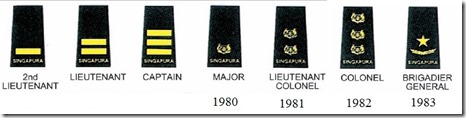
    Lee joined the SAF in 1971 and rose through the ranks to become the youngest BG in 1983 within a mere 13 years. Excluding the 5 years of studies funded by taxpayers, Lee achieved his miraculous promotion within 8 years. According to Dr Michael Barr, Lee “graduated in 1980 …by this stage he had risen to the rank of Major .. despite having only served for about three years on operational duty”.
    The interesting thing is Lee’s final years in the army where he had received a promotion every year from 1981 to 1983 without a single day in combat!

    In other democratic countries, it takes ‘forever’ to be promoted when one is already holding a very high ranking position. Guess our generals are not known as ‘paper generals’ for nothing.

    Lee’s phenomenal rise in the SAF?

    With a military career as smooth as silk, it is not that PM Lee doesn’t want to understand the reality of mere mortals like us but he really can’t.

    The table (below) is a summary of our paper generals.

    NAME ENLIST RESIGN YEARS RANK
    LEE HSIEN LOONG 1971 1984 13 BRIGADIER GEN
    TEO CHEE HEAN 1972 1992 20 REAR ADMIRAL
    LUI TUCK YEW 1983 2003 20 REAR ADMIRAL
    CHAN CHUN SING 1987 2011 24 MAJOR GEN
    TAN CHUAN JIN 1987 2011 24 BRIGADIER GEN

    * Lee Hsien Loong holds the world record for attaining the rank of BG in the shortest time, without any combat experience, in a democratic country. Our military is designed by scholars, for scholars. Every Tom, Dick and Harry scholar will become a general so long as he toes PAP’s line.

    PM Lee and DPM Teo were both born with a silver spoon in the mouth. One shouldn’t expect them to understand the struggles of ordinary/low wage citizens and PAP’s flawed policies confirm their disconnect.

    Real leaders should never be fast-tracked to top positions based on academic results. Currently, all paper generals are not really elected because of our unique GRC system designed to perpetuate PAP’s power.

    Running a government requires a consultative approach while it’s a top-down approach in the military. After years of a top-down approach, it becomes impossible to teach old dogs new tricks. Paper general George Yeo has already paid the price for not listening. Paper generals are failed politicians as is evidenced by their refusal to engage in a meaningful manner with their ‘wayangs’.

    Without a doubt, generals are army-trained and best left in the military. If paper generals can run our country, pigs should be able to fly.


    Source: http://likedatosocanmeh.wordpress.com


  • Reprint of The Battle For Merger Launched

    Reprint of The Battle For Merger Launched

    SINGAPORE: A reprint of the book The Battle For Merger – which contains a series of 12 radio talks written and given by former Prime Minister Lee Kuan Yew between Sep 13 and Oct 9, 1961 – was launched by the National Archives of Singapore on Thursday (Oct 9).

    Originally published in 1962, it gives a vivid account of the then ongoing political struggle over the merger. But while the context of the talks was merger, the key focus was to expose the communists – who they were, how they operated and what their real aims were in opposing merger.

    Present at the launch was Deputy Prime Minister and Home Affairs Minister Mr Teo Chee Hean, who said that the reprint comes as Singapore celebrates it’s 50th anniversary in 2015 – a significant milestone, especially as the country considers its “precarious and tumultuous beginnings”.

    He noted that today the events surrounding merger are no longer at the forefront of the minds of Singaporeans – with the younger generation, especially those born after 1965, having no personal memory of these events. Mr Teo said that he hopes the re-publication of the book will awaken the interest among younger Singaporeans to the events of this period of history, as well as provide a “reality check” to revisionist views.

    Mr Teo had pointed out that some revisionist writers have attempted to recast the role played by the communists and their supporters on the merger issue, portraying the fight as a peaceful and democratic disagreement over the type of merger – this while ignoring the more fundamental agenda of the communists to seize power by subversion and armed revolution.

    He said the spirit of pioneers to rise above hardships of the moment, including the threat of communism, and focus on making Singapore a better country for the next generation is an inspiration for all Singaporeans. “This spirit, epitomised in The Battle For Merger, is a precious heritage which we all as Singaporeans should honour, recognise and emulate,” added Mr Teo.

    Featuring photographs, newspaper articles and other artefacts, an exhibition is also being organised to accompany the re-launch of the book.

    Held at the National Library Building, the exhibition is open to the public from Oct 9 to Nov 30. It will then travel to public libraries including Jurong Regional Library and Ang Mo Kio Public Library.

    Source: http://www.channelnewsasia.com/news/singapore/reprint-of-the-battle-for/1405456.html