Tag: Thaipusam

  • Why Not Make Thaipusam A National Holiday Again Alongside Deepavali, CNY And Hari Raya?

    Why Not Make Thaipusam A National Holiday Again Alongside Deepavali, CNY And Hari Raya?

    Another year, another incident. You’ve probably seen it – that viral video taken at the Thaipusam procession, or at least heard of its existence: How a volunteer officer from the Hindu Endowment Board (HEB) allegedly disrupted a procession over the use of musical instruments and amplification.

    Netizens have criticised the HEB and the authorities for disrupting the procession. Several in the Hindu community that The Pride spoke to feel that the authorities should allow them to carry out their religious rites without interference. The authorities have clarified that they have been accommodating to the Hindu community even if some may have broken the law, and the HEB has also since stated that the most recent incident has been settled amicably with the devotees.

    Yet, each year, what is supposed to be a joyful, religious festival for the Hindus seems only to be remembered for the disputes between devotees and the authorities.

    There have been umpteen calls to lift the ban on musical instruments at the procession – a ban which was put in place to control the noise levels. Those arguing against the ban often point out that lion dance troupes make plenty of noise – in public – too.

    Lion dance troupes with their drums and cymbals that are so active during the Chinese New Year period are arguably a lot noisier and affect far more people over a longer period than the Thaipusam devotees with their hand-held instruments and amplified voices, but Law Minister K Shanmugam, in a Facebook post made three years ago, said that lion dance troupes perform during social or community events and not religious events.

    This ban on music is not in place to discriminate against Hindus. Mr Shanmugam said that Hindus are given exemption from the law against religious foot processions during Thaipusam. He added that the Thaipusam procession goes through major roads – a privilege not afforded any other religious group.

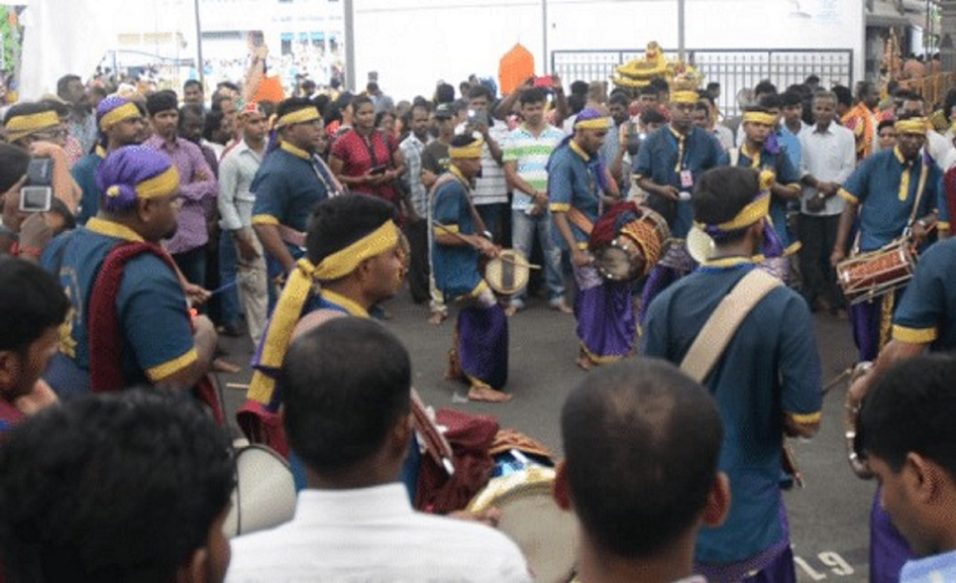
    The procession is by no means a silent one: This year, there were 19 points along the 3.1km stretch from which music was transmitted and three stages along the route where live music was played.

    Retired police officer M Kunalan, 70, carried the spiked kavadi several times during his younger days. He says that there are troublemakers among the younger group of devotees who challenge the authorities and play their music loudly, disturbing the peace in what is supposed to be a solemn occasion.

    “These groups should be investigated and brought to task under the law. They bring shame to the Hindu community during a sacred festival,” he told the Pride.

    But is there a way to be even more accommodating to the Hindu community? Could there be more done to ensure that they are allowed to celebrate Thaipusam – which is to mark the victory of the deity Lord Murugan over evil?

    How about making Thaipusam a national holiday?

    The procession, with devotees bearing elaborate kavadis, is in itself a spectacular affair and communities other than Hindus or the predominantly Tamil devotees could join in the celebrations as respectful observers. Tourists could also soak in the festivities of such an event.

    “Thaipusam is not an easy event to organise. Logistically, it can be a nightmare and the devotees, even those who carry the kavadi, have to go through the added hardship of not having a public holiday on such an important occasion. Making it a holiday would go a long way in helping the Hindu-Tamil community,” said Mr Kalidass SKS, managing director of a security services company.

    The last time a call to turn Thaipusam into a holiday was in 2015, and the Ministry of Manpower (MOM) explained in nine points why not having it as a holiday would best serve Singapore. Thaipusam used to be a public holiday until 1968.

    It is regarded as a religious holiday, but if you considered it a holiday for Indians, which are largely represented by the Tamil community, there seems to be a fair argument for its reinstatement as a public holiday: The Chinese have two days – the first two days of the Chinese New Year, the Malays have Hari Raya Haji and Hari Raya Puasa, and the Indians currently have only Deepavali as a national holiday. Making Thaipusam a public holiday would mean the three main races of Singapore have two public holidays each.

    According to the MOM then, “the decision on which public holidays to give up was reached only after careful consultation with religious groups”.

    But that was in 1968. And the only religious festival that seems to be experiencing any sort of problem appears to be Thaipusam. Could we not all give up one day of work so that Thaipusam can get the space it needs?

    Residents in the area would probably be more forgiving of noise created as a result of the festivities if it were a holiday. Organisers of the procession would have a bigger pool to choose from for volunteers and helpers at the occasion. There will be less inconvenience to traffic if it weren’t a working day. And everybody in Singapore would begin to think of Thaipusam as a Singaporean religious festival instead of dismissing it as a day when Indians struggle in their fight against evil.

    MOM also explained that when the number of public holidays was set at 11 in 1968, the reason was this: “Faced with the British withdrawal and the need to compete in global markets, the government decided to reduce the total number of public holidays, among other things.”

    So never mind the music for now: The British have long departed. Singapore is suitably plugged into and very competitive in global markets. We could leave it to the economists to determine if one day less of work would plunge our economy into recession, and trust that city-planners and the Singapore Tourism Board would capitalise on the event to promote Singapore as a culturally rich and diverse destination.

    So, as the majority of Singaporeans prepare to celebrate Chinese New Year, which is just around the corner, perhaps it’s time to consider giving our Indian countrymen another public holiday.

    Source: PrideKindnessSg


    Rilek1Corner
  • Thaipusam: Sweet Music, Noise, Or Public Disorder?

    Thaipusam: Sweet Music, Noise, Or Public Disorder?

    By M Ravi

    Thaipusam and the Right to Religious & Cultural Practice in Singapore

    Thaipusam has been an integral part of my religious and cultural upbringing. As a child, I attended, supported and even participated in the festival. Singapore’s Tourism Board lists Thaipusam as an event in its rich diverse cultural heritage calendar. Each year, the streets are lined with supporters, devotees and curious tourists alike. The festival, however, has been shrouded in controversy in Singapore – the consequence being that thousands of Singaporeans would rather chose to flock to Batu Caves in Malaysia to celebrate the festival.

    The reason for the controversy was a 42-year-old ban on the playing of live music during the festival. First imposed in 1973, the government argued that the blanket ban on loud live music was necessary to quell disorder as several fights often disrupted between competing groups, thus disrupting the procession and risking the lives of spectators and accompanying supporters.

    I have written previously about this “Silenced Festival” in my book Kampong Boy and how in 2011, I myself stepped up as a plaintiff with the Attorney-General’s Office and the Hindu Endowments Board (HEB) that is responsible for running and organising the festival, as the defendants. This was the first time someone challenged the live music ban in court. Unfortunately, my legal action before then Justice Steven Chong, did not succeed due to the points I listed in the book.

    The Legalities

    Article 15(4) of the Constitution gives the executive branch of the government the broad authority to restrict the practice of religion in accordance with the law – the caveat being that the decision-maker’s power to do so may be challenged in Court. Additionally, the Public Order Act and its related regulation empower the Commissioner of Police to impose such conditions as he deems fit for the purposes of making an application for a licence to hold a public assembly or a public procession.

    Of particular relevance to Thaipusam are regulations 8(1)c and 8(2)c which do not permit singing or music, gongs, drums or the playing of music-producing equipment. Also public processions require permits and applications which also have conditions attached.

    2015 Case

    In 2015, three men were arrested during a scuffle which took place during a Thaipusam festival. In the ensuing case, Vijaya Kumar s/o Rajendran v Attorney-General, the three Applicants cited their constitutional rights to freedom of religious practise and equality before the law to challenge the conditions which prohibited the use of musical instruments (other than at certain fixed points) during the procession.

    The Applicants argued that music from an urumi is a fundamental aspect of the religious practice of marching in the Thaipusam procession and that the music conditions imposed constituted a breach of their rights to practice their faith without interference.

    The case raised important questions including firstly, the proper meaning of the term “public order” under Article 15(4) of the Constitution, secondly, the type of state interests which can justify restricting a religious liberty, thirdly, the degree of harm that must be posed by a religious liberty before it can be restricted, and fourthly, whether the possible hostility of third parties to a person’s peaceful exercise of faith can be deemed as constitutionally relevant under the “public order” consideration.

    I got involved in the case through my connections with the legal team at Eugene Thuraisingam LLP representing the Applicants. Everything balanced on being able to prove that the relevance of musical instruments was an integral part of Thaipusam and therefore to the practice and religion of Hinduism. We tried to find experts in Singapore who were able to affirm the position in our favour. We were confronted with the reality that as most temples in Singapore are affiliated to the government’s HEB, no one was willing assist the Applicants. I recall the day, I travelled with Eugene Thuraisingam who led the legal team to seek Hindu experts from across the border who were willing to share the history and origins of the procession and to explain the relevance of music and devotional songs played during the festival. We were thrilled to find Tan Sri Datuk R. Nadarajah, Chairman of the Batu Caves temple in Kuala Lumpur.

    The expert stated that the “playing of the musical instruments forms an integral and inseparable part to the carrying of the Kavadis” because the music facilitates the Kavadi carriers to “enter into a trance” which then enables them to bear the enormous physical burden and pain of weight of the hoisted Kavadi. The music is an essential part not just to the procession but also to the “nature of worship”. The expert’s affidavit went as far as to state that the taking away of the musical instruments would be “traumatic” for the Kavadi carrier as the trance will be broken and he will feel immense physical burden and unbearable pain from the body piercings. Without the music, the devotee is more likely to be “distracted from focusing on the divine”.

    In the end, the High Court dismissed the application on the grounds that the public order proviso to freedom of religion was made out, and the differential treatment was justified. The Applicants appealed, but later decided to withdraw their case in the light of increased dialogue between interested parties and the announcement by the government to relax the live music rule.

    Music to the Ears – Latest Developments

    In 2016, Hindu devotees in Singapore received their first bout of good news. The 42 year old ban on live music was lifted and live music was allowed to be played from 3 stages at different points during the procession. Broadcasted music was also permitted at 7 other locations. The Chairman of HEB was able to proudly announce that “there won’t be a stretch that is without music”. He also added, “The kavadi bearers pierce their bodies, causing enormous pain, as part of the vows they have taken. The music will be useful in reducing the pain and enhancing their spiritual focus throughout their journey.

    The latest bout of good news came last week. This year’s festival which will fall on the 9th of February, will see music broadcasted at 23 points along the 4km stretch. Live music will be continued to be played at 3 stages where musicians will play traditional classical Indian instruments so that the younger generation understands their rich cultural heritage and be interested to learn these instead of the modern western style drums and bongos which have appeared at the festival in recent years.

    No doubt tremendous progress has been made to listen to feedback from the Hindu community and from devotees. Participants are still not yet allowed to bring their own musicians or musical instruments and some restrictions remain. I personally hope some faith will be restored in the celebration of this festival in Singapore and that fewer Singaporean Hindus see the need to cross the border to partake in such a monumental and colourful festival.

    As I wrote in my book, it is hard to think that over 155 years of tradition and devotion could be “cowed into quietude”.


    Source: www.theonlinecitizen.com

  • Malaysian Cops Hunting For “Thaipusam Moral Police”

    Malaysian Cops Hunting For “Thaipusam Moral Police”

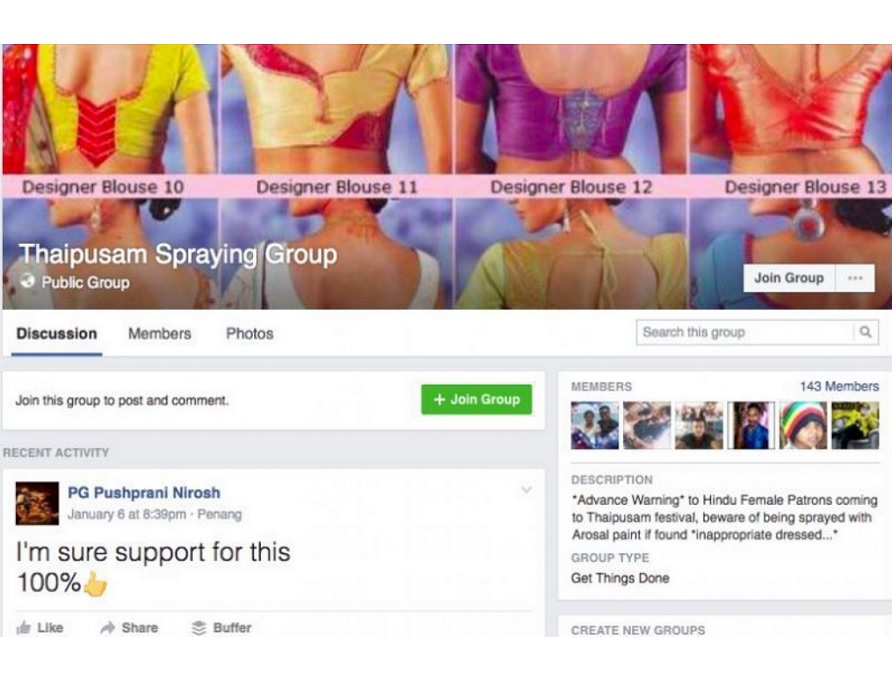
    Malaysian police said they are trying to track down those behind a Facebook group that threatened to spray paint the bodies of Hindu women who dress “inappropriately” during the Thaipusam festival next month.

    In a report by The Star Online, the police urged the public to inform them of any relevant information regarding the “Thaipusam Spraying Group”.

    “What these individuals are planning to do is unlawful, and we will not allow it.

    “If anyone is caught breaking the law, they will be dealt with,” Selangor police chief Commissioner Abdul Samah Mat told the portal.

    Mr Abdul Samah assured the public that the police will maintain security during the festival, celebrated with processions towards temples such as in Batu Caves and George Town.

    Meanwhile, Hindu Sangam Religious Advisory Board member Dr Thilagavathy Kanagaretnam was reported defending the group, claiming that its intention to prevent women dressed inappropriately was not wrong.

    Despite that, Dr Thilagavathy admitted that their planned actions were “drastic”.

    Thaipusam Task Force coordinator G Gunaraj was also reported saying that it will not condone such vigilantism.

    “There is a dress code that should be followed and we can only educate people to follow it. We can’t force them and it is not right to do so,” Dr Gunaraj said.

    The public Facebook group called “Thaipusam Spraying Group” was recently created by one “Henry Barnabas”, with more than 140 members at the time of writing.


    Source: Today

  • Government Agrees To HEB Recommendations For Thaipusam

    Government Agrees To HEB Recommendations For Thaipusam

    The Government has agreed to most of the recommendations by the Hindu Endowments Board (HEB) on Thaipusam, which includes reinforcing the ban on the sale and consumption of alcohol during the annual procession.

    More religious music for devotees in the form of “music points” at seven locations on the Thaipusam route will also be added, said the HEB in a press release on Wednesday (Dec 2).

    The third recommendation, which calls for the improvement of the movement and flow of devotees along the route, will allow for the last kavadi – intricate structures of steel and wood incorporating body piercings – to leave the Sri Srinivasa Perumal temple at 7pm.

    These come after HEB completed a public feedback exercise – conducted over 10 sessions with more than 100 participants – on the religious festival.

    HEB said it had taken “serious note” of the Government’s view that the primary concern was to tackle disorderly behaviour  that occurred during the procession earlier this year.

    The Feb 4 procession was marred by the arrest of three Singaporean men who were involved in a scuffle with police officers along Desker Road.

    The trio were said to have hurled vulgarities at officers and injured one of them. They were later charged for disorderly behaviour and attacking police officers.

    They were allegedly part of a group which hired drummers in the procession, with the altercation arising when they were told by the police to stop playing.

    The incident, which was further inflamed by untrue remarks spread on social media, sparked a public outcry over the banning of music at Thaipusam, and led to Law Minister K. Shanmugam addressing the issue.

    In a separate statement, the Singapore Police Force (SPF) said its priority was to ensure public safety and maintain law and order.

    It added that the foot procession “presents unique challenges in maintaining law and order”, as it draws around 10,000 devotees who walk more than 3km through the heart of Singapore over 26 hours. Thousands of supporters and onlookers also throng the route.

    “The Police’s approach is to strike a balance between facilitating the procession and ensuring law and order,” said the statement.

    “The actions of a few individuals can easily disrupt the event and risk the safety of other devotees and the public.”

    Besides agreeing to the seven additional music points, which include four music transmission points and three live music instrument points, the SPF is also introducing resting bays and a dedicated lane for women and children devotees along Clemenceau Avenue.

    HEB added in its press release: “The vast majority of participants are law-abiding and fulfil their religious obligations in an orderly manner. It is a small minority who seem to cause disturbance.

    “Rules are therefore needed to ensure that the majority enjoy a safe and orderly Thaipusam.”

    Later this month, HEB will start briefing participants of next year’s Thaipusam, which takes place on Jan 24.


    Source: www.straitstimes.com

  • In Face Of Rising Religiosity, Keep Faith With The Secular State

    In Face Of Rising Religiosity, Keep Faith With The Secular State

    For those like me who believe that rising religiosity is the greatest pressure on the status quo in Singapore now, and for decades to come, the City Harvest trial has been a bellwether saga.

    Since its start in 2012, the criminal investigation and judicial proceedings against six leaders of one of the largest and most powerful churches in Singapore have been a delicate balancing act for the secular state.

    Can it punish the City Harvest Church (CHC) leaders while reaffirming the church’s freedom of worship? Can it hold its religious leaders to account and persuade their flock, 30,000 Singaporeans at its peak, to accept the legitimacy of secular judgment?

    The verdict last week that found all six guilty, capping a 140-day trial that lasted two years, has answered some questions while making others more urgent.

    The words and actions of current and former CHC leaders in the aftermath of the verdict have raised eyebrows among many secular observers.

    As many have noted, in the matter of the misuse of $50 million of church funds, Kong Hee has persisted in referring to himself and the other five as “accused” persons rather than convicted ones; his apology to his congregation last week was for the “pain and turmoil” caused to them in the form of external criticism – not for his criminal actions.

    CHC pastor Aries Zulkarnain, in explaining the verdict to the congregation, said the church leaders were saddened by the verdict, but “respected” it.

    This word choice is significant and deliberate: respect is not the same as acceptance.

    As the six have yet to be sentenced, let alone indicate whether they will file an appeal, expressing an acceptance of the guilty verdict may thus be premature at this stage.

    But some see the public statements made last weekend as an implicit challenge to the secular judiciary’s judgment, through a differentiation of said judgment from the moral judgment of the church’s belief system.

    Such a dynamic emerges from another recent collision between the state and the religious authorities.

    In 2012, the Faith Community Baptist Church (FCBC), led by Pastor Lawrence Khong, fired a member of the church staff because of her adulterous relationship with a married church worker.

    Because she was seven months pregnant at the time, then Minister for Manpower Tan Chuan-Jin said the church should pay her $7,000 in salary and benefits.

    This was premised on the Minister’s judgment that the worker was sacked without sufficient cause. Under the Employment Act, an expectant mother from her fourth month of pregnancy must be paid benefits if she is sacked without sufficient cause.

    Mr Khong’s counter was that since the church is a moral body, persistent adulterous behaviour was “sufficient cause” for dismissal.

    The church petitioned the High Court for a legal review of the Minister’s decision, a challenge it unexpectedly dropped earlier this year. It said it had come to understand the rationale for the Minister’s decision and now “accepted” it.

    It is important here to understand why these two cases differ in kind, not just degree, from other recent headline-making incidents involving religious or racial groups.

    Petitions for the Government to allow the hijab, the Muslim headdress, to be worn by nurses in public hospitals who wish to do so, or petitions for musical instruments to be played during the Thaipusam procession are seen as challenges on the “common space” the Government believes must be kept race- and religion-neutral.

    This common space is fundamental to the peaceful functioning of Singapore’s multiracialism – a founding principle of Singapore’s secular state.

    The aforementioned groups want the secular state to carve out concessions from the common space to fulfil their desire for religious self-expression. The Government has hitherto, citing the pressures of snowballing demands, declined. This push and pull is the normal, healthy workings of a diverse society.

    But the FCBC case is not a challenge on the common space. It challenges the authority of the secular state – whether the political leaders or the judicial authorities – to determine the perimeters of the common space.

    The implicit argument it posed was that the morality of its belief systems stand equal, if not above, secular judgment.

    Ultimately, its church leaders decided not to pursue that argument but to cede to secular authority.

    In the CHC’s case, the legal process is ongoing but the six leaders have submitted to the workings of secular law.

    So the status quo can be said to have prevailed in both cases.

    But it would be naive to think that the rising religiosity, demonstrated in these cases, has not detracted from the secular state’s authority over the common space.

    In recent years, for example, there has been an assertive religious campaign to keep in place the section of the Penal Code which criminalises gay sex, Section 377A.

    This assertiveness has sent the signal that any repeal – rightfully a decision solely of the elected legislature – will lead to aggressive pushback against secular authority.

    To avoid such a collision, it is likely the Government will not consider repealing the law for, perhaps, at least one generation.

    This is yet another occasion in a long journey of rising religiosity finding an equilibrium with the secular state.

    Two major reasons give me optimism that secularism will prevail. The first is that Singapore, as befits its youthfulness, is starting this chapter later than other advanced economies with secular governments.

    What has emerged elsewhere is not pretty. Whether political gridlock in the United States driven by the growing influence of the religious right in the Republican party, the emergence of racial and religious enclaves in many parts of Europe or incidents of religion-related violence in many parts of the world, these trends should push popular support here behind a strong, secular state.

    The second and more important reason is that Singapore is, by default, multiracial and multi-religious.

    Few places in the world started off heterogeneously and have entrenched heterogeneity.

    Philosopher John Rawls made his name with a thought experiment that imagined a group of people designing the rules of a society they would live in, without knowing who they would be- rich or poor, male or female, Christian or Hindu, able-bodied or disabled.

    He argued that this ignorance would lead to a societal design that gave everyone the most liberties possible without infringing on the liberties of others – because who would take the chance of ending up at the mercy of a skewed system?

    Singapore’s mix of religions and races could be seen as a real-life corollary of this thought experiment.

    No one can imagine themselves out of their identities. But living with those of other races and religions can be a daily reminder that the only thing that guarantees your own choice of god and good is a secular state that stays silent on the merits of that choice.


    Source: www.straitstimes.com