Tag: tradition

  • Reliving The Golden Age Of Malay films

    Reliving The Golden Age Of Malay films

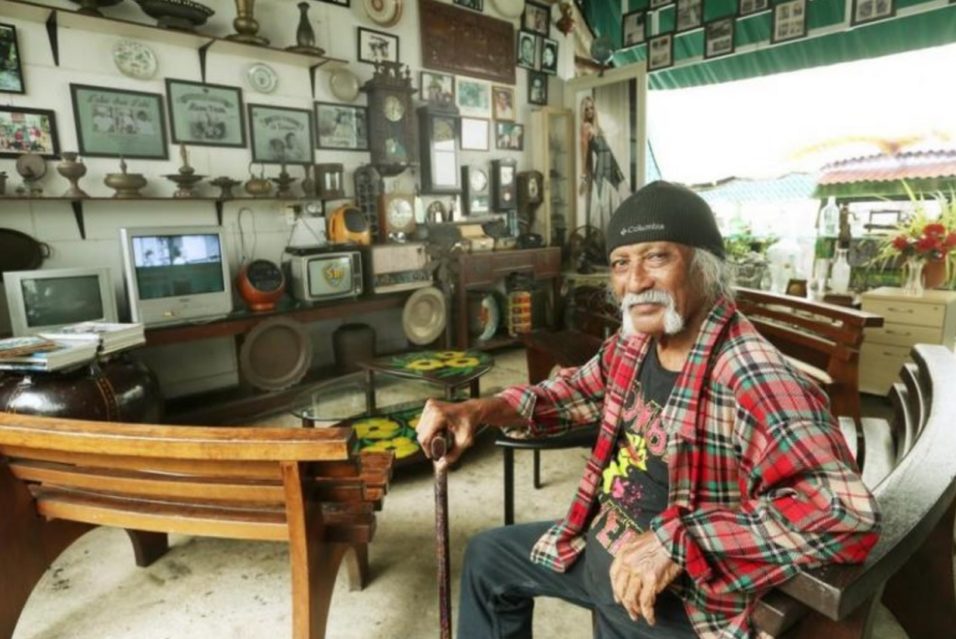
    As a teenager, Mr Jumahat Abu Bakar would peer through the gates of the Malay film studios in Jalan Ampas, hoping to catch a glimpse of actors such as the famed P. Ramlee.

    In 2012, when he was offered a caretaker job at the studios, located off Balestier Road, he leapt at the chance, even at the age of 70.

    The first thing he did was spruce up the studios, which stopped operating in 1967. He put up photos of old artists and painted the walls with a nostalgic motif featuring bamboo shoots and sugar cane.

    On Sunday (Aug 13), Mr Jumahat, now 75, showed off his work as over 160 visitors went there to relive the golden era of the Singapore Malay film industry, from the 1950s to 1960s.

    The visit was part of the Jejak Warisan tour, an initiative by Woodlands grassroots volunteers to run heritage trips for the Malay community to promote the cultural legacy.

    Sunday’s tour, the third since the effort began in February, saw the largest number of participants. It was conducted by local lyricist and film researcher Yusnor Ef, 80, once a student of P. Ramlee, who was also a musician and film-maker.

    He said: “This place holds a lot of pride for the Malays. Great artists were nurtured here. They worked from the heart. I hope it can be kept as a reminder of our heritage.”

    Parliamentary Secretary for Health and Home Affairs Amrin Amin, who was at the event, said Malay films that showcase tradition and heritage remain relevant even in a modern world dominated by Hollywood blockbusters.

    He added that “Hollywood can’t touch the heart like they can” with “their simple everyday language”.

    He said he was certain such films could be made again. “We just need to have the cultural confidence.”

    Veteran actors Zaiton Abdullah, K. Fatimah and Zaini Sattar were there to answer questions during the tour.

    Mr Jumahat said it made him very happy to see the usually empty studios filled with people. He said: “This place holds so much meaning for me, and I hope more Singaporeans will know about it and visit it.”


    Source: http://www.tnp.sg/

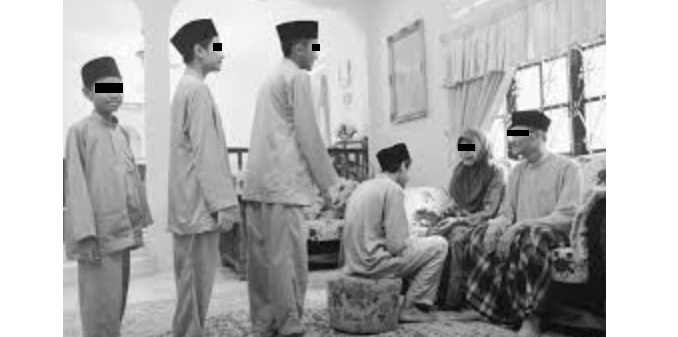
  • Seeking Forgiveness For Any Wrongdoings; A Yearly Hari Raya Practice

    Seeking Forgiveness For Any Wrongdoings; A Yearly Hari Raya Practice

    This is one of the yearly Hari Raya practices from our culture that I truly believe in and treasure. Recently, there were many debates about its relevance and importance. Many who do not fully understand the rationale behind the action will simply brush it off as insignificant to the point of it being almost a ridiculous practice. I beg to differ in opinion.

    While I agree that we have to apologise for our mistakes to the ones we hurt as soon as we have made them and not wait to do it during Hari Raya, we may not always be conscious or aware of our wrongdoings. Others may not be open enough to point out our mistakes/wrongdoings/transgressions/misdeeds and would rather keep the hurt to themselves.

    So, as we celebrate the blessed day with a fresh outlook in life filled with positivity and hope after the cleansing of the mind, body and soul during Ramadhan, it is only logical and befitting to ask others for their forgiveness for any or our wrongdoings whether they were done intentionally or otherwise…consciously or unconsciously. The very reason why we always start the seeking of forgiveness dialogue with “Kalau (if) ada salah dan silap sengaja atau tidak (there is any wrongdoings done intentionally or otherwise), TERkasar bahasa dan perbuatan (unintentional misdeeds and harsh words), TERmakan dan TERminum (unintentional consumption of food/drinks without others’ permission)….”. When we seek forgiveness, we learn to let go of our ego and realise that we are not above everyone else. When we forgive someone, we learn that we are not above God who is ever-willing to forgive no matter how big our sins may be.

    #tolongajaradatdanadabpadaanak2sekarang
    #hapuskanlahsifatterlaluego
    #bukankahislammengajarkitasupayabermaafmaafan
    #bersihkanhati
    #peringatanuntukdirijuga


    Source: Rasimah Jar

  • Mohd Khair: Singaporeans Are Capable Of Living Together Respectfully, Beyond Mere Tolerance

    Mohd Khair: Singaporeans Are Capable Of Living Together Respectfully, Beyond Mere Tolerance

    it is very HEARTENING indeed when Non-Muslim Singaporeans demonstrate deep understanding and empathy on the issues surrounding the ambiguous halal status of bazaar at Geylang Serai organised in the month of Ramadhan.

    Read the screenshots shared here in this album. They show genuine concern of Non-Muslim Singaporeans on the issue of non-halal status of some foodstalls at Geylang Serai Bazaar, organised in the month of Ramadhan.

    Such demonstration of care and concern is a fine example of how diversity is celebrated in the multiracial and multireligious society of Singapore.

    Underlying such expression of understanding and empathy is the value of RESPECT, going beyond tolerance. Such thinking also reflects maturity living harmoniously together. Together, regardless of race, language or religion, the multiracial and multireligious society of Singapore should move more in this direction in living harmoniously with one another.

    This album is saved here on this HCRS group as it reflects deep halal discernment among Non-Muslim Singaporeans towards the basic dietery needs of the Muslim consumer. Such discernment is very highly appreciated by Muslims who care so deeply on matters pertaining to halal foods.


    Source: Mohd Khair

  • Chee Soon Juan: Singaporeans – A People Cut Adrift

    Chee Soon Juan: Singaporeans – A People Cut Adrift

    I STOOD ON the balcony of the school block and surveyed the campus of the Anglo-Chinese School at Barker Road. I had not been back there since I graduated some four decades ago (I was accompanying Shaw Hur to buy his textbooks during the year-end break as he prepared for secondary school).

    I searched for a familiar landmark – any familiar landmark – of the place I had spent ten years of my school life. I couldn’t. Every inch of the grounds had been razed and, in its place, new buildings erected.

    Gone were the open spaces and lawns (more like sandy patches from our constant trampling) that afforded students the space to play before and in between classes. And play we did: football, marbles, spider-catching, chatekkuti-kuti, hantam bola… We invented our own games and laid down our own rules. We found our own fun – lots of it. And when you sat quietly in the afternoons, you could hear the crickets chirp.

    My mind returned to the present and it dawned on me how much the multi-storey buildings, squished up against one another, resembled the HDB jungle. The school field, where many a scrape and bruise was inflicted, was missing, replaced by a carpark that shouldered a swimming pool above. A boarding school for foreign students was even jammed into the premises. Every square foot of real estate was manicured, exquisitely engineered for maximum capacity.

    What does all this do for (or to) students? Sure, the AV equipment was state of the art, the auditorium outfitted with cinema-like plushness, and the driveways pristinely landscaped. But how does the environment facilitate play? How do students find their own leisure? Where do they go to do that? Yes they are studying, but are they learning?

    If all this sounds depressingly familiar, that’s because the campus reminds us of the country itself. The island is blanketed with residential blocks built ever closer and stacked up ever higher. It teems with inhabitants, the number of which this city has never seen.

    But fast as it was, construction on the island was always one step behind a burgeoning population whose explosive growth, ignited by lax immigration laws, meant that the infrastructure would be overtaxed.

    With the mass influx of foreigners came the escalation of the cost of living. At the same time, wages for the locals were put under downward pressure. Retrenchments and unemployment have risen. Leisure has become a scarcity and where there was once spacious greenery, there is now only bodies and concrete. Stress and work-related psychological disorders, as one might expect, run high. For the average Singaporean, the quality of life has deteriorated.

    That wasn’t all. The school’s wholesale makeover also meant that there was little I could relate to my son. There was nothing to share with him about how I grew up in a place in which he was now going to grow up. The past-present dislocation was as rude as it was complete.

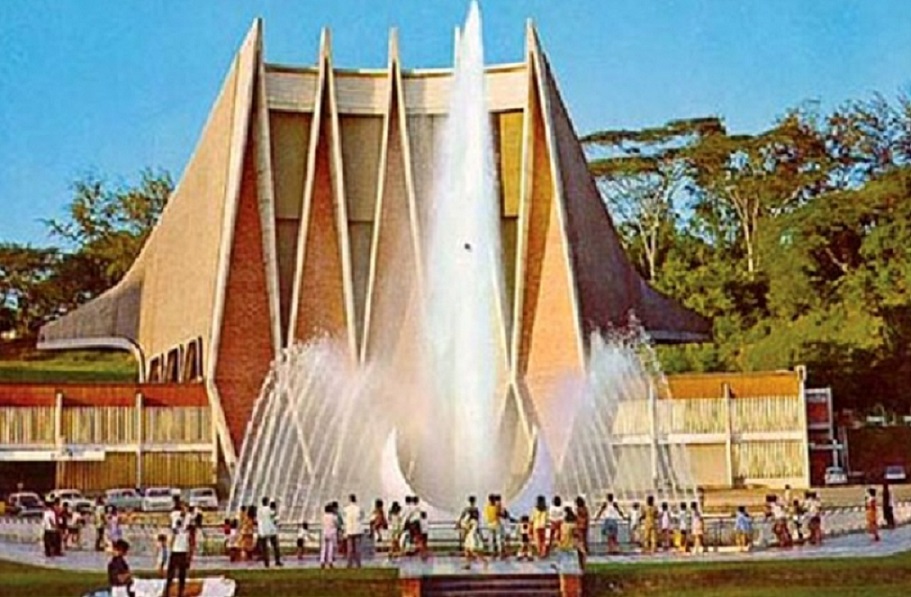
    Again, the situation is evocative of present-day Singapore. Anything and everything that served to remind us of days gone by – the National Theatre (photo above), Bugis Street, Satay Club, the National Library, Kallang Park – have been demolished and replaced by shopping centres, expressways and golf courses.

    When the break between past and present is so abrupt and comprehensive, we become unmoored from our own history. What, then, binds us to our roots? Need it be said that an undeveloped sense of belonging erodes our national identity?

    But can this country, one may be tempted to ask, afford to indulge in idle reminiscence? Why hanker for a past that would have impeded economic progress?

    These are wrong questions to ask. Progress and the retention of our collective past don’t have to be mutually exclusive; national development can proceed even as we preserve our history. What is needed to achieve a seemly balance are enlightened and dedicated planners. Japan and Europe, to cite but two examples, have done admirably in pushing the boundaries of modernisation while retaining their proud traditions and heritage.

    If we insist on hanging a price-tag on everything, as this country’s officialdom is wont to do, then what value do we put on places that tell the story of where we came from or where we’ve been? What amount of money do we place on Singaporeans emigrating because they don’t know what being Singaporean is anymore? What price do we figure for citizens living disengaged lives, tethered together only by that national creed that ‘No one owes us a living’ or its variant ‘What’s in it for me’?

    Even if we accept that nostalgic sentimentality has no place in the kind of hard-nosed pragmatic thinking needed for economc success, it is entirely appropriate to question what all the upheaval and change has brought us. A more genteel and less stressful lifestyle? A sustainable economic structure that ensures financial security for our retirees? A future that promises hope and opportunity for our youth? A system that can still deliver the Singapore Dream for our workers?

    When we cast our eyes ahead and see only ominous clouds, what conjures even more disquiet is to look behind and see that we’ve been cut adrift.


    Source: www.cheesoonjuan.com
  • Former Law Professor: Arab Culture Integral To Islam, Johor Sultan Advised

    Former Law Professor: Arab Culture Integral To Islam, Johor Sultan Advised

    The Johor sultan should realise that Arabic culture and norms are an integral part of Islam, said constitutional law expert Abdul Aziz Bari.

    “I think the sultan of Johor should consult the menteri besar or the mufti before shooting from the hip, or else he would embarrass everybody including himself.

    “He needs to realise that he is the head of Islamic religion for the state, apart from being the state head.

    “There is no question of turning the society into an Arab one; the fact remains that Arabic culture and norms have become an integral part of Islam,” the former law professor said in a statement today.

    He was responding to the Johor Sultan Ibrahim Ibni Almarhum Sultan Iskandar who had called on Malays to be proud of the Malay culture and not try to emulate Arabic culture.

    Abdul Aziz pointed out that the term sultan itself is Arabic and rooted in the Quran.

    “Perhaps the sultan of Johor ought now to be thinking of coining a new term to replace the term sultan,” he said.

    Arabic term

    Noting that Johor was the only state to use the term ‘ahlul hal wal aqdi’ to denote the members of succession council in the Johor Constitution, he also pointed out that it is an Arabic term and that the sultan should also consider replacing it.

    Jawi is also an aspect of Arabic culture which the sultan should think about, he said, adding that jawi is very much the culture of Johor as well.

    Abdul Aziz also responded to the crown prince of Johor Tunku Ismail Sultan Ibrahim, who had recalled the incidents during the 1992 constitutional crisis and reminded the government not to repeat such greed-driven episodes.

    It was the prince’s grandfather who presented then Prime Minister Dr Mahathir Mohamad with the opportunity to “whack the rulers”, Abdul Aziz remarked.

    “Some of the rulers, in fact, complained that they have been embarrassed by the incident provoked by the late Sultan Iskandar, which started with the alleged beating of the Johor state hockey coach,” he said.


    Source: www.malaysiakini.com