Tag: US

  • 5 Killed In Gun Attack On Canada Mosque

    5 Killed In Gun Attack On Canada Mosque

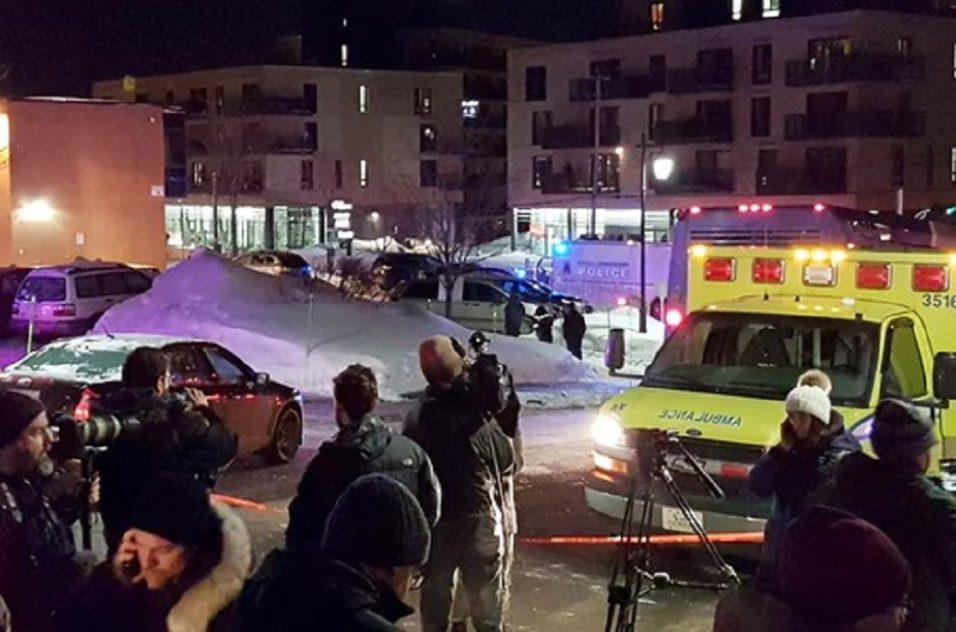
    ive people have reportedly been killed and several injured in a gun attack at a mosque in Québec City, the mosque’s president has said.

    The shooting was carried out by three attackers and happened during evening prayers at about 8pm on Sunday, said witnesses.

    About 40 people were thought to be in the building – the Québec City Islamic cultural center on Sainte-Foy Street – at the time.

    Two arrests have been made, a police spokesman said, but did not release details of the death toll.

    A large security cordon has been set up around the site.

    Canada’s publics safety minister, Ralph Goodale, said he was “deeply saddened” by the deaths.

    In June, during the holy month of Ramadan, a pig’s head was left at the mosque, CBC reported.


    Source: www.theguardian.com


  • Walid J. Abdullah: World Has To Deal With Failings Of American Democracy

    Walid J. Abdullah: World Has To Deal With Failings Of American Democracy

    Perhaps 2016 will teach us not to adopt a holier-than-thou approach towards those who disagree with us. Dismissing everyone who is a Trump supporter as a racist, xenophobic idiot evidently did not work out well.

    Sure, there are racists and deplorables amongst them. But there were people with genuine concerns that were not addressed, and instead of having their sentiments understood, they were dismissed as racists. Of course they would turn to Trump afterwards!

    The media especially has blood on its hands. In spite of not being a Trump fan, i found the media coverage – particularly by Huffington Post – to be absolutely disgusting. Clearly one-sided. If i were an undecided voter, the media coverage would push me towards Trump. I hope the liberal media is proud of itself now.

    Trump has won. Whether we like it or not, those are the rules of the game. We have to deal with a President Trump.

    Unless you’re the US government (democrat or republican). Then you don’t have to respect other people’s aspirations. Just dismiss them as Islamic fundamentalists and then engineer a coup.

    For peasants like the rest of the world, we have to deal with the failings of American democracy.


    Source: Walid J. Abdullah

  • Iraq Launches Mosul Offensive To Drive Out ISIS Terrorists

    Iraq Launches Mosul Offensive To Drive Out ISIS Terrorists

    Iraqi government forces launched a U.S.-backed offensive on Monday to drive Islamic State from the northern city of Mosul, a high-stakes battle to retake the militants’ last major stronghold in the country.

    Two years after the jihadists seized the city of 1.5 million people and declared a caliphate from there encompassing tracts of Iraq and Syria, a force of some 30,000 Iraqi and Kurdish Peshmerga forces and Sunni tribal fighters began to advance.

    Helicopters released flares and explosions could be heard on the city’s eastern front, where Reuters watched Kurdish fighters move forward to take outlying villages.

    A U.S.-led air campaign has helped push Islamic State from much of the territory it held but 4,000 to 8,000 fighters are thought to remain in Mosul.

    The Pentagon said that Iraqi forces were meeting objectives and were ahead of schedule on the first day of the offensive.

    Residents contacted by phone dismissed reports on Arabic television channels of an exodus by the jihadists, who have a history of using human shields and have threatened to unleash chemical weapons.

    “Daesh are using motorcycles for their patrols to evade air detection, with pillion passengers using binoculars to check out buildings and streets,” said Abu Maher, using an Arabic acronym for Islamic State.

    He and others contacted were preparing makeshift defenses and had been stockpiling food in anticipation of the assault, which officials say could take weeks or even months. The residents withheld their full names for security reasons and Reuters was not able to verify their accounts independently.

    The United States predicted Islamic State would suffer “a lasting defeat” as Iraqi forces mounted their biggest operation in Iraq since the 2003 invasion that toppled Saddam Hussein.

    But the offensive, which has assumed considerable importance for U.S. President Barack Obama as his term draws to a close, is fraught with risks.

    These include sectarian conflict between Mosul’s mainly Sunni population and advancing Shi’ite forces, and the potential for up to a million people to flee Mosul, multiplying a refugee crisis in the region and across Europe.

    “We set up a fortified room in the house by putting sandbags to block the only window and we removed everything dangerous or flammable,” Abu Maher said. “I spent almost all my money on buying food, baby milk and anything we might need.”

    The United Nations’ humanitarian coordinator for Iraq said the military had told the U.N. it expected the first significant population movement to begin in five to six days, suggesting that is when the assault would move to the city itself.

    Lise Grande said Iraqi security forces would transport fleeing civilians, who would be vetted to ensure Islamic State fighters could not hide among them, following residents’ reports that militants had shaved off their beards to escape detection.

    Video showing rockets and bursts of tracer bullets across the night sky and loud bursts of gunfire was shown on Qatar-based al-Jazeera television after Prime Minister Haider Abadi announced what he called “the heroic operations to free you from the terror and oppression of Daesh”.

    “We will meet soon on the ground in Mosul to celebrate liberation and your salvation,” Abadi said in a speech on state television in the middle of the night, surrounded by commanders of the armed forces.

    HUMANITARIAN CRISIS FEARED

    Early on Monday, Abadi sought to allay fears that the operation would provoke sectarian bloodletting, saying that only the Iraqi army and police would be allowed to enter the mainly Sunni city. He asked Mosul’s residents to cooperate with them.

    Local Sunni politicians and regional Sunni-majority states including Turkey and Saudi Arabia warned that if Shi’ite militias take part in the assault they could spark sectarian violence.

    The Iraqi army dropped tens of thousands of leaflets on Mosul before dawn on Sunday, warning residents the offensive was imminent, assuring them it “will not target civilians” and telling them to avoid known locations of Islamic State fighters.

    Reflecting authorities’ concerns over a mass exodus that would complicate the offensive and worsen the humanitarian situation, the leaflets told residents “to stay at home and not to believe rumors spread by Daesh” that could cause panic.

    Resident Abu Abdullah said he had wanted to witness the beginning of the offensive.

    “We heard repeated explosions at a distance, so I went to the rooftop to see fireballs, even if it was dangerous. I was happy that the operation to liberate Mosul started,” he said.

    In 2014, Islamic State leader Abu Bakr al-Baghdadi proclaimed a “caliphate” in Iraq and neighboring Syria from Mosul’s Grand Mosque. The group faced little resistance but has employed brutal methods to maintain control. On Monday, it circulated photographs showing children executing alleged spies.

    Russian President Vladimir Putin, criticized over the level of civilian casualties during Syrian government operations backed by Moscow in and around the city of Aleppo, said on Sunday he hoped the United States and its allies would do their best to avoid hitting civilians in the attack on Mosul.

    The United Nations has said the battle would require the world’s biggest and most complex humanitarian effort, which could leave up to 1 million people homeless and see civilians used as human shields or even gassed.

    There are already more than three million people displaced in Iraq as a result of conflicts involving Islamic State and up to 100,000 Iraqis may flee Mosul to Syria and Turkey. Medicine is in short supply in Mosul and food prices have risen sharply.

    “Families in Mosul started stockpiling food yesterday in case the fighting reaches our streets and we can no longer go out,” said Saeed, a resident.

    “Daesh are still in Mosul and it’s not true that they left. They are continuing to erect blast walls in the streets to obstruct any advance.”

    (With additional reporting by Maher Chmaytelli and Stephen Kalin in Baghdad, Michael Georgy in Erbil and Stephanie Nebehay and Tom Miles in Geneva; writing by Philippa Fletcher; editing by Giles Elgood and Gareth Jones)


    Source: www.reuters.com


  • US-Led Forces Strike Syrian Troops, Russia Calls Emergency UN Meeting

    US-Led Forces Strike Syrian Troops, Russia Calls Emergency UN Meeting

    US-led coalition air strikes killed dozens of Syrian soldiers on Saturday (Sept 17), Russia and a monitoring group said, putting a US-Russian brokered ceasefire in jeopardy and prompting Moscow to seek an emergency UN Security Council meeting.

    The United States military said the coalition stopped the air strike against what it had believed to be Islamic State in Iraq and Syria (ISIS)  positions in north-east Syria after Russia informed it that Syrian military personnel and vehicles may have been hit.

    A US military official said he was “pretty sure” targets mistakenly hit in the coalition strikes were Syrian forces.

    Russia called for an emergency meeting of the United Nations Security Council after the air strikes, which allowed ISIS militants to briefly overrun a Syrian army position near Deir al-Zor airport.

    The 15-member body is due to meet behind closed doors at 7.30pm EDT (7.30am on Sunday, Singapore time), diplomats said.

    “We are reaching a really terrifying conclusion for the whole world: That the White House is defending Islamic State. Now there can be no doubts about that,” the RIA Novosti news agency quoted Russian Foreign Ministry spokeswoman Maria Zakharova as saying.

    She said the strikes threatened to undermine the ceasefire in Syria brokered by Russia, which has been aiding Syria’s President Bashar al-Assad in the civil war, and the United States, which has backed some rebel groups.

    The Russian Defence Ministry said US jets had killed more than 60 Syrian soldiers in four air strikes by two F-16s and two A-10s coming from the direction of Iraq.

    The Syrian Observatory for Human Rights, a Britain-based monitoring group with contacts across the country, cited a military source at Deir al-Zor airport as saying that at least 80 Syrian soldiers had been killed.

    The ceasefire, which took effect on Monday, is the most significant peacemaking effort in Syria for months but has been undermined by repeated accusations of violations on both sides and by a failure to bring humanitarian aid to besieged areas.

    As well as the US and Russian involvement, Assad is supported by Iran and Arab Shi’ite militias, while Sunni rebels seeking to unseat him are backed by Turkey and Gulf Arab states.

    All those warring parties are also sworn enemies of ISIS, whose territory extends along the Euphrates valley from the Iraqi border, including around Deir al-Zor, up to land near Syria’s frontier with Turkey.

    In its sixth year, the conflict has cost hundreds of thousands of lives, displaced half of Syria’s pre-war population, prompted a refugee crisis in the Middle East and Europe and inspired a wave of  Islamic militant attacks across the world.

    Syria’s army said the strikes, which took place at around 5pm (10pm Singapore time) were “conclusive evidence” of US support for ISIS, calling them “dangerous and blatant aggression”.

    The US military said in its statement that Syria was a “complex situation” but that “coalition forces would not intentionally strike a known Syrian military unit”.

    ISIS said via its Amaq news channel it had taken complete control of Jebel Tharda, where the bombed position was located, which would have allowed it to overlook government-held areas of Deir al-Zor.

    The city’s airport and some districts have been entirely surrounded by ISIS since last year, with the airport providing their only external access.

    However, Russia and Syrian state media said the Syrian army later recaptured positions it lost. The Observatory monitoring group said at least 20 ISIS fighters were killed in heavy Russian air strikes during that fighting.

    The incident threatens to undermine not only the ceasefire agreement, but also proposed joint targeting by the United States and Russia of ISIS and some other jihadist groups across Syria.

    SHAKY TRUCE

    Earlier on Saturday, Russia and Syrian rebels cast doubt over the prospects for the increasingly shaky ceasefire, with Moscow saying the situation was worsening and a senior insurgent warning that the truce “will not hold out”.

    While the ceasefire has reduced fighting, some violence has persisted across Syria. Meanwhile, there has been little movement on promised aid deliveries to besieged areas and both sides have accused the other of bad faith.

    Russia’s Defence Ministry said conditions in Syria were deteriorating, adding that it believed the ceasefire had been breached 199 times by rebels and saying the United States would be responsible if it were to collapse.

    After the Deir al-Zor air strike, it said Moscow had told the United States to rein in the Syrian opposition and make sure it did not launch a new offensive, adding that it had told Washington about a concentration of rebels north of Hama.

    Insurgents say they only reluctantly accepted the initial deal, which they believe is skewed against them, because it could relieve the dire humanitarian situation in besieged areas they control, and blamed Russia for undermining the truce.

    “The truce, as we have warned, and we told the (US) State Department – will not hold out,” a senior rebel official in Aleppo said, pointing to the continued presence of a UN aid convoy at the Turkish border awaiting permission to enter.

    Rebels have also accused Russia of using the ceasefire to give the Syrian army and allied Shi’ite militias a chance to regroup and deploy forces ready for their own offensives.

    OVERNIGHT SHELLING

    Both sides have accused the other of being responsible for aid deliveries being stuck far from Aleppo, where army and rebel forces were supposed to pull back from the Castello Road which leads into besieged, insurgent-held eastern districts.

    Russia on Friday said the Syrian army had initially withdrawn but returned to its positions after being fired on by rebels, who in turn say they saw no sign of government forces ever leaving their positions. “There is no change,” said Zakariya Malahifji, an official for a rebel group in Aleppo on Saturday, asked whether there had been any move by the army to withdraw from positions along the road.

    Syria’s government said it was doing all that was necessary for the arrival of aid to those in need it in all parts of the country, particularly to eastern Aleppo.

    Two convoys of aid for Aleppo have been waiting at the Turkish border for days. The UN has said both sides in the war are to blame for the delay of aid to Aleppo, where neither has yet withdrawn from the Castello Road into the city.

    The government said the road was being fired on by rebels, which they deny, so it could not give convoys a guarantee of safety.

    Senior UN officials have accused the government of not providing letters to allow convoys to reach other besieged areas in Syria.


    Source: The Straits Times
  • Saudi Arabia Identifies Bombers In Two Attacks This Week

    Saudi Arabia Identifies Bombers In Two Attacks This Week

    Saudi Arabia identified on Thursday suspects in two of the three attacks that struck the kingdom on the same day this week, including one outside the sprawling mosque where the Prophet Muhammad is buried in the western city of Medina that killed four Saudi security troops.

    In a statement released by the Interior Ministry late Thursday, authorities said the Medina bomber in Monday’s apparently coordinated attacks was 26-year-old Saudi national Na’ir al-Nujiaidi al-Balawi.

    Three suicide bombers behind a botched attack, also Monday, outside a Shiite mosque in the eastern region of Qatif in which no civilians or police were wounded, were identified as Abdulrahman Saleh Mohammed, Ibrahim Saleh Mohammed and Abdelkarim al-Hesni, all in their early 20s.

    It was not immediately clear what nationality or nationalities the three carried.

    The ministry said investigations following the attacks led to the arrests of 19 suspects, seven Saudi and 12 Pakistani nationals. No other details were immediately available.

    On Tuesday, Saudi Arabia identified the suicide bomber who struck outside the U.S. Consulate in Jiddah as a Pakistani resident of the kingdom who had arrived 12 years ago to work as a driver. It named him as 34-year-old Abdullah Qalzar Khan. It said he lived in the port city with “his wife and her parents.” The statement did not elaborate.

    In that attack, the bomber detonated his explosives after two security guards approached him, killing himself and lightly wounding the guards, the ministry said. No consular staff were hurt.

    No group has yet claimed responsibility for the attacks but their nature and their apparently coordinated timing suggested the Islamic State group could be to blame.

    Pakistan has condemned Monday’s attacks in the kingdom. There are around 9 million foreigners living in Saudi Arabia, which has a total population of 30 million. Among all foreigners living in the kingdom, Pakistanis represent one of the largest groups.

    The Saudi ministry said the attacker in the Medina assault set off the bomb in a parking lot after security officers became suspicious about him. Several cars caught fire and thick plumes of black smoke were seen rising from the site of the explosion as thousands crowded the streets around the mosque.

    Worshippers expressed shock that such a prominent holy site could be targeted.

    The Prophet Muhammad’s mosque was packed on Monday evening, during the final days of the Muslim holy month of Ramadan, which ended on Tuesday. Local media say the attacker was intending to strike the mosque when it was crowded with thousands gathered for the sunset prayer.

    Saudi Arabia is part of the U.S.-led coalition fighting the Islamic State group in Iraq and Syria, and the militant group views its ruling monarchy as an enemy.

    The kingdom has been the target of multiple attacks by the group that have killed dozens of people. In June, the Interior Ministry reported 26 terror attacks in the last two years.


    Source: abcnews.go.com