Tag: violent

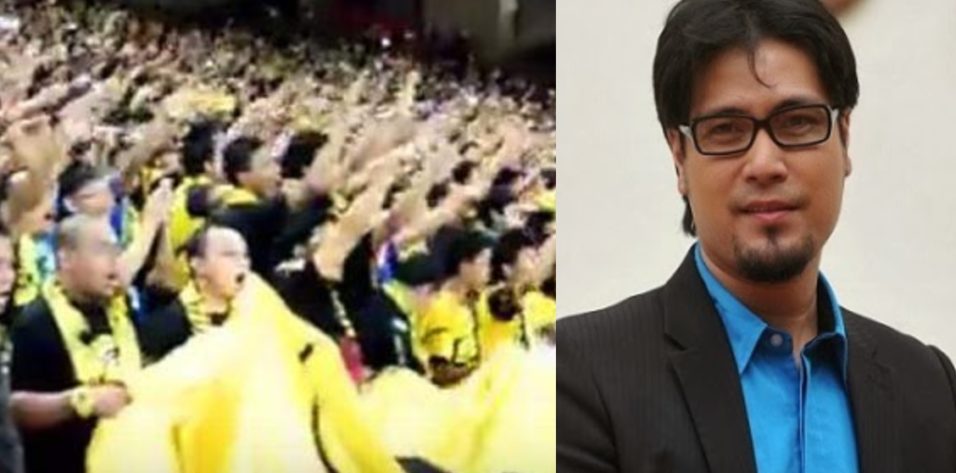
  • Commentary: Perangai Ganas Msia Inspired Dari Zed Zaidi; Tak Terima Orang Luar Lebih Bagus

    Commentary: Perangai Ganas Msia Inspired Dari Zed Zaidi; Tak Terima Orang Luar Lebih Bagus

    Menteri dan Polis Malaysia sepatutnya ketatkan kawalan, memberi nasihat pada peminat2 sukan yg fanatik supaya jaga akhlak dan melayan tetamu dgn baik. Apa gunanya semangat nak bantu Syria, Palestin, Rohingnya, tapi bila part sukan, menjadi pengganas diluar stadium memukul orang menumpahkan darah, memanggil orang dgn kata2 makian. šŸ‘Ž

    Takde satu pun Menteri dan Polis bersuara untuk menjaga akhlak. “Majulah Sukan untuk Negara”? Apa gunanya harumkan nama negara dgn pingat emas tapi akhlak peminat fanatik seperti anjing serigala mengancam keselamatan dan membuat kerosakan. šŸ‘Ž

    Dalam 20 tahun sukan sea diadakan, kali ni di Malaysia paling buruk dan ganas dalam sejarah. Kalau tak tahu adat bersukan, lu main bola kocek sudah lah bro! Perangai inspired dari Zed Zaidi yg tak boleh terima orang luar menang pingat. Puikks! šŸ’¦šŸ’¦šŸ’¦šŸ‘Ž

    Tapi aku banggalah kawan2 Malaysia aku kat fb ni semuanya sportmanship dan berakhlak. šŸ‘
    Keep it up bro n sis.

    Majulah sukan untuk negara.
    Malulah akhlak untuk negara.

    Atok Bekam
    Atok Khairuddin


    Source: Ahmad Khairuddin

  • Commentary: Don’t Take The Meaning Literally!

    Commentary: Don’t Take The Meaning Literally!

    You know what I find funny?

    Almost everyone assumed and equated the word triumph with violence and hatred. But have they really check or even bother to check the arabic word for that supplication and in what context it is used?

    And even more funny all these people who decide that its violent do not even have the slightest background and knowledge in arabic to even know what the word exactly means in its original language source and the context.

    Its like an english teacher who do not possess malay language tell a native malay teacher that his or her malay is wrong. LOL.

    Even I who have limited arabic knowledge do not dare to assume the arabic words in its translation because the moment you translate a word to another language such as english, it has slightly lost the actual essence of the original meaning.

    And thats why we cannot take the meaning literally.

    If you want to be a fair judge, then you must know your arabic, and understand islamic context deeply only then you can judge fairly who is wrong and right otherwise the judgement is one-sided and not just.Ā 


    Source: Siti Kate

    Reader’s Contribution

  • What’s Missing In The Teaching Of Islam

    What’s Missing In The Teaching Of Islam

    There has been much misinformation about Islam. Reports in Western media tend to perpetuate stereotypes that Islam is a violent religion and Muslim women are oppressed. Popular films like ā€œAmerican Sniperā€ reduce places like Iraq to dusty war zones, devoid of any culture or history. Fears and anxiety manifest themselves in Islamophobic actions such as burning mosques or even attacking people physically.

    At the heart of such fear is ignorance. A December 2015 poll found that a majority of Americans (52 percent) do not understand Islam. In this same poll, 36 percent also said that they wanted to know more about the religion. Interestingly, those under 30 years were 46 percent more likely to have a favorable view of Islam.

    These statistics highlight an opportunity for educators. As a scholar of Islamic art and architecture, I am aware that for the past 20 years, educators have been trying to improve the teaching of Islam – both in high school and college history courses.

    The problem, however, is that the teaching of Islam has been limited to its religious practice. Its impact on the arts and culture, particularly in the United States, is seldom discussed.

    What teaching of Islam misses

    In high school history books, there is little mention of the intertwined histories of Europe, Asia and Africa in the middle ages and the Renaissance. There is even less mention of the flowering of art, literature and architecture during this time.

    In a world history textbook for New York public high schools, for example, the ā€œMuslim World,ā€ appears in the 10th chapter. In condensing a thousand years of history – from the seventh to the 17th century – it focuses only on ā€œArab armiesā€ and the rise of early modern Muslim empires.

    Palatine Chapel borrowed from the art of the Fatimids.
    Al-dabra, CC BY-NC-ND

    Such narrow focus misses out on the cultural exchanges during this period. For example, in medieval Spain, the Troubadour poetsborrowed their lyrical beauty from Arabic. Arabic was the courtly language of southern Spain until the 15th century. Similarly, the 12th-century Palatine Chapel in Sicily was painted and gilded in the imperial style of the Fatimids, the rulers of Egypt between the 10th and 12th centuries.

    Such exchanges were common, thanks to the mobility of people as well as ideas.

    The point is that the story of Islam cannot be told without a deeper understanding of its cultural history: Even for early Muslim rulers, it was the Byzantine empire, the Roman empire and the Sassanian empire (the pre-Islamic Persian empire) that provided models. Such overlaps continued over the centuries, resulting in heterodox and cosmopolitan societies.

    The term ā€œMiddle Eastā€ – coined in the 19th century – fails to describe the complex social and cultural mosaic or religions that have existed in the region most closely associated with Islam – and continue to do so today.

    How the arts can explain important connections

    So, what should educators do to improve this literacy?

    From my perspective, a fuller picture could be painted if identities were not to be solely defined through religion. That is, educators could focus on the cross-cultural exchanges that occurred across boundaries through poets and artists, musicians and architects. Both in high school and university, the arts – visual, musical and literary – could illustrate the important connections between Islam and other world histories.

    For example, a class on the Renaissance could explain how the 15th-century Italian painter Gentile Bellini gained famed at the court of Mehmet II, the conqueror of Istanbul. Mehmet II commissioned Bellini to design an imperial portrait that was sent to rulers throughout Europe. His art presents a wonderful example of the artistic exchanges that took place between early modern cities such as Delhi, Istanbul, Venice and Amsterdam.

    It might also help students to know that the Dutch painter Rembrandt collected Mughal miniature paintings. Silks from the Safavid empire (the Iranian dynasty from the 16th to 18th century) were so popular that Polish kings had their coat of arms woven in Isfahan.

    This exchange of art continued into the Age of Enlightenment, a time when ideas around politics, philosophy, science and communications were rapidly being reoriented in Europe. A class on the Enlightenment may highlight the fact that writers like Montesquieuturned to the Middle East to structure a critique of their own religious institutions.

    Goethe found inspiration in Persian poetry.
    kaythaney, CC BY-NC

    A poetry class could similarly show connections between the German author Wolfgang von Goethe’s writings and Islam, as exemplified in his ā€œWest-Eastern Diwaan,ā€ a collection of poems. This epitome of world literature was modeled after classical Persian poetry in its style, and inspired by Sufism, the mystical tradition in Islam.

    Most students are open to seeing these connections, even if it might require overcoming their own preconceptions about Islam. For example, when I teach my class on medieval architecture, students are surprised to learn that the two oldest continuously run universities in the world are in North Africa (in Fez – a city in Morocco – and Cairo).

    Indeed, it is not easy to disentangle contemporary politics from historical fact, to teach more fully the culture and diversity of a religion that is almost 2,000 years old.

    Perhaps educators could learn from a recent exhibition at the Metropolitan Museum of Art in New York titled ā€œJerusalem 1000-1400: Every People Under Heaven.ā€ The show illustrates how Abrahamic religions – that is, Christianity, Judaism and Islam – borrowed freely from each other in the realm of art, music and literature. Jerusalem was home to diverse populations and the arts played an important role within its religious and political life.

    Muslims in America

    It’s not in the past alone. We see these connections continue today – here in America, where Islam is an intrinsic part of the culture and has been for centuries.

    From the Mississippi delta to the Chicago skyline, Muslims have made contributions, which might not be so obvious: West African slaves in the South were central to the development of the blues. Its complex vocalization and rhythms incorporated the rituals of Islamic devotion many of them had to leave behind.

    The same is true of architecture. A quintessential example of modern American architecture is the Sears Tower in Chicago, which was designed by the Bangladeshi-American structural engineer Fazlur Rahman Khan.

    Muslim contributions to art and architecture don’t just reflect the diversity of America, but the diversity of Islam in this country. Muslims in America comprise a rich tapestry of ethnicities, languages and cultures. This knowledge is particularly meaningful for young Muslim Americans, who struggle to claim their place in a country in which they are sometimes made to feel like outsiders.

    Educators, especially within the arts and humanities, have an important role to play in this religious literacy, that helps students understand the unity in the diversity. After all, as the most popular poet in America, the 13th-century Muslim mystic Rumi wrote:

    All religions, all this singing, one song.
    The differences are just illusion and vanity.


    Source: huffingtonpost

  • Schizophrenic Convicted Of Sending Threatening Facebook Messages To Lee Hsien Loong

    Schizophrenic Convicted Of Sending Threatening Facebook Messages To Lee Hsien Loong

    In what is believed to be the first case of its kind, a 33-year-old Singaporean man has been found guilty on Tuesday (Oct 6) of sending threatening messages to Prime Minister Lee Hsien Loong via Facebook.

    Tan Yeong Hong said he became frustrated when he attended a Meet the People’s Session (MPS) in PM Lee’s Ang Mo Kio ward on Jun 24 this year, only to find that the PM would not be there.

    Tan said he attended the MPS to pass the PM ā€œan article he had typed outā€. He had to settle for passing the letter to a grassroots leader instead.

    In the four threatening messages he sent to the PM, Tan said: ā€œEh, you challenged me to visit your MPS but you are not here. I will find and stage an attack on you when I have information on your public appearances. You know who I amā€.

    Tan also included his NRIC number and handphone number in the messages.

    A police report was lodged the next day by a Senior Manager of the Online Communications Unit of the Prime Minister’s Office, which manages the PM’s social media accounts.

    HE IS ā€˜VIOLENT … ALWAYS ARMED WITH A KNIFE’

    A team of investigating officers traced the messages to Tan, and a background check revealed that he lived at Block 108 Hougang Avenue 1, while his father lived in an old folks’ home and his mother had been admitted to hospital.

    Police interviewed Tan’s parents, who informed them at their son was ā€œa violent person … always armed himself with a knifeā€.

    Hours later, police nabbed Tan close to his home. A hostile Tan punched a policeman on his shoulder and elbowed another in the face, but was eventually subdued and placed under arrest.

    In a search of Tan’s home, police found assorted dangerous weapons including a hammer, two choppers and several knives. Police also found a list of PM’s upcoming public appearances.

    Tan admitted that he had brought a hammer along to the MPS but never intended to use it.
    The man also disclosed that he had been approached 10 years ago by an unnamed Chinese male, and was ā€œinstructed to pass ā€˜data’ to PM Leeā€. He claimed he ā€œwas being prompted by someone with a hidden audio and surveillance deviceā€ planted in his house.

    ā€œThe people in the audio and surveillance system told me to … throw a hammer at (PM) because he refused to take the document from me after he had asked me to prepare itā€, Tan said.

    When District Judge Mathew Joseph asked if Tan had seen this device, Tan said that he had not.

    TAN SUFFERS FROM PARANOID SCHIZOPHRENIA

    Deputy Public Prosecutor Andre Chong said that psychiatric reports show that Tan suffers from paranoid schizophrenia, which had been left untreated at the time of his offences. The illness played ā€œa large contributory role in (his) offending behaviorā€, according to the report. However, Tan was not found to be of unsound mind and is still fit to plead, the report concluded.

    Tan, who was unrepresented, said he is sorry for ā€œthe childish actā€ and asked for a light sentence because his mother has had knee surgery and is father is a stroke patient. ā€œI was facing financial problemsā€, Tan said, in response to Judge Mathew’s question as to why he had sent the threats to the PM.

    ā€œI think I’m living in a unit with a secret cameraā€, Tan told the court, and stated again that he had no intention of carrying out the threats.

    Judge Mathew, speaking to Tan directly, said this is ā€œan extremely serious case, you are facing a stiff sentenceā€, and expressed concern that the accused did not realise the severity of the charges he is facing.

    When he heard that the prosecution intended to seek a sentence of 18 to 23 months’ jail, Tan did an about-turn and told the judge that he did in fact wish to engage counsel.

    The judge, having previously expressed his intention to refer Tan’s case to a voluntary lawyer ā€œin the interests of justice and fairnessā€ and ā€œin light of the charges (Tan) is facingā€, adjourned the matter until Oct 15, at which a lawyer for Tan is expected to be present.


    Source: www.channelnewsasia.com
  • Malaysia Will Not Allow Chin Peng’s Ashes To Be Brought Back To Malaysia

    Malaysia Will Not Allow Chin Peng’s Ashes To Be Brought Back To Malaysia

    MALACCA – The Malaysia government will not allow the ashes of Communist Party of Malaya (CPM) leader Chin Peng to be brought back to Malaysia, said Home Minister Ahmad Zahid Hamidi on Sunday.

    “We will not allow his ashes to be brought back as we are sensitive to the feelings of the children, grandchildren and great-grandchildren of the soldiers, policemen and others whose family members were killed or maimed by the brutal CPM insurgents,” Datuk Seri Zahid said at a news conference after launching an event at the Malacca Motorcycle Carnival, The Star reported.

    Chin Peng, whose real name is Ong Boon Hua, led the armed struggle of the Communist Party of Malaya against the colonial British authorities and then the Malayan government after 1957.

    The hostilities ended only in 1989 with a Thailand-brokered peace accord.

    Chin Peng died of cancer in September last year at the age of 88. He had been living in exile in Thailand after the 1989 peace accord, and his attempts to return to his birthplace in Perak had been stymied by the Malaysian courts on the basis that he did not have citizenship papers.

    Malaysian Premier Najib Razak has called him a “terrorist leader” and said that his ashes would not be allowed into the country.

    But a non-governmental organisation, 21st Century Malaysia Friendship Association, recently called for the Malaysian government to respect the Hatyai Peace Accord which allowed Chin Peng’s ashes to be brought back to the country, The Star said.

    The Malaysian Chinese Association, a component party of the ruling Barisan Nasional coalition, had pointed out that the remains of ethnic Malay terrorists like Noordin Mohammad Top were allowed to be buried in their Malaysia hometowns.

    On Sunday Dr Zahid also defended the government’s move to strengthen the 1948 Sedition Act, reported the Star.

    The Act will be amended to include sedition through the Internet, touching on religious sensitivities, and calling for Sabah and Sarawak to leave Malaysia. Dr Zahid was cited as saying the move was necessary to preserve unity and harmony in Malaysia’s multiracial society.

    “The Sedition Act was introduced in 1948 where there was no Internet at the time. Therefore, this Act needs to be amended,” said Dr Zahid. He added that a Bill to amend the Sedition Act is expected to be tabled in Parliament in March next year.


    Source: www.straitstimes.com

deneme bonusu