I have benefited from dealing with people from the Muslim part of the Middle East and the Indian subcontinent, so I was gratified to read the commentary “Time to look beyond the Western view of the Middle East” (Nov 23).
My experiences when I talk about the Islamic world and the subcontinent confirm Ms Koh Choon Hwee’s point: The average Singaporean’s knowledge of both regions is inadequate, and his or her views reflect those of small-town American news outlets.
Why do we parrot the views on cultures we have grown up with from a group of people who are too far removed from those cultures to know better?
Our ignorance is more shocking, especially as gaining markets in those regions has become more crucial to our economic well-being.
I think back to 2006, when I worked with oil firm Saudi Aramco on an event promoting Saudi culture: One of the Saudis asked me if geography was taught in Singapore, after several members of the public had asked him which part of Dubai he was from.
This was not an isolated incident of ignorance. One only has to think of the way people think that Sikhs come from Bengal. A glance at the map would show that Bengal and Punjab are at opposite ends of a very large country.
Our small island has prospered from being open to the world. While it remains important to be tuned in to the Western world, we cannot be deaf to places that people in the West are.
Like any other part of the world, the Middle East and India present both challenges and opportunities that we cannot ignore.
To succeed in the wider business world, we should encourage people to understand cultures beyond the ones we know.
We must acknowledge that things such as the Paris bombings were caused by people claiming to be Muslims.
We must be vigilant against terrorism. We must understand there are reasons why things such as terrorism exist, however, and we cannot let the experiences and prejudices of the West influence our interactions with people from other parts of the world.
I remember Khaled Maeena, former editor of Saudi daily Arab News, telling me: “Singaporeans, you should trust your own experiences and culture, and not believe everything the West tells you.”
The Friday 13th attacks in Paris killed 130, and was the deadliest terrorist attack to hit Paris since the end of World War II. But it could have been much worse. Had the terrorists succeeded in smuggling bombs or guns into the Stade de France and caused a stampede at the France-Germany football match where French President Francois Hollande was present, the outcome could have been even grimmer. The current high threat alert across Europe represents a fourth crisis on top of the three interlocking crises that the European Union has been grappling with in the past few years – the euro crisis (since 2008); the immigrant influx from the Middle East and North Africa (one million refugees are expected for 2015); and the EU’s geopolitical stand-off with Russia over Ukraine.
Flashback to Sept 13, 2001, after the twin towers collapsed in New York: Le Monde’s front-page editorial (nous sommes tous Americains) pithily summed up the sympathy and identification that French citizens felt for America. France supported Washington’s invoking of Nato’s Article 5 (mutual defence clause), and the United States-led military operation in Afghanistan to flush out Al-Qaeda’s territorial base.
But French backing did not extend to supporting Washington in toppling Saddam Hussein and invading Iraq in 2003. Paris’ 2003 decision to delimit military aims to attacking Al-Qaeda’s resource bases, rather than redraw the political map of the Middle East, was a prudent one. Paris escaped the major terrorist attacks that targeted the European supporters of the Iraq invasion – Madrid in 2004, and London in 2005.
Fast forward to November 2015: Paris is confronted with a crisis of similar proportions to the one then US President George W. Bush faced in 2001. Should France prosecute a limited war against the Islamic State in Iraq and Syria (ISIS) to deny its territorial bases in Iraq and Syria? Or should it go further and ally with the US and Russia to redraw the larger map in the Middle East? Unlike the US, however, France is geographically close to the Muslim world, has a deep colonial history and strong ties in Muslim North Africa and the Middle East, and houses a sizeable Muslim minority.
REASSESS MIDDLE EAST POLICY
In the past week, Mr Hollande has vowed “merciless” attacks against ISIS. France has asked and received support for military cooperation from EU member states. Mr Hollande has met US President Barack Obama and will meet Russian President Vladimir Putin tomorrow, and has asked the United Nations to condemn ISIS. French jets have worked with Russian forces to pound Raqqa, ISIS’ would-be capital in Syria.
.
Over the longer term, the heightened state of alert in Europe is likely to see Paris recovering some of its lost leadership in the EU, especially on military security, immigration, border security and diplomatic matters.
The UN’s Climate Change Conference in Paris, to be held from Nov 30 to Dec 11, will be the largest international gathering of ministers and leaders from around the world in Paris in years. This promises to be a nightmare for the French and security services of all the international delegations.
Whatever France chooses to do in its foreign policy, it will have to weigh the consequences of its decisions on its own domestic audience and social cohesion. French people of Islamic faith or Middle Eastern origins are a large and fast-growing minority. Estimated at between 7 and 10 per cent of the total French population, French Muslims far outnumber the older confessional minorities of Jewish or non-Catholic Christian faiths combined, and represent in absolute numbers the largest group of European Muslims in a single EU member state. French Muslims follow events in their countries of origin in the Middle East (mainly) closely, and as historian Jonathan Laurence and political scientist Justin Vaisse argue, they are a growing factor in France’s Middle East policy. Remember that at least five of the Nov 13 attackers were French citizens (and more than 1,400 French nationals are estimated to have joined ISIS).
As difficult as circumstances are, this is perhaps an opportune time to reassess Western policies towards the Middle East, from which a majority of continental Europe’s Muslim population originate. The failure of the international community to resolve the Palestinian crisis is a genuine point of contention among many Muslims worldwide, and there needs to be an honest discussion about this. Other foreign policy decisions, including military strikes against Muslim countries and the continued support for regimes that deny their citizens basic freedoms in the Middle East, must be reconsidered. In fact, to do justice to the victims of the Paris attacks, the Muslim populace in the West and all of Europe’s citizens, there is no better time to engage in these difficult but necessary discussions. We need to move beyond the “they hate us for our freedoms” narrative dominant in the Charlie Hebdo attacks in January this year.
MUSLIMS IN EUROPE
Some commentators have suggested that Islam itself is the source of the complications, and have called for a “reformation” of the faith to suit it to modern times. Others have repeatedly asked Muslims to denounce terrorism and proclaim loyalties to the state. This is unfortunately part of the problem. In perpetuating such discourses, one is already promoting the idea that Muslims are the “other” in Western societies. In asking Muslims not to abide by some of the beliefs that they hold dear, for example, the infallibility of the Quran, what is being asked of Muslims is for them to abandon their very identities. And when the community is perpetually being hectored to “condemn” terrorism, it is as if they are presumed guilty until proven innocent.
Not only can these calls lead to a further sense of alienation or a siege mentality among Europeans of Muslim faith, but they also betray the liberal Western/French values of liberty and equality. No doubt, French secularism is often more muscular than others (for example, the ban on headscarves), but this does not in any way mean that any religious group should be prevented from choosing their lifestyles, as long as they do not violate the laws of the land. How Europeans react to these attacks will be defining for themselves. Will the EU states react to the intolerance of a few radicalised maniacs, with more intolerance of their own, closing off borders to foreigners, or circumscribing the free movement of people, goods and services between themselves? Can Europe remain true to its own history and proclaimed values, by embracing the largely peaceful Muslim population with warmth and genuine tolerance?
MOVING FORWARD
An often-neglected aspect in analyses on terrorism is the role of the ulama, or Islamic religious scholars. Traditionally, Muslim communities have always held their ulama in high regard. They have a pivotal role to play in the prevention of extremist ideologies being spread among young, disenchanted Muslims, by propagating the true version of Islam. Western states would do well to consider empowering the ulama; by this, it does not mean that they need to formally co-opt the ulama, which in actuality could be counter-productive. Perhaps a better approach would be to let the ulama be truly independent; the ulama must be allowed to interact with mainstream intellectuals and policymakers, to debate and openly present dissenting views against the state (and against extremist ideologies like those of ISIS), so that they gain credibility among their constituents. This will also demonstrate to disenfranchised Muslims that if they are frustrated, there are legitimate non-violent ways to express their sentiments, instead of resorting to acts of terror and murder.
Whether one likes it or not, the reality is that Muslims and Islam are here to stay in Europe. It is neither practically feasible, nor morally defensible, to entertain thoughts of a Europe or West without Islam and Muslims. It is best to concentrate efforts on making Muslims identify themselves as full and equal citizens of their countries, rather than as marginalised immigrants or unwelcome foreigners.
The first writer, Reuben Wong, is Jean Monnet Professor in European Integration and Foreign Policy at the National University of Singapore. The second writer, Walid Jumblatt Abdullah, is a PhD candidate in political science, NUS-King’s College London joint degree programme.
The scenario I’m about to describe has happened to me more times than I can count, in more cities than I can remember, mostly in Western cities here in the U.S. and Europe.
I walk into a store. There’s a woman shopping in the store that I can clearly identify as Muslim. In some scenarios she’s standing behind the cash register tallying up totals and returning change to customers. She’s wearing a headscarf. It’s tightly fastened under her face where her head meets her neck. Arms covered to the wrists. Ankles modestly hidden behind loose fitting pants or a long, flowy dress. She’s Muslim. I know it. Everyone around her knows it. I stare at her briefly and think to myself, “She can’t tell if I’m staring at her because I think she is a spectacle or because I recognize something we share.”
I realize this must make her uncomfortable, so I look away. I want to say something, something that indicates I’m not staring because I’m not familiar with how she chooses to cover herself. Something that indicates that my mother dresses like her. That I grew up in an Arab state touching the Persian Gulf where the majority dresses like her. That I also face East and recite Quran when I pray.
“Should I greet her with A’salamu alaikum?” I ask myself. Then I look at what I picked out to wear on this day. A pair of distressed denim short shorts, a button-down Oxford shirt, and sandals. My hair is a big, curly entity on top of my head; still air-drying after my morning shower. Then I remember my two nose rings, one hugging my right nostril, the other snugly hanging around my septum. The rings have become a part of my face. I don’t notice them until I have to blow my nose or until I meet someone not accustomed to face piercings.
I decide not to say anything to her. I pretend that we have nothing in common and that I don’t understand her native tongue or the language in which she prays. The reason I don’t connect with her is that I’m not prepared for a possibly judgmental glance up and down my body. I don’t want to read her mind as she hesitantly responds, “Wa’alaikum a’salam.”
I’m guilty of judging and projecting my thoughts onto her before giving her a chance to receive this information and respond to it. It’s wrong. My hesitation in these scenarios comes from knowing that a sizable number of people from my religion look at people dressed like me and write us off as women who have lost their way and veered off the path of Islam. I don’t cover my thighs, let alone my ankles. (The most dominant Islamic schools of thought consider a woman’s ankles to be ‘awrah, meaning an intimate part of her body, and revealing it is undoubtedly a sin.) Nothing in my outward appearance speaks to or represents the beliefs I carry. Some might even get to know me and still label me as a non-practicing Muslim—I drink whiskey and I smoke weed regularly.
However, I am a practicing Muslim. I pray (sometimes), fast, recite the travel supplication before I start my car’s engine, pay my zakkah (an annual charitable practice that is obligatory for all that can afford it) and, most importantly, I feel very Muslim. There are many like me. We don’t believe in a monolithic practice of Islam. We love Islam, and because we love it so much we refuse to reduce it to an inflexible and fossilized way of life. Yet we still don’t fit anywhere. We’re more comfortable passing for non-Muslims, if it saves us from one or more of the following: unsolicited warnings about the kind punishment that awaits us in hell, unwelcomed advice from a stranger that starts with “I am like your [insert relative],” or an impromptu lecture, straight out of a Wahhabi textbook I thought was nonsense at age 13.
Islamic studies was part of my formal education until I graduated from high school in the United States. The textbooks we used were from Saudi Arabia, which is the biggest follower of the Wahhabi sect of Islam. The first time I realized it was okay to verbalize how nonsensical these books were was when I was watching a movie with my mother about a family that lost one of their children due to a terminal disease. I must have been 6 or 7 years old. My mother said something to the effect of, “I know Allah has a special place in heaven for mothers that lose their children at a young age.” I looked at my mom and asked her, “Even if they’re not Muslim?” Without breaking eye contact with the TV set she responded, “Even if they’re not Muslim.”
That was all the permission I needed to allow myself to believe in a more compassionate God than the one spoken about in these textbooks. My parents are pretty religious. They don’t know I smoke or drink. I’m honestly not quite sure how they would react to knowing that I do, but I’m not exactly ready to find out. They encouraged me and my sister to wear headscarves, but they didn’t force us to. Like most parents they didn’t want us wearing anything too revealing or attention grabbing. They would not approve of my wearing shorts.
When it became fairly evident that we weren’t always praying five times a day, they mostly stayed quiet and occasionally spoke to us about the benefits of prayer. My mother loved reading novels by American writers. She loved movies. She loved music. She tried hard to memorize the Quran, but thought she started too late. They welcomed our male friends and didn’t look at us with suspicion when we walked out of the house with them. My parents hoped their children would closely follow in their footsteps, but trusted us with our own choices.
I’m steadfast in my belief that exploring and wandering are the reasons I know I am Muslim. Learning about Buddhism brought me closer to Islam because it taught me what surrendering means, a lesson none of my Islamic studies teachers have been able to teach me even though that’s literally what Islam means. My Islamic studies teachers taught me how to how to obsess about the mundane—about all the things I’m doing incorrectly and therefore my prayers will not be accepted. They taught me guilt. They taught me fear. They taught me that being a good Muslim is difficult.
I never quite rejected Islam, I just took a break from going through the motions of prayer out of guilt. I wanted to see if I could be compelled to return to my prayer rug. I did. I returned when I felt like my life was empty without worship. I prayed out of gratitude. I prayed and it gave me solace. Ablution became less about splashing water over various parts of my body and felt more like a daily cleanse. A baptism. I stopped obsessing about the small things and my new mantra was “Al-‘amal bil niyat,” which means actions are dependent on their intentions. My other mantra was “Al deen yusr,” which translates to religion is ease.
Exploring and wandering gave me the tools I needed to critically look at the hypocrisy of the ‘ulama’a (Islamic elites/scholars/clerics). I realized that I did not have to practice my religion from the point of view of a largely misogynistic group of people. Two years ago, I denounced most hadith (prophetic traditions and sayings), fiqh (Islamic jurisprudence) and tafseer (interpretation) because these three things, all of which play a huge part in how Islam is practiced today, are filtered through the perspective of Muslims born into normalized extreme patriarchy.
I haven’t denounced all hadith. I kept the ones that undisputedly made me a better person by teaching me a lesson in morality, kindness, and patience. The two mantras I mentioned above were, in fact, adopted from hadith. The mantra, “Religion is ease” is from a hadith related byAbu Hurayra, one of the Prophet’s companions and the mantra, “actions are dependent on their intentions” is from a hadith related by Umar ibn al-Khattab, one of the successors of the Prophet.
I mentioned before that there are many like me. Outliers, outsiders, passing as non-Muslims in the vicinity of other Muslims. When confronted, our stance on religion is waived off as a rebellious phase or an urge to fit in with the dominant non-Muslim society we live in. Despite this feeling of not belonging, we are, generally speaking, not tormented by this existence. We live very healthy, dynamic, and diverse lives. We’ve established connections and common ground with many different groups of people and we don’t feel like pariahs. We’ve accepted that until a drastic cultural change happens, we’re going to continue to lead dual or multiple lives.
I have a new mantra these days, a short surah titled Al-Kafirun (the Disbelievers). For me, the disbelievers, commonly understood to mean those who don’t believe in God and the prophet, also take the form of those who disbelieve that I, too, am a Muslim. The last ayah states, “Lakum deenakum wa liya deen,” meaning for you is your religion, and for me is my religion. A simple phrase that holds the power of interconnectedness in spite of our differences. A verse that can empower me to smile at and greet the woman in the headscarf without fear of judgment.
Thanaa El-Naggar has been living in the U.S. for the last 19 years and currently resides in Brooklyn, NY.
A party of school-age swimmers takes to the waters of a municipal pool in north London. Among her peers, one Muslim girl stands out – nine or 10 years of age, brown face and eyes under a yellow cap, sliding gingerly into the water in a cotton salwar kameez that prevents the male attendants, the boys in her class, and other random males in the pool, like me, from seeing her prepubescent body.
So far as I know, there is nothing in Islam that bars girls below the age of menstruation from showing their legs and tummy in public, but in more conservative households there is a strong distaste for the idea of even partial undress in mixed company at any age. In less understanding circumstances, this distaste could have led to the girl’s withdrawal from her school’s weekly swimming outing – denying her a part of our holistic modern curriculum. But in this case consultations have evidently taken place between parents, school and pool management (has the salwar kameez been washed?), leading to this civilised modus vivendi.
Back home, in Pakistan, or Bangladesh, the question would not have arisen because such outings to the pool would almost certainly be single-sex affairs. Silly me: this is home, where she was born, where she is part of, and her life here will be one long variant on this trip to the swimming baths, a negotiation between her expectations and the expectations that others have of her. Ideas will be batted about, solutions proffered; change and adaptation happen on both sides. It isn’t only among Muslims that values are in an unsettled state – who would have thought that gay marriage would enter polite acceptability as smokers are being shown the door?
The girl in the yellow cap popped into my mind after the attacks in France this January – which, like the copycat killings last week in Copenhagen, prompted another round of discussions about Islam’s “place” in the modern world. It was generally agreed that the Muslims must pull themselves together. According to Hubert Védrine, a former French foreign minister, writing in Le Monde on 13 January, the answer is the kind of Islam that is in tune with the Enlightenment and sharply delineated from jihadism. “What a boost that would be for an enlightened Islam,” he wrote, “what an example (while awaiting a genuine reform of Islam), and what a beacon!” In the following day’s edition of the same paper, three schoolteachers renewed their own vows to secular values. “We have learned to do without God,” they wrote. “We have no master but knowledge … we take it for granted that [Eugène Delacroix’s painting] Liberty Leading the People and [Voltaire’s] Candide are part of the heritage of humanity.” The challenge, they wrote, is to inculcate this heritage in their pupils, those left “by the wayside of republican values”.
Whenever jihadi groups carry out an atrocity, or – as is happening a lot these days, western foreign policy failures lead to large areas of the world coming under the sway of oafs who claim to be acting for God – the call goes up for a Muslim Enlightenment. The imputation of Védrine, the French schoolteachers, and thousands of other commentators is that various internal deficiencies have excluded Islam from this indispensable cultural and intellectual event, without which no culture can be considered modern. Such views cut across political borders; they would find sympathy at the BBC as well as in the editorial offices of the Sun. Islam needs to get with the programme.
Yet it cannot escape the attention of any westerner who has travelled to a Muslim country that for the people there, the challenge of modernity is the overwhelming fact of their lives; the double imperative of being modern and universal on the one hand, and adhering to the emplaced identities of religion and nation, on the other, complicates and enriches everything they do. To anyone outside the west, it is self-evident that there is more than one way to be modern – a truth easily observed in any developing country. Modernity is at the best of times a tension, a dislocation and an agitation, producing – in a phrase from Nietzsche that expresses a kaleidoscopic weirdness of perspective – “a fateful simultaneity of spring and autumn.”
Nietzsche was referring to the west, where the questions that led to modernity had been volunteered in the first place, during the Enlightenment, the Industrial Revolution, and the race for empires, and where the cultural necessity of providing an answer was never seriously doubted. But his words are also relevant to the lands of Islam. The history of the Middle East over the past two centuries is also a history of modernisation – of reforms, reactions, innovations, false starts, discoveries and betrayals – and there is something gloriously cack-handed and unreal about westerners demanding an “Enlightenment” from people whose lives are coterminous with a strenuous, ceaseless engagement with all that is new. The experience of modernity cannot be reduced to various rites of passage through which the west has passed. Modernity is the shared predicament of all who discover or are discovered by new values and technologies – and a description of the pleasure and pain that follows.
I have retained the image of the young swimmer negotiating the waters in her salwar kameez, steering between competing expectations, while I have been researching a book about the earlier time when “modern ideas” first arrived in the Middle East from the newly dominant west. Few people have thought to qualify the word “modernity” using a culturally loaded adjective other than “Muslim”; one doesn’t hear much about “Indian” modernity, or “Chinese” modernity, even though the new ways of looking at the world have not entered these cultures without difficulty. Nor do I think that many modern Muslims regard their lives as substantially different or more complicated than those of non-Muslims across the globe. Certainly, those in the 19th and early 20th centuries who were the first bearers of new ideas were animated by a desire to be part of a movement that represented not only certain cultures or geographies, but all mankind.
Looking at the tableau before me, running from those early modernisers to the blameless mermaid of north London, I have the impression of a long, difficult, but very often joyful negotiation – the same negotiation in which many more have prospered without being noticed, and in which a number, among them the killers of Paris and Copenhagen, have catastrophically failed.
***
The reform of the Muslim world began in earnest at the turn of the 19th century, when Europe penetrated the Middle East with all the brusqueness you would expect from a rapidly developing civilisation whose constituent parts were in a race for colonies, wealth and glory. The cultural heartlands of Islam, by contrast, were lame, lachrymose, and chronically resistant to novelty. Cairo’s school of Al-Azhar – the acknowledged citadel of Islamic learning – suspected science, despised philosophy and hadn’t produced an original thought in years. The paradigmatic idea was that society under the prophet Muhammad had attained a perfection from which later generations were condemned to live at an exponentially increasing remove.
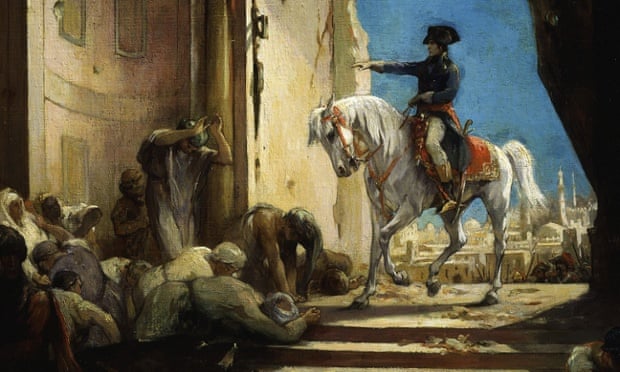
The meeting of the two cultures (which, for obvious symbolic reasons, is often dated to the Napoleonic invasions of Egypt) led to a realisation on the part of Muslim rulers that only by adopting western practices and technologies could they avoid political and economic oblivion. The extraordinarily rapid process of change that this triggered has been summed up by the historian Juan Cole:
“In the space of decades intellectuals forsook Ptolemaic for Copernican astronomy … businessmen formed joint-stock companies (not originally allowed in Islamic law), generals had their armies retrained in new drills and established munitions factories, regional patriotism intensified and prepared the way for nationalism, the population began growing exponentially under the impact of cash cropping and the new medicine, steamboats suddenly plied the red Sea and the Persian Gulf, and agrarian capitalism and the advent of factories led to new kinds of class conflict.”
And so on. In the middle of the century the Ottoman Sultan declared equality between his Muslim and non-Muslim subjects, the slave trade was outlawed and the harem fell gradually into desuetude. The sheikhs and mullahs saw their old prerogatives in the law and public morality arrogated by an expanding government bureaucracy. Clerical opposition to dissection was overcome and theatres of anatomy opened. Culture, too, was transformed, with a surge in non-religious education, and the reform of the Arabic, Turkish and Persian languages – the better to present modern poetry, novels and newspaper articles before the potent new audience of “public opinion”. Compared to the western experience, modernisation was drastically “telescoped”, as Cole puts it, with the moveable-type printing press, dating back to the 15th century, and the telegraph, which was invented in 1844, arriving almost simultaneously.
Political consciousness also rose. In the last decades of the 19th century, Egypt, Iran and Turkey, the most populous and culturally influential centres of the Middle East, all experienced movements in favour of representative government – in Turkey and Iran, parliamentary rule came into effect a few years after the turn of the new century, and in Egypt after the first world war.
The story of Muslim modernisation has sometimes been depicted as the efforts of a few potentates to enforce alien precepts on resistant populations. Muhammad Ali, Egypt’s khedive, or viceroy, for most of the first half of the 19th century, and his near contemporary (and nominal sovereign), Sultan Mahmud II, are the names to remember here, and there were indeed many instances of popular opposition to what were depicted as godless innovations. In 1814, for example, the Muslim notables of Piraeus were persuaded by a local divine not to set up quarantine stations to protect themselves from an outbreak of the plague. The pandemic was “from God”, he said; “to try and limit its progress is to oppose Providence”. (The population was duly obliterated.) The Persian crown prince Abbas Mirza, modernising his fiefdom of Tabriz, in north-west Iran, drilled the soldiers of his new army behind high walls, for fear that they would be spotted by their disapproving families.
The myth that modernisation had no natural constituency – to be contrasted invidiously with the spontaneity of emergent modernity in the west – has been exacerbated by some of its rankly insincere recent apologists. The Mubaraks andBen Alis of this world paraded modernity like a codpiece; to look at these self-described apostles of secularism and development, one might be forgiven for thinking that modernisation in the Middle East has always been infertile, and always will be.
But if we want to understand the relationship between ideas and change in the Middle East, we must turn to an earlier moment, and to the figures who found themselves mediating between the two. We are limited here by the historical record – which preserves the accounts of a few distinguished figures – but there is no reason to believe the hope and trepidation that they expressed were not also felt by a great many of their lesser-known contemporaries. Societies changed, as the dialectic of new and old continued, and people lost themselves in the intensity of the transformation of which they were a part.
***
One of the earliest Middle Easterners to appreciate the unavoidable, tentacular qualities of modernity was the Iranian Mirza Muhammad Saleh Shirazi. He was one of five students who were sent to England by Crown Prince Abbas Mirza in 1815 to study useful things and bring them home. The travelogue that Mirza Saleh wrote is among the first books written in Persian about a Christian country. Reading it one gets the sense of a worldview that is changing; even Mirza Saleh’s writing alters as he acclimatises to Regency London, moving from stiltedness to fluency, directness and utility. Here, in real time, is the literary modernisation of the Middle East.
In the spring of 1817, Mirza Saleh made a trip to the west Country, which forms the most exquisite section of his book. A sense of diligent journalism permeates his writing as his coach quits London on the westward turnpike. In comparison to the potholed and rutted dust roads of Iran, passable only on horseback or on foot, his detailed description of this efficient mode of transport must have struck his readers as a great novelty. At first he sits inside the coach, with a Spaniard and several farmers for company (all equally unintelligible); after nightfall he takes his place on top, where he remains until Salisbury Cathedral comes ethereally into view at dawn.
And on to Exeter, where he is met by his host, Robert Abraham, and the two set off for the latter’s home in the stannery town of Ashburton. Amid the tin mines, Mirza Saleh exchanges European clothes for Iranian robes, which causes the daughters of his host much amusement. Indeed, much of Mirza Saleh’s stay is spent in the company of these and other Devonshire girls, “moon-faced” and “sweet-natured”. (He seems to have censored himself, for in the descriptions he provides of bucolic musical interludes overlooking the River Dart, mention of cider is suspiciously absent – only tea.) Mirza Saleh is partial to young Sarah Abraham, who displays “the utmost excellence, perspicacity, sagacity and delicacy” as they converse on the road to Plymouth. For the people back home, used to a strict segregation of the sexes, the outlandishness of such a friendship would not need spelling out.
In Plymouth, Mirza Saleh lavishes his ever-improving descriptive powers on “the most secure port in England”, with its armouries and massive hospital. The anchorage is so extensive a thousand warships could park there, protected by ramparts bristling with cannon – and he explains dry docks and breakwaters for the landlocked Tabrizis, whose only experience of the sea is as poetic metaphor. Amid celebrations to mark George III’s birthday he ventures out clutching the hand of Miss Sarah (again, a liberty he would not take with a girl back home) is mobbed by 500 people, and flees. And when the time comes for him to say farewell to the Abrahams, he asks, “of what importance are differences of religion? … I wept for the members of this family, old and young, such that I have never been so affected.”
Several hundred pages of British history and actuality are still to come. Mirza Saleh traces events from the Roman invasions to the Napoleonic Wars, and there is something thrilling about seeing the names of the Saxon Kings transliterated into Persian for the first time. His account of contemporary London takes in house design, domestic mores (not unreasonably, he is surprised that when people enter houses, rather than take off their dirty shoes, they remove their hats), and detailed descriptions of the prerogatives of the king and parliament. Admiring but never cringing, fully aware that his exposition of Britain’s partial democracy will prompt interest and perhaps envy in the Iran of the divine right of kings, he reserves his greatest astonishment for the ability of a single artisan, “a poor man, with a shop”, to postpone the building of Regent Street by refusing to sell his freehold to make way for the thoroughfare. “And suppose,” Mirza Saleh writes with pardonable hyperbole, “that the whole army were to come down on his head, they cannot oblige him to give it up … the prince himself cannot inflict the slightest financial or physical harm on him.”
Mirza Saleh and his fellow students were a small sample of similar contingents that were dispatched from Muslim countries to Europe over the course of the 19th century. In 1819 the five Iranians were recalled home, where Mirza Saleh went on to become a teacher, diplomat and pioneering newspaper owner and printer. (Among his productions was a Qur’an with a Persian translation between the lines – he appreciated the importance of Tyndale’s translation of the Bible into English). Of his former travelling companions, one rose to be chief engineer to the (newly modernised) army, and translated a biography of Peter the Great, while another, who had studied medicine in London, assumed the title of royal doctor and designed Iran’s first polytechnic. The only artisan in the party, the master craftsman Muhammad Ali, became head of the royal foundry; his English wife introduced knives and forks into their household.
Thus change entered Iran and the wider region through the cerebral and the banal, and if it was to stand a chance of popular success it would need the endorsement of men of religion. In the absence of a central ecclesiastical institution capable of bringing people – with the authority, say, of a papal encyclical – over to a new understanding of things, the sheikhs and mullahs would have to be guided by their own consciences.
***
Perhaps the most celebrated of the early modernising theologians was Egypt’s Rifa’a al-Tahtawi. Rifa’a was the archetypal “new” sheikh; chloroformed at al-Azhar and revived abroad (in his case, as a student in Paris in the late 1820s), he returned home to join the bureaucracy and trill the virtues of civilisation – a word whose Arabic equivalent, tamaddun, from the word meaning “city”, he did much to popularise.
The idea that the future will be better than the past is integral to any understanding of progress, and Rifa’a adopted it unambiguously: his love of the new was heartfelt and unapologetic; he ridiculed those who dismissed the modern era. He promoted a reformed Arabic, published furiously (including the first Arabic grammar for schools), and edited the country’s first newspaper. In 1836, he set up a translation bureau that brought new and unfamiliar ideas rushing into Egypt by rendering 2,000 European and Turkish works into Arabic, ranging from Greek philosophy and ancient history to books about geography and geometry.
The effect of these translations on the engineers, doctors, teachers and military officers who read them can easily be imagined. For this new elite, forerunners of the secular-minded middle classes that dominate public life even now, learning about antiquity expanded the meaning of the instructive past. The feats of the hitherto reviled non-Muslims presented an alternative story of talent and achievement, occluding faith-based partitions and suggesting a more equitable distribution of God’s favours than many Muslims had previously entertained.
Rifa’a had been amazed by the malleability of the French language, geared to utility more than embellishment, and he introduced similar principles into Arabic as Mirza Saleh, through his travelogue, had done for Persian. Translation is an expression of the universality of the intellect, but one Middle Eastern language remained unable to receive the new ideas – arguably the most important of them all, Ottoman Turkish. When writing in Ottoman Turkish it was considered a fine thing to approach the subject in as ornamental and long-winded a fashion as possible, executing puns, ransacking the Persian classics and eschewing punctuation. Nine different calligraphic systems were in use, getting to the point was considered facile and functionality was ignorance.
In the late 1850s and early 1860s Turkish was made fit for purpose by a curmudgeonly polymath named İbrahim Şinasi. The orphaned son of an artillery captain, Şinasi grew up in the Tophane district of Istanbul (now much sought after by foreigners), where he learned Arabic, Persian and French before going to Paris on a scholarship. He returned with a shrewd realisation that the goals of human progress and linguistic development are linked – and applied himself to both.
In 1860 Şinasi co-founded the empire’s first independent Turkish-language newspaper, and shortly afterwards he launched his own paper, the Tasvir-i Efkâr, or Illustration of Opinion. The subjects he wrote about ranged from foreign policy (he was a hawk) to literature and the importance of good manners. Şinasi also pushed the idea, then in its infancy, of a national identity. In Egypt Rifa’a al-Tahtawi was thinking along similar lines, popularising the word watan, or nation, and translating the Marseillaise. The outlines of the Middle Eastern nation states were coming into view.
One of the most fascinating of Şinasi’s editorials reveals his ability to draw philosophical significance from apparently quite workaday subjects. The government had announced a scheme to introduce street lighting to parts of central Istanbul, opposed by kneejerk conservatives – just as the same innovation had been opposed in London almost 200 years earlier. Şinasi, of course, was enthusiastic, not only for practical reasons of reduced criminality and enhanced commerce, but also because the illumination of the streets seemed to presage the deeper and less extinguishable illumination of people’s minds. “Who opposes street lighting,” he demanded, “if not those ruffians who profit from the darkness of the night?” And then, in a barbed reference to the intellectual monopolists whose feeble glow depended on surrounding gloom and the ignorance of others: “A firefly only glows at night.”
Sultan Abdulaziz read impertinence and sedition into editorials of this kind, and in January 1865 the government introduced censorship following the example of Napoleon III. Within the month Şinasi had fled to Paris but the press could not be controlled. Over the next 11 years the number of publications available in Istanbul went from four to 72, with the most popular papers selling as many as 24,000 per issue. It was a similar, if slower story in Egypt, where the newspaper-reading public in 1881 has been put at 72,000; Iran’s press revoultion was just as dramatic.
It was little wonder that governments across the Middle East viewed with alarm the transformation of the public discourse and their diminishing ability to regulate it. Relationships between people of different backgrounds were being formed against the neutral backdrops of the university, the office and the steamship. The rigid seclusion of the harem fell away and for men it was no longer necessary to be a eunuch in order to enjoy the society of a woman who was neither a prostitute nor your mother. Between the strata of the Ottoman family a kind of pluralism inserted itself, with one modernist insisting that his patriarchal father show respect for an “individual’s opinion”.
What if that individual was female? While decades would pass before most Muslim women were acquainted with even the theory of their rights, change came earlier for the upper classes in the cities. There, rising female literacy led to employment in nursing and teaching, and the emergence of western-style charities independent of the mosque. New women’s magazines showed the Paris fashions and called for the prohibition of polygamy.
The career of the Turkish writer Fatma Aliye shows how a combination of new institutions, technology and altered patterns of thought were changing society with a convulsive force. Born in 1862, the daughter of an Ottoman grandee, she might have seemed destined for a traditional life – and indeed, despite showing exceptional intellectual promise and even learning French in secret (her mother feared her exposure to impious notions), she went into purdah at 15 and was married off at 19 to a man who disapproved of her vocation.
But Aliye continued to write and translate, eventually winning her husband’s support, and what she produced in seclusion the new press enabled her to diffuse among an expanding audience of literate women. Hers became a distinctive voice in the Istanbul papers, where she promoted girls’ education and kicked against the stock male denigration of women as “long on hair, short on nous”.
What makes Aliye’s experience so instructive is the way in which she was formed by modernisation and formed it back in turn. Among her best-known works is an epistolary novel comprising letters by upper-class women speaking of their lives and their loves, a conceit that would have been meaningless were it not for the new institution of the imperial postal service. She was the sort of woman who would engage in philosophical conversations with strange men while crossing the Bosphorus on a steamer. Public transport was exercising its usual levelling function, with hitherto segregated members of society thrown together and their candour naturally heightened by the transience and anonymity of such encounters.
In her later years, she continued to exercise a degree of autonomy as a Muslim woman that would have been unthinkable in her youth – travelling alone to Europe to pursue her errant younger daughter Zubeyda, who (to her immense chagrin) had become a Catholic nun and moved to France. Zubeyda later recalled that her mother had been “haunted” by the question of the “equality of the sexes in society and the struggle to achieve it”. In the Turkey of the 1860s, when Aliye was a child, there had been little question of “equality of the sexes”. There had been no “struggle”. Now there were both.
The stories of Fatma Aliye, Mirza Saleh, Rifa’a al-Tahtawi and İbrahim Şinasi are only few among many, but they reiterate what should already be apparent, that Muslims had an energetic engagement with modernity more than a century before television pundits began demanding one – an engagement, then as now, defined by negotiation rather than conquest. It may be, as these examples show, that there is not a “canon” into which they can be fitted – a neat narrative of Muslim modernity to put alongside the western one we know so well, thanks to M. Védrine and others. But then it could be argued that the idea of a canon is somewhat déclassé, with contributions to the collective experience being written, as the young swimmer in the council pool demonstrates, around us all the time.
To suggest that the Muslim world’s experience of modernity has been severely deranged by the repeated incursions of western imperialists and post-imperialists is to restate one of the truisms of our age. When Britain and France invade Egypt with the aim of protecting their loans (literally in the case of Gladstone, with his heavy personal exposure to Egyptian government bonds) and Sykes and Picot split the region into British and French zones under cover of the first world war; when the western nations award land to Zionism that isn’t theirs to give and when the region is thrust into a cold war not of its making, with a harvest that includes Saddam, Mubarak and the Assads – with all this happening in the space of a few decades it would be optimistic to expect the reordering of cultures and societies to go without a hitch.
It is not surprising that many at the business end of this penetration have been sceptical of the westerners’ claim to be acting in their best interests, and that in time some of these Arabs, Turks and Iranians expanded their distaste for the curled colonial lip into a more general critique of modern life. When the radical Muslim Brother (and founder of modern Islamism) Sayyid Qutb went to study in the United States in the late 1940s, his reaction to the west was sharply dissimilar to that of Mirza Saleh 140 years earlier; what was revealed to Qutb was less a model worthy of emulation than the seedy internal workings of a system that he – an Egyptian chafing against a sybaritic monarch propped up by Britain – knew all too well.
Few westerners have considered how bruising it is to be constantly reacting to another’s invention, statement or action: always being told to “catch up” or improve. This is the situation that so many Muslims have found themselves in over the past two centuries. But this is the backstory that has made Islam’s engagement with modern values more suspenseful, more despairing, more suffused with the “simultaneity of spring and autumn”, than anywhere else in the world.
In the light of adverse politics and history, the surprise is not that modernity has been a tortuous experience for some Muslims, but that it has been adopted so widely and with such success. (Many millions of Muslims live in harmony with the modern values of personal sovereignty and human rights: another self-evident truth in need of reiteration.) With immigration from the Middle East and north Africa to Europe, the Mediterranean culture that ended with the expulsion of the Muslims from Spain in 1492 has been revived. Our world is even more interpenetrated than the communal gallimaufry of the Ottoman empire. Talk of European values that exclude Islamic values will be barren for as long as millions of Europeans regard Islam as an important element in their lives. Talk of teaching them Voltaire is a joke as long as they cannot teach us back. The much-touted choice facing the “Muslim community”, between modernity and obscurantism, between “here” and “home”, is false. Here is home. Life is modern. All we can do is negotiate.


 .
.