Category: Sosial

  • Pakar: Kaum Arab Yang Dahulu Temui Amerika Syarikat, Bukan Columbus

    Pakar: Kaum Arab Yang Dahulu Temui Amerika Syarikat, Bukan Columbus

    Bukan Christopher Columbus yang pertama temui benua Amerika Syarikat, tapi orang orang Arab!

    Demikian dakwaan daripada Profesor bahasa purba di Univerisiti Raja Saud dan pengkaji di Pusat Raja Faisal bagi Pengkajian dan pengajian, Suleiman Al-Deeb.

    Beliau mendakwa bahawa Amerika Syarikat ditemui terlebih dahulu oleh suku bangsa Arab Thamudic sebelum Christopher Columbus ke sana pada abad ke-15.

    Dalam satu wawancara yang diterbitkan dalam satu laman web, Prof Al-Deeb berkata beliau antara 15 orang dari pelbagai bahagian di dunia yang membincangkan satu ukiran yang dijumpai di sebuah pangkalan tentera di Colorado.

    Teks tersebut dibaca dan didapati bahasa Arab Thamudic yang sama seperti yang dijumpai di Semenanjung Arab, menurut laporan Arab News.

    WUJUD PENGHIJRAHAN ARAB KE AMERIKA 500 TAHUN SEBELUM COLUMBUS

    Menurut laporan Arab News lagi, Prof Al-Deeb berkata ukiran tersebut adalah dari abad ke-10 dan ini mengandaikan bahawa adanya penghijrahan orang Arab ke sana semasa zaman tersebut.

    Beliau juga berkata tiada masala untuk beliau membaca teks Thamudic itu yang dikirim kepadanya dari AS.

    Prof Al-Deeb menjelaskan bahawa ada cebisan batu di Semenanjung Arab khususnya di Arab Saudi yang mempunyai ukiran yang berusia lebih daripada 3,000 tahun.

    Menurut Prof Al-Deeb ukiran pada cebisan batu itu adalah satu bentuk karya seni yang mencatatkan kehidupan, agama, makanan dan minimum bangsa tersebut pada zaman itu.

    Christopher Columbus dikatakan menemui Amerika Syarikat pada 1492 semasa menerajui ekspedisi laut rentas Atlantik, yang berpangkalan di Sepanyol.

    Ekspedisi itulah yang dikatakan membawa kepada penemuan Amerika Syarikat.

    Source: Berita MediaCorp

  • Laluan Hang Tuah Bawa Tun Teja Dikaji Bagi Buktikan Wujudnya Hang Tuah

    Laluan Hang Tuah Bawa Tun Teja Dikaji Bagi Buktikan Wujudnya Hang Tuah

    Ekspedisi jejak laluan Hang Tuah dari Sungai Muar hingga Sungai Pahang di Pahang dijangka dilaksanakan pada November sekiranya ia mendapat kerjasama tiga negeri yang terlibat.

    Pengerusi Institut Kajian Sejarah dan Patriotisme Malaysia (Iksep) Profesor Datuk Dr Mohd Jamil Mukmin berkata usaha itu perlu mendapat kebenaran daripada kerajaan Negeri Sembilan, Johor dan Pahang kerana ia melibatkan laluan sekitar 500 kilometer di negeri tersebut.

    Beliau juga menambah usaha itu turut melibatkan kerjasama Institut Alam dan Tamadun Melayu dan Universiti Kebangsaan Malaysia.

    “Ekspedisi berkenaan digerakkan dengan penyertaan lebih 100 orang terdiri daripada golongan belia, kakitangan kerajaan dan media bagi menjejaki sekaligus membuktikan kewujudan Hang Tuah.

    “Antara kaedah yang akan digunakan adalah secara arkeologi, kajian manuskirp dan temu bual dengan penduduk asal di kawasan sepanjang laluan itu,” jelas Profesor Mohd Jamil.

    Beliau bercakap kepada para wartawan semasa majlis pembentangan hasil kajian awal jejak laluan Hang Tuah Membawa Tun Teja dari Pahang ke Melaka di Malaysia, hari ini (7 Jun).

    Majlis berkenaan turut dihadiri Ketua Menteri Melaka Datuk Seri Idris Haron.

    Profesor Mohd Jami mengulas lagi laluan berkenaan dikenal pasti digunakan Hang Tuah ketika membawa Tun Teja ke Melaka selain menjadi laluan pembesar, pahlawan, pedagang dan pendakwah khususnya dari Melaka ke Pahang dan sebaliknya.

    Sementara itu, Encik Idris berkata kerajaan negeri akan terus menyokong termasuk dari segi kewangan, usaha Iksep bagi membuktikan kewujudan Hang Tuah dan menjadikannya sebagai satu produk pelancongan baru negeri Melaka.

    “Ia perlu dilaksanakan secara serius dengan bukti-bukti sejarah sedia ada.

    “Kita tidak mahu keuwjudan Hang Tuah terus dipertikaikan padahal Melaka memang sinonim dengan nama pahlawan itu dan sejarah Kesultanan Melayu Melaka,” tegas Encik Idris.

    Source: Berita MediaCorp

  • Police Clerk Admits To Leaking Confidential Details Of Traffic Accident Victims

    Police Clerk Admits To Leaking Confidential Details Of Traffic Accident Victims

    A former Singapore Police Force clerk pleaded guilty on Tuesday (Jun 7) to five charges under the Official Secrets Act (OSA) for divulging privileged information to an unlikely accomplice – an employee of a law firm.

    Khatijah A Manap, 61, also pleaded guilty to three counts under the Prevention of Corruption Act (PCA) for receiving at least S$2,500 in bribes from legal executive Gulzar Raja Singh Sandhu, 69, in exchange for contact details of people involved in traffic accidents.

    Another 23 charges – 18 under the OSA and five under the PCA – will be taken into consideration during sentencing.

    The duo met in 2008, when Khatijah was herself involved in a traffic accident. She was put in touch with Raja by a relative, and he in turn introduced her to his daughter, a lawyer at Clifford Law LLP. Khatijah told Raja then that she was working as a clerk in the investigation branch of the Traffic Police.

    As a clerk, Khatijah had access to traffic accident investigation papers, including the personal and contact details of those involved.

    When the two bumped into each other again more than two years later at the Traffic Police headquarters, Raja asked Khatijah if she wanted to work together by giving him the contact details of traffic accident victims.

    Raja offered to pay her S$200 for every successful “contact” – traffic accident victims who engaged the law firm to act for them in compensation claims. Khatijah agreed, and eventually pocketed at least S$2,500 from the scheme, Deputy Public Prosecutor Sanjiv Vaswani told the court.

    She would randomly pick “victims”, copying their details down on a piece of rough paper which she would destroy after communicating these to Raja, the court heard.

    Either Khatijah or Raja would then contact the victim to inform them they could lodge a compensation claim, and engage Raja’s daughter, a lawyer at the firm, to do so. In some cases, Raja told victims he had obtained their contact details from a police officer, or an employee of the Traffic Police.

    Their offences came to light in 2013, after a traffic accident victim – who was contacted by the pair twice in two years regarding separate accidents – complained to Khatijah’s boss.

    In 2012, Mr Haresh Vishindas Chandiramani was involved in a traffic accident and was contacted by Khatijah, using the alias “Azizah”. Azizah informed Mr Chandiramani he could seek compensation, and arranged for Raja to visit the man at his home.

    At Mr Chandiramani’s home later that day, Raja admitted he had an arrangement to obtain contact details of accident victims from “someone at Traffic Police for a fee”, the court heard. Mr Chandiramani told Raja to leave.

    About a year later, in 2013, Mr Chandiramani was involved in another accident. He again received a call from Azizah, claiming to be an employee of Clifford Law LLP. She advised Mr Chandiramani to engage the firm – specifically, Raja’s daughter – if he wanted to seek compensation.

    Azizah then offered to set up a meeting with her paralegal, Raja, but was cut off by Mr Chandiramani over the phone. He immediately called Khatijah’s office, and asked why she had disclosed his number to “an outsider”. She explained that she and Azizah were, in fact, the same person.

    Mr Chandiramani warned Khatijah that what she was doing was against the law, and complained to her boss, who advised him to lodge a police report.

    For breaching the Official Secrets Act, Khatijah could be sentenced to up to two years’ jail and a fine of up to S$2,000. For receiving bribes, she could be jailed for up to five years and/or fined up to S$100,000.

    Investigations against Raja are ongoing.


    Source: ChannelNewsAsia

  • Moment Of Near-Failure Spurred Him To Succeed

    Moment Of Near-Failure Spurred Him To Succeed

    The Nanyang Technological University (NTU) convocation ceremony on Aug 1 will be a special occasion for Mr Ridhwan Muzaki and his family.

    Not only will the 27-year-old be the family’s third graduate, but he will also celebrate the milestone with his brother, Mr Abdul Rashid, 32, who will be receiving his doctorate in biological sciences the same day.

    Mr Ridhwan, who will receive his biological sciences honours degree, is a three-time Dean’s lister and scholarship recipient.

    His academic success belies an unusual background.

    Like his older brother, he was from the Normal (Academic) stream in secondary school. Many of his classmates smoked, others dropped out, and he was not motivated to do well.

    But something changed when he was in Secondary 4. A teacher who never stopped believing in him encouraged him not to drop the subject, Principles of Accounts, when he was on the verge of giving up.

    “She was like a mother-figure to me… I did some reflection and thought to myself, if I don’t work hard now, my future will never be bright,” he recalled.

    So he studied hard, becoming the top N-level Malay student in 2005 and went on to study biomedical sciences at Singapore Polytechnic.

    In 2010, his application to NTU’s School of Biological Sciences was rejected, but he did not give up.

    He applied again the following year and got in.

    He was so determined to get a head start that he borrowed his elder brother’s notes and studied them a year before he was due to start his university course.

    During weekends, he would spend 10-11 hours each time poring over his notes.

    “Ridhwan had a timetable which he would stick to strictly,” said his mother Rosiah Osman, 54. “He has always been quite an average student, but he studies very hard.”

    The third of four siblings in his family, Mr Ridhwan has an older sister, Ms Siti Rawaidah, 31, who works as a project officer, and a younger brother, Mr Zulfadhly Muzaki, an NTU undergraduate.

    All four siblings have either pursued or are pursuing the biological sciences course at NTU.

    Mr Ridhwan says he hopes to be a researcher. He received a scholarship from NTU in April to do postgraduate studies.

    He has a special interest in RNA – ribonucleic acid – a messenger in the body, transferring instructions from DNA to make proteins.

    Mr Ridhwan says he is especially grateful to his parents for their support. His father, Mr Mohammad Muzaki, 57, works as a senior technician in a drinks packaging company.

    Said Mr Muzaki: “It is every parent’s wish to see their children go further than they have. Being able to see my children come this far makes me proud.”

    Source: The Straits Times

  • Meet Professional Female Boxer – Nur Shahidah Binte Rosli

    Meet Professional Female Boxer – Nur Shahidah Binte Rosli

    Nur Shahidah Binte Roslie chose a career path most women in Singapore would not have thought of – professional boxing. The 28-year-old graduated from University of Western Australia with degrees in exercise and health and sports science, and has been on the national amateur boxing team since 2009. With 10 years of boxing experience under her belt, Shahidah decided to turn professional with Juggernaut Fight Club earlier in February this year.

    How did you get involved in boxing?

    I was already into martial arts when I was younger, and when I was in secondary school at Gan Eng Seng, I took up taekwondo and eventually earned my black belt. But I felt that I needed something more. During a school project at ITE, where we had to shadow and observe a coach, I was introduced to kickboxing and I started learning kickboxing and boxing altogether. Two years later, I got my first fights within two weeks. The first was boxing and second was kickboxing and from there, I was able to gauge my strengths and weaknesses and see which I preferred. After some time, I did more boxing than kickboxing and in 2009, I got into the national team and focused more on boxing. Eventually, when the opportunity came to turn professional, I knew I had to take it.

    What are the biggest misconceptions of boxing?

    It’s amazing how people expect you to be a bit disfigured and deformed, or maybe boyish and manly and masculine in some way when you’re a female. I’m actually quite the opposite. I can be like that during training, but outside, I mean, I like pink and I love Hello Kitty. I can be very feminine as well and people have these stereotypes that we’re not feminine. There were also a lot of questions on whether my parents would be afraid I would not be able to get married, that typical girls would have to settle down. Fortunately for me, my parents and relatives don’t ask these questions so I’m not sure how to answer that.
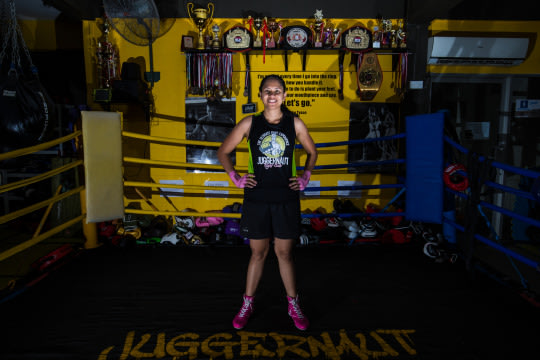
    image

    Nur Shahidah Binte Roslie poses for a photo at Juggernaut Fight Club on May 24, 2016 in Singapore. Photo: Lim Yong Teck

    What has been your most memorable experience in boxing?

    Training with my teammates. Every time I get injured or knocked down, it can be a painful experience but I see it as a memorable moment because it’s a learning experience as well. You get injured so you have to think, ‘What went wrong?’ So you sit down and think it through and you share it with your teammates so they can avoid making the same mistakes. And my teammates are all very encouraging and that keeps me going.

    And your most heartbreaking?

    The SEA Games loss was pretty heartbreaking for me. It was the first ever match that I almost won internationally. I always lose in the international matches that I’ve competed in by unanimous decisions. At the SEA Games, I thought I did well, but for some reason, it was a split decision and the victory was awarded to Vietnam. I was heartbroken, but it may be my own mistakes as well. I wasn’t exactly being very aggressive and I was focusing on my techniques instead. Most of the times, being aggressive in amateur boxing helps and I guessed I lost out on that. That is also one of the reasons why I decided to go into professional boxing because I feel that I fit in here more.
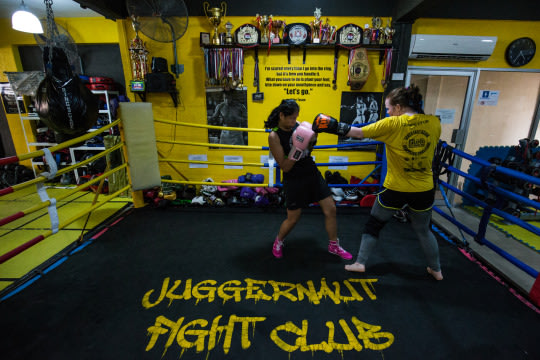
    image

    Nur Shahidah Binte Roslie (L) trains at Juggernaut Fight Club on May 24, 2016 in Singapore. Photo: Lim Yong Teck

    Was there a time when you felt like walking away from boxing?

    Yes – it was during the amateurs when there was no fights for a period of time. Sometimes, when I made the weight for a fight, there would be no opponents at all. It’s unlike professional boxing, where it’s definite unless your opponent pulls out and you know who your opponents are going to be. In the amateurs, you were made to cut your weight down to 57kg for example, wait until the weigh-in day and after you’re exhausted and starving, you’re told that you have no opponent and that feeling is not good. It happened two or three times in a row and I almost wanted to give up. Most female boxers would have faced the same situation at some point of time but I think it’s getting better now.

    How far do you think boxing has developed since its inauguration?

    When I first stepped into the ring, there were only a few female boxers. When the SEA Games was approaching, I heard of many more female boxers stepping into the ring and trying out for the national team. The SEA Games actually helped a little, because after the Games concluded, there was a good growth in the number of female boxers. The standard of female boxing had also improved a lot.
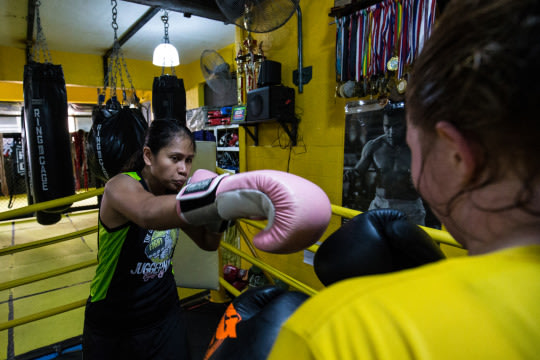
    image

    Nur Shahidah Binte Roslie (L) trains at Juggernaut Fight Club on May 24, 2016 in Singapore. Photo: Lim Yong Teck

    What kind of challenges do you foresee in your professional boxing career?

    Definitely financially, because I’m trying to pay off my education loan. When I graduated, I didn’t know what exactly I wanted to do and I worked with Arvind, the head coach here at Juggernaut, for a while. The opportunity to turn pro presented itself and I thought I’d give it a go. Not many people in Singapore at my age can get the opportunity to do what they really want and get paid for it. Of course, you start slow and you don’t get paid well at first, but I believe that when you put in the hard work and eventually everything else will come. At this point of time, I’m not worried about that and for now, this is my peak and I want to do something about it. And plus the fact that the female boxing scene is growing, I want to create a path for future female boxers to do this professionally. Even if I’m not earning thousands in my boxing career, at least I know that I paved the way for the younger generation to follow. Hopefully in time, they’re earning the thousands. Someone has to start it and I don’t want Singaporeans to think that there’s no future in boxing.

    There was also this once, in the Philippines, I went to get some training done at Elorde Boxing Gym and at the end of the session, the instructor asked if I wanted to turn pro and fight for them. I had to decline because at that point of time I was still holding a job with ITE as a lecturer. After that incident, I had thoughts of going overseas to turn pro before Arvind actually offered me. For now, I don’t have any overseas plans and if Arvind can provide me with the opportunities and help me keep the momentum going, I won’t be going anywhere.

    For my parents, they probably disagree with my career choice but they’re still supportive in what I do. Financially, it’s tight, but I think it’s going well for me so far and I think I can still afford to continue boxing professionally.
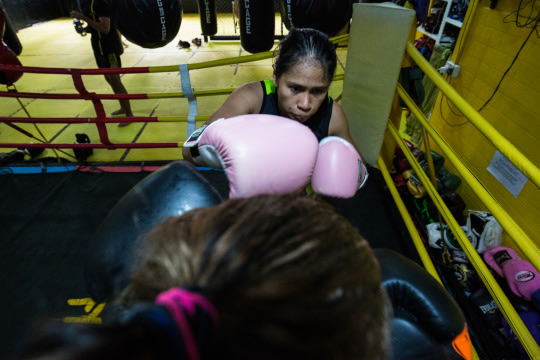
    image

    Nur Shahidah Binte Roslie (L) trains at Juggernaut Fight Club on May 24, 2016 in Singapore. Photo: Lim Yong Teck

    What advice would you give to young aspiring boxers?

    First and foremost, you have to take care of your own body and your own future. I’m not saying that you have to prioritise studies, but you have to balance out education and the sport. You can’t be a full-time athlete when you’re still studying and instead, you should use your youth to gain boxing experience through training and probably small tournaments. Studies is important because you have to secure your future that way. You need something to fall back on if it doesn’t work out, such as getting injured when you turn pro. That’s what I did. I focused on my studies first, and when I graduated and the opportunity came, I can do it without fear.

    How can people get involved if they’re interested in boxing?

    There are many gyms offering boxing classes today, although these classes may not be very cheap. If they have the means, go to the gyms and try it out. For the younger generation, try to push for boxing co-curricular activities (CCA) in schools. But for that to happen, the right coaches are necessary because boxing requires a lot of safety. For a start, gyms should work on training coaches so that eventually, the Ministry of Education would be willing to help set up boxing as a CCA in schools.
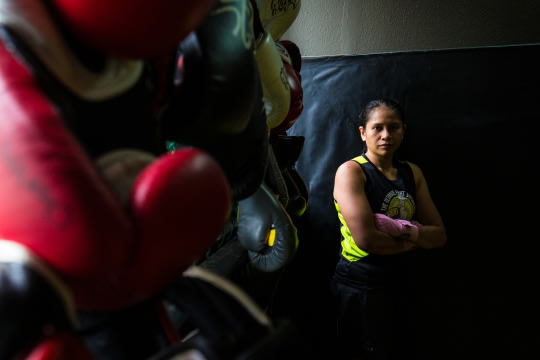
    image

    Nur Shahidah Binte Roslie poses for a photo at Juggernaut Fight Club on May 24, 2016 in Singapore. Photo: Lim Yong Teck


    Source: https://sg.sports.yahoo.com

deneme bonusu