Category: Uncategorized

  • How to Evaluate Information Found Online

    The internet makes it possible to find guidance, research, news, and public records within seconds. Yet speed does not guarantee accuracy. A polished page may contain outdated claims, incomplete context, or opinions presented as established fact. Evaluating online information therefore requires more than noticing whether a page looks professional. Readers need to examine the source, the evidence, the date, and the purpose behind the content.

    Start With the Source

    The identity and expertise of a publisher provide an important starting point. Government agencies, universities, professional organizations, and established newsrooms usually explain who is responsible for their material. Individual authors should also be identifiable, particularly when an article makes technical, medical, legal, or financial claims.

    Authority is not the same as infallibility. Even reputable institutions can publish corrections or revise their positions. Still, a transparent source is easier to assess than an anonymous page with no editorial information. Look for an author biography, organizational details, contact information, and a clear explanation of how the material was produced.

    Check the Evidence

    Strong claims should be supported by evidence that readers can inspect. A health article might cite a peer-reviewed study, while a report about public spending might link to official data or an audit. References do not automatically make a statement true, but they allow readers to examine the underlying material and determine whether it actually supports the conclusion.

    Pay attention to the difference between evidence and assertion. Phrases including “experts say” or “research proves” are weak when no names, studies, or relevant details follow. A reliable article generally explains the limits of its evidence and distinguishes measured findings from interpretation.

    Consider Dates and Context

    Information can become misleading when it is separated from its original date. A technology recommendation may be obsolete after a product update, while an old statistic may be quoted as though it describes current conditions. Check both the publication date and the date of any cited research, legislation, or data set.

    Context matters just as much as recency. A dramatic number may represent a narrow subgroup rather than the entire population. A quotation may omit surrounding remarks that change its meaning. Before sharing a striking claim, read beyond the headline and identify what was measured, compared, or left out.

    Inspect Links and Web Addresses

    Links can help establish a chain of evidence, but they should be examined rather than trusted automatically. A destination may have moved, been changed, or no longer contain the material described by the original article. Readers should also check the domain name carefully, because deceptive sites may use addresses that resemble legitimate organizations.

    When testing a page or documenting a web resource, a simple neutral link like test can illustrate how visible link text and the destination address work together. In practical research, descriptive text is generally more useful than vague labels because it gives readers an indication of what they will find after following the link.

    Recognize Persuasive Techniques

    Online content often seeks to influence behavior, not merely provide information. Advertising, political commentary, fundraising pages, and sponsored articles may all use emotional language, selective statistics, or urgent calls to action. This does not make every persuasive page unreliable, but it does mean that the reader should identify the publisher’s interests before accepting its conclusions.

    Be cautious when a page relies heavily on fear, outrage, certainty, or promises of secret knowledge. Reliable information can be engaging, yet it usually leaves room for uncertainty and does not demand immediate belief. Comparing several independent sources can reveal whether a claim is broadly supported or dependent on one repeated assertion.

    Build a Practical Verification Habit

    A useful process is to pause, identify the central claim, locate the original source, and compare it with evidence from an independent authority. Reverse image searches, official databases, publication records, and reputable fact-checking organizations can help clarify disputed material. The goal is not to investigate every sentence equally, but to spend the most effort on claims that are consequential, surprising, or widely shared.

    Digital literacy is ultimately a habit of careful attention. By questioning sources, checking context, inspecting evidence, and recognizing persuasive design, readers can make better decisions without treating every unfamiliar page as automatically false. Online confidence is most justified when it is grounded in verifiable information.

  • Saudi Arabia Bans Selfies, Photos & Videos At Islam’s Two Holiest Mosques

    Saudi Arabia Bans Selfies, Photos & Videos At Islam’s Two Holiest Mosques

    The Hajj just became a bit less hip: Saudi Arabia has banned pilgrims from taking selfies at Islam’s two holiest mosques, effective immediately.

    Visitors to Mecca’s Masjid al-Haram, known as the Great Mosque of Mecca, and Medina’s Masjid an-Nabawi, or ‘The Prophet’s Mosque,’ will be prohibited from taking photographs or videos at the two holy sites.

    Saudi authorities stated that the ban will prevent unnecessary disturbances for those who wish to worship without distractions.

    While pilgrims may now be deprived of photographic mementos, security guards at the two holy sites have traditionally always been hostile toward people taking photos.

    Now that selfies and photographs of all varieties are officially prohibited, security guards have been instructed to “confiscate the photos and the camera if needed,” according to reports.

    Historically, Saudi Arabia has had a complicated relationship with selfies.

    Last year, Prominent cleric Saleh bin Fawzan al-Fawzan, a member of the powerful Saudi Council of Senior Scholars, denounced those who enjoy “taking pictures with cats,” lamenting that feline photoshoots had been “spreading among people who like to be like the Westerners.”

    The revered cleric later clarified that “taking pictures is prohibited if not for a necessity – not with cats, not with dogs, not with wolves, not with anything,” he said.

    However, as recently as October, photographic evidence of a serious selfie habit was found on Saudi Crown Prince Mohammed bin Salman’s Instagram account. The Saudi royal had taken an estimated 500 selfies in the span of less than two hours.


    Source: RT

  • Islamic State Makes Threat Against Britain’s Four-Year-Old Prince George, Royal Family Will Not Be Spared

    Islamic State Makes Threat Against Britain’s Four-Year-Old Prince George, Royal Family Will Not Be Spared

    LONDON: Islamic State militants have allegedly made threats against Britain’s four-year-old Prince George, British media reported on Sunday (Oct 29).

    Through encrypted instant-messaging app Telegram, a photo of the preschooler was shared with the message: “Even the royal family will not be left alone”.

    The photo allegedly shows the boy standing in front of his South London School, Thomas’s Battersea with the message, “School starts early”.

    The Daily Star reported that the encrypted transmission also had Arabic words which translated to: “When war comes with the melody of bullets, we descend on disbelief, desiring retaliation.”

    Cybersecurity expert Barry Spielman told the Daily Star that “these threats are to be taken seriously” according to his intelligence.

    “This threat to Prince George is chilling,” he added.

    It is not the first time the British royal family has been threatened by the Islamic State. Last month, an IS fighter believed to be from Singapore challenged Prince Harry in a propaganda video to “come and fight us if you’re man enough”.

    In 2015, IS threatened the queen in the runup to celebrations marking 70 years since the end of World War II.

    Telegram is believed to be popular with Islamic State sympathisers, who use chatrooms with hundreds of members, besides holding private conversations.

    In July, Indonesian authorities blocked access to some Telegram channels saying that some forums were “full of radical and terrorist propaganda”.


    Source: http://www.channelnewsasia.com/


  • Man Who Placed An Explosive Device At North Carolina Airport, Vowed To ‘Fight A War On US Soil’

    Man Who Placed An Explosive Device At North Carolina Airport, Vowed To ‘Fight A War On US Soil’

    A man planted a Mason jar filled with explosive chemicals and nails at a western North Carolina airport last week and vowed to “fight a war on US soil,” according to court documents released Tuesday.

    The criminal complaint written by an FBI agent said investigators found the improvised explosive device on Friday at the Asheville airport near a terminal entrance. Asheville police bomb technicians then rendered it safe.

    The complaint accuses Michael Christopher Estes of attempted malicious use of explosive materials and unlawful possession of explosives at an airport.

    Estes was arrested Saturday, and the complaint says he admitted leaving the explosive device at the airport. The complaint states that Estes “claimed he was getting ready to ‘fight a war on US soil,’” but didn’t elaborate on this alleged motive.

    He was being held at the Buncombe County jail without bond after a brief court hearing Tuesday. Jail records list him as a 46-year-old Native American.

    A federal public defender assigned to the case, Fredilyn Sison, didn’t immediately return messages seeking comment.

    Court documents say authorities found the improvised explosive device around 7 a.m. Friday at Asheville Regional Airport. The investigation revealed it contained ammonium nitrate, Sterno fuel, nails and a .410 gauge Winchester shotgun cartridge.

    An alarm clock was taped to the outside of the jar with matches attached to the arm that strikes the bells, according to court documents. The alarm had been set for Friday.

    Surveillance video showed Estes dressed in black pants, a jacket and black hat approaching the terminal entrance shortly after 12:30 a.m. Friday and appearing to leave behind a bag, the FBI agent wrote.

    In nearby woods, investigators later found a backpack and tool kit containing similar items to what was used in the explosive device: tape, Sterno fuel and more shotgun shells. Investigators determined such items had been purchased at nearby stores earlier in the week, providing more surveillance video.

    delta planeEstes left chemical explosives and nails in a Mason jar.Wikipedia

    Authorities released a photograph made from the video, and tips from the public led them to Estes, who was arrested Saturday near one of the stores. The complaint said Estes waived his Miranda rights, answering questions and admitting to building and planting the device.

    “Estes described how he created the device … and then rigged the alarm clock to strike the matches and cause the flame necessary to trigger the device,” the complaint states. “More specifically, the alarm clock would go off, the matches would strike, the Sterno would heat up, and then the Ammonium Nitrate would explode.”

    However, Estes also claimed that he hadn’t actually set the device to go off, the complaint says. He told investigators that he had staged himself in the woods near the airport in the days before planting the device.

    A man who answered the phone at a listing for Estes in Tazewell, Tennessee, said he didn’t know the suspect.


    Source: http://www.businessinsider.com

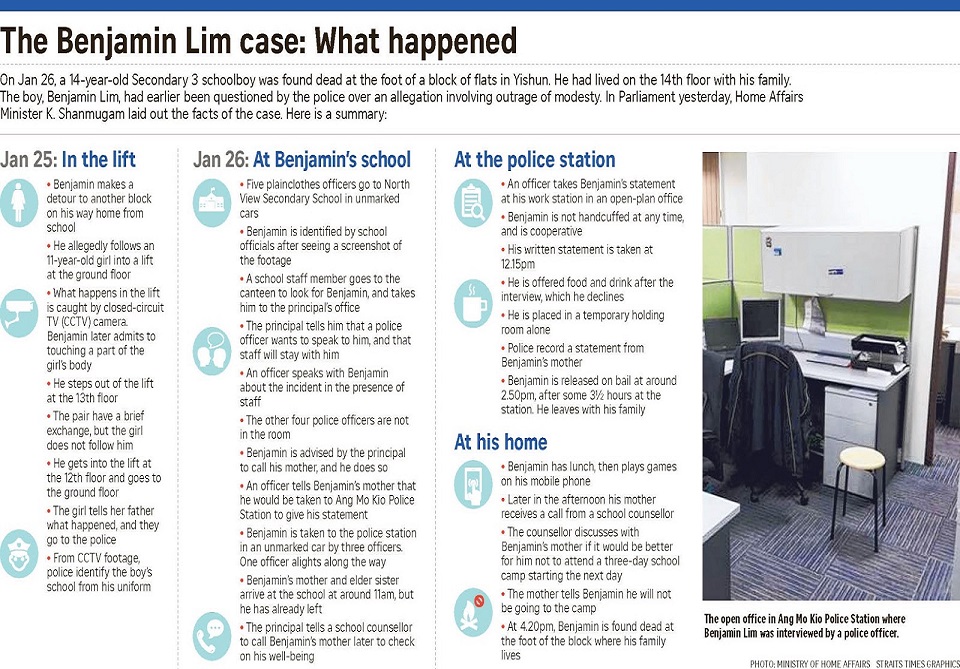
  • Legal Suit Against MOE And SPF For Death Of Benjamin Lim

    Legal Suit Against MOE And SPF For Death Of Benjamin Lim

    We, the immediate family of Benjamin Lim Jun Hui are writing this letter to members of the public to seek financial donation to support legal action against Ministry of Education and the Singapore Police Force.

    Benjamin passed away on 26 January 2016, the same day he was taken to Ang Mo Kio Police Division from North View Secondary School (unaccompanied by any adult from his family or school ) during school hours for questioning in relation to an alleged offence.

    He was brought back home on the same day by his mother and Sister after spending more than three hours in the police station where he underwent interrogation, and jumped from height to his death after a call was made by the School Counselor to his Mother later that afternoon.

    The family has been advised that the case raises many troubling issues regarding the duty of care expected of our schools towards school children and also the care owed by our police force to members of the public. We therefore appeal to concerned citizens to help us in our cause.


    The family of Benjamin wishes to seek justice for him. The family has engaged a lawyer and raised about S$15K to fight the case. However, legal action of this nature is financially very challenging and will cost a lot more than $15K.

    We therefore appeal to concerned members of the public for support to fund the legal challenge, which may run to hundreds of thousands of dollars.

    For anyone who wish to contribute directly via bank account, you may transfer any amount to POSB saving account (bank account hidden). This account was recently set up by the family to gather funds for the purpose above stated.

    We thank you for your support and do feel free to write to us at (email hidden) if you have any questions or if you need further clarification.

    ***

    Editor’s note: Those who would like to contribute, may do so at: https://give.asia/story/legal_suit_against_moe_and_spf_for_death_of_benjamin_lim


    Rilek1Corner