Blog

  • “Raise Fares To Improve Train Service”

    “Raise Fares To Improve Train Service”

    “Raise fares to improve train service”, says the title of the letter to the Straits Times forum page on Wednesday.

    Mr Jonathan Toh Joo Khai, the writer, pointed at the Public Transport Council (PTC), which regulates public transport fares, as the “root cause of SMRT’s frequent train breakdowns.”

    “The fare hikes are miserly compared with the rate of inflation,” Mr Toh said.

    He then rattled off a litany of “financial indicators” of the SMRT which, he said, “had been falling for five straight years.”

    “Unlike other companies, SMRT cannot shed its money-losing train business,” Mr Toh said. “Yet, it is yet expected to improve reliability even as the PTC moderates fare hikes to meet the demands of commuters, some of whom even want a freeze to fare hikes until reliability improves.”

    “How is that possible?” he asked.

    He argued that “train fares in Singapore are low relative to gross domestic product per capita.”

    Mr Toh thus called for fares to be increased, and that discounts be given to those in need.

    “The rest who happily use our latest flashy iPhones and Samsungs to kill time on the trains can surely afford a fare hike,” he concluded.

    The public transport operators (PTOs) make yearly application, usually towards the end of the year, for “fares review”, which the PTC will consider and decide on several months later, usually around March.

    Mr Toh’s call is not new and is the latest in the last two years or so from various quarters who have also also called for higher fares for buses.

    In January 204, for example, this report appeared in the TODAY newspaper:

    TODAY, Jan 2014
    TODAY, Jan 2014

    “Rather than complain about both poor service and fare increases, perhaps it is time for a shift in commuters’ thinking towards paying even more, so that we get the transport services we deserve in a world-class city,” the writer said.

    About four months later, the former chairman of the PTC, Gerard Ee, echoed the same sentiments.

    Straits Times, May 2014
    Straits Times, May 2014

    “At the end of the day, buses and trains are about transporting a lot of people from Point A to B as affordably as possible,” Mr Ee said. “So by that very nature, they are going to be crowded. They’re not designed for comfort.

    “If you treasure your time and treasure your comfort, you pay a premium – there are premium bus services. If you value your time and comfort even more, buy a car. And then ultimately, get a chauffeur. You have to decide for yourself what it is you want.”

    Straits Times, Jan 2014
    Straits Times, Jan 2014

    But in January 2014, the PTC itself delinked the relationship between fare hikes and better service, particularly breakdowns of the system.

    The PTC’s remarks were in response to public sentiments that fares should not go up when trains are still breaking down.

    “[The] Public Transport Council (PTC) has said that the two issues should be kept separate,” the Straits Times reported.

    Nonetheless, Prime Minister Lee Hsien Loong said in September last year that progress and improvements have been made, and that “there are not so many breakdowns as before.”

    But just three months later, the TODAY newspaper reported that the “number of major MRT delays had hit a] four-year high.”

    Sept 2014
    Sept 2014

    There were 12 “major delays” in the first nine months of 2014 alone, the newspaper reported. This was more than the 11 for the entire year in 2011, the previous record number of delays.

    And on Thursday, 30 July 2015, the Straits Times reported that there have already been “five major delays in Q1, nearly half last year’s total.”

    Straits Times, 30 July 2015
    Straits Times, 30 July 2015

    “[There] were five service delays lasting more than 30 minutes between January and March this year,” the Straits Times said.

    This included a disruption in February where a breakdown in the line between Yew Tee and Kranji station lasted for four hours and 38 minutes.

    And earlier in July, the entire train system was shut-down for several hours due to a train fault, affecting 250,000 commuters.

    Would all these problems disappear with the simple solution of increasing fares?

    One would be hard-pressed to argue for such a simplistic expectation.

    Yet, the truth is that much public funds have been poured into the transport system, billions in fact, and billions more have been earmarked for the same in the next decade.

    And are the PTOs making losses?

    If they were, there would be no justification for them to double the salary of their chief executive officer, as SMRT did this year, raising its CEO pay from S$1.2m in 2013, to $2.25m to $2.5m in 2015. (See here: “SMRT CEO paid $2.2m to $2.5m – a multifold jump in three years?“.


    Source: www.theonlinecitizen.com

  • Zulfikar Shariff: Elected MPs Do Not Represent The Malay/Muslim Community

    Zulfikar Shariff: Elected MPs Do Not Represent The Malay/Muslim Community

    There is a common misunderstanding on the role and appointment of Malay MPs and the Minister in charge of Muslim Affairs.

    There are regular comments from the Muslim community that as our leaders and representatives, it is the duty of these MPs and Minister to fight for our interests. They ask why the MPs have not fought for the hijab, why they did not fight against the destruction of masjid, or the removal of wakaf.

    While it is expected that a Muslim will do all he can for the community, we should not be mistaken into thinking that these MPs and Minister are our representatives.

    Let us be clear how they were appointed. And what role the Muslim community played in their appointment.

    The Minister in charge of Muslim Affairs, according to the government, is the Apex of Muslim leadership in Singapore.

    And yet, he was not appointed by the Muslim community.

    He became a Minister by virtue of his political position.

    Lee Hsien Loong (and the PAP) nominated Yaacob Ibrahim to be a candidate in the last election.

    The Muslim community did not nominate him.

    He was elected by the Moulmein-Kallang GRC, of which about 80% are non Muslims to administer their constituency.

    The Muslim community did not elect him.

    Lee Hsien Loong then appointed him to be Minister in charge of Muslim Affairs.

    The Muslim community did not appoint him.

    In which part of this process was the Muslim community involved?

    He was nominated by the PAP as a candidate, elected by his constituency to be an MP and appointed by Hsien Loong to be Minister.

    How did he become our representative?

    Let us be clear…

    He is not our representative.

    He is the PAP’s representative to manage the Muslim community.

    His job is to represent the PAP’s interests to the Muslim community.

    Not the reverse. That he is a Muslim and may voice his opinions on the community’s concern is incidental. That is not his function as Minister.

    The community had no role in his appointment. We should not assume he is our representative.

    Treat him as the PAP’s representative. Thats it.

    Yaacob Ibrahim and the Malay MPs are not our representatives.

    They represent the PAP to our community.

    Once we understand that, Insha Allah, it makes our engagement with the government much clearer.


    Source: Zulfikar Shariff

  • PAP Will Not Abandon Aljunied

    PAP Will Not Abandon Aljunied

    The People’s Action Party (PAP) team will stay on in Aljunied, said its Eunos branch chairman on Wednesday (Jul 29).

    “We are here to stay. We haven’t deserted you. We will continue to put in extra effort to win your vote, so please support us and let’s have a change,” said Mr Chua Eng Leong, on the sidelines of an event at Bedok North Ave 1 to celebrate Hari Raya.

    The Workers’ Party took over Aljunied GRC from PAP in 2011, after winning the constituency in the general election.

    “We’re part of a team, let the party decide if we are to be candidates and if we’ll be fielded and where we’ll be fielded,” said the 44-year-old Mr Chua when asked about PAP candidates for the upcoming election. He has been with the PAP since 2001.

    Speaker of Parliament Halimah Yacob was guest-of-honour for the event organised by the Malay Activities Coordination Committee of Aljunied Cluster, a grassroots organisation. The celebrations included a dinner for about 1,200 residents of Aljunied and Hougang.

    “Our motto, our principle, our values are very simple. We work really, really hard. We do our best for the residents,” said Mdm Hailmah. “Our motive, objective, goal is always to see how we can uplift the welfare of the people. Having that as a motive and objective, we will not go wrong.”

    Mdm Halimah was also asked if the coming election will see a tough fight in Aljunied. “We must always be prepared,” she said. “We cannot be complacent and I’m sure the team in Aljunied has been working very hard to do their best for the residents.”

    Also present were PAP Serangoon branch chairman Chan Hui Yuh, Paya Lebar branch chairman K Muralidharan Pillai, Kaki Bukit branch chairman Mohamad Kahar Abu Hassan and Eunos Grassroots Adviser and former Aljunied Member of Parliament Zainul Abidin Rasheed.

    Mr Pillai, who has been involved in grassroots activities since 2001, said the Paya Lebar branch has helped residents to find jobs, get subsidised tuition and transport, as well as distribute food.

    He said many activities are funded by well-wishers, and the Paya Lebar branch spends a lot of time trying to raise funds as well. “When it comes to community assistance, that’s above politics. We do it putting the residents at the centre of what we do, so that’s the purpose. It’s not really an election gimmick. Aljunied residents won’t like that,” he said.

    Mr Mohamad Kahar has been conducting Meet the People sessions every Monday since March 2014. He admitted that when they started, the response was not that good, and he saw about five to six people per session. And so he went house-to-house, to tell residents about this “alternative” Meet the People sessions.

    His efforts have paid off, he said. Currently, the team sees around 30 cases each session. On busy nights, the number of cases can even reach 47.

    He still continues his house visits, to explain to residents the Pioneer Generation Package and Silver Support scheme.

    “The idea of telling people that we’ve always been here, we didn’t move out, despite the fact that there are opposition MPs, we provide you an alternative. That by itself tells people that you are genuine, we have your welfare, interests in our mind.”

    He added that he hopes to encourage more Malay residents to lead a healthy lifestyle. In Prime Minister Lee Hsien Loong’s National Day Rally speech last year, he had highlighted the prevalence of Malay and Muslim patients with hypertension, diabetes and obesity.
    Mr Mohamad Kahar also hopes those behind the Smart Nation initiative can consider rolling out pilot projects in the Kaki Bukit estate, where sensors can be used to monitor the movement of elderly who live alone and alert their family members if there is anything amiss.


    Source: www.channelnewsasia.com

  • FB Najib Razak Dibanjiri Puluhan Ribu Letak Jawatan

    FB Najib Razak Dibanjiri Puluhan Ribu Letak Jawatan

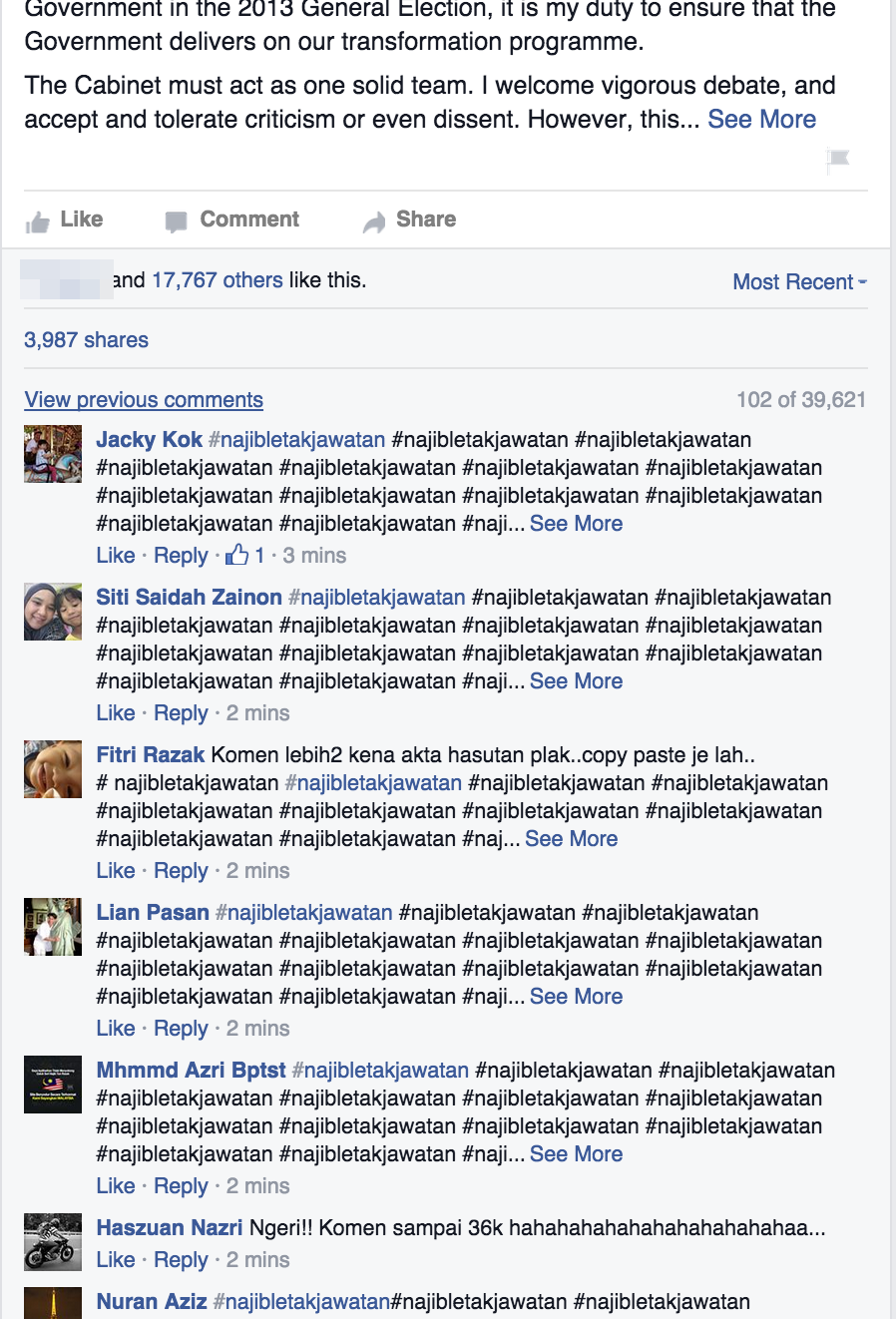
    Bermula dari pengumuman rombakan kabinet yang menggugurkan Muhyiddin Yassin baru-baru ini, Facebook Perdana Menteri, Najib Razak dibanjiri dengan puluhan ribu mesej letak jawatan yang dicopy paste  di ruangan komen status Perdana Menteri Malaysia itu.

    Komen-komen terbabit dipenuhi dengan hashtag najibletakjawatan.

    Selain dari itu terdapat juga komen-komen dari pengguna media sosial yang melawan komen letak jawatan itu dengan menulis #wesupportyounajib.

    Komen-komen terbabit paling banyak ditulis di dalam kenyataan di Facebook tersebut yang menjelaskan tindakannya merombak kabinet semalam.

    Sehingga ke saat ini, pertarungan berbalas komen itu masih lagi berlaku.


    Source: www.siakapkeli.my

  • US Academic: Blame Dr Mahathir For Malaysia’s Mess

    US Academic: Blame Dr Mahathir For Malaysia’s Mess

    History should judge former Prime Minister Tun Dr Mahathir Mohamad as being himself the author of a long national decline that has culminated in this latest crisis, wrote University of Chicago political science associate professor Dan Slater.

    In a piece published in the EastAsiaForum today, Slater wrote that Malaysian Prime Minister Datuk Seri Najib Razak is right about one thing. “The current mess in Malaysian politics is the making of his greatest nemesis, Dr Mahathir, who led the Southeast Asian nation with an iron fist from 1981–2003.”

    Slater wrote that Mahathir has not produced this mess by criticising (Najib’s) leadership, but by paving Najib’s path to power in the fashion he did during his decades in office.

    “Dr Mahathir may believe that he can end the crisis by bringing Najib down… But this road toward ruin commenced with Dr Mahathir, not Najib.”

    In outlining the events that led to the current crisis, Slater wrote: “Dr Mahathir was holding a winning hand when he became prime minister in 1981.

    “Then came the debt. Obsessed with following in the footsteps of Asia’s technological leaders, Mahathir began borrowing heavily to fund his ‘Look East’, state-led heavy-industrialisation programme.

    “Privatisation was part of his growth package, but the beneficiaries were businessmen of loyalty more than talent.

    “When the global economy went into recession in the mid-1980s, patronage started drying up. Umno split, largely in reaction to Dr Mahathir’s strong-armed style of rule.

    “Dr Mahathir’s two most talented rivals, Tengku Razaleigh (Hamzah) and Tun Musa Hitam, bolted from Umno despite their deep personal ties to the party, mostly to get away from Dr Mahathir himself.

    “Dr Mahathir responded by launching a police operation under the pretext of racial tensions, imprisoning and intimidating political rivals, and cementing his autocratic control.

    “Hence by the late 1980s, all of the defining features of Malaysia’s current crisis under Najib’s leadership were already evident under Dr Mahathir.

    “Ethnic tensions had been reopened to political manipulation. The economy was worrisomely indebted. Umno was shedding some of its most capable leaders. This was the beginning of Malaysia’s sad national decline, under Dr Mahathir’s watch and at his own hand.”

    These seeds were to play out towards the current crisis because of what Dr Mahathir did next, wrote Slater.

    “Fast-forward a decade and all of these syndromes would recur in even nastier forms. The Asian financial crisis of 1997–98 punished Malaysia for the unsustainable dollar-denominated debts it had accumulated under Dr Mahathir’s single-minded push for breakneck growth.

    “Dr Mahathir blamed everybody but himself for the crash. Dr Mahathir didn’t pull Malaysia out of its crisis with economic reform or adjustment, but with more and more borrowing and spending.

    “Hence even before the turn of the millennium, Malaysia was hurtling down the very trajectory of decline we are witnessing in the current crisis.”

    Slater also noted that Najib has taken a page out of Dr Mahathir’s playbook, when the latter was publicly criticised by then Deputy Prime Minister Datuk Seri Anwar Ibrahim.

    “In consummate Dr Mahathir style, Najib has now even sacked his deputy Tan Sri Muyhiddin Yassin for questioning Najib’s repression of the media in response to the 1MDB scandal.

    “In sum, Dr Mahathir has nobody to blame more than himself.”


    Source: www.therakyatpost.com

deneme bonusu