Blog

  • Cherian George: Lee Kuan Yew Was Bulwark For Singapore Minorities

    Cherian George: Lee Kuan Yew Was Bulwark For Singapore Minorities

    Unlike-Lee admirers around the world may be missing significant details.

    In an amusing case of mistaken identity, a banner honouring Lee Kuan Yew has appeared in India, bearing a photo of another Singaporean elder statesman, President Tony Tan. Both are white-haired ethnic Chinese males, but Tan, as you have may noted from Channel NewsAsia’s coverage of Lee’s funeral today, is rather more alive.

    The picture has been making the rounds on social media in Singapore, bringing smiles to an otherwise sombre day. It serves as a useful reality check for Singaporeans, that although Lee has been lauded by world leaders as a 20th century giant, not everyone can recognise him from Tom, Dick or Tony.

    Some other cases of mistaken identity are less trivial. It’s nothing new. For at least a couple of decades, he has been all things to all men who aspire to a certain kind of leadership. They see in him a model, a kind of proof-of-concept that they can point to when defending their own missions and methods. Leader X is Country A’s Lee Kuan Yew. How often have you heard that line.

    As a Singaporean born in the year of the republic’s independence, I’ve benefited from Lee’s global brand, most tangibly in the fact that my red passport travels extremely well. But the way that brand is sometimes used is cringeworthy.

    Most of the parallels that foreign politicians and their acolytes draw with Lee Kuan Yew are selective and self-serving. His name is evoked by anyone who wants to apply less-than-democratic means in the name of strong, decisive leadership in order to achieve high economic growth. But there was a lot more to the man and his formula for success.
    My interview with Maria Ressa of Rappler.com.

    The most obvious was the zero tolerance of corruption that he embodied and instituted in the Singapore system. That is probably a chapter in his bestselling memoirs that admirers like former Thai prime minister Thaksin Shinawatra skipped. Similarly, fans of Indonesia’s late president Suharto who cite his friendship with Lee conveniently ignore the fact that Suharto topped the world league table of corrupt leaders, according to the same organisation that routinely names Singapore as the cleanest in Asia.

    Less noticed is the fact that Lee, while loudly dismissive of the liberal brand of democracy, never deviated from electoral authoritarianism – the belief that regular multi-party elections are ultimately the only way for a government to win legitimacy, and are not bad at keeping a dominant party on its toes. Of course, he did his best to insulate his government from distractions like short-term public opinion, an adversarial press and protest movements; he also treated the opposition unfairly, to put it mildly.

    But, to this day, elections in Singapore remain competitive enough and credible enough to make democracy “the only game in town”, as political scientists would put it. As a result, opponents of the regime plot election strategy, not extra-parliamentary struggle; and Singaporeans accept the government’s authority as legitimate, even if they disagree with its policies. The thousands of Chinese officials who pass through Singapore to learn the Lee model may think this lesson can’t apply to the People’s Republic, but shouldn’t overlook how important it has been to Singapore’s success.

    Back to India. When its government decided to fly the tricolour at half-mast today, I wonder which Lee they were honouring. I hope – but I doubt – that it was the leader who stood resolutely against sectarian politics and majority domination. Among all his core principles, this is the one least talked about abroad. Yet, to minorities like me – and, thankfully, most members of the majority race as well – this may be the single most precious aspect of the legacy.

    Not that he got everything right. Older Indian Singaporeans still bristle at the way he labelled us as “fractious and contentious”. The stereotype might not have been off the mark (note Amartya Sen’s Argumentative Indian thesis), but if only he had seen it as a positive contribution to Singapore’s national culture rather than a weakness. Similarly, his open suspicion of Muslim Singaporeans’ growing religiosity was hurtful. Some of such straight-talking about race and religion could come back to haunt Singapore, should future bigots exploit his words to justify their prejudices.

    But minorities never needed to doubt this: Lee was an unshakeable bulwark against majoritarian tendencies that could have easily overwhelmed Singapore. Malay/Muslims make up only 15% and Indians 7% of the population. For decades, the risk of a Chinese chauvinist party playing the race/language card posed the single biggest threat to PAP dominance. This fact is lost on most of the Western press, who self-aggrandisingly like to believe that they were Lee’s bête noire. They were more like sparring partners, compared with champions of the Chinese-speaking ground, who were the main victims of both detentions without trial as well as flagrant censorship.

    Lee went to the extent of amending the republic’s Constitution to stop any party from sweeping into power without minority support. For most Parliamentary seats, candidates are forced to contest as small teams that must include minorities. Thus, no Chinese party could do in Singapore what the BJP did in India last year – come to power without a single MP from the country’s largest minority group.

    Thankfully, Lee and his comrades were influenced by an older Indian tradition, the Nehruvian secular ideal that accommodated minorities – the same tradition that the BJP and the larger Hindutva movement is bent on dismantling.

    Singapore should not presume that it can serve as a model for any other country, least of all India. The world’s largest democracy is 200 times larger than the city state that Lee ran, and its challenges are profoundly more complex.

    But if foreigners do choose to honour Lee Kuan Yew, they shouldn’t fall into the mistaken-identity trap. Yes, he was a firm leader who stretched the limits of democratic government to breaking point in order to get things done.

    But a leader who makes minorities feel unwanted, insecure and fearful?

    That’s not a face that Singaporeans recognise.


    Source: www.airconditionednation.com

  • Zulfikar Shariff: Rethingking Lee Kuan Yew’s Legacy – Islam Beyond Rituals

    Zulfikar Shariff: Rethingking Lee Kuan Yew’s Legacy – Islam Beyond Rituals

    Quite a few Tipah and Tiped (tak tahu nama Tipah lelaki) tried to justify discrimination with “Aku boleh pergi masjid sembahyang…aku boleh puasa”….mana ada diskriminasi.

    As if that is all that is in Islam. Dapat sembahyang dapat puasa…dah cukup. Baik LKY…tengok kita boleh puasa…dia tak paksa kita makan.

    Another group of Tipah pula argue when discussing Kuan Yew… “Our mission is to cleanse our heart”…

    tu pasal lah nothing changes….bukan Kuan Yew je yang tipu Tipah…Tipah tipukan diri sendiri.

    Rasulullah bawa risalah selama 23 tahun….just untuk ajar solat dan puasa? Tu je? Punya lama nak ajar solat dan puasa?

    And our mission in life is just cleanse our heart? Tak kisah lah Kuan Yew buat apa..tak kisah he discriminate our brothers and sisters….tak kisah lah dia kutuk Islam..

    Kita bersihkan hati je cukup…

    Tu pasal lah Rasulullah hari hari cuma duduk….bersihkan hati…puasa dan solat..tu je? He didnt do anything else for Islam?

    A Muslim is not simply someone who prays, fasts and cleanse his heart. The three are parts of the behaviour of the Muslim. But does not encapsulate what being a Muslim means.

    A Muslim is someone who submits fully, totally…with no reservations to Allah’s wills and commands.

    He not only prays, fast and cleanse his heart…he lives in full accordance with what Allah has decreed. And if there are any commands that he is prohibited from applying..he strives to remove the prohibition.

    He speaks and stands against oppression. He applies Islam totally in his life or he strives within himself to apply it.

    Islam is a full, comprehensive way of life, worldview, understanding.

    Let us not reduce Islam to just a couple of rituals.


    Source: Zulfikar Shariff

  • Bertha Henson: An Era Is Over

    Bertha Henson: An Era Is Over

    It’s over. Seven days of mourning and shared sorrow. Who would have thought that half a million people would wait for hours, whether day or night, whatever the weather, to bid goodbye to someone? Who have thought we would queue along the roadside in the rain to watch his cortege go by, that we would yell LKY, LKY and strew petals on the road as he went on his last journey?

    Singaporeans did it. Not because they were sheep or suffering from mass hysteria,  but because of a deep, abiding attachment to the man. They probably can’t even explain it, not by dissecting his policies in detail or by calculating the pros and cons of his leadership. To many, he was, in the words of his younger son, an “orang besar’’. Bigger than anyone they ever knew, who commanded every stage he was on, whether here or abroad.

    This was LKY.

    And so thousands carried umbrellas and wore ponchos just to watch the cortege whizz by. Others were glued to their television sets, picking out the dignitaries in the University Cultural Centre sitting silence for Mr Lee Kuan Yew’s last entrance before an audience.

    I was one of those in front of the TV watching the State funeral along with my mother. The pictures were grainy. The heavens had opened up after a week of humid weather, for Singapore’s chief gardener. The Lee family walked in the rain. The lines of uniformed citizens were drenched to the bone. I wondered about whether musical instruments used by the SAF band would be destroyed in the rain. I wondered if children would catch cold. I tried to identify the roads. Anything, anything. To stop myself from wallowing in the mood of the occasion. I didn’t succeed.

    Who could? You watch fervently, hoping that the State flag wouldn’t slip off the casket, that the coffin bearers wouldn’t, gasp!, lose their grip and you wondered if Mr Chiam See Tong was all right in his wheelchair. You try to keep count of the gun salute and wish you could see the plane formation in the grey sky. You make out the lines on the Prime Minister’s face and saw his puffy eyes. All of us were trying to take in every moment of this time in history. We didn’t want to miss anything.

    As the Prime Minister took to the stage to deliver the first of 10 eulogies, my mother hoped out loud that he would hold it together. For a while, we thought he would succeed without a hitch. He was in “political speech mode’’, that is, until he turned personal. He had to pause after he said he had tried to spend a quiet moment meditating alongside his father’s casket before the ceremony. I don’t know about you, but I cried. Not for the man in the casket, but for his son, who was so determined to carry out his national role of Prime Minister, that he never once said “Papa’’. (By the way, this is not an indictment.)

    Every day over the week, I learnt something new about our first Prime Minister as people started trotting out anecdotes about their interactions with him. Today was no different. Former MP Sidek Saniff told of how Mr Lee advised him to borrow an overcoat from Dr Ahmad Mattar and a pair of boots from Mr Goh Chok Tong when he had asked him if he was equipped for a trip to China. Mr Sidek was also the most emotional, bidding farewell three times as he turned to the casket.

    Long-time grassroots leader Leong Chun Loong recalled how he got testy when the firing of firecrackers was mistimed during a Chinese New Year event. You can’t run a country if you couldn’t get such a little thing right…(How like the man, I thought. The perfectionist. But isn’t it true that most of us try to run before we have even learnt to walk? We want to do the “big stuff” when we can’t even do the small things…)

    Both President Tony Tan and Emeritus Senior Minister Goh Chok Tong told of Mr Lee’s great respect for office. When he was no more Prime Minister, he would always defer to Mr Goh and Dr Tan, like making sure that it was he who visited the President and not the other way round. Never mind that it was Dr Tan who wanted to pay him a visit while he was ill.

    Mr Goh also said something that will probably set some quarters buzzing: that Mr Lee “never muzzled’’ anyone. He was a man of great intellect who put forth his views forcefully, but he was open to being converted if the arguments convinced him. Former Cabinet minister S Dhanabalan said much the same. Mr Dhanabalan seemed unsettled by descriptions of Mr Lee as a “pragmatist’’. He was an idealist too – or he would have simply courted the Chinese majority instead of pursuing the ideal of a multi-racial society, he said.

    I think all of us listened especially closely to the last speaker, Mr Lee Hsien Yang, who delivered the eulogy on behalf of the family. We know now what it was like to have a famous father. How Papa was seldom around and how they always took their family holidays nearby, like in Cameron Highlands. And how he found out about his parents’ secret wedding at Stratford-upon-Avon in England only upon reading his father’s memoirs. There were little vignettes of family life – like how they left birthdays “unmarked’’ until recently and how Papa and Mama were delighted to have another grandchild while they were in their 70s. Frankly, he sounded like a son who missed his father even before he died.

    In my mother’s living room, I recited the pledge, hand on heart, and sang the national anthem. The State funeral had ended, and I left for my own home.

    I could see the streets come back to life, slowly. People started emerging from their homes to do whatever they usually do on Sundays. My mother’s neighbor left his flat at the same time as I did. We wondered if our younger and not-so-young leaders were of the same calibre as Mr Lee…How? It was a sombre ride in the lift.

    As I walked back to my home, I realized that I had not bumped into any cyclist or handphone-staring pedestrian on the pavement – because there weren’t any.

    I also noticed something in the air. The rain was over. The air was fresh. One era has ended. A new one has begun.

    Majulah Singapura.


    Source: https://berthahenson.wordpress.com

  • Top 10 Searches On Yahoo Singapore Were Related To Lee Kuan Yew

    Top 10 Searches On Yahoo Singapore Were Related To Lee Kuan Yew

    On the day Singapore bid farewell to Lee Kuan Yew, the former Prime Minister was obviously on the minds of everyone in the country. The top 10 searches on the Yahoo Singapore search engine were all connected in some way to him and his funeral.

    Here they are:

    Lee Kuan Yew Funeral

    The state funeral of the late Lee Kuan Yew took place on Sunday. Tens of thousands braved the heavy rain to line the route of the funeral procession.


    Lee Hsien Loong

    He delivered the first eulogy for his father and at times, he had trouble choking back his tears.


    Lee Wei Ling

    The only daughter of the late Lee Kuan Yew, the director of the National Neuroscience Institute was rarely seen during the Lying-in-State of her father.

    Lee Hsien Loong and family walking during funeral procession. 


    Lee Hsien Yang

    The younger son of the late Lee Kuan Yew and the chairman of the Civil Aviation Authority of Singapore, he delivered the final eulogy and spoke on behalf of the Lee family.

    Lee Hsien Yang, son of former leader Lee Kuan Yew, delivers his eulogy during the funeral service at the University Cultural Centre at the National University of Singapore March 29, 2015. Grieving Singaporeans were joined by world leaders on Sunday to pay their final respects to the country's first prime minister, Lee Kuan Yew, as the nation came to a near-halt to honour its "founding father". REUTERS/Edgar SuLee Hsien Yang, son of former leader Lee Kuan Yew, delivers his eulogy during the funeral service at the University …


    Remembering Lee Kuan Yew

    A website and Facebook page called“Remembering Lee Kuan Yew” was set up to provide important information to mourners. Details such as queue updates to the Lying-in-State and funeral procession can be found on the site. It was also a trending term on Twitter after Lee’s death.

    Screengrab of the Remembering Lee Kuan Yew website.


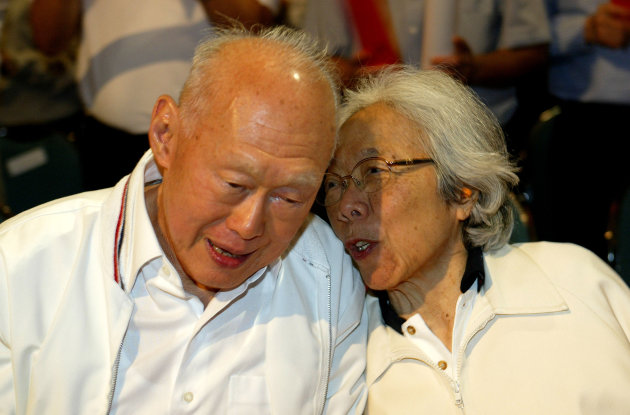
    Kwa Geok Choo

    She is the deceased wife of the late Lee Kuan Yew, who passed away before him in 2010. After her death, Lee was never quite the same.

    FILE - In this May 1, 2006, file photo, Singapore's then Minister Mentor Lee Kuan Yew, left, shares a light moment with his wife, Kwa Geok Choo, right, during the Labour Day Rally in Singapore. Lee Kuan Yew, the founder of modern Singapore who helped transform the sleepy port into one of the world's richest nations, died Monday, March 23, 2015, the government said. He was 91. (AP Photo/Wong Maye-E, File)


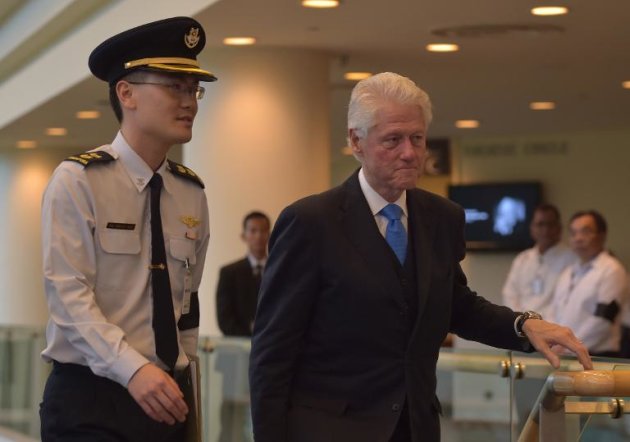
    Bill Clinton

    The former US president lead a high-powered delegation from the US who included Henry Kissinger, the former US Secretary of State.

    Former US president Bill Clinton arrives at the University Cultural Center (UCC) for the funeral services for Singapore's former prime minister Lee Kuan Yew in Singapore on March 29, 2015


    Goh Chok Tong

    Goh Chok Tong is the emeritus senior minister of Singapore. He succeeded Lee as the second prime minister of Singapore from 1990 to 2004. In his eulogy, Goh said, “For me, he would always be my teacher.”

    Emeritus Senior Minister Goh Chok Tong and wife paying their respects to Mr Lee Kuan Yew at the Family Wake on 23 Mar 2015 at the Sri Temasek, Istana. (Photo courtesy of Ministry of Communications and Information, Singapore) 


    Lee Kuan Yew Biography

    The late Lee Kuan Yew has written a two-volume set of memoirs, among many other books and essays.


    King of Bhutan

    The King of Bhutan, Jigme Khesar Namgyel Wangchuck, came to Singapore to pay his respects to the late Lee Kuan Yew and attend his state funeral.

    The King of Bhutan pays his respects to the late Lee Kuan Yew. 
    Source: https://sg.news.yahoo.com


  • Black Nights Could Not Peform Missing Man Formation During State Funeral

    Black Nights Could Not Peform Missing Man Formation During State Funeral

    The “Missing Man” formation by the Republic of Singapore Air Force’s Black Knights, one of the most anticipated elements of the State Funeral procession for Mr Lee Kuan Yew, was not performed on Sunday.

    Four Black Knights F-16C aircraft were to fly the Missing Man formation to honour the late Mr Lee as the funeral cortege drove pass Esplanade Bridge.

    The Straits Times understands that the jets did an aerial flypast above cloud cover, but could not do the formation due to rainy weather and low visibility.

    The planes were likely not visible to the crowds who lined the bridge despite the downpour.

    A video of Black Knight aircraft doing a Missing Man formation had gone viral on Sunday, but it was recorded at the rehearsal on Saturday, and not at the State Funeral procession.

    The 28-second video, which was uploaded on Facebook, received almost 2,000 likes and was shared almost 4,000 times.

    Mr Lee embarked on his final journey at 12.30pm from Parliament House to the University Cultural Centre where the State Funeral service was held.


    Source: www.straitstimes.com