Blog

  • Norway Muslim Plans To Form Ring Of Peace Around Synagogue On Saturday

    Norway Muslim Plans To Form Ring Of Peace Around Synagogue On Saturday

    The headlines have been grim. Europe’s Jews face “rising anti-Semitism“; in some countries, many are leaving in “record numbers.” In separate incidents in recent months, gunmen have targeted Jews and Jewish institutions in Paris and Copenhagen. Even the Jewish dead have not been left in peace, with reports of graves being desecrated.

    But the future of tolerance and multiculturalism in Europe is far from bleak. The bigotry on view has been carried out by a fringe minority, cast all the more in the shade by the huge peace marches and vigils that followed the deadly attacks. And some communities are trying to build solidarity in their home towns and cities.

    One group of Muslims in Norway plans to form a “ring of peace” around a synagogue in Oslo on Saturday. On a Facebook page promoting the event, the group explained its motivations. Here’s a translated version of the invite:

    Islam is about protecting our brothers and sisters, regardless of which religion they belong to. Islam is about rising above hate and never sinking to the same level as the haters. Islam is about defending each other. Muslims want to show that we deeply deplore all types of hatred of Jews, and that we are there to support them. We will therefore create a human ring around the synagogue on Saturday 21 February. Encourage everyone to come!

    According to the Times of Israel, Ervin Kohn, a leader of Oslo’s small Jewish community, had agreed to allowing the event on the condition that more than 30 people show up — a small gathering would make the effort look “counter-productive,” Kohn said. Close to 1,000 people have indicated on Facebook that they will attend.

    “We think that after the terrorist attacks in Copenhagen, it is the perfect time for us Muslims to distance ourselves from the harassment of Jews that is happening,” 17-year-old event organizer Hajrad Arshad said in an interview with Norwegian television.

    “If someone wants to attack the synagogue, they need to step over us first,”posted another of the event’s organizers on Facebook.


    Source: http://www.washingtonpost.com

  • More Public Holidays May Be Better

    More Public Holidays May Be Better

    I refer to the Manpower Ministry’s letter, “Impractical to make all key festivals public holidays” (Feb 14). Perhaps, the consideration is how it could be hard for Singapore to be competitive if we have too many holidays.

    Our fierce economic competitor, Hong Kong, has 17 public holidays, though, and the Chinese territory has no problems remaining one of Asia’s best economies, often beating Singapore in economic rankings.

    Unlike Hong Kong, Singapore is multiracial. So during this Chinese New Year, for example, those from the other races might be working.

    This is true for services that must run throughout the holidays, such as public transport, our airport, the checkpoints and some supermarkets.

    Hong Kong, as a homogenous territory, has the luxury of providing holidays for both major and minor occasions; the residents take their breaks and return to work refreshed.

    Perhaps, overworked Singaporeans would be better off having holidays that make everyone happy. Every racial community is an important cog in our economy.

    With less annual leave left, just so they can attend an important religious or cultural occasion, some Singaporeans may end up feeling less refreshed.

    Further, more holidays means that the ever-important and growing tourism industry has more reasons to bring in foreign visitors.

    For example, Thaipusam is a crowd-puller in Malaysia. Were it made a public holiday in Singapore, with the entire road for Hindu Singaporeans to perform their procession, there may be many tourists preferring Singapore as a holiday destination instead.

    But it seems we want workers to work more days when it would be better to earn the tourist dollar, let our Hindu friends enjoy their religious festival, and for the rest of us, a well-deserved break.

    The ministry should rethink this issue. What happened in 1968 is no longer relevant; we may have needed to make compromises then for our young nation to become an Asian Tiger, but we are at the top now.

    More holidays does not necessarily mean a slow or weaker economy as Hong Kong has demonstrated.


    Source: www.todayonline.com

  • Goh Meng Seng: Alternative Media Sites Must Unite To Balance MSM

    Goh Meng Seng: Alternative Media Sites Must Unite To Balance MSM

    According to a survey done on the comparative strength and influence of Main Stream Media (MSM) vs New Media (NM which includes blogs, TRS, TRE, TOC and other key sites), the MSM influence in terms of readership has dropped drastically and the readership of NM has shot up with the popular usage of Smart Phones which allow people to read articles from NM much easier than MSM.

    The influence of NM and MSM has attained equal status. When the survey asks their interviewees where they get their information and news from, NM and MSM have equal share. This situation poses a tremendous challenge to PAP’s continue dominance of political power. Thus, it is of no surprise that the FIXING of New Media will pick up in momentum as the next General Elections is ticking nearer.

    I sincerely hope that all NM like TRE, TRS and TOC will unite and defend this piece of land of Freedom for all Singaporeans. Without the balancing influence of NM, it will be almost impossible for Singapore to advance the dream of building a more democratic system. Hold on there, TRS! Hold on there, TOC!

    Source: Goh Meng Seng

  • SingFirst’s $6 Billion Social Safety Net Will Not Bankrupt Singapore

    SingFirst’s $6 Billion Social Safety Net Will Not Bankrupt Singapore

    SingFirst’s social safety net package is not prepared overnight but is the outcome of several years of research and discussion. It started with the S$60 billion economic plan outlined in the 2011 essay “Creating Jobs and Enterprise in a New Singapore economy – Ideas for Change” by Tan Jee Say, our Secretary-General.

    Our proposal has now been updated following discussions in the last few years with international experts in Finland, Norway, Berlin, Oxford and Harvard. It has also been discussed and debated internally over several months. We took into consideration what the Minister of Finance told Parliament about the use of returns on investment of Singapore’s national assets.

    To help our readers understand our approach, we have decided to use simple illustrations and graphics, rather than post a long article. We believe these simple messages will help to communicate our proposal more effectively and clearly.

    1. The ISSUE – Rising Social Inequality

    Economic growth in Singapore has created a large gap between the rich and poor, leaving a big segment of society behind. Inflation and technology has widened the income gap. Singaporeans have also become the most stressed, unhappiest and least emotional people in the world.

    According to an article in The Economist on 7 March 2014, Singapore is presently the most expensive city in the world as housing, education, healthcare and transport costs are rising day by day.

    ” It has been a long time coming, but Singapore, a tiny city-state of about 5m people, has finally made it: to being the most expensive city in the world. According to the Economist Intelligence Unit (EIU), a sister organisation of The Economist, after a decade of steadily climbing up the table from 18th place, Singapore now occupies the position usually reserved for the Japanese capital, Tokyo. Paris is now the second-most expensive, ahead of Oslo in Norway”.

    – The Economist (article here)

    Singapore has the biggest income gap among developed countries, as indicated by the Gini co-efficient, an international standard of measure of income inequality. The higher the Gini, the greater the inequality.
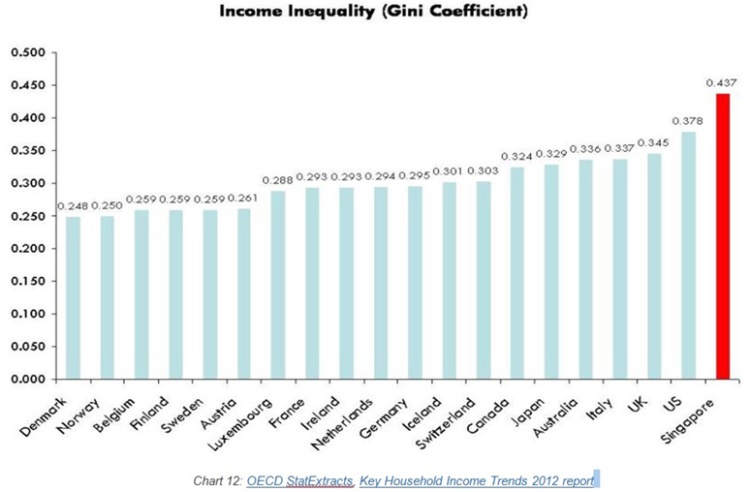
    gini1

    Singapore’s economic inequality is highest because its public spending as a percentage of GDP is the lowest among the developed countries.

    gini2

    2. Our PROPOSAL – Social Spending and Social Investment

    SingFirst wants to increase social spending and reduce social inequalities with

    a. Social Safety Net   (S$6 billion per annum)

    b. Social Investment  (S$8 billion per annum)

    This will be funded by the returns on our investment of national assets

    • GIC, MAS, Temasek Holdings etc generate huge investment returns
    • These huge investment returns are more than SingFirst’s proposed social spending amount
    • Principal sum (capital) of national assets WILL NOT be touched.

    2.1 The Government’s existing framework on NIR (Net Investment Return)

    • Returns on investments (R)     : from GIC & MAS
    • Investment income (I)              : from Temasek Holdings
    • R + I = Net Investment Return (NIR)
    • average annual NIR is about S$16 billion

    2.2  The Government’s existing framework on NIRC (Net Investment Return Contribution)

    • ½ R + ½ I = Net Investment Return Contribution (NIRC)
    • In last few years, NIRC has been estimated as S$8 billion
    • Balance ( NIR minus NIRC) = S$8 billion
    • Currently, this balance is RE-INVESTED into GIC & Temasek Holdings

    nirc 2

    To emphasize the above illustration, investment return contribution from GIC and MAS assets is STABLE, is based on expected long term real rate of return and is NOT AFFECTED by year to year fluctuations in actual returns (similar formula used by Norway and Yale University).

    That means the total NIR of S$16 billion is a stable amount year after year.

    In last few years (see illustration below), annual NIR is estimated at S$16 billion. NIRC is estimated at S$8 billion. So the balance for re-investment is S$8 billion on the average.

    nirc

    In the past 4 years, NIRC hovered around S$8 billion per year. So SingFirst proposes to use the NIRC for funding our S$6 billion social safety net package.

    As we are only using S$6 billion per year (75% of NIRC), this is SUSTAINABLE.

    There is a healthy surplus of S$2 billion per year (25% of NIRC) that is not used.

    3. PROPOSAL 1 – Social Spending

    The table below illustrates our social spending to defray the current high cost of living for all Singaporeans.

    safety net

    3.1 Monthly Benefits for Singaporeans

    A simple illustration below of how our social spending will benefit a family with 2 elderly parents, 2 parents and 2 young children on the monthly basis.

    family

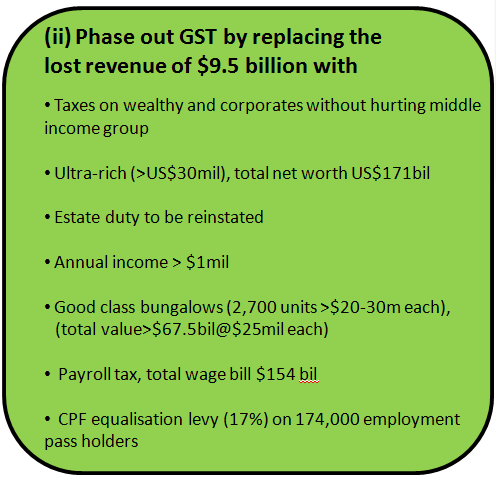
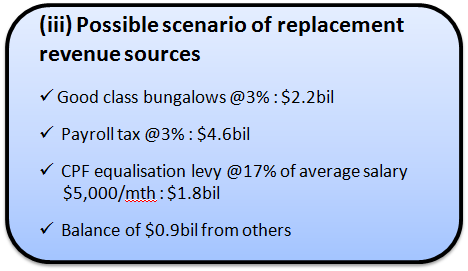
    3.2 Tax Restructuring – to phase out GST

    1

    2

    3

    4

     4. PROPOSAL 2 – Social Investment

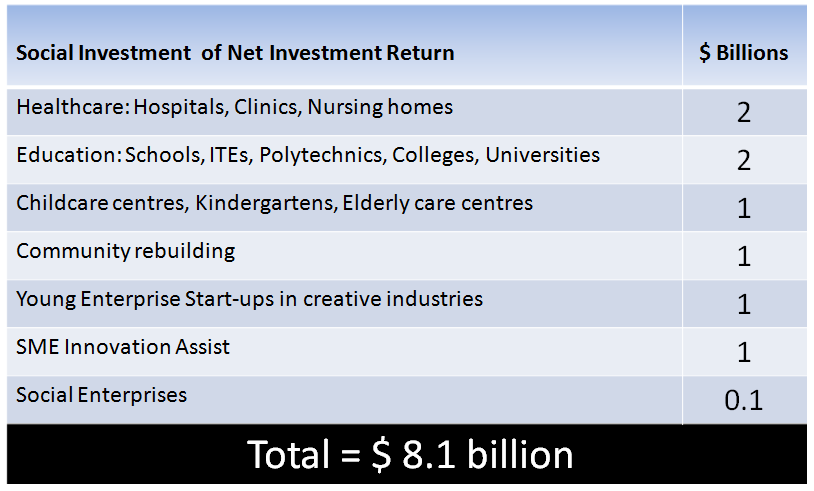
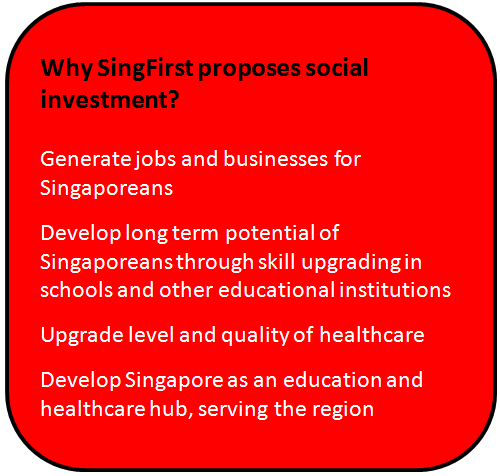
    Presently, the Ministry of Finance has re-invested approximately half of the net investment returns back into Temasek and GIC which are then used for Portfolio Investment. SingFirst proposes to broaden re-investment to include social investment (eg hospitals, schools). NOT only back into Temasek or GIC.
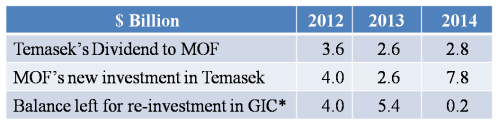
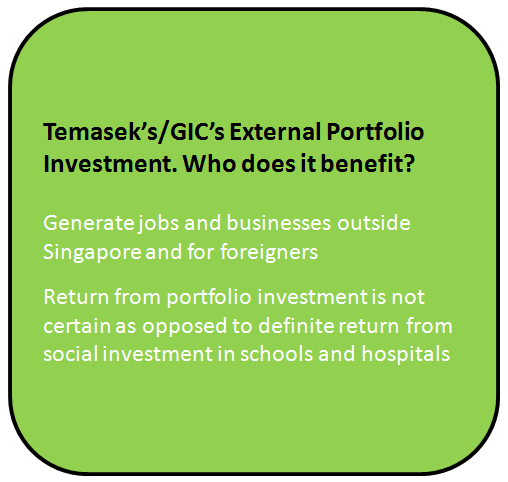
     

    5

    6

    7

     4.1 Our Proposed Initiatives

    9


    4.2 Reserves are not RAIDED by our proposals

    4.3  Pro-growth Social Package

    Our package is not wasteful consumption but will give a strong boost to the local domestic economy. We will create a strong, stable and diversified economy that benefit local businessmen and families.

    • Social safety net                          $ 6 billion
    • Social investment                        $ 8 billion
    • Healthcare (from defence)         $ 5 billion     (over 5 years)
    • Consumer (from GST)                $ 9.5 billion  (over 5 years)
    • Re-investment per year over 5 years   $14 – 28.5 billion

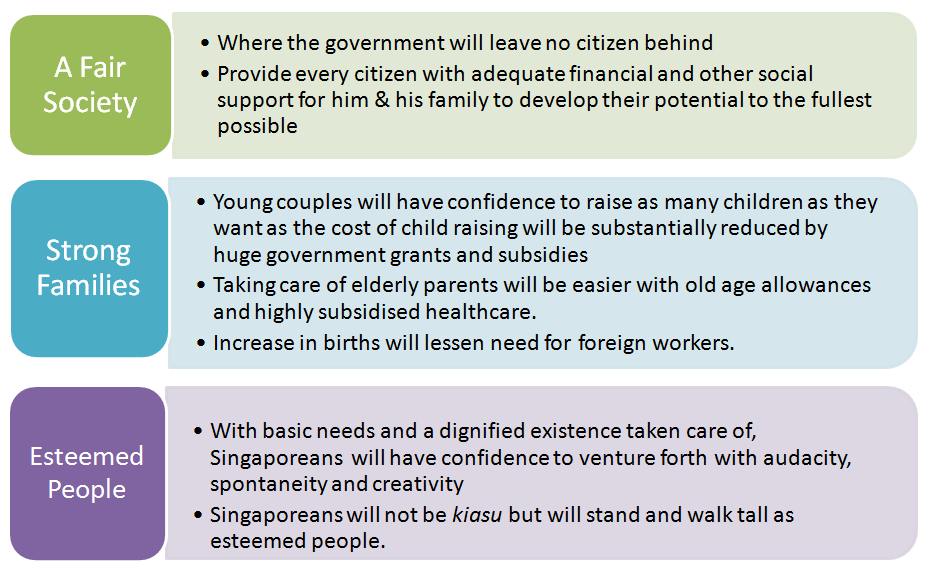
    4.3  Fair Society, Strong Families and Esteemed People

    With this package, SingFirst will deliver
    11

    In Conclusion: Our difference from the PAP

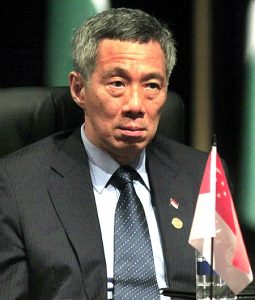
    At the Forbes Global CEO Conference on 28 October 2014, Prime Minister Lee Hsien Loong said that he wanted Singaporeans to always be paranoid about someone else stealing their lunch.
    05slide1

    “Looking forward beyond the 50th anniversary, I think that is what Singapore needs to do – to be aware, to be paranoid so you always know that somebody can take your lunch away…”

    While PM Lee wants Singaporeans to be paranoid (“kiasu”), SingFirst prefers to put esteem into Singaporeans. Do you want to feel inferior and be “kiasu” or do you want to stand tall and be esteemed?

    You have a choice. Choose wisely.

    Stand tall. Vote SingFirst.

    SF_LOGO


    Source: http://singfirst.org


  • LBW Structurally Certifies HDB Flats In Own Ward

    LBW Structurally Certifies HDB Flats In Own Ward

    Khatib Court is a HDB BTO project launched in September 2013 [Link]. It is sited next to the Khatib MRT station. The development consists of two 14-storey residential blocks and offers 310 units of Studio Apartments and 3-room flats. The expected completion date is in 2nd quarter of 2017.

    Specifically, it is located at Yishun Neighbourhood 8, part of Nee Soon South ward. Nee Soon South generally encompasses Yishun Neighbourhood 8 (Khatib), part of Neighbourhood 7 and private residential areas along Sembawang Road (near Sembawang Army Camp).

    Nee Soon South used to be an SMC but was absorbed into Ang Mo Kio GRC in 1997 after SDP narrowly lost there in 1991 GE. It remained in Ang Mo Kio GRC till 2011 GE when it was merged together with other wards in Yishun to form the present Nee Soon GRC.

    The PAP MP specifically in-charge of Nee Soon South is Er Dr Lee Bee Wah. She is also the grassroots adviser there [Link].

    The reader who forwarded the information on the BTO project at Khatib highlighted that the C&S (Civil and Structural) engineering service has been awarded to LBW Consultants LLP, a consultancy owned by MP Lee Bee Wah [Link]:

    LBW Consultants LLB

    Ms Lee was a Malaysian before she became a Singaporean MP. Her consultancy firm, LBW Consultants, provides “civil, structural, project management and golf course design services” while her other company, LBW Engineering, provides turnkey solutions and product distribution for satellite communications.

    In fact, her companies have a lot of experience participating in numerous residential, commercial, industrial and institutional projects in Singapore [Link]. They even include military ones:

    • Proposed Airport Emergency Services (AES) Training / Live-Fire Fighting Facilities at Paya Lebar Airbase
    • Proposed Upgrading of Khatib Camp
    • Proposed Upgrading of Kranji Camp
    • Proposed Upgrading & Renovation of Hangars in Sembawang Air Base
    • Proposed Upgrading of School of Ammunition in Rifle Range Road Camp II
    • Proposed Upgrading of Airfield Ground Service Section in Sembawang Air Base

    Last month, it was reported that she intends to set up 50 more designated public spots in Nee Soon South, where smokers can smoke (‘More light-up shelters to curb second-hand smoke’, 28 Jan). It was reported that the decision was made, “following a successful year-long pilot scheme”.

    Six shelters for smokers have been erected during the pilot. The shelters were funded by NEA with the objective of reducing second-hand smoke in Nee Soon South.

    To see how “successful” the pilot scheme has been, TRE sent a correspondent to Nee Soon South to take a look at the smoking shelters during lunchtime on 3 Feb. It didn’t appear to be as “successful” as what Ms Lee had told the media, observed the correspondent (‘Countering LBW’s claim smoking shelter scheme works‘).

    In any case, it should be comforting for the new residents of Khatib Court to know that their HDB flats are structurally being certified by their very own MP, Lee Bee Wah.

    UPDATE:

    Since last year (2014), Ms Lee’s consultancy has been merged with Meinhardt Group International:

deneme bonusu