The statements by the National Council of Churches of Singapore and the local Roman Catholic Church regarding the “gay moment” in the Disney movie, Beauty And The Beast, are quite clearly meant as advisories to the leaders of their respective congregations and the parents there (Disney’s Beauty And The Beast given PG rating for ‘mild violence’; March 15).
But the statements were picked up and published by various media outlets.
Not unexpectedly, a number of netizens took offence and attacked and ridiculed these statements without considering the context.
We should not impose our secular views and opinions upon any religious body or organisation, out of respect for its religious belief and also out of respect for our Maintenance of Religious Harmony Act.
The various online alternative media outlets which mock religious beliefs and activities could be seen as making mischief.
They risk tearing the fragile fabric of religious harmony in Singapore.
I hope they can rein in their attacks before the situation gets out of control.
The police have arrested a 32-year-old man for the offence of Dangerous Driving.
Earlier in the morning, the Traffic Police received information that a trailer truck had driven dangerously along East Coast Parkway (ECP) towards MCE, Marina Coastal Expressway, (AYE, Ayer Rajah Expressway).
The blue and red trailer truck from Rio Logistics was caught on video camera driving against traffic on the ECP near the entrance to MCE.
A line of cars had to stop while the truck made a U-turn which blocked the entire expressway, a video uploaded on road safety community page Beh Chia Lor showed.
The police said in a news release on Friday that through follow-up investigations, the identity of the male driver was established and he was arrested.
Ms Foo Chi Hsia, Singapore’s High Commissioner to the United Kingdom, has responded to a recent article in The Economist alleging a lack of free speech in Singapore, saying no country gives an absolute right to free speech.
Society pays a price when the right to free speech is extended to fake news, defamation or hate speech, she added, citing the Brexit campaign and elections in America and Europe.
“Trust in leaders and institutions, including journalists and the media, has been gravely undermined, as have these democracies. In contrast, international polls show that Singaporeans trust their government, judiciary, police and even media,” wrote Ms Foo in her letter to the UK-based weekly, which was published in its latest edition. “Singapore does not claim to be an example for others, but we do ask to be allowed to work out a system that is best for ourselves.”
The article Ms Foo was responding to was published on March 9, titled Grumble and be damned. In it, the conviction of three protesters for creating a public nuisance at Speakers’ Corner was mentioned to back the allegation.
Ms Foo noted that in this 2014 case, the individuals are not taken to court for criticising the government. Rather, they had “loutishly (barged)” into a performance by a group of special education needs children, “frightening them and denying then the right to be heard”.
Ms Foo added that Singapore does not stifle criticism of the government, and there is free access to information and the Internet.
“But we will not allow our judiciary to be denigrated under the cover of free speech, nor will we protect hate or libellous speech. People can go to court to defend their integrity and correct falsehoods purveyed against them. Opposition politicians have done this, successfully,” she said.
Earlier this week, comments by one of the three protesters, blogger Han Hui Hui, on the same case were deemed by the Attorney-General’s Chambers as tantamount to scandalising the judiciary. Ms Han was given a week from Monday to remove and apologise for her various posts alleging impropriety on the part of judges who heard her case, or face contempt of court proceedings.
Ms Han’s allegations of mistreatment by Singapore Prisons Service officers during her time in the lock-up for the case were also repudiated by the Ministry of Home Affairs.
In one of the most expensive countries in the world to own a car, Peter Chiu is finding a novel way to pay for one.
The 58-year-old retired policeman rents a car in Singapore, drives three to four hours a day for Uber Technologies Inc. to cover its cost, and has a shiny Honda Vezel the rest of the time for his personal use. Hiring a vehicle to work for Uber is becoming a more common sight in the city-state, where Chiu’s SUV costs more than a BMW M3 luxury sports sedan does in New York.
“Buying a car in Singapore is so expensive,” said Chiu. “If you want to drive around to cover expenses, that is quite easy. And any extra money you get, that’s more income for you.”
New technologies are not only disrupting traditional industries in Singapore — a trend that Prime Minister Lee Hsien Loong said will force the economy to transform — but also changing consumers’ behavior as they try to cope with rising costs and unemployment at a six-year high.
“Uber is another avenue for employment,” said Brian Tan, an economist with Nomura Holdings Inc. in Singapore. “It makes the labor market more efficient, because it provides you with an alternative career. You don’t need a special license for that.”
A Honda Vezel like Chiu’s typically sells for more than S$100,000 ($71,000) in Singapore, almost four times the price in the U.S. On top of taxes, car owners in the city state are forced to buy permits — called Certificates of Entitlement — which are limited in supply and auctioned by the government to help curb road congestion and pollution. At the most recent offering this week, the permit cost S$50,789 for the smallest vehicles.
Rental Surge
Chiu drives six days a week for Uber, just enough to cover the S$500 weekly cost of his vehicle, which he rents from Lion City Rentals, a local subsidiary of the car-hailing company. He doesn’t mind the part-time work or the traffic in a country that’s smaller than Rhode Island in the U.S.
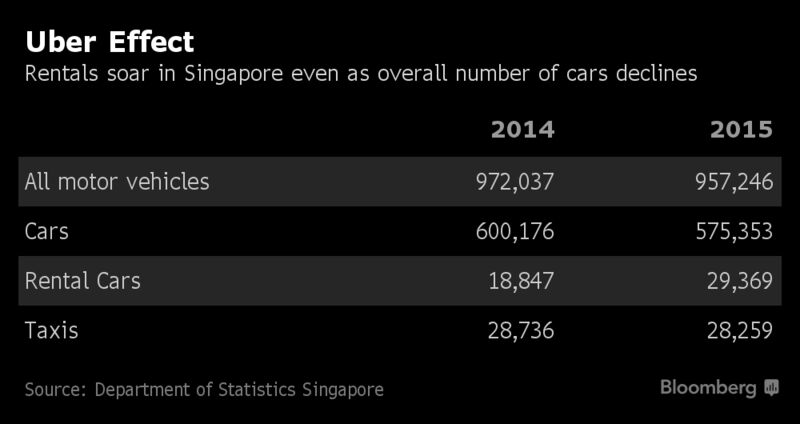
Between 2014 — the year after Uber began operating in Singapore — and 2015, the number of rental cars in the country soared more than 50 percent to 29,369, surpassing the number of taxis on the road, according to official data. Even so, the total vehicle population decreased by 1.5 percent.
Simon, a 45-year-old former property agent who preferred to give his first name only, rents a Toyota Corolla and drives for Uber four hours a day at most. A slump in home sales since the government began imposing measures to rein in prices has pushed many in the industry to seek other sources of income, including ferrying commuters around the island for Uber.
Simon said his main job now is making “alternative investments” and the Uber gig allows him to have a car of his own to use on weekends, when he makes trips about 20 kilometers (12 miles) across the border to Malaysia with his wife and two kids. The journey has an added cost-saving advantage: he buys gas for his car in Malaysia, where it’s cheaper.
Uber is using auto rentals and financing to attract and retain drivers around the world, as are rivals such as GrabTaxi Holdings Pte in Singapore and Lyft Inc. in the U.S. While for many drivers, earning an income may be the main reason they turn to the ride-hailing companies, in Singapore, having the car may be just as important.
“It makes a lot of sense to rent a car,” said Tang Kin Yee, 53, whose main job is in commercial photography and advertising. Business was slow last year and he started driving for Uber to supplement his income.
He now rents a Honda Vezel and is thinking about driving for Uber full time.
The Public Transport Council (PTC) and the Land Transport Authority (LTA) have approved proposals from taxi companies and ride-hailing app Grab to implement surge pricing in the form of flat fares for trips booked via mobile applications.
In a joint media statement, PTC and LTA said: “The companies have informed LTA and PTC that this will be introduced as an additional option for commuters to book a taxi, on top of the current metered fare taxi bookings. We have no objections to the proposals.”
Just like private hire cars booked via Grab and Uber, the cost of a taxi trip booked through a mobile app will vary according to demand. Peak hour trips will cost more, while off-peak trips will cost less.
Separately, SMRT Taxis has inked an exclusive partnership with Grab to enable all SMRT taxi drivers to use Grab as the only ride hailing app for taxi bookings. Both companies are also collaborating to offer customers dynamic fixed fares for taxi trips booked via Grab. This lets customers know the fare for their intended trip before the start of the journey.
According to a Grab spokesman, “Dynamic fixed fares are displayed upfront, and already accounts for travel time, distance, booking fees, and real-time demand and supply for taxis. SMRT taxi drivers who accept bookings via this new Grab service enjoy fixed, competitive fares for their service.”
Metered fares continue to apply for street-hail pickups as well as phone and GrabTaxi bookings.
Managing Director for SMRT Taxis and Private Hire Services, Tony Heng, said: “The market has evolved and matured significantly, and more customers are now open to having dynamic fixed fares for their taxi rides. This partnership with Grab allows us to keep the pricing for our services competitive, catering to different customer needs and preferences.”
Melvin Vu, Head of GrabTaxi Singapore, added that Grab has been engaging the authorities since December on implementing dynamic fixed fares for taxis. “The current taxi fare model does not account for real-time passenger demand and driver supply, which often means that passengers pay a surcharge even when there are many available taxis within the vicinity. Dynamic fixed fares ensure that taxis are better utilised throughout the day and passengers enjoy more affordable rides based on real-time market demands, while not eliminating metered fares.”