Blog

  • What Drives People To Join Extremist Groups?

    What Drives People To Join Extremist Groups?

    Militant groups such as the Islamic State (IS) can offer direction and a certain meaning in life that some people crave, said Professor Andrew Silke from the University of East London, where he is programme director for Terrorism Studies. Prof Silke, who serves as a counterterrorism consultant to government agencies in Britain and America, is in Singapore to give a lecture at the S Rajaratnam School of International Studies. In this interview with TODAY, he examines the appeal of IS and suggests ways to deal with returning fighters.

    What is the draw of the Islamic State? In particular, why does it appeal to young people even from developed countries?

    The appeal is based on a range of factors. For some, it is a sense of adventure and excitement. For others, it provides a strong sense of identity and belonging. To the people attracted, IS can offer a powerful sense that you are doing something meaningful and that you matter. The reality, of course, when people get there can be much harsher and very different. But for young people looking for meaning and direction in their lives, IS can appear to offer answers and certainty.

    There have been many instances of young women in their teens being radicalised by the Islamic State and travelling to the conflict areas for marriage. What drives them?

    The Islamic State offers clarity, certainty and a clear sense of belonging and meaning. That can be very, very attractive to young people, who are often searching for a clear sense of identity and a quest for significance and acceptance. In its propaganda, IS offers all these and more.

    What is the typical psychological state of a jihadist who has returned after fighting? Is it euphoria and a sense of accomplishment or emptiness as the “mission” has ended?

    Most are tired and have no intention of trying to continue the conflict elsewhere. Probably fewer than 10 per cent have a serious interest in further violence. Some are disillusioned by their experiences. The conflict was not the noble, heroic adventure they expected. The group they were fighting for also failed to live up to expectations. Some suffer from post-traumatic stress disorder and other problems as a result of what they have seen or done. Many are anxious about their future and what will happen if they are identified by the authorities as a returning fighter.

    How should countries rehabilitate jihadist returnees? How do we strike a balance between the carrot (counselling, making them feel less marginalised) and the stick (stronger legislation to “punish” them)?

    This is a very tough question and one that the United Kingdom, for example, is really struggling with today. About 600 UK citizens have travelled to fight with the Islamic State. Many have already returned and some of those have been imprisoned. Others have tried to travel and have been stopped and imprisoned too.

    I think we need a balanced approach. We should offer a route out for people who have changed their minds and are desperate to leave IS. Some people remain in Syria mainly because they think they will be imprisoned if they try to return home. There are disengagement and counter-radicalisation programmes these people can do which can help them leave without having to face years in prison. But we also need to recognise that there will be highly radicalised individuals who are extremely committed to the IS cause, and prison is a legitimate and sensible option for them.

    From the macro policy perspective, what are the most vital measures governments should take to prevent the radicalisation of individuals?

    First, I think we need to accept that you cannot have a society that is completely free of extremism and if your focus is to try to eliminate all extremism, you are setting yourself up for failure. Only totalitarian regimes can have such ambitions and who would want to live in that type of society?

    Second, we need to be careful about claiming radicalisation is the result of one factor. The UK government, for example, is pushing the view that extreme ideology is the primary cause of radicalisation. It is convenient to blame ideology because the role of other factors such as discrimination, marginalisation and foreign policy get pushed to the side.

    The counterterrorism effort starts to focus increasingly on only countering the ideology and expecting that that will be the solution.

    Research shows us that a range of factors drives radicalisation and that identity issues, for example, are more important than ideology in explaining how and why young people become radicalised.


    Source: www.todayonline.com

  • When It Comes To Role Models, Race Is Irrelevant

    When It Comes To Role Models, Race Is Irrelevant

    Earlier this month, there was a media article on how a toy-plane lover and former television child star was now a high-flying colonel in the Republic of Singapore Air Force (RSAF).

    The article began by saying that Col Zakir Hamid, 46, had become the RSAF’s first Malay pilot in 1992 and was now the highest-ranked Malay officer there.

    I wondered why there was an emphasis on Colonel Zakir’s race, alongside his achievements. This emphasis seems to occur in instances when Malays rise to high positions in society.

    In April, when Minister in the Prime Minister’s Office Masagos Zulkifli was promoted to a full minister, all news reports said this was the first time that Singapore had two Malay full ministers. Prime Minister Lee Hsien Loong, in his Facebook post announcing the appointment, said this reflected the progress of the Malay community.

    I agree that stories of success serve to motivate and inspire younger Singaporeans. In the case of Malays who have done well, the Malay community celebrates their achievements, and younger Malays see these figures as good role models.

    Their success stories exemplify the meritocratic system in Singapore. They also help to convince the Malays that, even though we are a minority — the community forms 13.4 per cent of the citizen population — we can, like anyone else, and with effort and determination, succeed.

    However, in mentioning race when highlighting the achievements of Malays, might it not create a sense of inferiority, that we are not as capable and so any success attained by a Malay needs to be tied back to their race?

    It does not reflect Singapore’s meritocratic value of seeing ourselves as a united people regardless of race, language or religion.

    Academic Hussin Mutalib, in his book Singapore Malays — Being Ethnic Minority And Muslim In A Global City-State, wrote about the Malay “marginality” that some Malays felt as Singapore progressed. Could such mentions of race-based achievements be an attempt to remove those perceptions?

    It is a fact that the Malay community falls behind the Chinese and Indian communities in terms of educational qualifications and other socioeconomic attributes. But the gap is narrowing.

    The Malay community is moving forward and we want to continue doing so. According to the Education Statistics Digest published by the Ministry of Education, close to eight in 10 of Malay students in the 2003 cohort received admission to post-secondary education institutions.

    In 2012, almost nine in 10 achieved this — the biggest improvement seen among the races.

    Another positive trend by the Ministry of Social and Family Development data also showed that the home ownership rate among Malay residents is highest among the other races at 93.2 per cent.

    DO NOT LET RACE GET IN THE WAY

    I believe that members of the Malay community want to be seen as being as capable as other Singaporeans, and able to achieve similar success to their friends in school and at work.

    It will be even more encouraging if Malays who have benefited from the system in Singapore are willing to guide and mentor young Malays. Self-help groups such as Mendaki have programmes that require volunteers and mentors to lead them, and this will be a great opportunity to engage and empower future generations of the community.

    This will go a long way in dispelling perceptions of inferiority or discrimination that these young Malays may have internalised.

    The media can also play a part. They are instrumental in telling the stories of Singaporeans and also in moulding perceptions of the different communities and groups.

    While it is perfectly fine to showcase celebrations of racial cultures or cultural events, I believe there is no need to emphasise race, especially when articles are accompanied by photos of the people mentioned.

    This special mention for Malays in stories of success may unintentionally cause Singaporeans of other races to see Malays as less capable. This can affect how they relate to and communicate with their Malay friends.

    As we progress, I hope to see less emphasis put on a person’s race when highlighting his or her achievements.

    In my opinion, Singapore will never be a race-blind country because race, for good reasons, will continue to be a huge part of a person’s identity.

    Based on a survey by the Institute of Policy Studies on race, religion and language, 70.7 per cent of the respondents indicated that race is important to their overall sense of identity.

    Race should be less of a social marker and more of a cultural marker. We can be proud of our individual ethnicities and share our unique cultures, while still having a strong national identity. But we should not let race shape our interactions or perceptions of others.

    Stories of success should be read as they are — the achievements of fellow Singaporeans. I, for one, am sure that members of the Malay community can find any successful Singaporean, regardless of race, a worthy role model.

    ABOUT THE AUTHOR:

    Muhammad Syakir Bin Kamal is a second-year student at Imperial College London, where he is reading aeronautical engineering. He is currently interning at the Institute of Policy Studies, National University of Singapore.


    Source: www.todayonline.com

  • Pioneer Estate Now A Ghost Town

    Pioneer Estate Now A Ghost Town

    Singapore’s first 10-storey flats, colloquially known as “chap lau chu” in Hokkien, are seven blocks of brown and beige-coloured flats in Commonwealth Drive.

    Built in the early 1960s, this pioneering “mini estate” introduced Singaporeans to the concept of a self-contained “public housing precinct” with several tall housing blocks next to a food centre.

    Decades later, the once-bustling neighbourhood lies vacant.

    After the area was earmarked for redevelopment in 2008, residents of blocks 74 to 80 and businesses cleared out by early last year.

    The abandoned estate has sat in limbo since, awaiting the wrecking ball which is expected to strike later this year.

    Entrances to the stairways of flats are gated and padlocked to keep away loiterers.

    An eerie silence hangs in the aisles of shuttered provision stores and the odd childcare centre or barber shop below the blocks.

    In the courtyard lies a worn-out playground and pavilion that were once a distraction to children and their elderly caregivers on many an afternoon.

    “It has an eerie vibe, especially when night falls and you see the leaves scattered all over the desolate streets,” said Mr Jason Seow, 45, a former Tanglin Halt resident who returned to photograph the place before it is torn down.

    As the nation relentlessly renews itself, more housing estates have been left deserted.

    These are curious places, caught in between yesterday and tomorrow, with everything intact but its inhabitants gone.

    Over the last decade, 19 projects have been completed under the Housing Board’s Selective En bloc Redevelopment Scheme. This means that residents in all these 19 areas have vacated their flats.

    However, the old blocks of flats in seven of these sites are either still in various stages of demolition or set aside for interim use or conservation today.

    The ghost town in Commonwealth Drive has become a spot for some to linger.

    On a warm weekday evening, two Chinese construction workers cut through the blocks to get groceries from the supermarket across the road.

    On the way back, they went to sit on the concrete floor at the fringe of Block 76, shelling peanuts and drinking rice wine.

    They later used a small sandy track that winds through the dense vegetation to get back to their nearby worksite.

    Security supervisor Tong, who declined to give his full name, found himself early for his night shift that same evening and sat down at a stone table for a rest.

    “This is a special place because there’s no one here and the quiet clears my mind,” said the 65-year-old.

    After 20 minutes, he left via another shortcut that office workers use to pass through the empty estate to get to Biopolis and Commonwealth MRT station.

    Hollowed-out neighbourhoods like these can also become hot spots for crime. In April, a researcher was slashed in the dim and derelict shortcut at night.

    Her employer, the Agency for Science, Technology and Research (A*Star), has advised staff against using the public footpath.

    Surveillance cameras have since been installed there by JTC Corporation. The Housing Board said it conducts inspections every day to “deter unauthorised entry into the vacated site”.

    The seven blocks are part of the authorities’ biggest housing redevelopment project to date, with 3,480 flats in 31 blocks in Tanglin Halt Road and Commonwealth Drive slated for demolition.

    Affected residents have the option of moving to new flats in the nearby Dawson estate.

    Residents said the abandoned estate’s destruction seems inevitable, given that its once-distinctive “10-storey” look is now overshadowed, literally, by modern skyscrapers with futuristic names such as Galaxis, Sandcrawler and Fusionopolis.

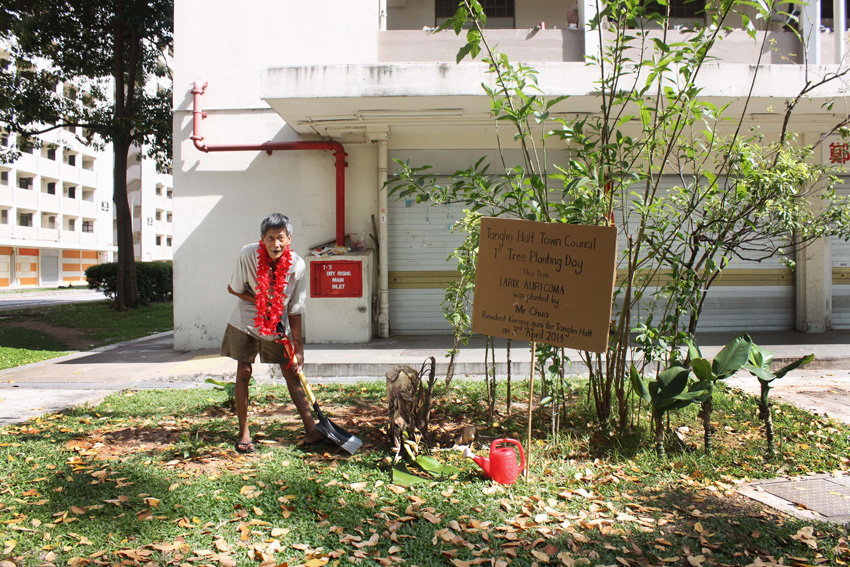
    Yet one stubborn presence continues to haunt the forlorn corridors – karung guni man Chua Thiam Seng, 62.

    The long passageways below the flats are strewn with cardboard boxes and cans that he collects from occupied flats and coffee shops across the road.

    “This is my office,” he said with a toothless grin. Mr Chua has been a rag-and-bone man in the neighbourhood for the past 20 years.

    He claims to have taken up HDB’s offer of a new flat nearby after the relocation exercise, but he still sleeps in a little corner on cardboard beneath his former block on most nights.

    He added that it was for convenience, but reporters have spotted him cleaning up at a nearby market many mornings.

    The bachelor reminisced about the old days when the close-knit community would gather in coffee shops or outside the lottery shop to exchange gossip.

    He lamented: “They don’t construct flats like these any more and though my neighbours have moved nearby, they are not as close as before.”


    Source: http://news.asiaone.com

  • Malaysia Arrests 10 Suspected Of ISIS Links

    Malaysia Arrests 10 Suspected Of ISIS Links

    KUALA LUMPUR – Malaysian police on Thursday said they had arrested and were investigating 10 Malaysians suspected of links to Islamic State, among them six members of the country’s security forces.

    Although the Southeast Asian country has not seen any significant militant attacks, it has arrested nearly 100 citizens this year on suspicion of links to Islamic State. Authorities have identified 39 Malaysians in Syria and Iraq.

    “They are suspected to be involved in activities to promote the Islamic State ideology,” police chief Khalid Abu Bakar said in a statement announcing the arrests.

    These activities ranged from raising funds for the movement to recruiting Malaysians and planning to buy weapons for an attack in Malaysia, he added, but gave no details.

    The suspects, who included two women and two civil servants, were arrested following an operation launched by the police anti-terrorism unit in the capital, Kuala Lumpur, and five Malaysian states, the statement added.

    A police spokeswoman did not immediately respond to telephone calls seeking comment.

    Malaysian militants have used Facebook and other social media sites to lure recruits, attracting thousands of followers online.

    Recruits now include young women and families, with domestic news reporting that a family of four had traveled to Syria, while a Malaysian female doctor’s posts on Facebook on her life as a militant’s wife in Syria have attracted wide attention.


    Source: www.todayonline.com

  • Netizens: If SAF Soldiers Do Crowd Control During Major Tran Disruptions, Who Defend Singapore?

    Netizens: If SAF Soldiers Do Crowd Control During Major Tran Disruptions, Who Defend Singapore?

    Stomper Vincent shares his disapproval over plans to deploy soldiers from the Singapore Armed Forces (SAF) to help manage crowds during massive train breakdowns.

    A report from the Straits Times earlier today (Aug 21) stated that the Land Transport Authority (LTA) is beefing up its contingency plans for in the event of large-scale rail disruptions.

    Soldiers will be roped in as marshals to give directions to stricken commuters.

    The Defence Ministry also confirmed the move, saying that the SAF will work with LTA in the event of a major disruption, “while maintaining our primary responsibility to safeguard our security environment”.

    Expressing his opinions about this new move, Stomper Vincent wrote in an email to Stomp:

    “This news has created unhappiness for many Singaporeans and many have shared it to express concern.

    “I hope Mindef can see this and will not approve soldiers to be deployed during major MRT breakdowns.

    “I thought these public transport companies are listed and profit-driven?

    “Military personnel are meant for defending Singapore, not for marshaling during train disruptions!

    “This is a private company’s disaster. Not a natural and national disaster like floods, forest fires etc.

    “How can a private company activate soldiers?”

    The Stomper added that soldiers are funded by tax payers’ money and should not be deployed to manage problems of a private company.

    Vincent is not the only one with such sentiments. Readers of The Straits Times report have also left comments expressing their disapproval of the plan.

    David Lee wrote, “SMRT is a profit-making operation, are they going to pay for the services rendered by the soldiers?”

    颜树芬 added that the only way the plan would work is if it was executed by a non-profit driven organisation.


    Source: http://singaporeseen.stomp.com.sg

deneme bonusu