Blog

  • Deconstructing Arguments Of Young Singaporean Elitist

    Deconstructing Arguments Of Young Singaporean Elitist

    ‘Elitism’ can be good for society

    It’s very interesting to me whenever a teenager thinks that he has something important or meaningful to say about society. I used to blog about social issues as a teenager myself, and it wasn’t too long ago– so I like to think that I relate to the civic-minded young ones. [1]

    The first and most important thing we need to remember about young teenage thinkers is that they’re most probably dependent on their parents.

    This does not automatically discredit their perspective, but it does shape it tremendously. [2]

    Or, to look at it from another point of view, there’s a lot about society you simply don’t know about until you start paying for the roof over your head and the water coming out of your taps.

    How does this play out in Russell’s argument?

    He claims that “equity is better than equality”, but he has no proposal for actually increasing the net amount of equity in Singapore.

    So all he’s really saying is that the status quo works well for him, and he’d like things to be kept that way, thank you very much.

    Which is quite rational from his perspective. Why should commoners get access to the privilege that HE inherited?

    (Actually there’s a good reason: because it’s a step towards increasing the net amount of equity in Singapore. But he avoids talking about this, probably because he’s a teenager who isn’t actually accountable for anything yet.)

    Let me go through Russell’s argument, bit by bit:

    In recent years, we seem to have collectively confused equity with equality.

    Well, maybe. Let’s see.

    Equality is making everyone stoop down to the lowest common denominator of society – everyone does the same thing and all are given equal probabilities.

    Straw man! We’re conflating equality of opportunity here with a sort of imposed collectivism. Imposed collectivism typically leads to the shittiest kind of equality, AKA “we’re all equally miserable”.

    Also, “Making everyone stoop down to the lowest common denominator” implies some sort of Down to the Countrysidemovement. Like we’re deliberately weighing people down so that they can’t be excellent (see: Vonnegut’s Harrison Bergeron).

    Vonnegut’s story demonstrates “making everybody stoop down”, where people are literally policed and maimed. Giving the disenfranchised access to education is a totally different thing.

    Equity entails everyone doing what their abilities allow them to do, and everyone being given equal opportunities to succeed; only the most outstanding grab those opportunities.

    That’s the end goal that pretty much everybody agrees is a good thing.

    The challenge is that we often disagree about how to get there.

    If we take a modern society and reduce it back to an agrarian one, where everyone puts in equal effort, we achieve equality but not equity – because we are taking people with the capability to be, for instance, lawyers and doctors, and making them do the same menial tasks as everyone else.

    What is up with the “reduce modern society back to an agrarian one” motif?

    Also, what are these horrible menial tasks that everybody does except lawyers and doctors? Washing their own underwear? The horror.

    It is a natural consequence that students from affluent backgrounds get into better schools because their parents are likely more well-heeled and can afford better-quality education for them.

    Oh man, that’s not even half of it. Parents from affluent backgrounds also are likely to read more, read to their kids more, have more thoughtful conversations at the dinner table, have better connections and so forth. Check out this great comic: On a plate
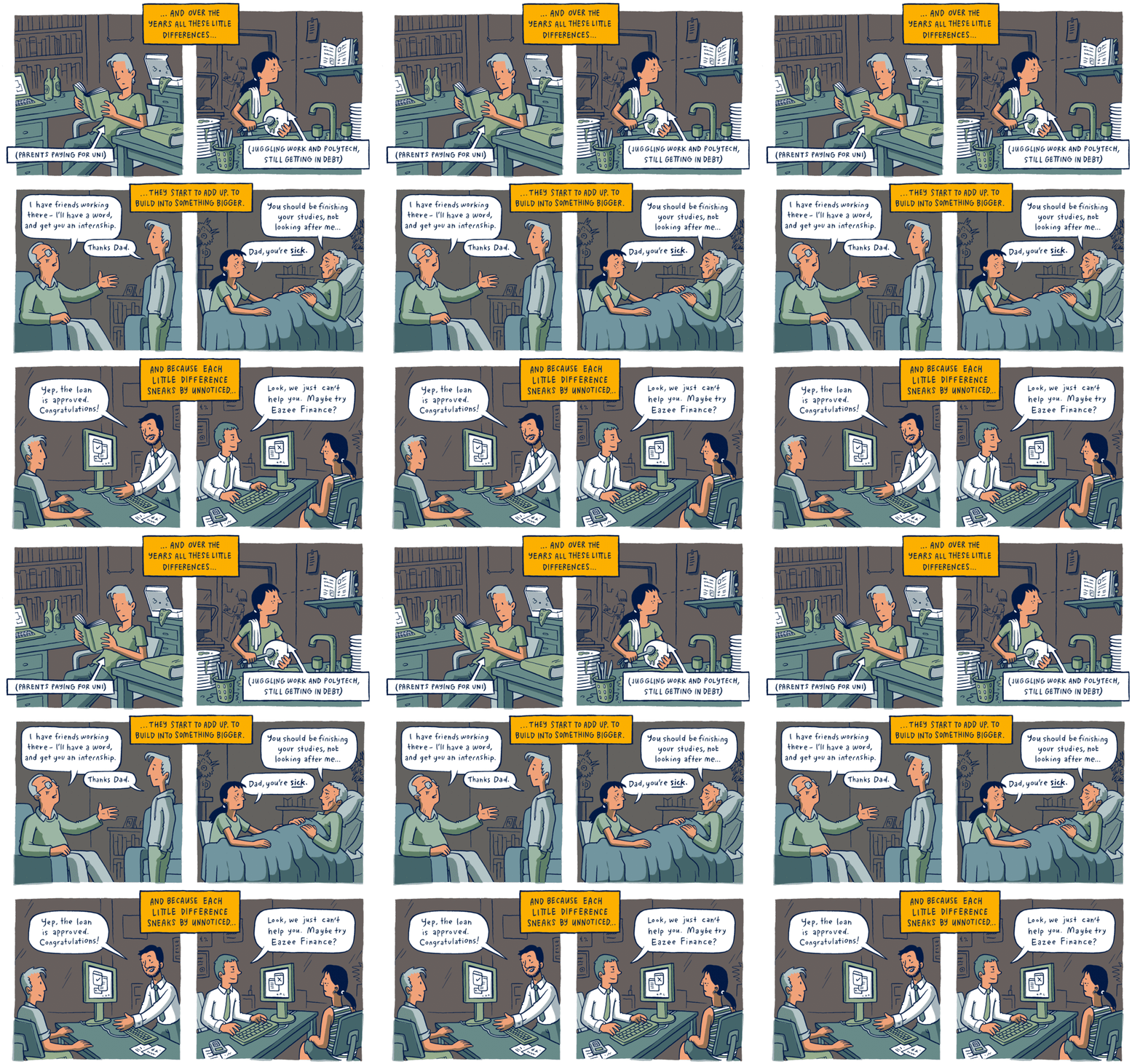
    differences

    There is no point aiming for equality for the sake of equality, and giving up equity.

    Ah, but you see, the point is to GAIN equity by reducing inequality. The point is to GAIN more high-quality doctors and lawyers from the people who don’t currently have access to opportunities.

    Did you seriously think that the Principal of RI is saying “let’s give up equity for the sake of equality”? Equity bad, equality good?

    […] when we stream students according to their abilities, it is only natural that students whose families can afford better quality education make it to better institutions.

    Try to avoid “it is only natural” statements, because they’re actually non-arguments. It’s only natural for a 17-year-old to write things like this. It’s only natural for people to desire and persue equality.

    Everything is only natural, ergo it’s redundant to talk about it.

    A natural consequence that stratifies society does have its own purpose for the well-educated, critical minds to mingle together to build Singapore up to greater heights.

    Don’t pretend that “natural phenomena” has noble intentions. It only seems to because it serves your interests.

    The idea that a country will be brought to greater heights by a circlejerking elite is a romantic one, but it’s BS.

    Intelligence is an asset; and we cannot allow ourselves to prioritise equality over intelligence and equity.

    Again, the idea that equality takes precedence over equity here is utterly mislaid.

    The fundamental point that you’re missing is that addressing inequality is a necessary step towards creating more equity. We don’t need to send doctors and lawyers to the countryside. We need to give rural children the opportunity to read and write.

    RI is often touted as a factory for future leaders – why would we want to draw resources away from the nurturing of our future leaders, or worse still, level the playing field?

    Oh, that’s a pretty simple one. Because leaders aren’t made better by throwing more resources at them, or by putting them on a pedestal.

    Leaders need perspective. Leaders need empathy. Leaders need to see the big picture. Leaders need to mingle with everybody, not just the equity-laden, menial-task-avoiding elites. Leaders are nurtured in difficulty and struggle, not with silver spoons.

    You see, Russell, you fundamentally misunderstand the pursuit of maximizing equity for a society, and you fundamentally misunderstand leadership.

    We should relook the way we go off the well-trodden path, and ensure that we do not shake up the status quo just for the sake of doing so.

    The status quo will get shaken whether you like it or not. What you should actually relook, though, are the assumptions in your own thinking.

    Here are a couple of quotes worth ruminating on:

    Elizabeth Warren: “There is nobody in this country who got rich on their own. Nobody. You built a factory out there – good for you. But I want to be clear. You moved your goods to market on roads the rest of us paid for. You hired workers the rest of us paid to educate. You were safe in your factory because of police forces and fire forces that the rest of us paid for. You didn’t have to worry that marauding bands would come and seize everything at your factory… Now look. You built a factory and it turned into something terrific or a great idea – God bless! Keep a hunk of it. But part of the underlying social contract is you take a hunk of that and pay forward for the next kid who comes along.”

    Lee Kuan Yew: “The successful have forgotten that without the peace and stability that made their education, their job or their business opportunities possible, they would never have made it. But having made it, they think they made it on their own. Some students from the top schools like Raffles Institution or Hwa Chong, they go abroad and they think that they had done it on their own. They don’t owe the government or society anything. They are bright chaps, but how did they make it? Because we kept a balance in society. With peace, stability, we built up our education system and enabled the brightest to rise to the top.”

    _____

    [1] If you’re bored enough to dig into my archives, you’ll find that I too was a presumptuous little twit who thought he had a valuable perspective that the world ought to know about. What changed? I moved out, bought a flat, and pay my own bills. Lol.

    Incidentally, I think it’s very important to remember that news sites are uniquely incentivized to publish incendiary letters. If a letter published on straitstimes.com sparks outrage, that means a lot of traffic for straitstimes.com. It’s not hard to imagine the editors sorting through the letters and laughing amongst themselves, saying, “Wah, this one damn jialat, publish this one!”

    [2] One of the easiest ways to “win aguments” as a teenager is to just use bigger words and talk longer than everybody else. (You’ve got all the time in the world, and no bills to pay.)

    People will eventually find it too tedious to engage with you, and their disengagement means you’re the one left standing. Hooray, you win!

    ____

    Update: Got a great comment about this on Facebook:

    “I think your argument could be summarised into a “equity good not equals equality bad” essay rather than a slightly tedious point-counterpoint.

    Also, the only part I slightly disagree with is precisely the part you quoted above. I think you’re both arguing on a false dichotomy. More resources do to a certain extent allow for the development of better leaders. It can pay for programmes that stretch the capabilities and capacities of participants beyond what normal programmes allow. It can also create opportunities for experiences that are beyond a smaller budget. The problem is that those things are easy to programme, but what we’re missing is the perspective and empathy that you’ve rightly pointed out. We need to be doing more of that, which doesn’t necessarily mean we have to scrap the other good developmental programmes that are already in place.”


    Source: www.visakanv.com

  • Saktiandi Supaat Ingin Terus Sumbang Kepada Negara

    Saktiandi Supaat Ingin Terus Sumbang Kepada Negara

    Encik Saktiandi Supaat menyandang dua jawatan di Maybank sebagai naib presiden eksekutif dan ketua kajian mata wang asing.

    Sebelum itu beliau bertugas sebagai ahli perbendaharaan ekonomi kanan di United Overseas Bank (UOB) dan ahli ekonomi Penguasa Kewangan Singapura (MAS).

    Sejak 2004 beliau giat dalam sayap belia Angkatan Karyawan Islam (AMP) dan mengetuai sayap itu pada 2010 hingga 2013.

    Selanjutnya, beliau berkhidmat sebagai anggota Lembaga AMP.

    Beliau juga pengerusi jawatankuasa memandu Skim Dana Kepimpinan dan Kemajuan (Labs), Forum Pemimpin Masyarakat (CLF) yang menawarkan dana kepada projek keusahawanan sosial yang dikendalikan golongan belia.

    Berikut sedutan wawancara bersama beliau:

    Apakah isu Melayu/Islam yang bakal menjadi tumpuan anda?

    Pertama, dari segi pekerjaan terutama dalam kalangan anak muda, umpamanya daripada aliran Institut Pendidikan Teknikal (ITE) dan diploma.

    Adakah mereka boleh dapat pekerjaan selepas tamat sekolah? Jika boleh, bagaimana pula hendak pertingkat keupayaan mereka dengan lebih lanjut? Ada perkembangan dalam bahagian ini… dan cabarannya adalah sama ada keadaan boleh diperkasa sementara mengekalkan teras warga Singapura dalam pekerjaan.

    Kedua, mungkin dari segi keluarga. Saya lihat dalam kalangan keluarga rentan, yang mempunyai sumber pencarian tunggal dan perlu menyara hidup anak-anak muda.

    Golongan ibu tunggal dengan anak-anak muda juga mencetus keprihatinan, terutama dari segi pendidikan anak-anak mereka, supaya tidak ketinggalan di masa depan.

    Isu ini tidak begitu berbeza daripada isu di peringkat nasional.

    Mengapakah anda memilih menceburi politik?

    Saya telah menceburi kerja kemasyarakatan sejak 2004. Saya mula berkhidmat dengan pertubuhan bantu diri daripada peringkat belia ke usaha sosial dan bagi masyarakat Melayu/Islam menerusi Mendaki dan Labs CLF, sebelum berkhidmat di peringkat nasional menerusi Spring dan Kolej Perkhidmatan Awam.

    Menerusi khidmat saya, saya menemui golongan yang terlepas menerima bantuan dan saya yakin dapat menyumbang lebih lanjut dengan melibatkan diri dalam dasar bagi isu-isu tertentu.

    Penglibatan saya dalam politik bukan satu peralihan semula jadi, tetapi saya mulai sedar (menerusi penglibatan di peringkat akar umbi) bahawa ada warga yang menghadapi isu harian dan memerlukan bantuan.

    Bagaimana pengalaman anda dalam sektor swasta boleh membantu dalam arena politik?

    Saya pernah bertugas sebagai ahli ekonomi dan boleh berkongsi perspektif swasta bagi perkembangan global. Saya kerap ke luar negara dan memahami persaingan yang diwakili rakan serantau dan beberapa isu yang dihadapi Singapura dalam usaha melangkah ke hadapan. Antara lain, saya berharap dapat menggunakan sedikit kemahiran yang ada bagi mencorak beberapa isu dasar awam.

    Adakah anda bersedia mengimbangi masa antara tuntutan kerjaya dengan tanggungjawab kepada warga sebagai seorang anggota parlimen (jika dipilih)?

    Sebenarnya, saya sedang menguruskan masa dari segi kerjaya dan kerja di peringkat akar umbi. Jumlah kerja yang telah saya laksanakan dalam tempoh dua tahun ini adalah penting dan sejauh ini saya mampu mengimbangi tuntutan ini.

    Apakah mesej anda kepada warga Melayu/Islam Singapura

    Kemajuan yang ditunjukkan masyarakat Melayu/Islam setempat amat ketara dalam tempoh 50 tahun yang lalu.

    Selanjutnya, sebagai sebuah masyarakat, kita perlu memberi tumpuan memberi sumbangan kepada pertumbuhan ekonomi Singapura bagi tempoh 50 tahun mendatang.

    Saya rasa amat positif masyarakat Melayu/Islam setempat mampu memberi sumbangan yang amat besar kepada Singapura pada masa akan datang, dari segi pendidikan, pekerjaan, sumbangan sukarelawan… itu amat ketara.


    SAKTIANDI SUPAAT

    Nama: Saktiandi Supaat

    Usia: 41 tahun

    Tempat lahir: Singapura

    Keluarga: Sudah berumah tangga dan mempunyai tiga anak berusia lima, lapan dan 12 tahun

    Agama: Islam

    Hobi: Fotografi, membaca dan ragbi

    Pendidikan: Sarjana Muda (Kepujian) Perdagangan, Universiti Melbourne (1998), dan Sarjana Pentadbiran Perniagaan (MBA), Universiti Cambridge (2007-2008)

    Pekerjaan: Naib Presiden Eksekutif, Ketua FX Research, Maybank


    “Sesiapa sahaja yang dicalonkan oleh Parti Tindakan Rakyat (PAP) adalah mereka yang telah ‘dicuba’ (diuji) untuk melihat kebolehan mereka di lapangan dan juga bagi menunjukkan kebolehan mereka – daripada apa yang mereka dapat sumbang kepada masyarakat dan juga kepada negara. Jadi yang penting bukan siapa yang dicalonkan tapi apa yang dibawa oleh mereka (yang dicalonkan) yang menjadi harapan rakyat semua dan juga masyarakat kita.”

    – Menteri Kedua Ehwal Luar merangkap Dalam Negeri, Encik Masagos Zulkifli Masagos Mohamad.

    Encik Saktiandi, yang lebih selesa dengan panggilan ‘Andi’, berkata jika diberi peluang berkhidmat, beliau mahu menumpukan perhatian pada keperluan harian penduduk, termasuk golongan warga emas, yang membentuk lebih separuh penduduk di sana.

    Menyentuh tentang khidmat kepada masyarakat Melayu/Islam, beliau berkata isu pekerjaan bagi lulusan diploma dan Institut Pendidikan Teknikal (ITE) antara perkara yang menjadi tumpuannya.

    Beliau, yang pernah tinggal di Kampong Tempeh dekat Sixth Avenue di Bukit Timah, juga bangga dengan pencapaian negara ini daripada negara Dunia Ketiga kepada negara maju dalam tempoh singkat.

    “Saya menyaksikan sendiri Singapura berkembang daripada kampung dan sehingga kami berpindah ke HDB. Perkembangan Singapura, dalam memberi saya pendidikan baik, pelantaran baik bagi membina hidup keluarga baik, sesuatu yang saya hargai.

    “Saya ingin terus memberi sumbangan kepada perkembangan Singapura selanjutnya, supaya generasi masa depan, termasuk anak-anak saya, dapat menyaksikan kemajuan dan perkembangan Singapura dalam tempoh 50 tahun mendatang,” kata beliau.

    Encik Saktiandi mendapat pendidikan di Raffles Institution dan Maktab Rendah Catholic.

    Beliau berkelulusan sarjana muda perdagangan dari Universiti Melbourne di Australia dan Sarjana Pentadbiran Perniagaan (MBA) dari Universiti Cambridge di Britain.


    Source: http://beritaharian.sg

  • Walid J. Abdullah: Discourse On Voting Need To Move Beyond Fear-Mongering And Red-Herrings

    Walid J. Abdullah: Discourse On Voting Need To Move Beyond Fear-Mongering And Red-Herrings

    Often, when people say ‘yes the PAP is not perfect, but what alternative do we have?’, you get the sense that they either do not comprehend our political system or they are setting up a false dilemma. This time, like previous years, we are not voting for which party will serve as government: in all likelihood, the PAP will remain as our government. With that in mind then, the questions that should be asked automatically become different. Perhaps the following questions, amongst others, would be more pertinent:

    1) Do we believe there is a need to have checks and balances in Parliament against any one party?

    2) Since 2011, with more opposition parliamentarians, has the government become more responsive to the desires of the electorate?

    3) Has the Workers’ Party lived up to its claim of being a ‘responsible opposition’ party?

    4) Are the individual opposition candidates and their respective parties ‘credible’ enough for us, however we define it?

    I personally believe that in any other situation, most people would loathe the idea of giving any one person or party near-absolute control over their affairs, so I am not sure why people make exceptions in the case of Singapore politics. At the same time, I cannot say that the performance of WP – both in and outside Parliament – has been so stellar in the past 4 years that they would immediately deserve my vote. That would be my personal dilemma.

    Ultimately, each of us would have our own standards in choosing which party to cast our vote for. Hopefully as our society matures politically, the discussions on voting, politics and societal issues would be centered on genuine considerations rather than fear-mongering or red herrings.


    Source: Walid J. Abdullah

  • Low Thia Khiang: Lui Tuck Yew A Loss, Questions If Lui Lacked Support From Cabinet

    Low Thia Khiang: Lui Tuck Yew A Loss, Questions If Lui Lacked Support From Cabinet

    Workers’ Party chief Low Thia Khiang on Wednesday expressed disappointment that Transport Minister Lui Tuck Yew was leaving politics, saying the timing of the decision by the “hardworking minister” has raised questions about his reasons for doing so.

    Mr Low added that Mr Lui had done a good job, pointing out that he “goes to the ground to try his best to resolve transport issues”.

    He said: “It’s a loss to the Cabinet.”

    He also said that the unexpected announcement of Mr Lui’s impending departure from politics has raised speculation about the internal workings of the Cabinet and the Government’s handling of a public transport system beset by breakdowns in recent years.

    “Was it because of the recent incident of the MRT big breakdown…or is it because he feels he has not been supported by his Cabinet colleagues who is supposed to work as a team to give him enough confidence to stay on and solve the issues?” Mr Low told reporters before he attended his weekly Meet-the-People session.

    About 250,000 people were affected when both the North-South as well as the East-West MRT lines broke down in July during the evening peak hours.

    He also said he would be “very disappointed” with the People’s Action Party (PAP) if it allows a minister to resign in order to take the heat off public transport issues.

    Mr Low noted that Mr Lui’s predecessor, Mr Raymond Lim, also left the Cabinet after a stint as Transport Minister and questioned whether the Government needed to fundamentally rethink Singapore’s transport model.

    “Was it because philosophically I think how they treat transport is not correct and not convincing to the Minister for Transport?” he wondered aloud.

    He also suggested that perhaps Mr Lui’s morale had been affected after his ward in the soon-to-be-defunct Moulmein-Kallang GRC was “chopped off into pieces and redistributed” into other constituencies.

    Mr Low acknowledged that public transport was “a long-term problem” that would “take some time to solve” as the network is heavily used daily.

    He was also asked a series of questions on the coming general election, such as whether he feels the PAP is trying to ride the wave of national unity generated by Singapore celebrating 50 years of independence and Singaporeans celebrating the life of founding Prime Minister Lee Kuan Yew, after his death in March.

    He declined to comment, saying: “It is better for members of the public (and) the younger generation of Singaporeans to look at what (the PAP) is doing and make their own judgement.”

    On what he thought of recent comments PAP ministers have made about integrity and town council management, he said: “If they really want to launch an attack,we will respond to them.”

    Meanwhile, said Mr Low, his party plans to engage younger voters through a younger slate of candidates who will be more savvy on social media, which he admitted to knowing little about.

    “I’m not on Facebook,” he said, adding that he is not planning to start a Facebook page.

    He also said the WP will introduce its candidates soon and that they were “already on the ground”.

    He said his party would probably not depart from its past practice of revealing only on Nomination Day where its candidates will stand.

    He, however, hinted that his party’s Aljunied MPs will disclose if they were staying to defend the GRC on Sunday during the sale of the WP’s newsletter.

    Mr Low was also asked to evaluate the performance of his fellow MPs in the House in the past four years. Recently, various websites have tabulated the attendance of MPs in Parliament.

    He said he would leave it to Singaporeans to evaluate them, but added that the role of an MP is not confined to attending Parliament. An MP is also involved in running town councils and serving constituents.

    However, he added, MPs should prioritise attending Parliament over other activities.

    “That’s why you offer yourself to be elected. Parliament is your destination, where you represent the people. So even if you are not slated to speak, at least you (have to be there) to know what happened.”


    Source: www.straitstimes.com

  • Zainudin Nordin Steps Down To Spend Time With Family

    Zainudin Nordin Steps Down To Spend Time With Family

    Citing the desire to spend more time with their loved ones, two People’s Action Party (PAP) backbenchers from the Bishan-Toa Payoh Group Representation Constituency — including one who is known for not shying away from controversial topics — will be stepping down.

    Speaking at a press conference to unveil the PAP candidates for the coming General Election, Mr Zainudin Nordin, 52, who entered politics in 2001, and Mr Hri Kumar Nair, 49, who had served two terms in office, said they will be making way for new blood.

    Mr Hri Kumar said that he had to relook his priorities after his wife was diagnosed with lymphoma in 2012 and underwent chemotherapy.

    While she is “doing well” currently, Mr Hri Kumar noted that the condition is something that would not go away. “(Her illness) has sort of propelled me to rethink how I would spend my time and what my priorities are,” he said.

    He also hopes to have more time with his eight-year-old daughter. “She’s a great little girl, I’m looking forward to spending more time at home annoying her, that’s what she accuses me again all the time,” he joked.

    Recounting his time in office, he said he was glad to have had the opportunity to raise issues in Parliament. “I’ve never held back, I think the ministers don’t always agree with me, but they have always respected my right to speak up and to say what I want to say, I think that’s important,” he added.

    Mr Hri Kumar, who is currently the chairman of Bishan-Toa Payoh Town Council, also heads the Government Parliamentary Committees for law and home affairs.

    Speaking to TODAY, Mr Hri Kumar said he was proud that during his tenure as an MP, he did not shun from speaking about lesbian, gay, bisexual and transgender (LGBT) issues, for instance, and voicing his disagreement with the National Library Board’s decision to pulp three children’s books deemed to contravene pro-family values.

    Among other things, he had also suggested the idea of a National Defence tax on permanent residents and foreigners, and abolishing the Primary School Leaving Examination.

    “But I’m not afraid of saying these things and asking people to debate and consider them,” he said.

    For Mr Zainudin, who will also be stepping down as the president of the Football Association of Singapore later this year, the “time is right” for him to focus on his family, he said.

    The former Mayor of the Central Community Development Council added that as an MP, there would always be a desire to do more. Nevertheless, he felt he has contributed by speaking up for low-wage workers. He also recalled that in his maiden Parliamentary speech, he spoke about the need for the Government to do more in early childhood education.

    At the municipal level, Mr Zainudin said his proudest project was setting up the Bishan Active Park which has since become “one of the most iconic community parks in Singapore”.

    On what he would miss about being a politician, he cited meeting residents and helping them.

    “Helping people has never been an easy journey. We always try our best … the fond memories are about the difficult things you do,” he said.


    Source: www.todayonline.com

deneme bonusu