Tag: ban

  • Watain Concert Banned, Minister Dragged in Racial Issues Involving Malays, Muslims and the Christian Community in a Follow-up Explanation

    Watain Concert Banned, Minister Dragged in Racial Issues Involving Malays, Muslims and the Christian Community in a Follow-up Explanation

    In the wake of the government’s order to block a black metal band from playing here (just hours before the concert was due to start), Minister of Home Affairs K Shanmugam oddly dragged in racial issues.

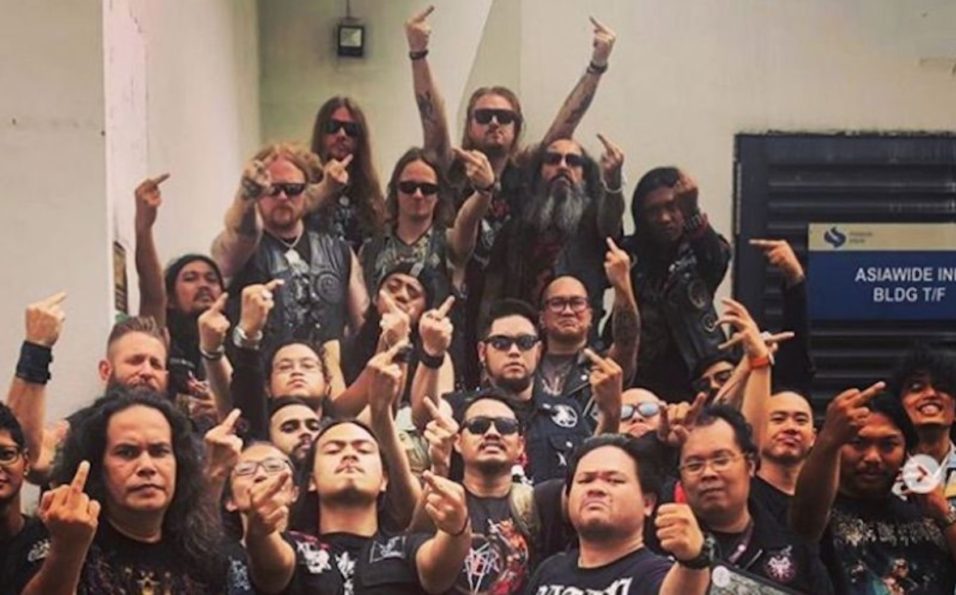
    In a speech at an appreciation lunch for Malay-Muslim anti-drug campaigners on Saturday, the minister honed in on a photograph taken at a meet-and-greet session between Swedish band Watain and their fans. The picture depicted Watain and their fans showing ‘the middle finger’ — a defiant (and very metal) response to the government’s decision to cancel the concert on grounds of preserving “public order”.

    According to Channel NewsAsia, Shanmugam detailed how the ministry would be unable to let the concert go ahead, given how Watain’s lyrical content held anti-Christian themes. Then he went into length about the photograph, harping on how it showed “primarily Malay young men”.

    “You have a group of Malay young men, showing the one-finger sign, supporting the group,” CNA quoted the minister.

    “If a group of Chinese went and showed the finger sign and said that we should allow it – how would you all have felt? It is the same.”

    Mentioning that the photo has gone viral “across the Christian community”, Minister Shanmugam stated that it was crucial to show that the picture does not represent what the Muslim community thinks.

    “They won’t realize that this a small group of Malays, but they may think, is this what Muslims think of us? So now we have to send the message that this is not what the Muslim community thinks. These are black metal group supporters, they are not the mainstream community.”

    In conversations with Christian leaders, Shanmugam pointed out how the leaders would oftentimes draw comparisons to how tough the government would quash anti-Islam sentiment, such as banning the Salman Rushdie book The Satanic Verses in Singapore.

    “(The leaders) said what these people (Watain) are saying is far worse, it is a hundred times worse about Christianity – how come you would allow that?” said Shanmugam to The Straits Times.

    “They said you treat the Muslim community differently than the Christian community.”

    Shanmugam acknowledged there was “some truth” to what the leaders said but said it was not fully true “but it is an approach”.

    He also pointed out to Channel NewsAsia that not all bands would be banned because they spoke about Christianity.

    ———————————————————————————————————————————————————–

    The aftermath?

    It led to confusion among the Muslim community. How did this become an issue that involves the Muslim community? Is the minister trying to be a “hero” that saved the Muslims from depicting a bad, intolerant stand against Christians? What has the brown-skinned fans in the photo got to do with Malays in general, or worse representing what the Muslim community in Singapore thinks about the Christians. Is it because there is a stereotype about Malays in Singapore where they are called Mat Rockers? And who are these brown-skinned fans in the viral photo? Are they even Malay/Muslims from Singapore?

    What was the Minister thinking by saying all this?

    Source: Coconut, Yahoo, The Straits Times and Channel NewsAsia
  • Why Not Make Thaipusam A National Holiday Again Alongside Deepavali, CNY And Hari Raya?

    Why Not Make Thaipusam A National Holiday Again Alongside Deepavali, CNY And Hari Raya?

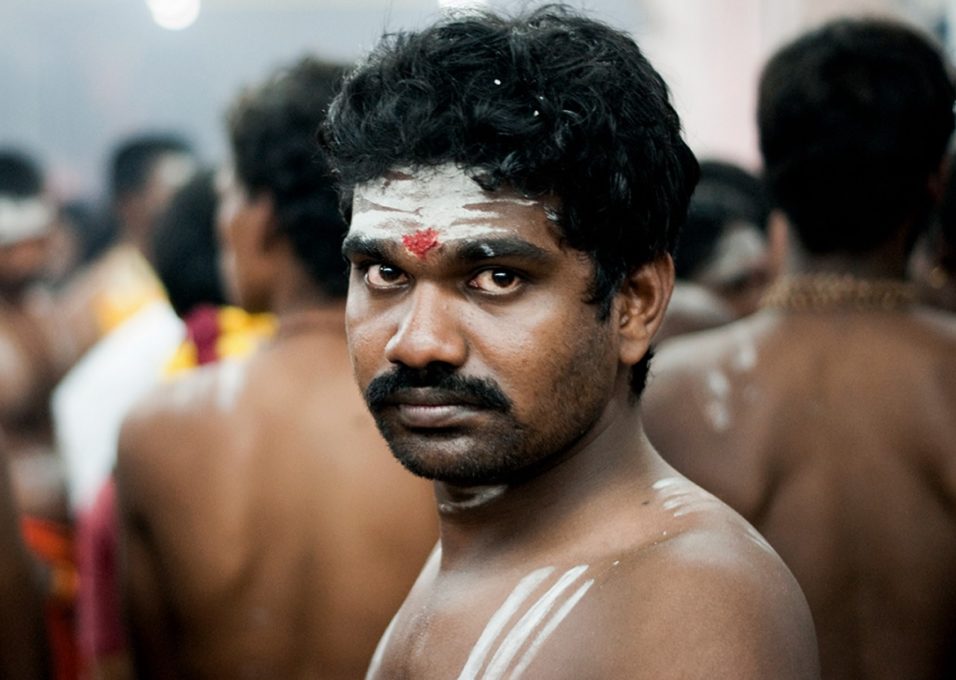
    Another year, another incident. You’ve probably seen it – that viral video taken at the Thaipusam procession, or at least heard of its existence: How a volunteer officer from the Hindu Endowment Board (HEB) allegedly disrupted a procession over the use of musical instruments and amplification.

    Netizens have criticised the HEB and the authorities for disrupting the procession. Several in the Hindu community that The Pride spoke to feel that the authorities should allow them to carry out their religious rites without interference. The authorities have clarified that they have been accommodating to the Hindu community even if some may have broken the law, and the HEB has also since stated that the most recent incident has been settled amicably with the devotees.

    Yet, each year, what is supposed to be a joyful, religious festival for the Hindus seems only to be remembered for the disputes between devotees and the authorities.

    There have been umpteen calls to lift the ban on musical instruments at the procession – a ban which was put in place to control the noise levels. Those arguing against the ban often point out that lion dance troupes make plenty of noise – in public – too.

    Lion dance troupes with their drums and cymbals that are so active during the Chinese New Year period are arguably a lot noisier and affect far more people over a longer period than the Thaipusam devotees with their hand-held instruments and amplified voices, but Law Minister K Shanmugam, in a Facebook post made three years ago, said that lion dance troupes perform during social or community events and not religious events.

    This ban on music is not in place to discriminate against Hindus. Mr Shanmugam said that Hindus are given exemption from the law against religious foot processions during Thaipusam. He added that the Thaipusam procession goes through major roads – a privilege not afforded any other religious group.

    The procession is by no means a silent one: This year, there were 19 points along the 3.1km stretch from which music was transmitted and three stages along the route where live music was played.

    Retired police officer M Kunalan, 70, carried the spiked kavadi several times during his younger days. He says that there are troublemakers among the younger group of devotees who challenge the authorities and play their music loudly, disturbing the peace in what is supposed to be a solemn occasion.

    “These groups should be investigated and brought to task under the law. They bring shame to the Hindu community during a sacred festival,” he told the Pride.

    But is there a way to be even more accommodating to the Hindu community? Could there be more done to ensure that they are allowed to celebrate Thaipusam – which is to mark the victory of the deity Lord Murugan over evil?

    How about making Thaipusam a national holiday?

    The procession, with devotees bearing elaborate kavadis, is in itself a spectacular affair and communities other than Hindus or the predominantly Tamil devotees could join in the celebrations as respectful observers. Tourists could also soak in the festivities of such an event.

    “Thaipusam is not an easy event to organise. Logistically, it can be a nightmare and the devotees, even those who carry the kavadi, have to go through the added hardship of not having a public holiday on such an important occasion. Making it a holiday would go a long way in helping the Hindu-Tamil community,” said Mr Kalidass SKS, managing director of a security services company.

    The last time a call to turn Thaipusam into a holiday was in 2015, and the Ministry of Manpower (MOM) explained in nine points why not having it as a holiday would best serve Singapore. Thaipusam used to be a public holiday until 1968.

    It is regarded as a religious holiday, but if you considered it a holiday for Indians, which are largely represented by the Tamil community, there seems to be a fair argument for its reinstatement as a public holiday: The Chinese have two days – the first two days of the Chinese New Year, the Malays have Hari Raya Haji and Hari Raya Puasa, and the Indians currently have only Deepavali as a national holiday. Making Thaipusam a public holiday would mean the three main races of Singapore have two public holidays each.

    According to the MOM then, “the decision on which public holidays to give up was reached only after careful consultation with religious groups”.

    But that was in 1968. And the only religious festival that seems to be experiencing any sort of problem appears to be Thaipusam. Could we not all give up one day of work so that Thaipusam can get the space it needs?

    Residents in the area would probably be more forgiving of noise created as a result of the festivities if it were a holiday. Organisers of the procession would have a bigger pool to choose from for volunteers and helpers at the occasion. There will be less inconvenience to traffic if it weren’t a working day. And everybody in Singapore would begin to think of Thaipusam as a Singaporean religious festival instead of dismissing it as a day when Indians struggle in their fight against evil.

    MOM also explained that when the number of public holidays was set at 11 in 1968, the reason was this: “Faced with the British withdrawal and the need to compete in global markets, the government decided to reduce the total number of public holidays, among other things.”

    So never mind the music for now: The British have long departed. Singapore is suitably plugged into and very competitive in global markets. We could leave it to the economists to determine if one day less of work would plunge our economy into recession, and trust that city-planners and the Singapore Tourism Board would capitalise on the event to promote Singapore as a culturally rich and diverse destination.

    So, as the majority of Singaporeans prepare to celebrate Chinese New Year, which is just around the corner, perhaps it’s time to consider giving our Indian countrymen another public holiday.

    Source: PrideKindnessSg


    Rilek1Corner

  • 10 Reaksi Orang Singapura Terhadap Yusuf Estes Yang Tidak Dibenarkan Masuk Singapura

    10 Reaksi Orang Singapura Terhadap Yusuf Estes Yang Tidak Dibenarkan Masuk Singapura

    1. MUIS tak bersuara, takut MHA, selalu angguk kepala aje. Tapi takpe… da biasa
    2. Komen pun tak guna. Simple.
    3. Kenyataan nya Melayu Singapura sudah kena belengu dengan doktrin jahiliyah tapi Tak sedar
    4. Satu2 yg diluar di tutup pintu …yg didalam ditaruh grill dan gate …dasar polisi islam the singapore way…..
    5. Jgn salahkn MUIS atau MUFTI, ini diluar kuasa mereka, ni arahan dr kementerian ehwal dlm negeri yg diterajui oleh org2 kafir
    6. Cabaran pendakwah di akhir zaman. Yang benar tidak boleh dicerahkan tapi yang batil dijunjung dan ditatang !!!
    7. Klau gomen ckp jimat air. Sebok khubat jumaat ckp pasal air. Klau gomen ckp pasal nyamok Khubah jumaat pun pasal nyamok. Klau gomen ckp pasal kurang kan gula khubah jumaat pun ckp pasal gula hehehehe tu pasal lah bila time khubah jumaat byk yg tidur lena. Dan yg paling merdu di dgr ia lah…. Pehat masjid tidak bertanggong jwp klau kereta ada di denda..yg ni paling class.. Belum pernah dgr khubah yg menaik kan semangat org2 islam ..sampai khubah kita pun di periksa oleh kafiroon..
    8. Ada Yusuf Estes kesah? Confirm dia tak kisah pon. And he’s better off in the US. Where he has thousands more of followers.
    9. Cuba sekat lagi, ilmu Allah itu luas. Inshallah. Kalau kita nak dengar yang baik2 anytime youtube ada
    10. Dilarang masuk kerana takot kebenaran disebarkan. Yusuf Estes tau tipu hela bekas agama dia.


    Rilek1Corner


  • Australian Senator Pauline Hanson Wears Burqa To Parliament In Bid To Ban Them

    Australian Senator Pauline Hanson Wears Burqa To Parliament In Bid To Ban Them

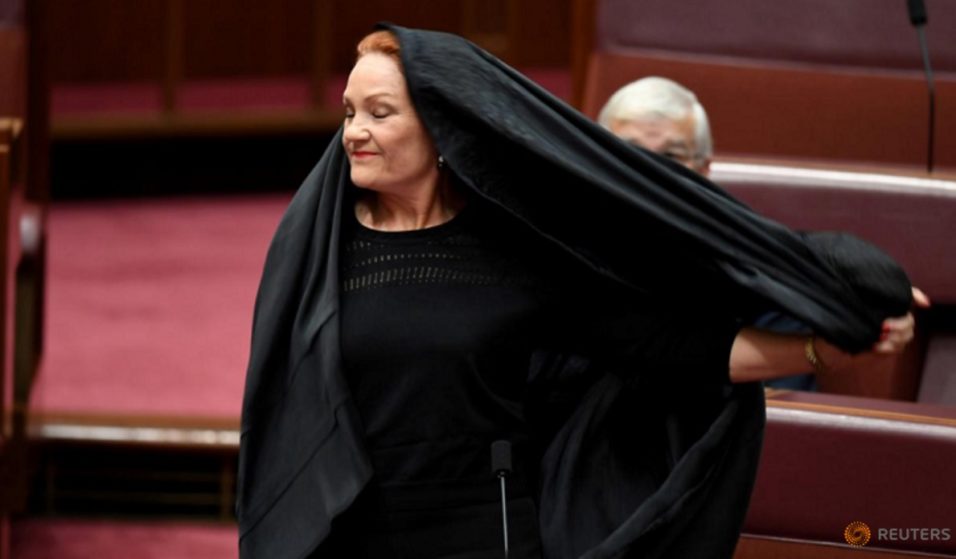
    Australian far-right senator Pauline Hanson wore a burqa to parliament on Thursday (Aug 17) as part of her campaign to ban the all-enveloping garment worn by some Muslim women, drawing a quick rebuke from the government and Muslims.

    Hanson sat in her seat in the assembly for about 20 minutes covered by the black burqa before removing it to call for them to be banned in public for national security reasons.

    “I’m quite happy to remove this because this is not what should belong in this parliament,” Hanson, who leads the far-right One Nation party, told the Senate.

    “If a person who wears a balaclava or a helmet in to a bank or any other building, or even on the floor of the court, they must be removed. Why is it not the same case for someone who is covering up their face and cannot be identified?”

    Hanson, who first rose to prominence in the 1990s because of her strident opposition to immigration from Asia and to asylum seekers, has in recent years campaigned against Islamic clothing and the building of mosques.

    Her party has four senators, which gives it influence in parliament when closely contested legislation is being voted on.

    Attorney-General George Brandis rebuked Hanson.

    “I am not going to pretend to ignore the stunt that you have tried to pull today by arriving in the chamber dressed in a burqa,” he said, drawing applause from members of the Senate.

    “We all know that you are not adherent of the Islamic faith. I would caution and counsel you with respect to be very, very careful of the offence you may do to the religious sensibilities of other Australians.”

    Adel Salman, vice president of the Islamic Council of Victoria state, said Hanson’s action was “a mockery of her position”.

    “It is very disappointing, but not surprising as she has sought to mock the Islamic faith time and time again.”


    Source: http://www.channelnewsasia.com

  • Malaysia Sparks Anger After Banning Book Published In Singapore About Moderate Islam

    Malaysia Sparks Anger After Banning Book Published In Singapore About Moderate Islam

    Activists and authors in Muslim-majority Malaysia reacted with outrage Tuesday (Aug 2) after authorities banned a book aimed at promoting moderate Islam, as concerns mount about growing conservatism.

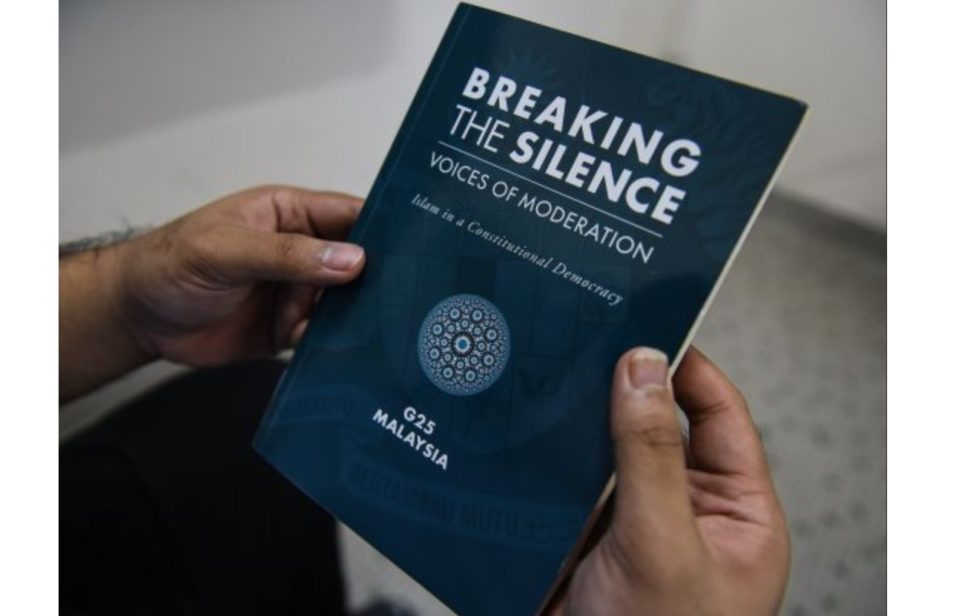
    The book, Breaking The Silence: Voices Of Moderation — Islam In A Constitutional Democracy, is a collection of essays whose publication was organised by a group of prominent Muslim Malaysians pushing a more tolerant form of Islam.

    The ban, signed by Deputy Prime Minister Ahmad Zahid Hamidi, said that printing or possessing the book was “likely to be prejudicial to public order” and “likely to alarm public opinion”.

    Anyone breaching the ban on the book — which was published in neighbouring Singapore — can be jailed for up to three years.

    Malaysia routinely bans books, movies and songs that may contain sensitive material regarding religion or sex, but critics say the government has been clamping down harder in recent times.

    The book was the brainchild of a group of high-ranking former civil servants and diplomats known as the “G25” — for the number of its founding members — which was formed to push back against intolerance, and some of the essays were written by its members.

    Mr Chandra Muzaffar, one of the authors featured in the collection, said the ban showed the government’s “authoritarian approach to Islam”.

    “It’s a collection of essays which is intended to show that extremists and bigoted thinking on matters pertaining to the practice of Islam in the country should be combated in an intellectual manner,” he told AFP.

    Ms Marina Mahathir, a rights activist and daughter of former long-serving premier Mahathir Mohamad, said the ban — signed last week — was aimed at silencing government critics.

    “It is about silencing anybody who has a different view,” she said.

    Critics say the government clampdown on anything deemed un-Islamic has accelerated in recent times as Prime Minister Najib Razak’s party seeks to appeal to its Muslim Malay base amid speculation elections could be called in the coming months.

    In July the hit song Despacito was banned on state TV and radio due to its racy lyrics after pressure from an Islamic political party.

    More than 60 per cent of Malaysia’s population of over 30 million are Muslim, but the country is also home to significant religious minorities.


    Source: http://www.todayonline.com/