Tag: candidates

  • Issues That Need To Be Addressed Fast Before The Formal PE 2017 Process Begins

    Issues That Need To Be Addressed Fast Before The Formal PE 2017 Process Begins

    PE 2017 by Former MP Inderjit Singh

    In less than 2 months, Singaporeans will get a new elected President. Unlike the past Presidential Elections (PE), the run up to this year’s PE has not been a smooth sailing one. Parliament passed a new ruling allowing for a Reserved Election. While many have questioned the wisdom of a reserved PE, Parliament has passed the law and this is our current system of how we will select our future Presidents.
    As the Head of State, the President must have the respect of all Singaporeans once he or she is elected (or appointed as in the past). After the new President has been elected in the reserved PE in September this year, I hope all Singaporeans will give that elected person the respect the office of the President of Singapore deserves.
    Many of us are saddened with the recent developments and comments from different quarters of society but I hope that we can put all these differences behind us. Once the new President is elected, we should all unite behind that person and focus on uniting the nation so that the respect accrued to the office of the President remains intact.
    To help that process, I feel that the following issues need to be addressed fast before we go into the formal PE 2017 process:

    1. For the purposes of effecting a reserved election, it is important to establish who our first elected president was Some feel that it is Mr Ong Teng Cheong. He was the first person who was formally elected to the office of President. Before him though, Mr Wee Kim Wee had exercised the powers of the elected president during his term, which was when the constitutional changes were made to allow for Singapore to have an elected President. The court will be deciding on this very soon, but I feel the policy makers could have avoided this question all together by paying more attention to this issue – the constitution could have said that the 5th election should be a reserved election and not the 6th. Nevertheless, once the courts decide, we have to move on.

    2. The concept of “Malayness” has also become a debatable issue. Questions about how Mendaki and SINDA classify who is a Malay and who is an Indian do not seem to be aligned with how a Malay or an Indian is defined for the purposes of a GE or a PE. For now, it is critical that the leaders of the Malay community and the government come out and make this position clear and hopefully this position will apply to all aspects of life in Singapore. I hope this can be resolved before the formal process of PE 2017 starts.

    3. This being the 1st ever reserved PE, many hope to see qualified Malays step forward and give Singaporeans an opportunity to choose their President. It is also very important that Singaporeans and the rest of the world see that we have enough qualified Malays in Singapore who meet the very stringent requirements set in the constitution. It will be a pity if we don’t have enough qualified candidates to choose from for the first ever reserved PE. So, I hope all those who meet the criteria, come forward for this wider call.

    4. While the constitution is open about having a current sitting government politician standing for the PE, some Singaporeans have expressed concerns on the prospects of a current government MP, still in parliament, resigning as an MP and immediately standing for the PE. The spirit of the Elected President is independence of office as intended by Mr Lee Kuan Yew when the idea was mooted. While I have no question about how each person will do his or her duty to serve the office they are elected to serve, public perception is also important. While Mr Ong Teng Cheong also did the same in 1993, I sense people are increasingly uncomfortable with this.

    As the Head of State, the President of Singapore holds the highest office and he or she must get the full respect of all Singaporeans. I hope the above issues are addressed before PE 2017 kicks off formally. It is good that Singaporeans are debating the issue of the reserved PE. My hope is that we can largely come to an understanding of the above 4 issues before we kick off PE 2017. And once our President has been elected, let’s all show respect for the President of Singapore and stand united as Singaporeans.


    Source: Inderjit Singh
  • Suitable Eligible Candidates Should Step Forward, Proper Contest Of Presidency Beneficial To Singapore

    Suitable Eligible Candidates Should Step Forward, Proper Contest Of Presidency Beneficial To Singapore

    By Lin Weijie

    The ruling party in Singapore, the People’s Action Party (PAP), has governed our country for more than 50 years. PAP has dominated the Parliament since independence. The judiciary has been highly supportive of the government. It can be beneficial for our country, government and even ruling party to have an independent, non-partisan and qualified President who is caring, capable, committed, credible and constructive (5Cs?). An additional bonus is if he or she has charisma. The eighth President of Singapore who assumes office in September 2017 should be able to successfully work with our government to lead, unite and care for our people while exercising his constitutional, ceremonial and community responsibilities as our Head of State. Who are the potential candidates?

    Currently, the two interested candidates from the private sector, Salleh Marican and Farid Khan do not meet the stated financial criteria as their companies to do not have shareholder equity of at least $500 million. Salleh Marican is an Indian-Muslim chief executive officer (CEO) who seems not very fluent in Malay language. Farid Khan, who grew up in Geylang Serai, is a CEO of Pakistani descent. The third potential candidate is Halimah Yacob, our Indian-Muslim Speaker of Parliament who expressed interest.

    The Singapore electorate can benefit from having suitable Malay-Muslim candidates taking part in this election. As Prime Minister Lee Hsien Loong said in Parliament, the 2017 Presidential Election will be reserved for Malay candidates.

    Presently, there are a few potentially eligible Malay CEOs who may qualify as possible private sector candidates. One of them is Alternate Member of the Council of Presidential Advisers and Bank of Singapore CEO Bahren Shaari, who has not ruled out running for the Presidential Election. He was appointed CEO in February 2015. Though he has not met the minimum three years criteria as CEO, the Presidential Election Committee (PEC) may approve of his application and allow him to run for this election, if he decides to take part.

    The other potentially eligible private sector candidate is Shafie Shamsuddin who has served as CEO of Carrefour in Singapore and Malaysia. He is currently, the president and chief executive of PT Trans Retail (Carrefour Indonesia). Shafie Shamsuddin was named the Outstanding Chief/Senior Executive (Overseas) of the Year at the 2016 Singapore Business Awards. In 2016, Singapore’s Government Investment Corporation (GIC) invested 5.2 trillion rupiah (SGD$387 million) for a 17% stake in PT Trans Retail.

    According to the Presidential Election 2017 Candidate Handbook, one of the financial requirements is that “the company must have, on average, at least $500 million shareholders’ equity, during the interested candidate’s most recent 3 years of service as chief executive”. It has yet to be ascertained if PT Trans Retail meets this requirement. The companies led by Salleh Marican and Farid Khan do not meet this requirement.

    From the public sector, other potentially eligible candidates include Minister Yaacob Ibrahim and Abdullah Tarmugi who served as Speaker of Parliament from 2002 to 2011. Minister Yaacob Ibrahim has publicly declared that he was not interested. Abdullah Tarmugi may be persuaded to step out of retirement from politics to contest for this election.

    Another possible candidate is Singapore’s non-resident Ambassador to Kuwait and Foreign Minister’s Special Envoy to Middle East, Zainul Abidin, who is the Indian-Muslim CEO of Mendaki from 1990 to 1993. He served as Minister of State for Foreign Affairs in 2004 and Senior Minister of State from 2006 till 2011, when he lost his parliamentary seat as part of the PAP team that contested in the General Elections for the Aljunied Group Representation Constituency.

    Though former Senior Minister of State Zainul Abidin may not meet the requirement 1.1.1a of holding the office of Minister for 3 of more years, the PEC may qualify him under requirement 1.1.1c, which specifies that he has “served for 3 or more years in an office in the public sector for which the PEC must be satisfied, having regard to the nature of the office and the person’s performance, that he has experience and ability comparable to a person who satisfies paragraph 1.1.1 (a)… The PEC must also be satisfied that he has the experience and ability to effectively carry out the functions and duties of the office of President.” There is also a similar clause for private sector candidates who might not meet the exact requirements. There should not be a walkover for this Presidential Election.

    Indeed, it can be beneficial for our country if we have highly suitable (5Cs?) and eligible candidates from both public and private sectors taking part in this reserved Presidential Election so that our citizens will not be denied the opportunity to take part in this democratic process and vote for our eighth President of Singapore.


    Lin Weijie is a director in the private sector. He has served more than 15 years in the public service, before providing consultancy services to overseas governments and organizations such as the World Bank


    Source: www.theindependent.sg

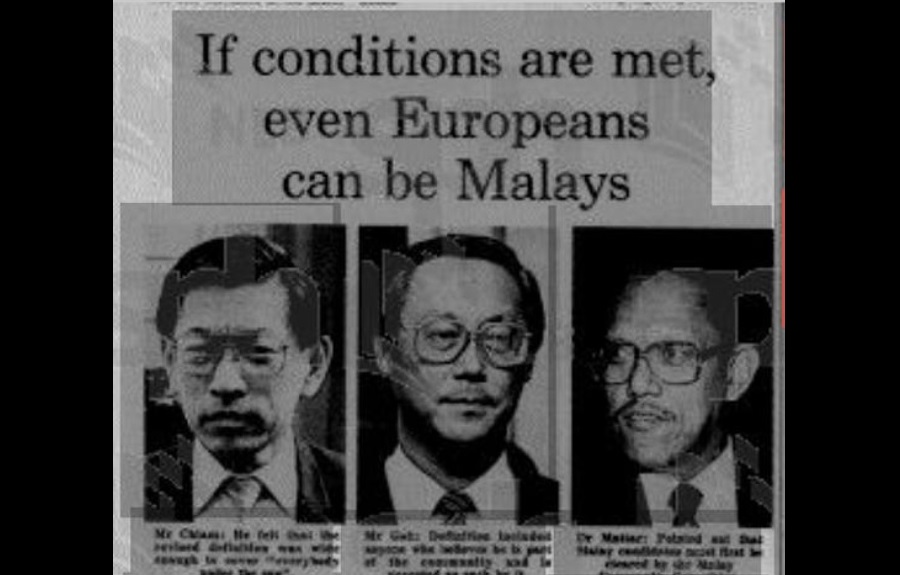
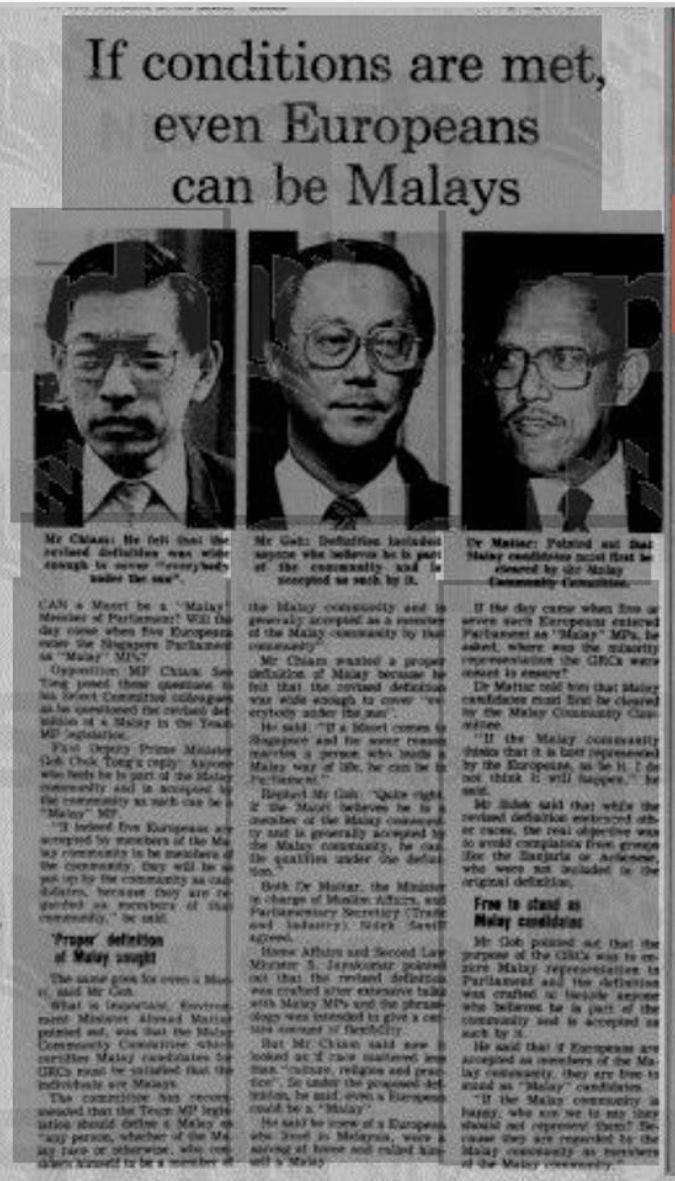
  • Flashback 1988: Definition of Malay Was Debated In Parliament (In The Context Of GRC System)

    Flashback 1988: Definition of Malay Was Debated In Parliament (In The Context Of GRC System)

    The issue on the definition of Malay was debated earlier in Parliament (in the context of the GRC system) back in 1988.

    It was an exchange involving Goh Chok Tong, Chiam See Tong and Ahmad Mattar.


    Part of the excerpt read;

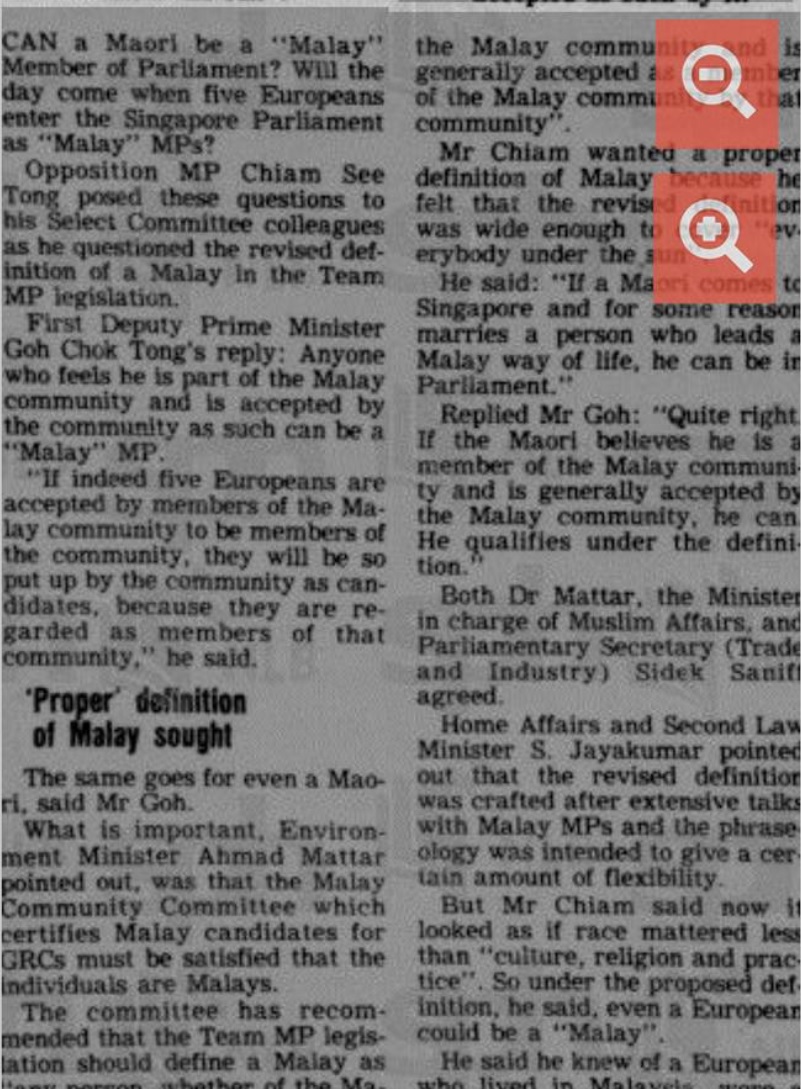
    Can a Maori be a “Malay” Member of Parliament? Will the day come when five Europeans enter the Singapore Parliament as “Malay” MPs?

    Opposition MP Chiam See Tong posed these questions to his Select Committee colleagues as he questioned the revised definition of a Malay in the Team MP legislation.

    First Deputy Prime Minister Goh Chok Tong’s reply: Anyone who feels he is part of the Malay community and is accepted by the community as such can be a “Malay” MP.

    “If indeed five Europeans are accepted by members of the Malay community to be members of the community, they will be so put up by the community as candidates, because they are regarded as members of that community,” he said.

    The same goes for even a Maori, said Mr Goh.


    In another part;

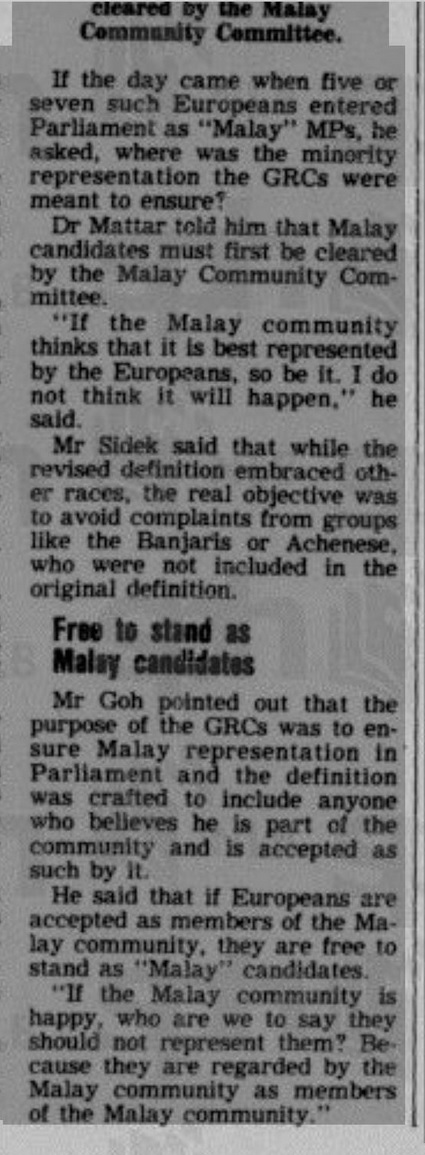
    If the day came when five or seven such Europeans entered Parliament as “Malay” MPs, he asked, where was the minority representation the GRCs were meant to ensure?

    Dr Mattar told him that Malay candidates must first be cleared by the Malay Community Committee.

    “If the Malay community thinks that it is best represented by the Europeans, so be it. I do not think it will happen,” he said.

    Mr Sidek said that while the revised definition embraced other races, the real objectives was to avoid complaints from groups like the Banjaris or Achenese, who were not included in the original definition.


    Also;

    Mr Goh pointed out that the purpose of the GRCs was to ensure Malay representation in Parliament and the definition was crafted to include anyone who believes he is part of the community and is accepted as such by it.

    He said that if Europeans are accepted as members of the Malay community, they are free to stand as “Malay” candidates.

    “If the Malay community is happy, who are we to say they should not represent them? Because they are regarded by the Malay community as members of the Malay community.”


    Source: Abdul Rohim Sarip

  • New Panel To Certify Ethnicity Of Presidential Hopefuls

    New Panel To Certify Ethnicity Of Presidential Hopefuls

    Potential candidates running for the presidency will need to have their ethnicities certified by a new Community Committee, under proposed legislative amendments tabled on Monday (Jan 9) for the new hiatus-triggered model to ensure the country has a minority President from time to time.

    The proposed Community Committee will be made up of a chairman and five members each from the Chinese, Malay, as well as the Indian and other minority communities. Depending on which ethnicity a prospective candidate submits an application under, the sub-committee for that particular community will determine if the individual belongs to that community.

    The Community Committee members will be appointed by the Prime Minister, on nomination by the Presidential Council for Minority Rights, according to the legislative changes mooted for the Presidential Elections Bill tabled for first reading in Parliament by Minister in the Prime Minister’s Office Chan Chun Sing on Monday.

    Last November, changes to the Elected Presidency scheme were passed into law, including instituting a mechanism that reserves an election for a particular ethnicity that has not had an elected representative for five consecutive terms. The upcoming presidential race due in August will be reserved for the Malay community.

    Under the proposed legislative amendments tabled on Monday, all prospective candidates will have to submit a community declaration, on top of the existing application for a certificate of eligibility with the Presidential Elections Committee (PEC). This applies for both open and reserved elections.

    The Elections Department said requiring a community declaration for an open election is needed to operate the hiatus-triggered reserved election process.

    Applicants can be rejected if they fail to submit an application with either committee.

    There is a possibility that in an open election, some candidates are not considered to be members of the three main communities — such as a naturalised citizen — or are rejected in their applications for the community certificates. But they can still contest in an open election as long as they meet the other criteria for the certificate of eligibility.

    In the event that no candidate is successfully nominated at a reserved election, the amendment Bill states that the Prime Minister will issue a fresh writ to call for an open election or a reserved election for the next eligible community.

    The new Community Committee is similar to the Malay and Indian and other minority communities committees found under the Parliamentary Elections Act, which determines if the potential candidate contesting in a particular Group Representation Constituency belongs to these minority groups
    Voters can know who will be on the new committee by May at the latest, just before prospective candidates can start applying for the certification. Applications for such certificates open three months before a sitting President’s term is up. President Tony Tan’s term lasts until end August.

    Given that applicants will need to submit more information to the PEC now that more stringent criteria for potential presidential candidates are in place, the application deadline was proposed to be extended to five days after the writ of election is issued, up from the current three days.

    To give the PEC more time to assess the applications, the Prime Minister’s Office also proposed that Nomination Day falls 10 days after the writ is issued, up from the current five.

    The Second Reading of the Presidential Elections (Amendment) Bill is expected next month.

    Other amendments under the Bill include improvements to the election processes, where the Returning Officer will automatically carry out a recount if the winning margin is 2 per cent or less. This is to avoid unnecessary delays. Currently, a recount is carried out only if a candidate or his counting agent applies for one — provided the winning margin is 2 per cent or less.

    Overseas voters could also have up to two calendar days after the writ is issued to register as an overseas elector, up from the current deadline on the day it was issued. Contingency procedures proposed include allowing the Returning Officer to provide up to an additional seven days for overseas votes to reach Singapore for counting.

    The same amendments for overseas voting processes will be made through future amendments to the Parliamentary Elections Act, which contains the relevant legislation.


    Source: Today

  • The 14 Best-Looking Candidates Of GE2015

    The 14 Best-Looking Candidates Of GE2015

    Two days after the election results, people are still going on about the “what ifs”.

    We serious journalists, too, are asking “what if” – what if we had voted for candidates based on their looks?

    These would be our top candidates:

    1. Ong Ye Kung (PAP)

    Mr Ong Ye Kung is now poised to be parachuted into a ministerial position after Friday’s results.

    Well, he has clearly been parachuted into my heart. Charismatic, and with the looks to boot, he is one – I mean, another – reason to look forward to Parliament.

    2. Chee Soon Juan (SDP)

    Dr Chee’s rousing speeches turned him into a superstar at rallies – his first in 15 years – and this was clear from the long queues for autographs and selfies after.

    3. Tharman Shanmugaratnam (PAP)

    If numbers turn you on, DPM Tharman is the man for you. He is probably one of the few men around who can excite you with talk of finances and taxation.

    4. Amrin Amin (PAP)

    Don’t you just want to pinch his cheeks?

    5. Daryl David (PAP)

    Mr David, you are definitely at the top of my pyramid.

    6. Leon Perera (WP)

    Perera was a breakout star during the campaign with his rally speeches. Often rousing, yet sensible, he has been praised, with his name even trending on Twitter after rallies. And we are all for that nerdy, scholarly look.

    7. Tan Chuan-Jin (PAP)

    Mr Tan is a fit, relatable minister who became known, in the last week of hustings, for his “runabouts”. He ran straight into our collective hearts. I am currently under the Holland-Bukit Timah GRC. Any chance my area can be included in Marine Parade GRC next elections? I mean… stranger things have happened right?

    8. Lim Tean (NSP)

    Mr Lim may not be a conventional choice but he has one of the best voices in local politics, and we’re sad that we won’t hear him at rallies or political debates for a while.


    ​Women

    1. Tin Pei Ling (PAP)

    A new mother, Ms Tin Pei Ling tops our list because of how classy and sophisticated she has grown over the past four years. After NSP candidate Cheo Chai Chen’s sexist comment against her, she issued a graceful response on Facebook that relayed her conviction effectively. That glow of a new mother doesn’t hurt either.

    2. He Ting Ru (WP)

    This Cambridge-educated lawyer has the beauty and the brains. What more do you need from one of WP’s more popular candidates?

    ​3. Indranee Rajah (PAP)

    Ms Indranee is practically the only person who can pull of that hairstyle for as long as she has. It’s a timeless haircut – and well, it suits her.

    4. Josephine Teo (PAP)

    Sure, she looks awkward punching the air with her firsts – as was seen during Nomination Day. But Ms Josephine Teo makes some great, edgy fashion choices. And well, who can fault a woman for speaking in Hokkien to “speak directly to the grandmas and grandpas”.

    5. Kevryn Lim (NSP)

    Most would remember her for that white dress. But in the later part of the campaign period, Ms Lim showed that she is passionate about several issues including advocating for the rights of single parents. And the fact that she is the face of most of NSP’s memorabilia shows just how attractive she is.


    Source: www.tnp.sg