For more than 40 years, Reverend Kang Ho Soon has preached the message of inclusiveness.
He has welcomed homosexuals to his services, invited religious leaders from various faiths to speak to his Christian flock and reached out to prostitutes and migrant workers.
The Methodist preacher, who retired this month at the age of 65, said: “I’ve been open to friendship with anyone in any station or walk of life, from all religions.”
His retirement service at Paya Lebar Methodist Church on Nov 22 was testament to this.
Among the 1,000-strong crowd were Catholic nuns, a Taoist priest, imams, Sikhs and a representative from atheist group the Humanist Society Singapore.
Rev Kang, a 30-year member of the Inter-Religious Organisation Singapore (IRO), said he does not set out to change people but to “accept them for who they are and to be their friend”.
At 23, in his first role serving the Methodist Church as chaplain of Anglo-Chinese School (Barker Road) and pastor of the Barker Road Methodist Church, he gave his “full blessings” to a Muslim caretaker – known to him only as Madam Saminah – to hold Islamic classes in her living quarters at the church.
Their friendship blossomed and he would visit her and her family every Hari Raya. Her grown-up daughters were present at his retirement service.
Instead of pursuing an engineering degree, Rev Kang studied theology at Singapore Bible College and Trinity Theological College.
He spent a decade at Paya Lebar Methodist Church, five years at Wesley Church and 17 years at Kampong Kapor in Little India – his longest term. There he reached out to prostitutes and migrant workers in the community.
He said: “Everyone, regardless of sexual orientation, sex trade workers and migrant workers were welcome to attend our services at Kampong Kapor. If we don’t reach out to them, we end up neglecting them.”
He credits his openness to having spent his youth growing up in a kampung on the southern isle of Pulau Bukom.
There, he learnt Jawi, an Arabic alphabet for writing Malay. It was something his late father, a labourer from China, encouraged him to pick up so he could interact with his Malay peers.
Rev Kang is married to former St Andrew’s Junior College teacher Kang Yeok Lung, 65, and brought up his three children in the same way.
His elder son, 35, a deputy public prosecutor, has four children of his own. Rev Kang also has a 29-year-old son who works in the communications field and a 26-year-old daughter who is an officer at the Economic Development Board.
Another friend, Imam Habib Hassan of the Ba-Alwie Mosque, an IRO member, said Singapore needs more open-minded leaders like Rev Kang.
“One time he wasn’t well in hospital, I went to see him. He asked me to pray for him,” said Imam Habib. “We pray for each other… This is the spirit of inter-faith relations that he has been building up.”
Bishop Wee Boon Hup of the Methodist Church Singapore said Rev Kang’s approach to reach out to those who might have a “less favourable view of the Church” has been well received.
“It is difficult to move forward in inter-faith relations unless someone first starts to reach out to another,” he said.
“Ho Soon is one of those who reach out… He makes friends with people from all walks of life, engages in conversation with them and, in the process of hearing them share their faith journey, he is also able to let them hear of his faith.”
Rev Kang, who admitted that his approach has not been “fully accepted” in some Christian circles, believes it is time for the Church “to speak more words of love, hope and peace to marginalised communities, instead of words of condemnation and judgment”.
While he has retired from the Methodist Church, Rev Kang said he will be a pastor till the day he dies.
He said he will devote his time to people, rather than institutional or organisational concerns.
He aims to be a “listening ear” and counsellor to people from all walks of life, including pastors, people of all faiths or no faith, and people of all sexual orientations.
“We’re a conservative society, but everyone can have a place and equal standing,” he said. “We look to try to understand and accept one another, with no agenda to convert.”
This is more for the converts. In coming to Islam, we still have family and friends of our prior faith. Just as we want them to respect our spiritual path, we must also respect their beliefs. It is never acceptable to condemn them because they did not find what Allah (s.w.t.) had Allotted for you. Your role is to be an example in this world, not so much in terms of knowledge, but more in terms of adab. And strive to be one of those Granted the Gift of interceding before Allah (s.w.t.) on the Day of Judgement.
It is also important that we do not tolerate disrespect of the faith of our family from the Muslims, just as we do not condone disrespect of Islam from the non-Muslims. Islam is about justice. We must be fair. And we cannot allow ourselves to be turned into performing monkeys by Muslims who feel the need to parade a convert condemning a prior spiritual path to feed their collective egos.
In every convert story, we speak and we hear about those who found Islam after study, after discovery after a epiphany. In reality, it was Allah (s.w.t.) Removing His Veil so that we could find Him.
Hakim ibn Hizam (r.a.) was a relative of Khadijah (r.a.), the wife of the Prophet (s.a.w.). He was renowned for his mercy and generosity. Before the rise of Islam, he used to buy the daughters of those families who wanted to bury them alive and graciously assumed the responsibility of taking care of them. Hakim ibn Hizam (r.a.) asked the Prophet (s.a.w.) about these good deeds which he had done prior to his declaration of faith in Islam.
The Prophet (s.a.w.) replied, “These good deeds are but the reasons that brought you the honour of being Blessed with Islam.”
Being Given Islam is a tremendous Honour. The shahadah is the Key to Paradise. Just as it is Given, it can be taken away. So we must consider why we are Muslim. And never think we are better than those who are not.
As a Muslim, I still have a great love of Catholicism. And spending time with both the Catholics and the Muslims, the Catholics are superiors to the Muslims in my eyes. If the Catholics were all Muslims and the Muslims were all Catholics, the ummah of Muhammad (s.a.w.) would not be in this sorry state.
The one thing that disgusts me about many Muslims is how they are so sure they alone are going to Heaven, or how they are full of triumphalism when someone converts as if it validates their ego. Aside from that, they do nothing for the converts. Or how they disparage the beliefs of the Christians when they only have kindergarten knowledge, but when a non-Muslim were to do that, they want to claim injury. Hypocrites.
If I were to look at the Muslims and confuse it with Islam, I would never have converted. The average Muslim is not a good example of the sunnah of the Prophet (s.a.w.). There is only affected piety, arrogance and cultural imperialism. As an ‘alim once said, “Islam is in the books and the Muslims are in the graves.” The ummah of Muhammad (s.a.w.) is dust and we are left with arrogant, self-righteous pretenders.
*Terrence Helikaon Nunis used to be Catholic and belonged to a missionary organisation. After his conversion to Islam, he sat on the board of a Muslim converts’ organisation and specialised in da’wah programmes, convert management, interfaith issues and apostasy cases. He is also an initiate of a Sufi order.
EDITOR’S NOTE
What a brave guy.
Life stories and testimonies from Muslim converts are always interesting because they come from different backgrounds and colourful cultures. Adapting to Islam can be quite challenging but all challenges bear fruits of joy at the end of sheer determination and perseverance.
People who are born into Islam have the benefit of having a foundation with their parents and family. The Qur’an is on their bookshelf, Arabic words are mixed into conversation without needing definition, and there is an environment of tradition that provides a reference point for looking at the world. A convert is experiencing the total opposite. He or she doesn’t have any sort of religious connection with their family anymore, and there is sometimes backlash from parents and extended family about the decision to become a Muslim.
Even if there’s no significant backlash, there are no blood relatives to talk to about Islam, no one to clarify things, and no family support to be offered in the entire process. All of these things can cause an immense amount of stress and disillusionment. It’s common for converts to have moments of breakdown where they feel like nobody is on their side. For those who are lucky enough to have a close friend or mentor to help them in situations like this, it’s still not the same as having family help. Converts need an exceptionally good amount of emotional support from individuals in their community to feel empowered as Muslims. This doesn’t require a full-time therapist, but just people to make them feel at home.
We are extremely disturbed and disappointed in a small number of Singaporeans who harbour such negative thoughts on Muslims and Islam. Singaporeans have lived together for so long as neighbours, and yet some of us do not make an effort to try understand those people who do not share the same faith. It is more convenient to hastily generalised people, and for this unfortunate case stereotyped Muslims as Evil, Jihadist, Disease.
We would like to remind our non-Muslim readers that Islam is not a bad religion like what Nonis Michael Aloysious have occasionally mentioned in his Facebook postings over a period of time from 2011 till year 2014.
Islam is also not a disease. Islam is not evil. In fact no religion in this world is evil. All religions teach human beings to be good and love each other regardless of colour, language, race, and/or religion.
The Internet allows us to share information and connect easily with one another. We should harness this powerful tool positively and responsibly. Let’s remember to be mindful of our words and to respect one another. We must uphold our racial harmony and social cohesion.
Alex Au, a blogger at Yawningbread and founder of a Singapore gay rights group, People Like Us.
When the story first broke, what struck me most was the focus on lesbians. It is far more common in anti-LGBT speech for the reference to be either directed at gay males or framed with reference to gay male sex, at least in Singapore and the West. But coming from a lecturer in Malay Studies, I wasn’t surprised.
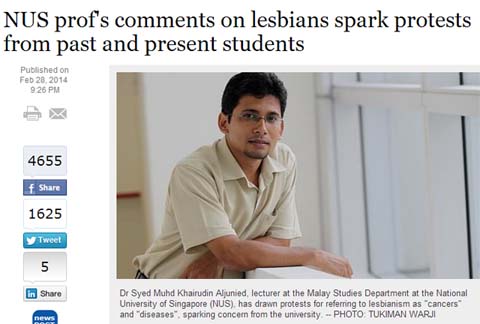
On 20 February, Syed Muhd Khairudin Aljunied made a post on Facebook in which he lambasted “liberal Islam” and its support for lesbianism, describing them not only as “wrongful ideologies” — a matter of opinion, perhaps — but also as “diseases” and “cancers”. The latter may have stepped into hate speech.
As the story in the Straits Times (headline shown above) shows, it generated protests and several petitions.
Now, before I go further, it is important to look at what Khairudin actually said. An anonymous comment led me to the Rilek1Corner site which had a screengrab (see thumbnail at left). His Facebook post seems to have been an answer to a question by an unnamed person, concerning a “new development” in which liberal Islam may be affirming unorthodox sexual identities. In his answer, Khairudin suggested giving advice, going to “proper religious classes”, and seeking help from counsellors. He urged using the “power of technology” to alert groups and movements about spreading these “wrongful ideologies”.
The recommendation may sound reasonable, even if we disagree with his view. Nevertheless, the dehumanising tone he used to describe lesbians — and for that matter, adherents of “liberal Islam” too — is what made the post stand out.
I have on several occasions argued that homophobia is deeply linked to insecurity stemming from a loss of male privilege. You get clues to this when you read some of the things Pope Benedict XVI used to say, speaking of both “radical feminism” and “homosexual lifestyles” in virtually the same breath, and how both have undermined “family life”. Traditionalists’ conception of a happily ordered family is one where the husband is the dominant member, and where the sexes had clearly demarcated roles. Feminism, which argued for equality and autonomy for women, was a serious threat. The gay rights movement sprang from this, making the point that true autonomy includes autonomy in sexual orientation and gender identity.
It is not easy to see this linkage between feminism and gay rights when one looks at the speech of the US-based Christian Right, and that may be why we forget that there is a link. This, in my view, is because in the US, it has become socially impossible to speak openly against equality for women. Thus, even as the Christian Right goes ballistic over gays and lesbians, they know it won’t be politick to attack heterosexual women as well.
However, this does not mean they don’t engage in side actions that try to limit women’s autonomy. The same people also tend to support tighter restrictions on abortion. But they have cleverly packaged it as a “right to life” issue, not as an “attack women’s right to control their bodies” issue, which in reality it is.
Islam is much less reticent about speaking out against equality and autonomy for women. I used to joke that Muslim clerics aren’t as prominent in attacking the LGBT movement as the Christian Right because they were too busy trying to control women. Things may be changing now, not because they are any more accepting of equality for women, but because the LGBT issue has made enough progress that we can’t be ignored any longer.
But it is probably no coincidence that the religions that feel most threatened by this “deadly mix” of feminism and gay rights, and are more explicit about linking the two, are the ones that still segregate men and women, either in prayer halls or in clerical roles. Gender distinctions are not just important in Islam and Roman Catholicism, they are part of the teaching. It is much easier for them to speak out against both feminism and gay rights simultaneously than it is for conservative Protestants, who have already conceded the point on women’s equality (even if they have not internalised it).
This dual threat perception comes together to explain why the question that Khairudin had to answer focussed on lesbians. Lesbians represent both a refusal to be subordinate to men and a challenge to heteronormativity. They are the “worst of the worst”.
* * * * *
In the wake of the news reports, I asked around if anyone knew Khairudin or had heard him speak on previous occasions. One friend gave me a particularly interesting answer, painting a negative picture of the man. She had attended one (or maybe more than one — I didn’t clarify with her) lecture by him and came away with the impression that he was insufferably sexist. She remembered how the notion of male privilege and dominance held up many of the ideas he propounded.
The other strong impression she came away with was his condescension towards Malays. She said, “His opening remarks was something along the lines of ‘I want to stress that while my field is Malay Studies, I myself am not Malay, but Arab’. Why was it necessary to stress that? He then added, ‘However, I married a Malay wife,’ and saying how much he ‘loved’ Malays.”
My friend got quite agitated just retelling this to me. I don’t blame her. It sounds awfully like people who say, “I have nothing against gays, in fact some of my best friends are gay, but . . . “
It’s a bit ironic then that a group called Fellowship of Muslim Students Association (FMSA), responding to petitions being circulated, described in a statement it issued,
Dr Syed Khairudin is an icon of the Malay/Muslim community in the field of academic achievement. He continues to play a contributing role to the Malay/Muslim community and the mainstream society.
Another thing you’d note from the FMSA statement is its reference to a “Neo-Sodom-Gomorrah community”, presumably newly coined by them. However, as playwright Alfian Sa’at pointed out,
They do use the term LGBT as well, which clearly shows that the coinage is a silly and childish attempt at testing the limits of provocative and inflammatory speech.
Which brings me back to the question of hate speech.
* * * * *
There is at least one petition calling on the university authorities to sanction Khairudin for committing hate speech. Khairudin’s defenders argue that if the university did so, it would be a violation of academic freedom.
Where is the line between academic freedom and hate speech? It may be hard to draw, for indeed there is value in allowing space for counter-mainstream, even offensive ideas. But a necessary test may be whether the idea being espoused is intellectually grounded: What is the basis for the idea? How sound is it?
This test may be easier to apply in some disciplines than others. It is, for example, quite clear that advocating the “truth” of creationism can seek no protection from academic freedom, but arguing the moral value of large-scale genetic engineering of humans — well, that may not be so clear-cut.
But lost in the debate about whether Khairudin was exercising his academic freedom is this: Was his Facebook posting on a matter that was within his area of expertise? It is doubtful. From what little I know, his area is that of Malay Studies, which I would think is quite distinct from Islamic Studies. He was pronouncing on religion, particularly on liberal Islam. I am sure there are scholars out there with much deeper knowledge about Islamic perspectives.
This is important. A professor of monetary theory can have no special claim to be an expert on transgender identities.
If on balance his passing judgement on liberal Islam and lesbians wasn’t within Khairudin’s area of expertise, then the greater laxity that one might give for academic freedom will not apply. He was in fact just exercising his right to free speech, the same right that you and I have. That speech will need to be tested on the same basis as anyone else’s speech for hate content. So the question comes back to this: Is labelling a class of people a “disease” and “cancer” something that would cross the line? Suppose one said that the migration of dark-complexioned people from such and such a place to Singapore was a “cancer” — would that be OK? Suppose one said that a new religion making inroads and gaining adherents was a “disease” infecting Singapore society, would that be acceptable?
POST-SCRIPT
In Straits Times’ Breaking News,
The National University of Singapore (NUS) professor who drew criticism last week for referring to lesbianism as “cancers” has been counselled by the university.
In an e-mail to all faculty members, staff and students on Wednesday, NUS provost Tan Eng Chye said he had counselled Associate Professor Syed Muhd Khairudin Aljunied, who acknowledged that his original post “reflected poor judgment in the tone and choice of words”.
Prof Tan, who is also NUS deputy president of academic affairs, said Dr Khairudin’s comments “contained provocative, inappropriate and offensive language”.
– Straits Times, 5 March 2014, NUS professor “counselled” by university for Facebook posting on lesbianism, by Pearl Lee
In a Clarification Statement which I found on Rilek1Corner (the source was Khairudin’s Facebook page) he wrote that he has not removed the original post, except the words “cancer” and “social diseases”. He also wrote that “My position as a Muslim about LGBT remains clear and is in line with the view of Muslims scholars”, and that “There is no disagreement in Islam on the prohibition of homosexuality.” Although Khairudin stressed that this was his personal view, the sense one gets from the foregoing is an attempt to invoke his religion for justification and defence.
Semoga Allah memberikan pedoman kepada mereka yang tersesat jalan.
——-
I am a born Muslim and now in the journey of getting myself baptized in the Catholic faith. I went through many years of hesitations and I’ve finally find myself at peace with the catholic faith. I’m hoping that everyone around would assist me in this journey towards the path of god. I’ve received my calling and I’ve felt god in ways I’m unable to describe. I want to build a relationship with god and not fear him. But as I go more in depth in the catholic faith, I realize that the transition from being a Muslim to a Catholic is not easy. I’ve receive my share of trials and challenges. My dear brother/sister, are you able to assist me with the following queries:
• How discreet would me as a convert be between my family and me? I do not want to disclose any information regarding my faith to my family yet as I do not wish to jeopardize my close knit relationship with my mother. I understand that its not easy for any Muslim parent to be able to receive the news but I’m head strong with my decision in my faith. I believe I’m past the legal age to make my own decision and I do have my legal rights to keep this matter from them. I love my family but I’m loving god more.
• How do I go about this journey legally? I’ve heard from past converts that MUIS will want to meet me personally for a few counseling sessions – is this true?