Tag: Chinese

  • Here’s What Lee Kuan Yew Did When WW2 Hit Singapore 75 Years Ago

    Here’s What Lee Kuan Yew Did When WW2 Hit Singapore 75 Years Ago

    February 15 is the day when the British surrender to the invading Japanese forces in Singapore, and this year marks the 75th anniversary of one of the darkest period in our island nation’s history — the Japanese Occupation (1942 to 1945).

    Many of S’pore’s past leaders, such as Lee Kuan Yew and David Marshall, were young men during that period. They experienced the hardships, felt the hunger brought on during that period, and lived through the uncertainties with some narrow escapes.

    Following our previous story on what these founding fathers did at the outbreak of war,  let’s now take a look at some of their experiences during the Occupation.

    1. Lee Kuan Yew, Singapore’s first prime minister (1959 to 1990): He had a lucky break as he escaped theSook Ching massacre.

    Lee was 18 years old when the Japanese Occupation of Singapore began.

    Source: NAS


    Recording his Japanese Occupation experience in his memoirs, The Singapore Story: Memoirs of Lee Kuan Yew, Lee wrote that a few days into the Occupation, the Japanese carried out the Sook Ching operation to cleanse the local Chinese population of anti-Japanese elements. He reported to Jalan Besar stadium together with his family friend and helper, Koh Teong Koo, for registration and screening. He narrowly escaped being one of the many Chinese rounded to be massacred in the operation.

    “Soon after the Japanese soldiers left my house, word went around that all Chinese had to go to a registration centre at the Jalan Besar stadium for examination. I saw my neighbour and his family leave and decided it would be wiser for me to go also, for if I were later caught at home the Japanese military police, the Kempeitai, would punish me. So I headed for Jalan Besar with Teong Koo.

    As it turned out, his cubicle in his coolie-keng, the dormitory he shared with other rickshaw pullers, was within the perimeter enclosed by barbed wire. Tens of thousands of Chinese families were packed into this small area. All exit points were manned by the Kempeitai. There were several civilians with them, locals or Taiwanese. I was told later that many of them were hooded, though I do not remember noticing any.

    “After spending a night in Teong Koo’s cubicle, I decided to check out through the exit point, but instead of allowing me to pass, the soldier on duty signalled me to join a group of young Chinese. I felt instinctively that this was ominous, so I asked for permission to return to the cubicle to collect my belongings.

    He gave it. I went back and lay low in Teong Koo’s cubicle for another day and a half. Then I tried the same exit again. This time, for some inexplicable reason, I got through the checkpoint. I was given a “chop” on my left upper arm and on the front of my shirt with a rubber stamp. The kanji or Chinese character jian, meaning “examined”, printed on me in indelible ink, was proof that I was cleared. I walked home with Teong Koo, greatly relieved.”


    Images of Sook Ching screening centres, taken at the Syonan Gallery.
    Images of Sook Ching screening centres, taken at the Syonan Gallery.


    Source: Extracted from http://mothership.sg

  • Singaporeans Petition For Ong Teng Cheong To Be Recognised As First Elected President

    Singaporeans Petition For Ong Teng Cheong To Be Recognised As First Elected President

    “The President shall be elected by the citizens of Singapore in accordance with any law made by the Legislature.”

    Singapore Constitution, Article 17(2).

    This is a call for the Government of Singapore, led by Prime Minister Lee Hsien Loong, to not disregard and disrespect Mr Ong Teng Cheong as our nation’s first Elected President.

    This call is made in light of remarks made in Parliament by Minister in the Prime Minister’s Office (PMO), Mr Chan Chun Sing, on 6 February 2017.

    Mr Chan, in responding to a question from the Workers’ Party Member of Parliament for Aljunied GRC, Ms Sylvia Lim, said that “President Wee Kim Wee was the first president to exercise the powers under the new Elected Presidency act”, and thus Mr Wee was Singapore’s first Elected President.

    Mr Chan said that the Government was advised on this by the Attorney General.

    Mr Wee is the fourth of Singapore’s seven presidents.

    We contend that the Attorney General is wrong in advising the Government that Mr Wee was our country’s first Elected President simply because Mr Wee had exercised the powers under the Elected President scheme; and we ask that the honour be rightly bestowed on Mr Ong Teng Cheong instead.

    We present the following reasons for this call.

    – Mr Wee, who held the post of president with distinction and honour, was nonetheless unelected, a fundamental requirement of our Constitution. He did not present himself to the people of Singapore as a candidate. Instead, Mr Wee was appointed by then Prime Minister, Lee Kuan Yew.

    – No other candidate was able to present himself as a challenge to Mr Wee and to let the people of Singapore choose or make their choice in a democratic and open election.

    – Mr Ong had relinquished his position as a minister in the Government, resigned his post from the People’s Action Party (PAP), before offering himself as a candidate for the Elected Presidency.

    – Mr Ong faced an opponent in Mr Chua Kim Yeow, a former Accountant General, in an open and democratic presidential election in 1993. Mr Ong won the popular vote and became our 5th President, and our First Elected President.

    Also, we note that through the last 24 years since Mr Ong became Singapore’s 5th President, numerous media reports and articles have cited and recognised him as our first Elected President.

    But the highest recognition of Mr Ong as Singapore’s first Elected President came from our former Prime Minister, Goh Chok Tong, himself.

    In his condolence letter to Mr Ong’s family when Mr Ong passed away in 2002, Mr Goh wrote:

    “As the first elected President, Teng Cheong had to work the two-key system…”

    Mr Goh is, of course, correct and right in recognising Mr Ong and affirming the fact that Mr Ong was indeed Singapore’s first Elected President.

    So was our founding Prime Minister, Lee Kuan Yew, who had initiated the idea for an Elected President as far back as 1985.

    Mr Lee had said then “that Singapore might have its first elected President at the end of Mr Wee’s four-year term or, perhaps, earlier.”

    Mr Ong’s status is also recognised by curators of our nation’s history.

    The website of the National Library Board (NLB) also affirms this fact, with this title on its “History SG” page on Mr Ong:

    “ONG TENG CHEONG IS THE FIRST ELECTED PRESIDENT OF SINGAPORE”.

    Please see here: http://eresources.nlb.gov.sg/history/events/a99d13…

    The basis for anyone being recognised as an Elected President is two-fold:

    1. He must offer himself as a candidate in a presidential election, so that the people of Singapore have a choice to express their wish. This is at the very heart of a democratic election, whether parliamentary or presidential. This is an unequivocal stipulation in Article 17(2) of the Constitution.

    2. Even if it turns out that there is no actual contest because of a lack of opponents, the candidate would still be recognised as the winner because he had actually stepped forward and put himself up as a candidate for the people to choose.

    The Elected President scheme was introduced so that the candidate and eventual president would have to go through an open election to get the people’s endorsement. And this was required for one very important reason:

    The Elected President must have the moral authority to act on behalf of the people in being a check on the government of the day. And he can only have such moral authority if he has the assent of the people who bestow such powers on him through the vote.

    With all due respect to Mr Wee, he did not offer himself as a candidate in an open election. This is not his fault as the scheme was introduced halfway through his term.

    Nevertheless, it would not be right to recognise him as our first Elected President.

    Professor of Law, Jack Lee, of the Singapore Management University, wrote on the Singapore Law website in 2016 that while Mr Wee was the first to exercise the powers of the Elected President scheme, “[the] provision [in the law] was carefully worded to avoid deeming Wee Kim Wee as having been elected, so although he exercised all the discretionary powers of an elected President, the first truly elected President was Ong Teng Cheong.”

    It is quite clear that Mr Ong, who fulfils all the necessary and important requirements of the Elected President scheme as stated in the Constitution, should be recognised as SINGAPORE’S FIRST ELECTED PRESIDENT.

    We must not do him a dishonour by brushing off his contribution with a simple stroke of the pen without any substantive, rational explanation.

    Mr Ong gave his whole life to public service, first as a Member of Parliament, later as minister and deputy prime minister, and finally as president.

    To now dismiss him as Singapore’s first Elected President is to dishonour him, and to dishonour Singaporeans who still hold him in the highest regard.

    It is also an attempt to re-write our history.

    We thus call on the Singapore Government to respect history and to respect Mr Ong, and to recognise him as our first Elected President.


    Source: www.ipetitions.com

  • The Hypocrisy Of Racism And Multiracialism In Singapore

    The Hypocrisy Of Racism And Multiracialism In Singapore

    *when an old man hurls racist insults at a Malay lady*

    ‘Oh, this is a one-off incident. This should be condemned, but it is not reflective of our society at all.’

    *when madrasah kids are labeled extremists*

    ‘Oh, that is just one sick dude’s comments. Ignore him.’

    *when building a fence is suggested to cordon off foreign workers*

    ‘You must understand the context of the post. She is not racist; in fact, she gets along with the foreign workers in her ward very well!’

    *when an influential person remarks that Malays and Indians cannot speak English well*

    ‘His comments were taken out of context. Let us not be so quick to judge others.’

    *when racist, xenophobic and Islamophobic comments are made (on Facebook) on the comments sections of ST articles*

    ‘Those are just keyboard warriors. Who hide behind anonymity. Most Singaporeans are not like that.’

    ———

    *when there is one incident of Malays at a wedding standing up for a Chinese funeral procession that was passing by*

    ‘This is what makes Singapore, Singapore. *tears a bit* I love this country. Multiracialism, at its best. Majulah Singapura!’


    Source: Walid J. Abdullah

  • Shanmugam Stresses Need To Uphold Racial Equality

    Shanmugam Stresses Need To Uphold Racial Equality

    The need for Singapore to remain committed to protecting its minorities was stressed by Home Affairs and Law Minister K. Shanmugam yesterday, as anti-Islamic and anti- immigrant sentiments jolt the world and the region grapples with growing polarisation along religious lines.

    “In the face of all this, the Government has to convey a clear message: We are all Singaporeans. We guarantee the safety, security and freedom of religion to all, including the Muslim community,” he said. “And as a community, we must covenant to ourselves to never allow xenophobia and majoritarianism to override the protection and guarantee of equality, particularly to minorities.”

    With 74 per cent of the population being Chinese, “our system of elections means majoritarianism could have easily taken hold and can, in future, easily take hold”.

    He credits Singapore’s founding leaders for laying the foundation that includes ensuring equal opportunities for the minorities.

    Mr Shanmugam’s robust statement on Singapore’s core principle of equality for those of all races and religions follows the upheavals of the past week after US President Donald Trump’s order suspending refugee intake and temporarily keeping the citizens of seven Muslim-majority countries out of the US.

    At a seminar on religion, conflict and peacebuilding, he said the US changes, made suddenly, present a serious risk to Singapore. The travel curbs, he noted, reflect anti-Islamic feelings gaining ground in the United States and Europe. “It is a groundswell fuelled by fear and a substantial element of racism. Many otherwise reasonable people are also supporting such movements,” he said.

    Singapore, with a 15 per cent Muslim population, could easily slide into a similar situation, he added. Hence, it is imperative that the Government steer clear of engaging in racial politics, Mr Shanmugam said.

    But it can do this only with the community’s support, he added.

    While the majority must back these efforts, the minorities must play their part, and not grow increasingly exclusive. Both sides need to “work together to increase common space, and work with the Government that is determined to hold the common space together”, he said.

    “That is the only way we can resist the tide of populism that is sweeping the rest of the world. We keep to our way of life,” he added.

    The two-day symposium is organised by the S. Rajaratnam School of International Studies under its Studies in Inter-Religious Relations in Plural Societies Programme.

    In his address, Mr Shanmugam sketched his view on what has led to the anti-Islamic wave in the West, Singapore’s approach in avoiding the backlash elsewhere against minorities, and regional trends that could agitate Singapore’s minorities.

    Pointing to the Chinese majority, he noted that Singapore has avoided majoritarianism by ensuring equal opportunities regardless of race or religion, guaranteeing religious freedom and clamping down strongly on hate speech.

    “The result is, regardless of all else, you can walk with a sense of being yourself, comfortable in your own skin, as an equal citizen… That is the lived reality of a Singaporean,” Mr Shanmugam said.

    But this takes work, he said, noting that the Government has not taken a laissez faire approach. Without active state intervention, he said, “you will get segregated communities, segregated schools, the lessening of common space and a reduction of opportunities for minorities”.

    Urging racial and religious leaders to champion integration and interaction, he said: “This is critical… to preserve what we have in Singapore.”


    Source: ST

  • Q&A – The Muslim Perspective On Chinese Traditions

    Q&A – The Muslim Perspective On Chinese Traditions

    # Q&A on CNY (Chinese New Year) Celebration ~ answered by Ustaz Hamzah Jummat

    Question 1:

    Assalammualaikum Ustaz,

    What about these questions?

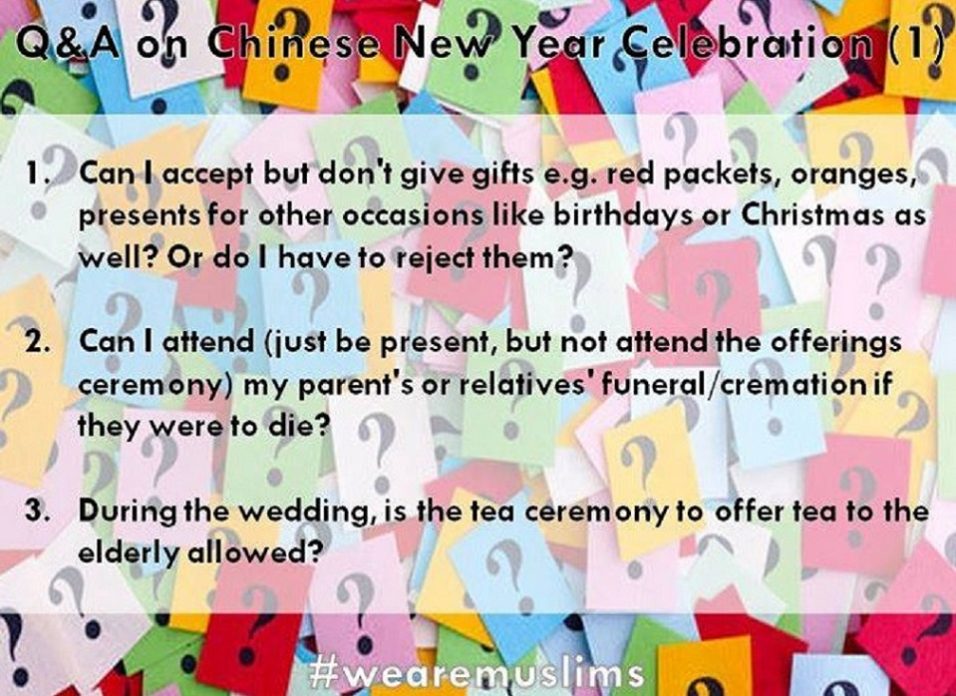
    Can I accept but don’t give gifts e.g. red packets, oranges, presents for other occasions like birthdays or Christmas as well? Or do I have to reject them?

    Can I attend (just be present, but not attend the offerings ceremony) my parent’s or relatives’ funeral/cremation if they were to die?

    During the wedding, is the tea ceremony to offer tea to the elderly allowed?

    I hope your clarifications can help.

    Awaiting for your kind respond.

    JazakALlahul Khairan Kathiran.

    Regards & Salam
    Wendy Ong

    Answer for Question 1:

    Wa’alaykumussalaam wa rahmatuLLaah,

    Bismillah walhamdulillah wassolaatu wassalaam ‘alaa Rasulillaah wa aalihi wa ba’d,

    1. According to some scholars of Islam, as you may read below, it is permissible to accept. But some others were of the view that it is not permissible, and they all unanimously agreed that it is prohibited to give. Please read below. The reason for their dispute in accepting gifts is to those who permitted, one who accept does not in any way commemorate the occasion, whereas those who disallowed viewed that accepting inevitably means agreeing and contributing to the commemoration of the occasion. Wallaahu a’lam. The best is to avoid and even if one were to accept, it is better to explain, since if one were to just accept without explaining one’s stance in this matter, the giver will continuously gives on the occasion on a yearly basis and it becomes a form of observance of the occasion. Wallahu a’lam

    2. Whatever involves rituals and practices or activities related to ways and beliefs not from Islamic teachings, and especially so when they are related to false beliefs against the teachings of Islam. It is obligatory for a true muslim to avoid. The verse in Soorah al-Furqan: 25:72: “And those who do not witness falsehood [al-zoor]…”. Even without doing them and yet to be present when they are being performed is falsehood and a wrong doing. So you are not to be present at the place where they perform the rituals and the procession of the Final Respect and not also the Cremation. But it is permissible for you to be near without having to witness all these. Wallahu a’lam.

    3. I do not know of this ceremony if it has any false belief intertwined with it. If it is just a manifestation of filial piety and respect for both parents, it is permissible Inshaa Allaah, wallaahu a’lam.

    #cny #aqeedah

    Source: http://www.al-jamaah.sg/2016/02/2-questions-on-cny-chinese-new-year.html

    Channel Telegram – https://telegram.me/islamIQsg
    ☢ Channel YouTube – https://www.youtube.com/IslamIQsg


    Source: Islamic SG