Tag: CPF

  • SDP Mahu Kemuka Tiga Isu Sewaktu Berkempen

    SDP Mahu Kemuka Tiga Isu Sewaktu Berkempen

    Parti Demokratik Singapura (SDP) akan mengetengahkan tiga isu semasa berkempen dalam pilihan raya umum akan datang, kata pemimpin parti itu, Dr Chee Soon Juan.

    Tiga isu tersebut ialah kos hidup, Jumlah Minimum Tabung Simpanan Pekerja (CPF) dan jumlah penduduk negara yang semakin bertambah.

    Isu yang bakal diketengahkan itu berdasarkan apa yang dimaklumkan kepada beliau oleh warga Singapura, terutama kesukaran dalam menampung kos sara hidup yang semakin meningkat, kata beliau dalam satu pameran di Holiday Inn Singapore Atrium kelmarin, yang diadakan sempena menyambut ulang tahun ke-35 parti pembangkang itu.

    Menurut beliau, SDP pertama kali menentang keperluan Jumlah Minimum CPF 20 tahun lalu.

    “Kami mahu memberitahu pengundi: jika anda tidak mempunyai pembangkang, Parti Tindakan Rakyat (PAP) akan bertindak bebas dalam mempertingkatkan Jumlah Minimum,” ujarnya.

    Pada Februari lalu, panel penasihat yang dilantik pemerintah menyarankan menjadikan skim CPF lebih fleksibel, namun berkata keperluan bagi jumlah asas untuk disimpan perlu dikekalkan.

    Mengenai jumlah penduduk pula, Dr Chee berkata ia penting dalam menilai sama ada Singapura mempunyai prasarana mencukupi.

    Terdapat bantahan pada 2013 apabila pemerintah memperkenalkan Kertas Putih mengenai parameter bagi jumlah penduduk lebih ramai.

    Namun, kertas itu juga menggariskan rancangan bagi prasarana menampung potensi jumlah penduduk antara 6.5 juta hingga 6.9 juta orang menjelang 2030.

    Dr Chee kelmarin berkata SDP telah membuat persiapan bagi pilihan raya umum akan datang, yang perlu diadakan menjelang Januari 2017, berdasarkan anggapan ia boleh diadakan seawal September ini.


    Source: http://beritaharian.sg

  • Netizens Slam Government’s New Video On CPF Life

    Netizens Slam Government’s New Video On CPF Life

    Last September, the government set up the CPF Advisory Panel to review Singapore’s compulsory savings system – the Central Provident Fund (CPF). This February, the panel gave its recommendations which were accepted by the government [Link].

    Summary of the main changes:

    1. Lump sum withdrawal

    A lump sum withdrawal, at age 65, of up to 20% of a CPF member’s savings. Members will be able to withdraw up to 20% of their Retirement Account, inclusive of the $5,000 that can already be withdrawn at age 55.

    2. Adjustments to the Minimum Sum

    CPF members have the option to park a Basic Retirement Sum of $80,500, a Full Retirement Sum of $161,000 or an Enhanced Retirement Sum of $241,500 at age 55. The monthly payouts at age 65 will range from $650 to $1,900. Members can also withdraw any amount above the Basic Retirement Sum, provided they have a property bought using CPF funds.

    3. Longer Notice to the Adjustment of the Retirement Sum

    The Basic Retirement Sum ($80,500 in 2016) will be increased by 3% yearly for members turning 55. The fixed percentage increase takes into account inflation and increase in standard of living, and at the same time provides members with lead notice. This is a demarcation from the current system where the Minimum Sum is only announced a few months in advance.

    To help Singaporeans understand the new CPF Life plan better, the government created an example with an accompanying video. The video was uploaded on YouTube last month (19 May):

    (Mr Bakar’s story) CPF – Your Assurance in Retirement

    https://www.youtube.com/watch?v=UAzJWKdMNUM

    “Like Mrs Ang, Mr Bakar will also be turning 55 next year. How will the recent CPF enhancements help him grow his retirement nest egg?”

    The video is linked to a post on the Facebook page of Gov.sg:https://www.facebook.com/gov.sg/posts/10153249488473686.

    However, netizens are not impressed with the video. Many are calling it “government propaganda” or “wayang”. Most netizens are demanding the government to return all their CPF money to them, as per the original agreement:

    On YouTube, the comments were so bad that the government was forced to shut the comment section of the video:


    Source: www.tremeritus.com

  • Why I No Longer Trust GIC (PAP) With My CPF

    Why I No Longer Trust GIC (PAP) With My CPF

    It is a fact that an unbelievable number of our CPF investments are underwater. I am doubtful GIC is a shrewd fund manager.

    The PAP has not been able to convince thinking Singaporeans that our CPF scheme is not a scam. To do so would require GIC to disclose all its investments and I suspect many will prove to be deeply embarrassing.

    Singaporeans who are still unconvinced can analyse the 281 investments on this list. It’s of course not a complete list but if there’s any evidence of GIC’s superior performance, please share the information. I have already posted some wiped-out CPF investments and will continue to do so as objectively as our mainstream media.

    Investments exceeding $1 billion will soon become the norm due to the legislated retention of humongous amounts of our CPF, ie the total amount of CPF balances doubled from $136 billion to $275 billion during the last 7 years. GIC is aware of the “inflated prices across all asset classes” but is forced to invest (risk) about S$20 billion of CPF monies annually. It is a fact that economic ‘growth’ post Global Financial Crisis has been built on a mountain of debt.

    DJIA long-term chart

    Source: Yahoo Finance

    Most stock market indices, such as Germany’s DAX, have been hitting new highs since 2 years ago. Perhaps our multi-million dollar GIC directors do not believe that stock markets are cyclical in nature?

    Source: Yahoo Finance

    GIC is not a nimble investor and frequently goes in for the kill. It is a major shareholder in many foreign companies, with stakes of more than 5%. When a financial crisis hits, GIC will not be able to exit when stock prices are plunging due to a lack of liquidity. In a prolonged economic downturn, divestment by a major shareholder like GIC will result in gargantuan losses.

    A recent example is its 63% investment in Nirlon. GIC’s Plan B = wipeout.

    Unaccountability THE problem with GIC (PAP)

    The 2 biggest investment blunders in GIC’s history are UBS and Citigroup. No one has been held accountable as if the combined 7-year S$25 billion investment is loose change.
    Lee Kuan Yew justified GIC’s bad investments by merely stating “..we went in too early. This is the part of the ride”.
    Lee was actually taking us for a ride because GIC was not investing in solid businesses but speculating for capital gains. Solid businesses make profits, declare regular dividends and the share price naturally heads north.

    UBS AG long-term chart

    Source: ft.com

    Citigroup long-term chart (divide share price by 10 due to reverse stock split in 2011)

    What’s so good about investing in a company whose share price has dropped 90% from 9 years ago?

    GIC did make some money from its Citigroup investment but this has nothing to do with good judgement as many have come to believe. It was entirely based on luck. As confirmed by its current share price, Citigroup was horribly mismanaged, ie it had taken on excessive risks with the possibility of bankruptcy.

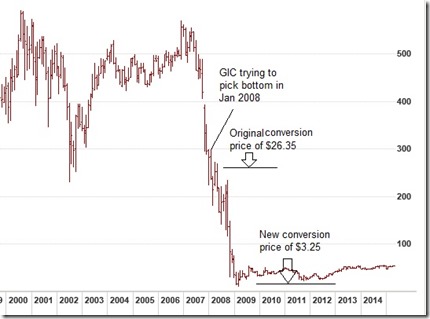
    GIC had invested in Citigroup notes with a 7% coupon payment at a conversion price of $26.35. To prevent its bankruptcy, the US government bailed out Citigroup and the original conversion price wasreduced to $3.25. Without the reduction, GIC would be sitting on massive unrealised losses of more than 60%.

    The point to note is GIC had not expected Citigroup to be:
    – a candidate for bankruptcy
    – its ‘attractive’ conversion price of $26.35 to be reduced by 87% to $3.25
    – US taxpayers to bail out its investment.

    Is this then not some sort of ‘tikam-tikam’ investment? Should anyone have faith in a fund manager who makes money by hoping for the best?

    GIC has invested about S$25 billion in Citi and UBS whose net return is close to zero after 7 years. Can GIC’s smaller investments be expected to perform well when it has proven to make lousy judgements on much bigger investments?

    The GIC board may not be involved in the day to day investment decisions but they certainly had beenconsulted before $25,000,000,000 of our CPF and reserves were invested. By not holding any director accountable, it appears the government has condoned risky behavior. GIC has therefore not learnt any lesson form its mistakes and CPF members should expect more losses when the next financial crisis hits.

    GIC’s returns cannot be confirmed

    The payment of CPF interests does not confirm GIC has been able to earn a 20-year 4.1% annualised real rate of return. Without providing a proper set of accounts, no CPF member should believe GIC’s data blindly. The payment of CPF interests was likely to have been from our reserves.

    Government absorbed ‘losses’ 8 out of 20 years?

    Last year, DPM Tharman told parliament that “in eight out of 20 years, GIC’s returns were lower than the rate promised to CPF members, but the Government absorbed the losses”. Why then were our reserves used 8 times without Parliament or the President being informed?

    To claim that “the Government absorbed the losses” is at best a half truth because CPF member are also taxpayers. Assuming a CPF interest rate of 4% with GIC’s rate of return at 2%, we have:

    GIC (2%) + Govt (2%) = CPF (4%, also taxpayers)
    GIC (2%) + Taxpayers (2%) = CPF (4%, also taxpayers)

    The government is not a separate entity and is funded by taxpayers. All CPF members are taxpayers and we are effectively paying ourselves. There are no losses by the government.

    Singaporeans are being forced to pay for an underperforming GIC, our ‘professional’ fund manager. In a true democracy, GIC would have been history.

    Understanding NIR framework confirms my suspicions

    The PAP has tried to confuse the public by introducing complicated schemes and frameworks. Few would then bother to question the government or understand its motives. But it is not really that difficult to understand when we focus on key words.

    The PAP currently supplements our budget with (1) up to 50% of the long-term expected real returns on the (2) relevant assets under the Net Investment Returns framework:

    (1) PAP wants the public to keep guessing its “up to 50%”, which could mean anything from 1% to 49%. “Long term” could mean 10-year or 20-year which again PAP is not being upfront. Words which are meaningless to the public confirm PAP’s intent to conceal information.

    PAP wants to prevent public knowledge of our reserves, money which belongs to citizens but somehow we aren’t supposed to know.

    Bear in mind this is not income earned from investments but expected future earnings. In a bad year where investment income is insufficient, PAP will be able to spend money which has not been earned, ie from our reserves. Neither does it need to inform the president nor consult Parliament. Read post by andyxianwong with links to other blogs.

    (2) Relevant assets are defined under the Constitution as the “assets managed by GIC and MAS, minus the liabilities of the Government (which include SGS and SSGS) and MAS. In short:

    MAS + GIC assets – (SGS + CPF) = Relevant assets

    The ability to determine the returns on relevant assets means the PAP (MAS?) must have known the actual investment returns earned by SGS and SSGS (CPF).

    Conclusion

    It is not possible that PAP does not know the actual CPF investment returns. When the government uses the excess return above the CPF rate to fund government expenditures, money which rightly belongs to me, I feel I have been cheated.
    In order to avoid disclosing actual CPF investment returns, the PAP has created a smokescreen of half-truths.
    The non disclosure of material information on CPF and the unaccountability of GIC have made it impossible for me to trust GIC (PAP) with my CPF. Do you?


    Philip Ang


    Source: https://likedatosocanmeh.wordpress.com

  • Pilot Personalised Retirement Planning Program By CPF To Begin In July

    Pilot Personalised Retirement Planning Program By CPF To Begin In July

    A personalised retirement planning service which targets CPF members who are approaching 55 and who may need the service most – such as those with outstanding home loans – will be piloted in July.

    The service, announced during the recent Committee of Supply debate in Parliament, is aimed at raising awareness and understanding of the CPF system and the new changes.

    In December 2014, the CPF Board sent a mailer to about 200 members who are turning 55, inviting them to participate in a trial of the retirement planning service.

    Madam Aishah Bakri took up the offer. She will be turning 55 in November this year – a pivotal point in a Singaporean’s life, where certain decisions on retirement need to be made.

    Said Madam Aishah: “Before I went (for the trial), I was thinking about how much money I have, and how much money will I take out. I think that is the main thing.”

    She noted: “When you go for that session, there are other things you actually have to consider. For me, that is housing. I have not fully paid (for a house), so this is one thing that I need to consider. So it is not just about taking out the money. You really have to actually look into it and decide carefully on how you are going to spend the money.”

    Madam Aishah added that the session was helpful as a breakdown was provided and explained to her. She then has time to decide on her next steps. The session also provided some comfort to Madam Aishah.

    “When I went for the session, they actually put in the figures, but there were some figures that they did not put in. I thought: ‘How come it’s not there?’ Later, I realised why – because it is the CPF monies that I actually took out for investment,” she said.

    “So it helps me, because I realise I have money that I invested. So after I went for that session, I came back and collated all my documents. I went through them and I said: ‘Okay, I actually have more than what is shown.’ That is comforting,” she shared.

    SERVICE TO BE OPENED UP TO MORE MEMBERS FROM JULY

    From July, the service will be piloted and opened up to more members – but only to those turning 55, and still servicing a housing loan, who may be affected by the transfer of monies from their Ordinary Account to their Retirement Account.

    Ms Dorcas Fong, senior manager at the Retirement Management Office at the CPF Board, said reaching 55 is an “important milestone” for members.

    “A lot of members actually do not realise it because at age 55, what happens is we transfer Ordinary Account and Special Account savings to create the Retirement Account. This actually reduces the Ordinary Account savings available for payable obligations, such as the housing loan people,” she said.

    Members will get personalised service that will take into account their needs and circumstances.

    Said Ms Fong: “So if a member comes to us at 54 and we notice that he still has an outstanding housing loan, what we tell him is he can use his Ordinary Account savings to do an early repayment of the loan. In this case, he does not carry obligations into 55 and he can set aside more for his retirement as well.”

    “For now there are a few obligations, which is housing, investment, education. If the member has all these concerns, then we will take those out and we will run through briefly with him so he can understand the implications and the options available to him. We estimate their future retirement incomes such as payouts using their current balances,” she added.

    The CPF Board said that through the pilot phase, it will fine-tune the initiative to better serve its members.

    “We discovered that members actually preferred charts and graphs in terms of communicating to them. They also find some comfort when our officers show their experience and scribble quick notes for them. So we are planning to improvise the material for the upcoming pilot in July,” said Ms Fong.

    Madam Aishah added that information pertaining to how much a member has taken out of his CPF for investment purposes, should also be presented.

    “They should have these figures so that you have a full view of the amount you have, including the investment,” she said.

    The retirement planning service will be conducted at the CPF Service Centre at Robinson Road. Depending on the complexity of the case, each session will last for about 45 minutes.

    Mailers will be sent to target groups to inform them of the service. The CPF Board will ramp up this initiative gradually from 2016.


    Source: www.channelnewsasia.com

  • Today’s Young Singaporeans Will Be In Relatively Good Shape To Retire

    Today’s Young Singaporeans Will Be In Relatively Good Shape To Retire

    Singaporeans who work regularly and make prudent housing choices should have no worries in meeting their retirement needs through the mandatory Central Provident Fund (CPF) system, Manpower minister Tan Chuan-Jin has said, as he told the House that the retirement picture for younger Singaporeans was “relatively healthy”.

    He was addressing concerns that Singaporeans might not save up enough in their CPF accounts to meet the Basic Retirement Sum, now that they will be given more flexibility and options to use their CPF savings.

    Citing the example of a 25-year-old polytechnic graduate earning S$2,200 and assuming this CPF member works 32 out of 40 years, the minister estimated that this worker would have a nest egg of about S$55,000 by the age 65. With compounded interest earned in the Special Account, he would have about S$165,000 at age 65 – three times what was put in.

    “This is not magic – it is just basic mathematics and is a very conservative estimate because I did not account for any wage growth at all and whatever savings he has accumulated in his Ordinary Account after paying off his flat. And if you add those, clearly, he would have even more.”

    As he walked the House through a typical CPF member’s stages in life, Mr Tan said that at age 65, the member would have to decide whether to withdraw up to 20 per cent of his Retirement Account savings in a lump sum.

    The minister also announced that from January 2016, members will need to choose from among the three payout streams to subscribe to under CPF Life from age 65 – up from the current 55. They will also have to decide whether they want to start receiving CPF Life payouts at age 65, or between age 65 and 70.

    The Manpower Ministry (MOM) will also restore the contribution rates for workers aged 50 to 55 to the same level as younger workers, as employment rates for this age band have improved and are almost on par with that of younger workers, he said.

    During Monday’s Committee of Supply debate, MP David Ong suggested raising CPF contribution rates for workers above 55 to the same level as younger workers.

    But Mr Tan said the employment rate for those above 55 was still much lower than those who were younger, so it would not be prudent to raise contribution rates of this group too quickly. The higher rates would also put employers off hiring older workers, he said.

    To encourage the employment of older workers, Senior Minister of State Amy Khor said the government has launched an additional Special Employment Credit (SEC); employers who hire Singaporean workers aged 65 and up and who draw up to S$4,000 a month will receive up to 3 per cent of the monthly wage bill under this SEC.

    This is on top of the current 8.5 per cent SEC for hiring Singaporean workers above 50.

    The government is supporting employers in improving workplace practices so as to attract and retain mature workers, said Dr Khor, who added that the government is putting in place legislation to extend re-employment to 67 in two to three years.

    Employers should also tap existing measures available to put in place age-management practices, so that they can be better prepared to hire older workers, she added.

    Mr Tan urged CPF members to be prudent with their housing purchases, especially when buying or upgrading a property later in life.

    “I think it’s important to pay attention to this because older members may have to take on loans with shorter tenures, higher monthly instalments; they should also factor in any decline in CPF contributions as they age, which may mean that they may need to service their monthly housing instalments with cash on top of CPF.”

    In response to calls for more targeted help for non-working women with low CPF balances, MOM’s support for this group is two-fold, noted Mr Tan.

    Firstly, it has encouraged non-working women to rejoin the workforce, which has led to higher Labour Force Participation Rates (LFPR) among women; as a result, the difference in average CPF balances between men and women have started to narrow, he said.

    Secondly, with families remaining a pillar of support for women, the rules have been tweaked to make it easier for CPF members to transfer their CPF savings to their spouse’s CPF.

    He added that the government is providing attractive interest rates to encourage such transfers: from next year, those aged 55 and above can earn an extra 1 percentage point of interest for the first S$30,000 in their combined CPF balances.

    As for Ms Foo’s suggestion that such transfers be made automatic or require spouses’ joint consent before withdrawals from the Retirement Account, Mr Tan replied that those were ‘very personal decisions” and “best left to couples to decide”, as it would be intrusive for the government to intervene.

    MPs Zaqy Mohamed and Seng Han Thong asked how MOM was communicating the various changes to its members.

    The House was told that, under efforts in this direction, a guided one-to-one retirement-planning service to CPF members would be launched so they can get a better understanding of the various CPF options before making their choices.

    The ministry has completed a three-month trial project and will pilot a retirement-planning service in the second half of the year. The plan is to ramp up the service gradually from next year, with priority given to those turning 55, said Mr Tan.

    In his speech, he stressed that the fundamental principles of CPF will not change and that retirement adequacy remained the scheme’s primary objective.

    And while Singapore’s social safety nets for the vulnerable need to be strengthened, the government and the CPF system alone will not be able to solve all problems.

    “There is a role of collective responsibility – individuals, families, employers, social groups. We all need to step in to provide the assistance and support.”


    Source: www.businesstimes.com.sg