Tag: discrimination

  • Quora Users Justify Unfair Discrimination Of Muslims In Armed Forces

    Quora Users Justify Unfair Discrimination Of Muslims In Armed Forces

    Responding to a question, ‘Why are there no Muslims in some sectors of Singapore Army and Navy?’, several Quora users have supported the Singapore Armed Forces’ perceived bias against Malays and Muslims.

    The following are excerpts from some of the most upvoted answers.

    “There are no muslims on the RSN’s ships or submarine. Actually there are no personnel that have strict dietary requirements on board. So if you have nut allergies, gluten allergies or very strict diet, you will not be posted to a ship.

    Why? Imagine the ship is deployed far from home. Say it heads to an Australian port to replenish resources. How easy is to obtain all halal ingredients? Not easy. And if you are very strict, once the kitchen is used for non-halal ingredient, it cannot produce halal food anymore.

    You may say it’s possible. But only during peacetime. If you are in combat, you can’t go pick and choose what food you want.” – Rhys Cheng

    “…while I don’t agree, I do understand the logic behind the practice. National defense is perhaps the most serious matter a government must handle, and there is a tradeoff between security and freedom. I can understand the government not wanting to take chances, especially since it’s very hard to tell who can be trusted and who cannot.” – Daniel Tan

    “Having Malay/Muslims in the sensitive sectors of the SAF will compromise our ability to defend Singapore. Here, many people think that we do not trust our Malays/Muslims, while the others are not given the same level of scrutiny. Many will also think we are implying Malay/Muslims are be prone to radicalisation, which is plain discriminatory. There is at least a grain truth in the assertions, and they are sufficient for SAF to justify the policy. Once again, this is for the sake of defending Singapore.” – Anonymous

    “We need to stop the smuggling of arms and other ingredients of terror attacks from entering our borders. Nor can we afford to allow hostile personnel to reach our shores. Homegrown terrorism is another issue altogether, and it cannot be denied that Muslims, and therefore Malays in Singapore, are the key targets of radicalisation efforts. As such, the same reason Malays (and Muslims today) are excluded from sensitive vocations remains valid.” – Anonymous

    In April last year, Dr Ng Eng Hen, the Defence Minister said that the “Singapore Armed Forces’ (SAF) operational concerns must come first and individual needs sometimes must (be) subsumed under that.”

    Dr Ng was responding to a parliamentary question from an opposition MP, Faisal Manap, who had asked on the lack of halal food onboard ships in the Republic of Singapore Navy (RSN). Mr Faisal suggested that this deprived Muslim men from serving in RSN ships.

    Reacting to the exchange in Parliament , lawyer and former Director of the Association of Muslim Professionals, Mr Nizam Ismail said:

    “It gets tenuous when the justification for what is essentially a discriminatory practice is on the non availability of a halal kitchen.

    Please, there are many ways to resolve this. It’s not rocket science.

    If the issue is still one of distrust of a Malay Singaporean son in defending his country, then say it as it is.

    The fact remains that there is an under-representation of Malay NSmen in several “sensitive” positions of the SAF, RSAF and RSN.

    And an over-representation of Malay NSmen in the SCDF and SPF.

    And a significant portion of Madrasah boys are not called up for NS.

    Or space for halal kitchen.

    This has nothing to do with food.

    It’s tragic that we are still debating this after 50 years of independence.

    If you truly believe in multiculturalism, there must be no space for discrimination.

    If you truly believe in multiculturalism, there must be inclusivity and equal opportunity. For all.

    When will there be a level playing field?”


    Source: www.theindependent.sg
  • Undergrad Part-Time Tutor Rejected By Tuition Agency Due To Parents’ ‘Racial Preferences’

    Undergrad Part-Time Tutor Rejected By Tuition Agency Due To Parents’ ‘Racial Preferences’

    Tuition has become a staple for school-going children in Singapore.

    While it is understandable that each child — and by extension, family — may seek specific tutors for specific needs, one tutor has come forward to share her experience of being repeatedly rejected for tuition jobs — despite being more than qualified for it.

    The tutor is an undergraduate student from a local university and is seeking part-time work at a local tuition agency for extra income.

    The agency essentially acts as a middleman by matching families with the tutors for the required subjects.

    Compiling all the requests of the different families, the tuition agency then sends them out to the tutors under them. Interested parties can apply to take up the vacant slots.

    censored-without-codecensored-without-code-2

    As the tutor in question specialises in English and Literature, she has repeatedly applied for positions that required tutors for those two subjects.

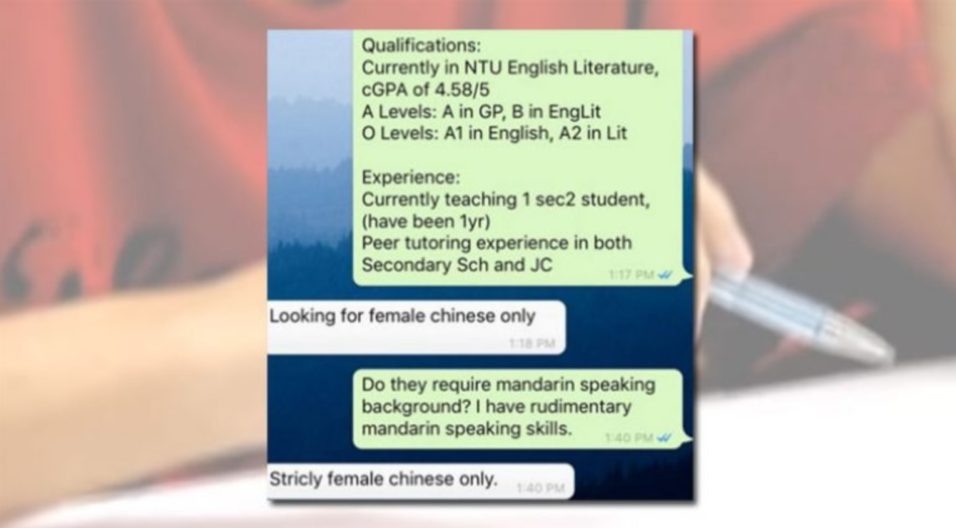
    However, time and time again, she has met with responses from families like the one below:

    rejected-profile-without-code


    Recently, it was more blatantly put across to her:

    screenshot-4


    Deep-rooted problem 

    Speaking to Mothership.sg, the tutor said she feels frustrated that she has to deal with this kind of issue time and time again.

    This is despite the fact that she is a first-class honours student.

    She also related that she has even met with a situation where after she was rejected by the family, the same tuition gig was offered to someone she knew, who is Eurasian Chinese.

    She also said any language or communication barrier with non-English-speaking families should not be a problem, particularly in her case, as she is from a mixed Malay-Chinese family.

    Acknowledging the sensitivity of the issue, she doesn’t demand recourse.

    Instead, she said she understands that some people just don’t feel comfortable with certain races.

    What have the authorities said about such practices

    According to TAFEP’s job advertisement guidelines stated in its fair employment practices handbook,

    “Employers who advertise a position requiring a specific attribute which may be viewed as discriminatory should ensure it is indeed a requirement of the job and state the reason for the requirement in the advertisement…

    Race should not be a criterion for the selection of job candidates as multiracialism is a fundamental principle in Singapore. Selection based on race is unacceptable and job advertisements should not feature statements like ‘Chinese preferred’ or ‘Malay preferred’.

    Religion is unacceptable as a criterion for recruitment except in cases where employees have to perform religious functions as part of the job requirement. In such cases, the requirements should be clearly and objectively presented”.

    But such practices are normalised

    However, a quick check on forums has shown how prevalent racial preference in tuition has become in Singapore.

    screen-shot-2017-01-06-at-11-12-39-amscreen-shot-2017-01-06-at-11-13-55-amscreen-shot-2017-01-06-at-11-19-30-am

    Ultimately, the student tutor said she hopes people, especially parents, can have a more open mindset towards tutors like her.

    She said: “I just wish that it wasn’t this way because it hasn’t changed since my mum’s time.”


    Source: mothership.sg

  • MPV Taxis, Grab & Uber Discriminate Against Big Malay Families

    MPV Taxis, Grab & Uber Discriminate Against Big Malay Families

    Dear Editors,

    Grab, uber and taxis, stop bring prejudice towards big group of passengers! Your fare is so expensive and your drivers now are so picky. No wonder many of them are taking bus and trains instead of using all the 3 modes of transport.

    Sometimes, we Malays are going out with big families, and when we book GrabCar economy, or uber X and got an MPV like Toyota Estima, the drivers refused to pick us due to having 6 passengers, still come out with nonsense what 3 adults and 3 infant MPV cannot take. Then why uber and grab 4 seater allocate an MPV to do 4 seater job? You are the ones spoiling the market and now making we passengers suffer is it?

    And taxis also another kind, why when we flag MPV taxi they still want to charge additional $3 for each additional passenger when I am travelling with 3 more adults and 3 kids which 3 years old or younger? At least make the additional passenger surcharge $3 flat regardless of how many extra passengers la eh you think very funny is it? Additional $3 per extra passenger is no joke ok?

    Don’t come and give me nonsense that additional passenger means more fuel burnt ok? The bus take passengers till standing till the door those stand at the door ones paid extra?

    So grab, uber and taxis, wake up your idea before more passengers switching to take bus or MRT. I am so disgraceful to have such public service providers in Singapore. All money minded jerks.

    Anita
    A.S.S. Contributor

    Source: www.allsingaporestuff.com


  • Are Malay Graduates And Job Seekers Being Discriminated In Malaysia? Yes, They Are

    Are Malay Graduates And Job Seekers Being Discriminated In Malaysia? Yes, They Are

    The high number of unemployed graduates, especially Malay graduates is not news in this country. We hear them blaming everything but themselves. But what if the Malays are indeed being discriminated against?

    “Yeah right,” I muttered at first as someone who is sometimes ashamed by my own race. How could I not, when I’m assumed to be ‘easily swayed and confused’ half the time?

    Trying to keep an open mind, I read this study, and was quite puzzled by the findings. It was entitled ‘Discrimination in high degrees: Race and graduate hiring in Malaysia‘ and was published in the Journal of Asia Pacific Economy by UM and UKM researchers. Here’s the paper abstract (bold is my own):

    This paper investigates racial discrimination in hiring fresh degree graduates in Malaysia through a field experiment. We send fictitious Malay and Chinese resumes to job advertisements, then analyse differentials in callback for interview attributable to racial identity, while controlling for applicant characteristics, employer profile and job requirements.

    We find that race matters much more than resume quality, with Malays, Malaysia’s majority group significantly less likely to be called for interview.Other factors, particularly language proficiency of employees, language requirements of jobs and profile of employers, influence employer biases.

    Applicants fluent in Chinese fare better, and Chinese-controlled and foreign-controlled companies are more likely to favour Chinese resumes, indicating that cultural compatibility explains part of the discrimination. Malay resumes tend to be perceived and prejudged adversely, and employers’ attitudes towards public policy outcomes, particularly pertaining to education quality and employment opportunity in the public sector, also account for the observed racial disparities.

    Let me simplify that for you:

    When researchers sent fake resumes of Malay and Chinese fresh graduates, the Malay applicants are much less likely to be called back for an interview. Employers perceive Malays negatively, think that they have lower-quality education and always have the safety net in the form of government jobs to fall back on.

    Huh. I’ve never been pro-Malay, but I hate discrimination more. How was the research conducted to come to this conclusion?

    How the research was conducted

    The research:

    • Sent over 3000 fake resumes, divided into 4 categories: AA Malay, AA Chinese, BA Malay and BA Chinese (AA = Above average; BA = Below average).
    • CGPA, university, language and technical skills were randomly assigned.
    • Sent the resumes to job vacancies in finance and engineering sector.
    • Did not include other races.

    The researchers:

    • Found that in general, AA applicants get more callbacks than BA applicants. Interestingly, AA Malay have lower callback rate than BA Chinese.
    • Showed that Chinese resumes received a 22.1% callback rate on average while Malay resumes received 4.2% callback rate on average.
    • Malay applicants for engineering jobs get the lowest callback rate at 2.9%.
    • Malay graduates from private universities get the lowest callback.
    • Showed that UTAR graduates get higher callback rates, but there is no penalty for UiTM degrees.
    • Malay resumes stating proficiency in Chinese get higher callback rates.
    • English and Malay proficiency and good English in cover letter have ‘negligible impact on call rates’.
    • Calculated callback rates among Chinese, foreign and Malay-controlled companies. Malays get lower callback rates in ALL of them.
    • Even Malay-controlled companies favour Chinese applicants 1.6 times more than Malays.

    As I read, it dawned to me the long-forgotten early struggles in my career, where I struggled to hear back from potential employers despite sending job applications after job applications. I thought it happened to everyone. I thought all job seekers faced the same problem.

    Was it… caused by my (very Malay-sounding) name instead?

    What caused this?

    The research said that the data generated cannot give conclusive reasons. But some important points to highlight:

    • Cultural compatibility and language ability matters. Employers with predominantly Chinese employees perceive that Malays are less likely to take jobs offered anyway (or quit within a few months), as Malays have the tendency to feel uncomfortable in these settings. The researchers theorise that Malays prefer environments where their religious customs and spoken language in work environment are catered to.
    • Malay applicants are negatively prejudged. This explains why BA Chinese get higher callback rates than AA Malays. No conclusive reasons are given, except that the negative stereotypes may be reinforced by past experience and lack of contact between these two groups to prove otherwise.
    • Appears to be the result of pro-Malay affirmative actions. People tend to think that Malays have lower-quality education and higher opportunities in the public sector anyway. This is a very complex issue, and further research are needed, but the researchers suggest that pro-Malay policies may in fact hurt Malay graduates’ job prospects.

    What does this mean?

    For the longest time, I thought, “Man, Malays are complainers,” when they say they can’t get jobs or get high pay or have limited opportunities. I thought: ‘The PM is Malay, the Parliament is majority Malay, the Kings are Malay, the policies are pro-Malay… what more do you want?’

    There’s substantive proof now to back up this discrimination claim. 22.1% callback rate vs 4.2% callback rate is a big difference. 1 in 5 Chinese applicants get called for interview, while less than 1 in 20 Malay applicants get the same. Remember that the quality of resumes were already factored in.

    Less callbacks means less opportunities, more likelihood to take lower-salary but stable jobs, and being stuck in lower-economic power for longer time.

    This is only one research though, and I’m happy to be pointed to other studies to disprove this or question the methodology of this research (for example, I didn’t like that it only compared Malay and Chinese resumes). But until then, won’t you agree that discrimination is discrimination?

    How now, brown cow?

    I hate the blame game, so I’m going to end this with a few suggestions on how can we level the playing field a bit more, so deserving Malay candidates get equal and fair chance in the job market, too.

    Employers (of ALL races):

    • If your employees are predominantly composed of a single race, get more diversified. Diversified workplaces earn more profits. It’s literally to your advantage to have a racially-balanced workforce.
    • Know that you (even Malay employers) have negative bias against Malays, and that potentially makes you lose out on those good Malay candidates.

    Malay graduates and job seekers:

    • If you have Chinese proficiency, put it in your resume. If you don’t and have difficulty getting callbacks, take Mandarin classes at the same time. This research proved that Chinese proficiency increased callback rates.
    • Make more friends outside of your race. Make more friends outside of your race. Make more friends outside of your race. You’re the majority. It’s up to you to reach out to others, not the other way around. Actively attend and network in events, not just Malay-organised events. Be a good friend, be a respectful person.
    • Even though you believe in your faith and race 100%, stop making remarks that make you sound stupid, non-accommodating and even violent. Be easy to work with.

    HXSM does this best so I’m just going to leave these examples of Malay-spewed absurdity to end this. If you’re gonna comment, be nice.


    Source: https://vulcanpost.com

  • Penerima Anugerah Pedang Merit Beri Kejutan Buat Ibu-Bapa

    Penerima Anugerah Pedang Merit Beri Kejutan Buat Ibu-Bapa

    APABILA ibu bapa beliau terbaca namanya tertera dalam senarai penerima anugerah Pedang Merit semasa Perbarisan Pentauliahan bagi pegawai Sekolah Kadet Pegawai (OCS) baru-baru ini, mereka tertanya-tanya apakah betul nama tersebut nama anak mereka.

    Ini kerana Pegawai Kadet (OCT) Angkatan Bersenjata Singapura (SAF) Muhammad Hidayatullah Abdul Majid, 21 tahun, itu langsung tidak memberitahu keluarganya bahawa beliau merupakan antara 10 peratus kadet terbaik yang terpilih menerima anugerah khas tersebut.

    “Saya ingin berikan kejutan istimewa kepada mereka dalam majlis itu,” kata Encik Hidayatullah.

    Menurutnya, walaupun ibu bapanya terkejut, mereka gembira dan bersyukur dengan pencapaiannya itu.

    Pengiktirafan Pedang Merit diberikan kepada 10 peratus kadet terbaik yang terpilih pada akhir Kursus Pegawai Kadet (OCC), berdasarkan prestasi cemerlang dalam semua aspek, termasuk fizikal, akademik, perancangan dan perlaksanaan, kepimpinan dan lain-lain.

    Encik Hidayatullah berkata anugerah tersebut adalah hadiah kerja keras dan latihan yang dilaluinya dalam OCS selama sekitar sembilan bulan.

    Tambahnya, beliau sama sekali tidak menjangka akan terpilih kerana ramai kadet lain telah memperlihatkan kecekapan mereka.

    “Saya bersyukur dan anugerah ini membawa maksud bahawa saya mampu menjadi seorang pemimpin yang berkebolehan dan mampu memikul tanggungjawab lebih berat,” katanya.

    Semasa dihubungi ketika majlis Perbarisan Pentauliahan OCS Sabtu lalu, Encik Hidayatullah, yang telah dinaikkan pangkat sebagai Leftenan Muda (2LT), berkata perasaannya bercampurcampur – antara gembira dengan gementar kerana perlu melaksanakan tugas baru.

    “Saya berasa teruja diberi peranan kepimpinan, tetapi pada masa yang sama saya juga berasa gementar kerana ini bermakna saya harus memikul tanggungjawab lebih berat,” ujar beliau yang telah diberi peranan memimpin formasi Kawalan SAF (Guards formation).

    Encik Hidayatullah selanjutnya berkata beliau mendapat inspirasi dan dorongan daripada pegawai-pegawai kanan yang ditemuinya semasa menjalani Perkhidmatan Negara (NS) yang telah memberikan kata-kata perangsang dan tunjuk ajar.

    Menyentuh tentang masa depannya, bekas pelajar Politeknik Temasek itu berkata beliau ingin menyambung pelajarannya di universiti tempatan dalam bidang sosiologi.

    Encik Hidayatullah berkata dari segi kerjaya, beliau berminat menceburi bidang media atau menjadi seorang kaunselor.

    “Pada pendapat saya, media merupakan wadah yang baik untuk menyebarkan kepada orang ramai peri pentingnya Pertahanan Mutlak di Singapura.

    “Ini kerana setiap individu memainkan peranan penting dalam memastikan keselamatan Singapura dan rakyatnya,” kata beliau.

    Seramai 335 pegawai kadet telah diiktiraf sebagai pegawai SAF Sabtu lalu.


    Source: www.beritaharian.sg