Tag: extremist

  • Terrorist Khalid Masood: A ‘Nice Guy’ Turned Extremist

    Terrorist Khalid Masood: A ‘Nice Guy’ Turned Extremist

    The man who mowed down pedestrians and stabbed a policeman in Wednesday’s deadly assault outside Britain’s parliament has been identified by police as 52-year-old former convict Khalid Masood.

    Known by “a number of aliases”, London’s Metropolitan Police said he had been convicted for a string of offences but none of them terror-related.

    Born on Christmas Day 1964 in Kent in southeast England, Masood had been living in the West Midlands where armed police have staged several raids since the attack, storming properties in the city of Birmingham.

    The police confirmed he was a British citizen.

    He was brought up by a single parent in the town of Rye, on the southern English coast, according to The Times.

    Over the course of two decades, Masood chalked up a range of convictions for assault, grievous bodily harm, possession of offensive weapons and public order offences, police said, with the incidents taking place between 1983 and 2003.

    Prime Minister Theresa May said he was once investigated by the intelligence service MI5 “in relation to concerns about violent extremism”.

    But Masood had never been convicted of terrorism offences and “was not the subject of any investigations,” the police said, noting there was “no prior intelligence about his intent to mount a terrorist attack”.

    At 52, his age has been highlighted by commentators as unusual, with most Islamist extremists behind similar attacks far younger.

    Although the police believe Masood acted alone, the Islamic State group claimed he was one of its “soldiers” acting on a call to target countries fighting the jihadists in Iraq and Syria.

    ‘A NICE GUY’

    Masood rented the car used in the attack from the Solihull branch of Enterprise, on the outskirts of Birmingham, the company confirmed in a statement.

    According to the BBC, he told the car rental company that he was a teacher.

    A spokeswoman for Britain’s education ministry told AFP Masood was not a qualified teacher and had therefore not taught in any state schools.

    The Sun tabloid said Masood stayed in a hotel on the outskirts of Brighton, a seaside city south of London, on the night before the attack.

    London’s Metropolitan Police would not confirm the newspaper’s report that investigators went to the hotel following the attack after finding a receipt in the hire car.

    British media described Masood as a Muslim convert, with one source telling Sky News he was a “very religious, well-spoken man”.

    “You couldn’t go to his home in Birmingham on Friday because he would be at prayer,” said the source, who Sky said met Masood in a professional capacity.

    “He was a nice guy. I used to see him outside doing his garden,” Iwona Romek, a former neighbour of his told the Birmingham Mail.

    “He had a wife, a young Asian woman and a small child who went to school,” she said. Other media have reported that he was a married father-of-three.

    Romek said the family had abruptly moved out of their house in Winson Green, a neighbourhood in western Birmingham, around Christmas without saying goodbye.

    Romek said she could not imagine him carrying out an attack, adding: “Now I’m scared that someone like that was living close to me”.

    More recently Masood may have been living in a flat next to a Persian restaurant and a pizza parlour in the upmarket Edgbaston neighbourhood, according to reports.

    One neighbour at that address told The Telegraph newspaper they were fearful after the day’s events: “It’s left me so scared and I don’t know what to tell the children. He seemed like a normal calm and kind family man, always with a smile on his face.”

    Following an armed raid on the property overnight, a man working in a shop nearby told the Press Association simply: “The man from London lived here”.


    Source: www.todayonline.com

  • 253 Individu Disyaki Terlibat ISIS Ditahan Di Malaysia Sejak 2013

    253 Individu Disyaki Terlibat ISIS Ditahan Di Malaysia Sejak 2013

    KUALA LUMPUR: Seramai 34 wanita yang disyaki mempunyai kaitan dengan kumpulan militan ISIS ditahan di Malaysia sejak 2013 hingga 7 Oktober lalu.

    Keseluruhannya, 255 individu termasuk 221 lelaki ditahan dalam tempoh itu.

    Kementerian Dalam Negeri menyatakan demikian dalam jawapan bertulis yang diedarkan di Dewan Rakyat hari ini (17 Nov).

    Sebanyak 140 daripada individu yang ditahan itu berumur kurang 30 tahun dan selebihnya berumur 30 tahun dan ke atas, menurut kementerian itu bagi menjawab soalan Er Teck Hwa (DAP-Bakri) berhubung jumlah individu yang ditangkap kerana terlibat gerakan militan ISIS.

    Kementerian itu menjelaskan, 121 individu sudah dikenakan tindakan di bawah Akta Kesalahan Keselamatan (Langkah-Langkah Khas) 2012 manakala 36 individu diambil tindakan mengikut Akta Pencegahan Jenayah 1959 dan 13 lagi mengikut Akta Pencegahan Keganasan 2015.

    “Sebanyak 21 warga asing sudah diusir dari Malaysia manakala 64 individu telah dibebaskan,” menurutnya.

    Source: http://berita.mediacorp.sg

  • Jakarta Anti-Governor Protest: Cars Burnt, 1 Dead And Many Injured

    Jakarta Anti-Governor Protest: Cars Burnt, 1 Dead And Many Injured

    Indonesian police have used tear gas and water cannon to subdue protesters as thousands of hard-line Muslims marched against Jakarta’s governor.

    Basuki Tjahaja Purnama, a Christian, is the first ethnic Chinese to hold the governor’s post in the capital of majority Muslim Indonesia.

    The demonstrators accuse him of having insulted Islam’s holy book, the Koran, and want him to be prosecuted.

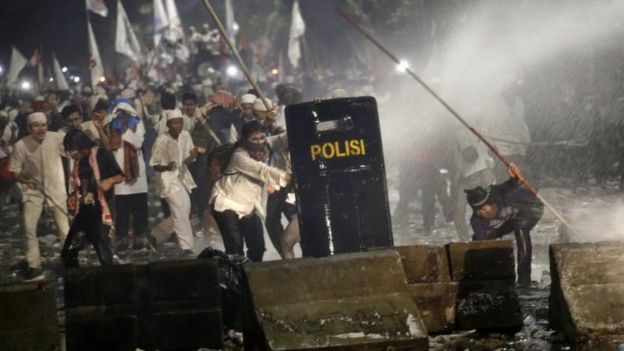
    Clashes broke out between police and protesters who refused to disperse.

    One elderly man died, the Associated Press reports, citing police. Several other people, including police officers, have been injured.

    Protesters had earlier marched upon the presidential palace.

    Police had been braced for the possibility of religious and racial tensions erupting at the rally, which an estimated 50,000 people attended.

    It had mostly been peaceful but groups of angry demonstrators clashed with police after nightfall and set vehicles alight.

    In 1998, a wave of anti-Chinese sentiment led to mobs looting and burning Chinese-owned shops and houses. Ethnic Chinese make up about 1% of Indonesia’s population of 250 million people.

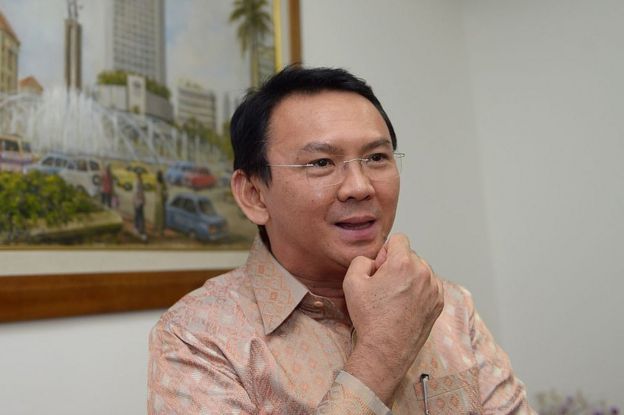
    Basuki Tjahaja Purnama, known by his nickname Ahok, speaks to journalists at his office in Jakarta in 2014
    Protesters are sprayed with water from a police water cannon truck during a clash outside the presidential palace in Jakarta, Indonesia, Friday, Nov. 4, 2016

    The protest was held to demand that Mr Purnama be prosecuted for blasphemy over comments he made in September that were seen as criticising a Koranic verse.

    He said that Islamic groups using a passage of the Koran to urge people not to support him were deceiving voters, who will go to the polls in February.

    The verse is interpreted by some as prohibiting Muslims from living under the leadership of a non-Muslim.

    Mr Purnama has since apologised but formal complaints were lodged against him by Islamic groups for defamation. He is now being investigated by police.

    Who is Governor Ahok?

    Some protesters at Friday’s rally carried signs calling for the governor’s death, the BBC’s Rebecca Henschke in Jakarta says.

    Representatives met with Vice-President Yusuf Kalla, who promised that the investigation into Mr Purnama would be completed within two weeks.

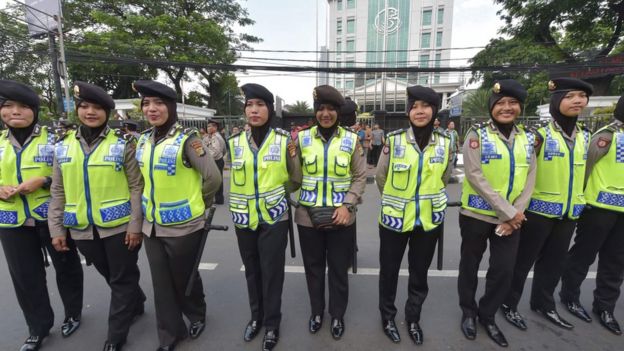
    Indonesian policewomen stand guard as Muslims march towards the presidential palace during a protest against Jakarta governor Basuki Tjahaja Purnama also known as Ahok over an alleged blasphemy in Jakarta on November 4, 2016

    There have long been tensions around Mr Purnama political role.

    In 2014, he was the deputy governor under Joko Widodo. When Mr Widodo was elected president the main group behind the current protest – Islamic Defenders Front (FPI) – did not want Mr Purnama to succeed him.

    They argued that a Christian should not govern a Muslim-majority city. The campaign against him has since taken on anti-Chinese overtones, though the FPI said the rally was not about the governor being from a minority group.

    Jakarta police said there were “provocative statements and images” on social media urging people to take violent action against Mr Purnama, including calls to kill him.

    Despite being seen as brash and outspoken, the governor is popular among many in the capital and has been praised for his effectiveness.

    Muslims in Indonesia are largely moderate and the country’s largest Islamic organisation, Nahdlatul Ulama, had advised its 40 million members not to take part in the protest.


    Source: www.bbc.com

  • Iraq Launches Mosul Offensive To Drive Out ISIS Terrorists

    Iraq Launches Mosul Offensive To Drive Out ISIS Terrorists

    Iraqi government forces launched a U.S.-backed offensive on Monday to drive Islamic State from the northern city of Mosul, a high-stakes battle to retake the militants’ last major stronghold in the country.

    Two years after the jihadists seized the city of 1.5 million people and declared a caliphate from there encompassing tracts of Iraq and Syria, a force of some 30,000 Iraqi and Kurdish Peshmerga forces and Sunni tribal fighters began to advance.

    Helicopters released flares and explosions could be heard on the city’s eastern front, where Reuters watched Kurdish fighters move forward to take outlying villages.

    A U.S.-led air campaign has helped push Islamic State from much of the territory it held but 4,000 to 8,000 fighters are thought to remain in Mosul.

    The Pentagon said that Iraqi forces were meeting objectives and were ahead of schedule on the first day of the offensive.

    Residents contacted by phone dismissed reports on Arabic television channels of an exodus by the jihadists, who have a history of using human shields and have threatened to unleash chemical weapons.

    “Daesh are using motorcycles for their patrols to evade air detection, with pillion passengers using binoculars to check out buildings and streets,” said Abu Maher, using an Arabic acronym for Islamic State.

    He and others contacted were preparing makeshift defenses and had been stockpiling food in anticipation of the assault, which officials say could take weeks or even months. The residents withheld their full names for security reasons and Reuters was not able to verify their accounts independently.

    The United States predicted Islamic State would suffer “a lasting defeat” as Iraqi forces mounted their biggest operation in Iraq since the 2003 invasion that toppled Saddam Hussein.

    But the offensive, which has assumed considerable importance for U.S. President Barack Obama as his term draws to a close, is fraught with risks.

    These include sectarian conflict between Mosul’s mainly Sunni population and advancing Shi’ite forces, and the potential for up to a million people to flee Mosul, multiplying a refugee crisis in the region and across Europe.

    “We set up a fortified room in the house by putting sandbags to block the only window and we removed everything dangerous or flammable,” Abu Maher said. “I spent almost all my money on buying food, baby milk and anything we might need.”

    The United Nations’ humanitarian coordinator for Iraq said the military had told the U.N. it expected the first significant population movement to begin in five to six days, suggesting that is when the assault would move to the city itself.

    Lise Grande said Iraqi security forces would transport fleeing civilians, who would be vetted to ensure Islamic State fighters could not hide among them, following residents’ reports that militants had shaved off their beards to escape detection.

    Video showing rockets and bursts of tracer bullets across the night sky and loud bursts of gunfire was shown on Qatar-based al-Jazeera television after Prime Minister Haider Abadi announced what he called “the heroic operations to free you from the terror and oppression of Daesh”.

    “We will meet soon on the ground in Mosul to celebrate liberation and your salvation,” Abadi said in a speech on state television in the middle of the night, surrounded by commanders of the armed forces.

    HUMANITARIAN CRISIS FEARED

    Early on Monday, Abadi sought to allay fears that the operation would provoke sectarian bloodletting, saying that only the Iraqi army and police would be allowed to enter the mainly Sunni city. He asked Mosul’s residents to cooperate with them.

    Local Sunni politicians and regional Sunni-majority states including Turkey and Saudi Arabia warned that if Shi’ite militias take part in the assault they could spark sectarian violence.

    The Iraqi army dropped tens of thousands of leaflets on Mosul before dawn on Sunday, warning residents the offensive was imminent, assuring them it “will not target civilians” and telling them to avoid known locations of Islamic State fighters.

    Reflecting authorities’ concerns over a mass exodus that would complicate the offensive and worsen the humanitarian situation, the leaflets told residents “to stay at home and not to believe rumors spread by Daesh” that could cause panic.

    Resident Abu Abdullah said he had wanted to witness the beginning of the offensive.

    “We heard repeated explosions at a distance, so I went to the rooftop to see fireballs, even if it was dangerous. I was happy that the operation to liberate Mosul started,” he said.

    In 2014, Islamic State leader Abu Bakr al-Baghdadi proclaimed a “caliphate” in Iraq and neighboring Syria from Mosul’s Grand Mosque. The group faced little resistance but has employed brutal methods to maintain control. On Monday, it circulated photographs showing children executing alleged spies.

    Russian President Vladimir Putin, criticized over the level of civilian casualties during Syrian government operations backed by Moscow in and around the city of Aleppo, said on Sunday he hoped the United States and its allies would do their best to avoid hitting civilians in the attack on Mosul.

    The United Nations has said the battle would require the world’s biggest and most complex humanitarian effort, which could leave up to 1 million people homeless and see civilians used as human shields or even gassed.

    There are already more than three million people displaced in Iraq as a result of conflicts involving Islamic State and up to 100,000 Iraqis may flee Mosul to Syria and Turkey. Medicine is in short supply in Mosul and food prices have risen sharply.

    “Families in Mosul started stockpiling food yesterday in case the fighting reaches our streets and we can no longer go out,” said Saeed, a resident.

    “Daesh are still in Mosul and it’s not true that they left. They are continuing to erect blast walls in the streets to obstruct any advance.”

    (With additional reporting by Maher Chmaytelli and Stephen Kalin in Baghdad, Michael Georgy in Erbil and Stephanie Nebehay and Tom Miles in Geneva; writing by Philippa Fletcher; editing by Giles Elgood and Gareth Jones)


    Source: www.reuters.com


  • Mohd Khair: Timbangkan Sendiri – Masuk Akal Ke Radio Hang FM Ini Sebarkan Ajaran Radikal

    Mohd Khair: Timbangkan Sendiri – Masuk Akal Ke Radio Hang FM Ini Sebarkan Ajaran Radikal

    Ramai pembantu rumah dari Indonesia dengar Radio Hang dari Batam setiap hari.

    Mereka terdedah dengan risiko ‘self-radicalisation’. Dan mereka ini sekarang berada di Singapura.

    Malah keseluruhan warga Indonesia di Batam pun berada dalam posisi ‘self-radicalisation’ kerana terdedah dengan Radio Hang dari Batam.

    Apakah langkah yang perlu diambil untuk melindungi keselamatan Singapura dalam isu ini?

    1. Jam frequency atau internet Radio Hang dari Batam agar ianya tidak lagi boleh didengari di Singapura

    2. Sementara menunggu kesan dari jamming atauu banning itu, para majikan pastikan yang setiap pembantu Indonesia tidak mengikuti siaran Radio Hang mulai dari sekarang.

    3. Angkut kesemua pembantu rumah dari Indonesia yang mendengar Radio Hang Batam untuk ditemuduga demi mencari elemen-elemen radikal di kalangan mereka.

    4. Hantar balik pembantu para pembantu rumah yang menunjukkan bibit-bibit ‘self-radicalisation’

    5. Membataskan perjalanan warga Indonesia ke Singapura, terutama ke atas mereka yang terdedah dengan Radio Hang setiap hari di Batam.

    6. Memantau pergerakan warga Indonesia dari Batam yang sekarang ini berada di Singapura kerana mereka ini sekarang berisiko tinggi kerana terdedah dengan Radio Hang

    7. Pihak MFA menghantar nota bantahan kepada kedutaan Indonesia kerana membenarkan Radio Hang beroperasi di Batas dengan frequency yang menjangkau ke Singapura dan mendedahkan rakyat Singapura dengan ideologi radikal. Di dalam nota bantahan itu, pemerintah Singapura menasihatkan pemerintah Indonesia agar mengharamkan Radio Hang dari Batam kerana menjadi sumber ‘self-radicalisation’ yang menimbulkan ancaman terhadap keselamatan Singapura.

    Semoga langkah-langkah ini akan menamatkan pengaruh radikal Radio Hang terhadap warga Batam dan juga warga Singapura serta sesiapa juga yang mendengar siaran radio tersebut.

    Demi keselamatan kita bersama, iaitu untuk warga Singapura dan juga warga Indonesia.

    Tetapi apakah benar Radio Hang di Batam itu bahaya dan menjadikan orang yang mendengarnya jadi ‘self-radical’?

    Kalau betul, maka apa yang dibentangkan di atas ini perlulah ditimbangkan secara serius.

    Betul ke?
    Boleh ke?
    Masuk akal ke?


    Source: Mohd Khair M Noor