Tag: foreign policy

  • Academics Express Concerns On Huang Jing, Laments Inadequacy Of Background Checks

    Academics Express Concerns On Huang Jing, Laments Inadequacy Of Background Checks

    Members of Parliament (MP) and foreign relations experts reacted with concern and shock that a senior academic had been identified by the Government as an “agent of influence” working for an unnamed foreign country, given his involvement in several think-tanks and “privileged position” here.

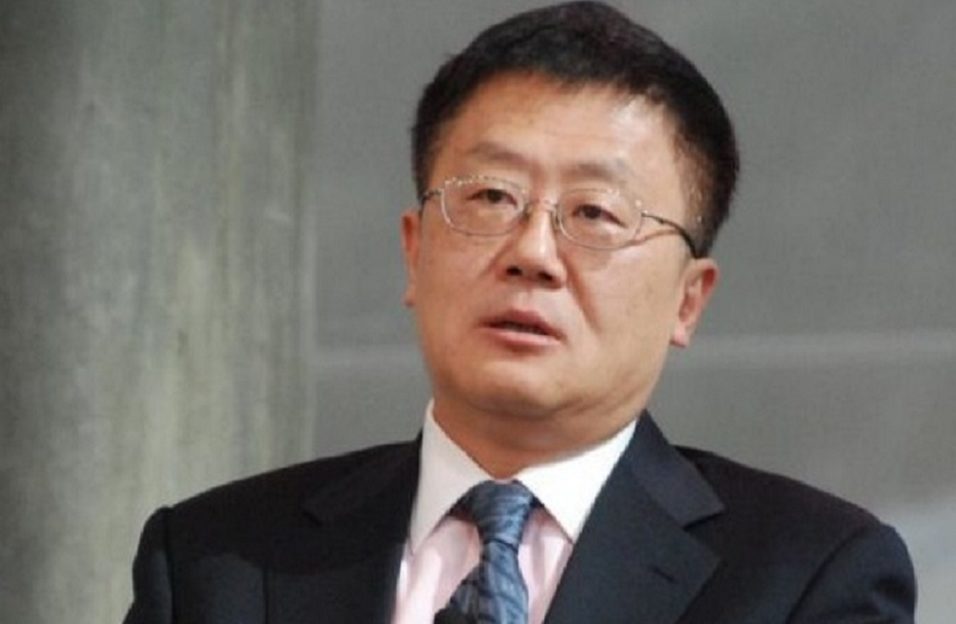
    Professor Huang Jing, 60, and his wife Shirley Yang, had their permanent residence statuses revoked by the Ministry of Home Affairs and will be barred from re-entering Singapore.

    National University of Singapore political scientist Bilveer Singh, pointing to the seriousness of the matter, said: “He is in (a) privileged position in Singapore, sitting on so many boards with people who are opinion-makers.”

    He was concerned that Prof Huang had held a senior position at “one of Singapore’s top think-tanks” and had lived here for several years.

    “A person like him is in a very strategic position to shape the mind, the thinking, and ideology of our key people who, in turn, can affect national policies, for example,” said Associate Professor Singh, who is also an Adjunct Senior Fellow at the Centre of Excellence for National Security at the S Rajaratnam School of International Studies.

    Sembawang MP Vikram Nair, who chairs the Government Parliamentary Committee for Defence and Foreign Affairs, described Prof Huang’s attempts to influence the Government as “very serious” and “worrying”.

    “It may not be so much the effect he had, but the intentions … Whether or not he succeeded, that is a worrying fact … I mean, if he was successful, it could be similar to what Marxists used to do to try and influence governments. (They start) by influencing the population, then the leaders,” said Mr Nair.

    Over the years, the Government has uncovered cases of individuals carrying out subversive activities for foreign countries.

    For example, in 1997, a female civil servant was detained for passing on classified government information to a man who was working under deep cover for a foreign intelligence service. In another case in 1998, four Singaporean men were detained for collecting classified government information for a foreign intelligence service. One of the four had also acted as a recruiter.

    The threat could be bigger now, with Bukit Panjang MP Teo Ho Pin pointing to the difficulties in mitigating “the influence of external agencies” in today’s “Internet world”.

    “Singaporeans must keep themselves informed of what’s happening in our country through reliable sources of information, such as government’s announcements,” he said.

    Referring to other countries’ experiences, Dr Teo reiterated that the potential impact of individuals working as agents of foreign countries “could be serious and will affect Singaporeans’ quality of life”.

    For someone to have not just his employment terminated but also be permanently barred from entering Singapore suggests that the extent and degree of foreign influence was “deeply troubling and problematic”, said Dr Mustafa Izzuddin, a fellow at the ISEAS-Yusof Ishak Institute.

    “Especially for a small state like Singapore, foreign interference in internal affairs is regarded as a serious threat which could also have long-term adverse implications for the governing of the country,” he added.

    Dr Mustafa and Assoc Prof Singh also questioned if the Republic may have let its guard down in this episode.

    “The domestic populace (would ask questions) on why a thorough background check was not done to sieve out such subversive activities before the said foreign person was hired in the first place,” said Dr Mustafa.

    Agreeing, Assoc Prof Singh said: “This is a good lesson for us that, in order to protect our interest, we should be a little bit more discerning, whoever is recruiting at the think-tanks.”

    News of Prof Huang’s expulsion also created some ripples overseas, with academics and political observers taking to social media to express their views.

    Dr Euan Graham, director of the International Security Programme at Lowy Institute, an independent think-tank based in Sydney, said on Twitter that he was “not entirely surprised” with the news, but “wow(ed) all the same”.

    Mr Nile Bowie, Singapore-based political commentator and columnist for The Malaysian Reserve newspaper, tweeted: “Elephant in the room is whether the country in question is #US or #China? … Curious to hear statement from #HuangJing and also how this incident will affect the already strained Sino-Singapore relationship.”


    Source: www.todayonline.com
  • American Professor At LKYSPP, Huan Jing, Identified As ‘Agent Of Influence Of A Foreign Country’

    American Professor At LKYSPP, Huan Jing, Identified As ‘Agent Of Influence Of A Foreign Country’

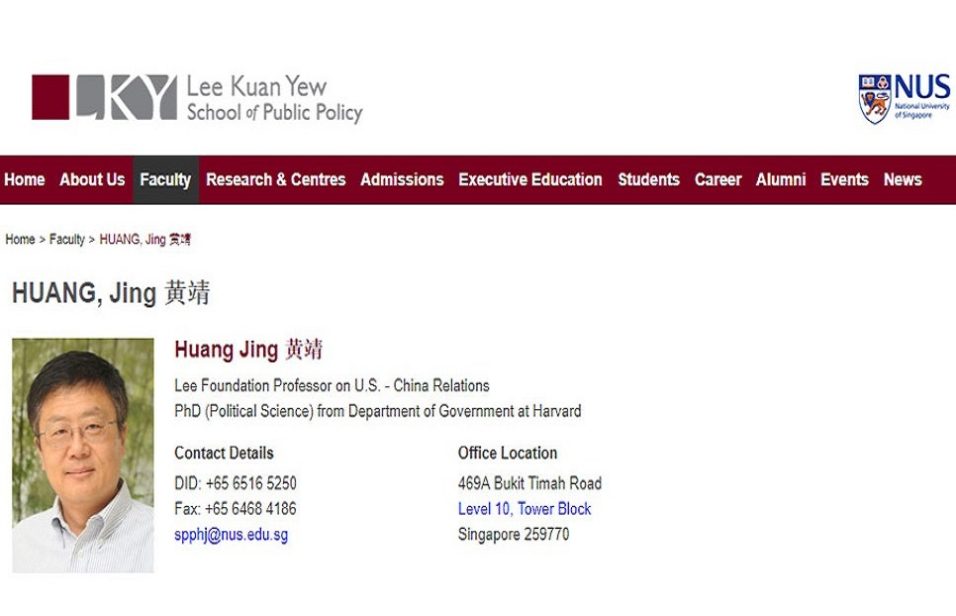
    A senior academic from the Lee Kuan Yew School of Public Policy (LKYSPP), Professor Huang Jing, has been identified as “an agent of influence of a foreign country,” announced the Ministry of Home Affairs (MHA) on Friday (Aug 4).

    “He knowingly interacted with intelligence organisations and agents of the foreign country, and cooperated with them to influence the Singapore Government’s foreign policy and public opinion in Singapore,” said MHA in a news release, without naming the foreign country.

    It added that Prof Huang, who is LKYSPP’s Lee Foundation Professor on US-China relations, gave what he claimed was “privileged information” about the foreign country to prominent and influential Singaporeans, with the aim of influencing their opinions in favour of that country.

    Among those who Prof Huang gave the “privileged information” to was a senior member of LKYSPP, said MHA, without naming the person. LKYSPP is a postgraduate school of the National University of Singapore.

    “The information was duly conveyed by that senior member of the LKYSPP to very senior public officials who were in a position to direct Singapore’s foreign policy. The clear intention was to use the information to cause the Singapore Government to change its foreign policy,” said MHA.

    “However, the Singapore Government declined to act on the ‘privileged information.”

    According to his profile on the school’s website, Prof Huang, who is an American citizen, has published extensively on subjects such as US-China relations, Chinese elite politics, China’s development strategy and foreign policy, Sino-Japanese relations and security issues in the Asia Pacific.

    Apart from the numerous journal articles he has written, Prof Huang, who was director of the Centre on Asia and Globalisation, also edited books on subjects like China’s Taiwan policy, the South China Sea dispute and China-India relations.

    His opinion pieces and columns have appeared in newspapers including Global Times, The Straits Times and Lianhe Zaobao. He has also appeared on Channel NewsAsia.

    “Huang used his senior position in the LKYSPP to deliberately and covertly advance the agenda of a foreign country at Singapore’s expense. He did this in collaboration with foreign intelligence agents,” said MHA. “This amounts to subversion and foreign interference in Singapore’s domestic politics.”

    According to MHA, Prof Huang recruited others to aid his operations. It added that his wife, Shirley Yang Xiuping, was aware of what he was doing.

    The Singapore Permanent Residency of Prof Huang and his wife – both US citizens – have been cancelled by Singapore authorities.

    “Huang’s continued presence in Singapore, and that of his wife, are therefore undesirable. Both will be permanently banned from re-entering Singapore,” said MHA.


    “MATTER OF SERIOUS CONCERN”: NUS

    The National University of Singapore (NUS) said Prof Huang has been suspended without pay with immediate effect.

    “This is a matter of serious concern,” said an NUS spokesperson. “NUS does not tolerate such acts of foreign interference, even as we continue to value and uphold the diverse and international character of our university.”

    The spokesperson also said that Prof Huang’s employment at NUS is conditional on the necessary permits for working in Singapore. “As these permits have been cancelled, we would not be able to continue with his employment.”

    The statement added that LKYSPP is cooperating fully with MHA. “As this matter relates to national security, the university is unable to comment on the details of the case,” said the spokesperson.

    Prof Huang also sits on the board of many organisations, including Singapore’s Keppel Land. When contacted for comment, a Keppel Land spokesperson said: “We have just been alerted to this development and will be looking into the matter.”


    Source: www.channelnewsasia.com

  • PRC Academics Ridicule Singapore Government In The Midst Of Lee Family Feud

    PRC Academics Ridicule Singapore Government In The Midst Of Lee Family Feud

    Academics from prominent state-linked universities in China have weighed in on the Lee Family Feud over 38 Oxley Road, the home of the late former prime minister Lee Kuan Yew.

    The dispute between current Prime Minister Lee Hsien Loong, his younger sister Dr Lee Wei Ling and younger brother Lee Hsien Loong, has become a topic of public interest in China, particularly among government officials. This comes after shocking revelations released on a nearly daily basis from the prime minister’s younger siblings.

    The key criticism of Singapore’s model of governance comes from a Confucian point of view.

    One academic who specializes in Southeast Asia, Ju Hailong, expressed doubts on the ability of Prime Minister Lee Hsien Loong to continue ruling Singapore: “This will definitely affect his political base, as ethnic Chinese hold the value that if a person cannot handle his family well then he loses the ability to run a country.”

    Another academic, Zhang Mingliang from Jinan University also spoke on the Confucian concept of family harmony, stating that Lee’s image has been undermined after he could not maintain his own family’s harmony.

    Even the State Council Information Office has criticized Lee for failing to uphold the Singaporean principles of integrity and meritocracy, values built up painstakingly by his father, pointing out that “even his closest family members distrust and openly accuse him.”


    Source: www.allsingaporestuff.com


  • Nazem Suki: Middle East Political Turmoil – No Military Intervention Needed, Islam Remains Uniting Force

    Nazem Suki: Middle East Political Turmoil – No Military Intervention Needed, Islam Remains Uniting Force

    Many are asking how we, the Muslims in Singapore & in this region, will respond to the current political crisis in the Middle East.

    I put forward these responds;

    1) We do not take sides between one brother state to the other. We love all of them in the spirit of Islamic brotherhood.
    2) We urge all parties to reconcile political differences diplomatically in brotherhood.
    3) We trust the basis of reconciliation is recorded & enshrined in the holy Quran & the Sunnah.
    4) We believe the interest of the Ummah precedes all political interest.
    5) We will not be pressured or forced to fix alliance with one state from the other.
    6) We do not subscribed to military intervention.
    7) Islam remains a uniting force of the Ummah of diverse opinions & political creeds.

    Wallahua’lam


    Source: Mohamed Nazem Suki

  • Pritam Singh: Stronger Sense Of National Identity Bulwark For Singapore In Spats With Big Countries

    Pritam Singh: Stronger Sense Of National Identity Bulwark For Singapore In Spats With Big Countries

    Numbers, sometimes, tell the best stories – whether they are about foreign policy, trade or the economy in general. These latest tables published by the Singapore Department of Statistics reveal that the United States and Japan are the biggest foreign investors in Singapore, their $250b accounting for almost 25% of all our foreign investments (Table 1). These countries have a vested stake to defend in Singapore and their investments – to a varying extent – create opportunities here. Table 1 also tells us why the Trans-Pacific Partnership, in principle, is of strategic importance to the Government. Countries like Norway, the Netherlands, and a host of tax havens make the list. But China is conspicuously missing.

    singapore-fdi

    Flip things around however (Table 2), and one sees that the overwhelming bulk of Singapore’s foreign investments are in China – about $110b to be exact. The US comes in at number 14. India and our immediate neighbours feature, but this table emphasizes how important China is to Singapore as a destination for our investments.

    fdi-out

    Broadly speaking, both tables are indicative of Singapore’s overall foreign policy posture, the imperatives behind our relationship with China and the US, the Government’s perspective on protectionism and global trade in general, amongst many other things.

    While numbers are helpful in personifying foreign policy, big powers and bigger countries usually have a wider scope and spectrum for action. For a major power like China, the ongoing diplomatic spat with Singapore over the impounded Terrex fighting vehicles (and before that, over allegations of diplomatic impropriety by Singapore in China’s Global Times), is but one manifestation of statecraft insofar as China’s national interests are concerned, and how it wishes to express and exercise those interests. It knows what is at stake for itself (and for Singapore). Compound this with Singapore’s small size and our near total reliance on our neighbours and countries further afield like China for our economic well-being, it should not surprise anyone how delicate things can be for a small country in Singapore’s position. Add our racial demographics and population imperatives, and the conflagration becomes even more complex, something our neighbours, competitors and friends know all too well.

    There must always be space to question our foreign policy or to find our more about its roots and imperatives, and to even disagree with it. But these tables tell us that one-dimensional conclusions about the Government’s strategy, whether one opines them to be right or wrong, are of limited utility, for an underlying question remains central – how differently would it be done, if someone else was in charge?

    When Singapore is pushed around in the international realm, or belittled unceremoniously usually as a result of our size, our opponents do so with their interests in mind, and for those with more nefarious intentions – to drive a wedge among Singaporeans. Rather than to curse our misfortune or those seemingly in charge of our fate, a stronger sense of nation and identity should be the only take-away for Singapore and all Singaporeans as a result of this drawn-out diplomatic spat with China. For it is in our destiny as a small state that similar spats will inevitably come to fore again in future. But is far from inevitable that Singaporeans are destined to be divided.


    Source: Pritam Singh