Will Geylang Serai lose the Malay cultural identity that we always had after this big ‘rejuvenation’? Take a look at some of the reactions from the Malay community.
“In my opinion, Geylang Serai has really lost its Malay identity unlike Chinatown and Little India which represents the Chinese and Indian communities here in Singapore. During festive seasons, we can also spot CNY decorations along 1KM, Tanjong Katong Complex etc. And Joo Chiat Rd area are just filled with nightclubs, massage parlours, bars etc. Heard that there will be new a CC next to Geylang Serai Market? (we have 3 CCs nearby) Also, with the latest massive development by Lendlease, what is left of Geylang Serai area and for our future generations to come?” – Brader Faisal
“Tu la hari tu naik cab Abang taxi pon cakap Geylang ni tak ada apa2, tempat Melayu makin lama makin dorang kecilkan” – Brader Gamo
“Betul tu jgn patah semangat demi pelapis & cucu cicit kita. Wahai peniaga2 musiman melayu islam bersatu lah anda utk berniaga di Geylang nanti di Ramadan akan dtg. Klu byk berserek kan berniaga di Bazaar lain (Tampines & Wdlands) tentu lah Geylang Serai jadi sepi. Mmg waktu OneKM mula naik Developer yg saya kebetulan temu janji ada berkongsi yg strategy dia orang ia lah akan commercialise kan Geylang Serai so… meaning akan kurang wajah kampong geylang serai klu peniaga kita tdk berkumpul di daerah sendiri.” – Sis Hana Roza
“Union kene pasang strategi.. suarakan pandangan kpd Presiden kak limah.. Kami mahukan Malay Street(peniaga2 melayu,pelancong2 boleh dtg, ada persembahan kebudayaan melayu, halal food)…” – Brader Fadzil
“Jangan tengok geylang serai saja..seluruh singapura yang asal nya negeri melayu sudah berubah menjadi negeri etnik tionghua..dlm nusantara..” – Brader Salim
“I only have this to say – when the Temenggong signed Singapore over to the British in a “in perpetuity lease”, it was game over for the Singapore Malays. Just like the Native Americans and the European settlers of North America. Talk of Singapore being Tanah Melayu – is just that ; empty talk. Today Singapore is largely Chinese and they have a strong grip on the economy too. Instead of looking back with nostalgia and regret – its better to worry and plan for the future. I agree with Muhammad Noor Othman. What is left – is Islam. Hold on to that coz we are now in the End Times (Akhir Zaman).” – Brader Syed
(Photo credit: theparkplace-residence.com)
Park Place Residences (Paya Lebar) is part of a massive $3.2 billion project by Australian Developer, Lendlease. The mega project, Paya Lebar Quarter, comprising of office space, shops and private housing, will be spread across seven buildings on land the size of eight football fields. There will be a retail mall, three office towers and three residential blocks all connected to Paya Lebar MRT. Watch the video.
His is a classic tale of rags-to-riches Singapore citizenry.
It was more or less an open secret among those following the developments of folks in the Malay community who might stand for the presidency this year.
Last month, four men emailed the press to inform them that they would be picking up forms for a then-unidentified candidate from the Elections Department.
When they were interviewed, they were coy on who they collected the forms for, but it emerged soon after that the man they were there for is Farid Khan Bin Kalim Khan, currently chairman of marine multinational firm Bourbon Offshore‘s Asia Pacific branch.
His last-held executive position at the firm was Southeast Asian Regional Managing Director, which he stepped down from about two years ago, according to his campaign manager Borhan Saini.
Now, while his automatic qualification to stand for president in the upcoming reserved election is not completely clear, Farid has nonetheless lived a story we reckon quite a few Singaporeans can rally around quite easily.
A classic rags-to-riches Singaporean
Photo by Chiew Teng
The second of 10 children — his older brother passed away at a young age —, Farid, who will turn 62 in November, felt the need to step up to support his family after his father passed away just as he was entering his teenage years.
He dropped out of his second year at Bartley Secondary School when he was 14, working by day at a timber processing factory and by night washing cars at a petrol station.
Two years later, he got a job as an assistant mechanic at a workshop, and discovered he really enjoyed working on board ships for projects. He then spent a few years working at a shipyard, got his first passport after his 21st birthday, and sailed as a captain’s steward for 14 months.
Spurred by passion for maritime engineering, Farid then completed a diploma in marine engineering at Singapore Polytechnic during his breaks onshore, and was finally appointed as a junior engineer in 1983, at the age of 28.
From there, he worked at Neptune Orient Lines and other shipping firms based in Singapore and Jakarta, after which he started up the Asian branch of Bourbon Offshore in 2005 as a partner.
He spent a decade at its helm, first as managing director and eventually stepping down from the post of Regional Managing Director to assume chairmanship at the French MNC’s subsidiary.
And somewhere in the middle of that, Farid got married, and now has a daughter, 24, and a son, 18.
Fulfilling people’s wish and trust
Photo by Chiew Teng
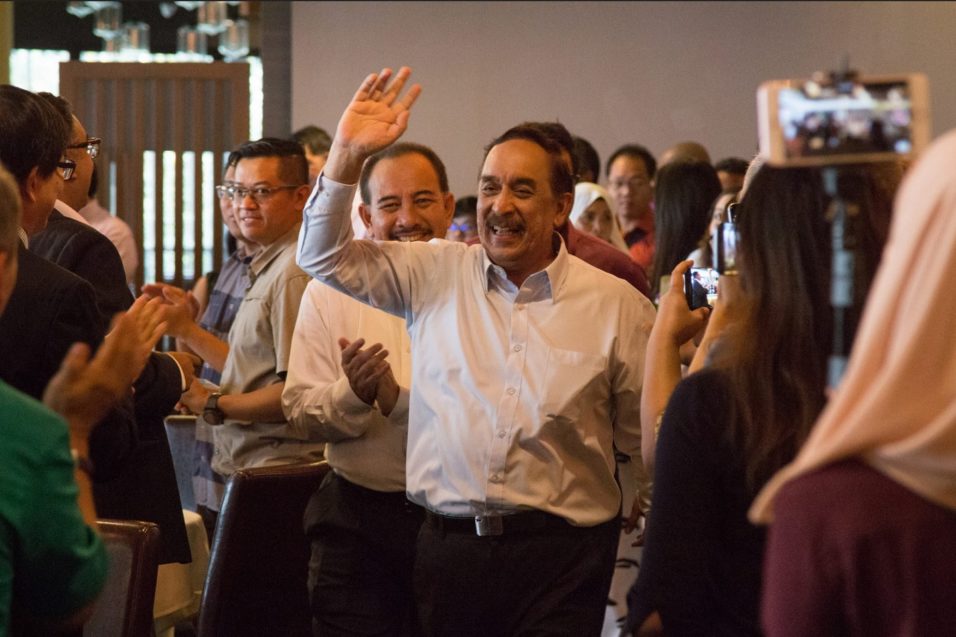
Tuesday’s press conference was held at the far-flung Village Hotel Changi, followed by a fancy lunch event attended by almost 200 supporters of Farid’s — many of whom come from the maritime sector.
Not only was there much fanfare welcoming him, complete with a rally-style speech, making rounds to meet attendees and even getting garlanded on the way, it was also pretty evident that the people who were there are fans of his.
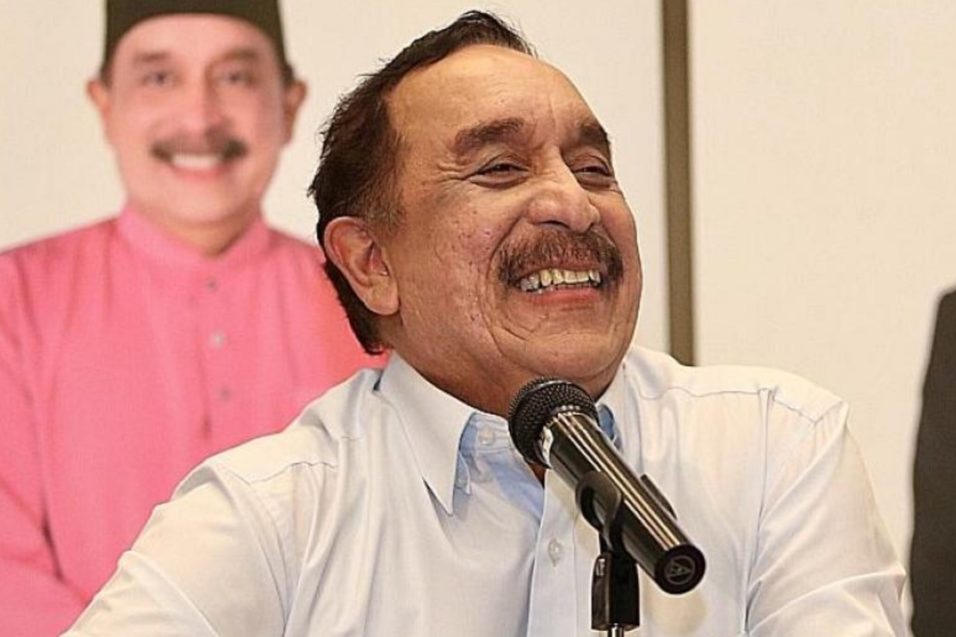
Speaking to media, Farid said he felt like it was time to step up and serve the nation after spending decades achieving his dreams and building a strong career in the maritime sector.
“You see, all my life, 48 years I have worked in this country which I love. I worked very hard for my family, I worked very hard for my community. And now I’m 62 years old, I can do two things: live comfortably, retire and walk away from all this, or whatever that I’ve learned from my 48 years of working in this country, use that experience and serve the nation, which is what I’m doing right now.”
At another point during the conference, when asked if he would run if this was not going to be a reserved election, he said he had been a workaholic through most of his life:
“Few years ago I was building companies, very busy building companies — career, you know… I’m one of the workaholics ah, you can call me that — those who worked with me will say this guy is a workaholic, 7 o’ clock in the morning until 10 o’ clock at night working.
So I build companies… so I’ve come to a point now where the companies are all stable, 62 years old, I wanted to spend more time with my family; I’m going into retirement mode actually now. But this opportunity came, and I feel that I can serve this country.”
“Malay” enough?
Photo by Chiew Teng
All this aside, however, this round’s new qualification criteria stand as two rather daunting hurdles for Farid — apart from the financial and professional criteria that he doesn’t clearly meet, there is also the issue of his ethnicity.
You see, Farid, who in the press conference showed great fluency in both English and Malay, is of Pakistani descent, and has “Pakistani” written on his identity card.
In his speech and during the press conference, Farid said he grew up in Geylang Serai and his family and relatives speak Malay and practice the Malay culture, and hence identifies as part of the larger Malay community.
“The thing is, in the Malay community you have all kinds of people, right, from Balinese, Javanese, all kinds of descent that are there. It’s difficult for me to call myself otherwise. I live in a society that I love very much. I went to the same school with them, I shared the same fears, I shared the same joys with the people around me in the Malay village.
So I consider myself a Malay or Pakistani, even tomorrow my daughter got married, Insyallah, it will be the same, the same ceremonial like the Malay. We’ve kind of accepted that we are here to stay, and we are Malay in the community, in the Malay community.”
So will Farid Khan qualify to run for the Singapore presidency? The Presidential Elections Committee will have to decide, and we’ll just have to see.
An entrepreneur of Pakistani descent yesterday announced his bid to become the next president.
Mr Farid Khan Kaim Khan, 62, the chairman of marine services provider Bourbon Offshore Asia Pacific, said he intends to stand in the upcoming presidential election (PE) because he wants to “serve the nation” and feels “capable of doing so to the best of my knowledge and ability”.
This PE, due in September, has been reserved for Malay candidates after the Presidential Elections Act was amended to ensure the presidency is representative of the country’s multiracial society.
Speaking in English and Malay, Mr Farid told reporters at the Village Hotel Changi that his identity card indicates he is Pakistani but he was born in Geylang Serai and celebrates Hari Raya every year.
“I am of Pakistani descent and my wife is of Arabic descent. Yet our family and relatives speak Malay and practise the Malay culture. So I am part of the Malay community,” he said.
In his speech, Mr Farid outlined five areas of concern: the growing threat of radicalism, strengthening the trust among the people, helping the needy, enhancing Singapore’s prosperity and strengthening families.
He is the second candidate to throw his hat into the ring.
Second Chance Properties founder and chief executive officer Mohamed Salleh Marican, 67, said on May 31 that he planned to run for president.
Political analyst Mustafa Izzuddin told The New Paper that Mr Farid addressed his ethnicity head-on to clear the air in the hope of quelling any doubts about his candidacy.
“He did not want the question whether he is Malay to hijack other issues he wants to discuss, and probably anticipated it,” he said.
ELIGIBLE
Associate Professor Eugene Tan, a law don at the Singapore Management University, echoed Dr Mustafa’s observations, noting that Mr Farid wanted to reassure his stakeholders by “asserting his claim to be eligible”.
He said: “Certainly now that he has indicated he would make an application, there is the question of eligibility.”
Dr Mustafa said the decision whether Mr Farid is Malay lies with the Community Committee.
Prospective candidates must submit a form to the Presidential Elections Committee (PEC) to get a certificate of eligibility, and another form to the Community Committee to declare that they are part of the Malay community to obtain a Community Certificate.
“I suspect the committee is going to stretch the definition to consider not just what you are born as, but what your experience is like, your environment, and whether or not the community sees you as Malay,” Dr Mustafa said.
Prof Tan also weighed in on another requisite – private sector candidates have to helm a company with at least $500 million in shareholder equity.
However, the PEC has the discretion to waive this requirement.
Bourbon Offshore Asia Pacific, a subsidiary of a French multinational marine company, reportedly has shareholder equity of US$300 million (S$415 million), but Mr Farid said he is confident of qualifying.
Mr Farid, who is married to Madam Naeemah Shaikh Abu Bakar, 61, with a daughter, 23, and son, 18, has been with the company for more than 10 years.
It has about 800 workers in the region.
Said Prof Tan: “If it does not appear that he qualifies outright, then he will have to go under the discretionary route, and the PEC will have to decide.”
FROM GEYLANG SERAI TO OXLEY ROAD – Defining the sense of place
It seems that this month has been about the heritage and identity of a place – from the debate about the character of the annual Ramadan bazaar that formed the heritage of Geylang Serai; to the contestation over the fate of 38 Oxley Road.
Just as one could argue that the heritage value of 38 Oxley Road merits that of national consideration; so does that of Geylang Serai which has been part of the heartbeat of the Malay and Muslim community in Singapore.
Singapore indeed comprises a multiracial and multireligious society.
Because it is multiracial, it has places called Chinatown, Little India, Geylang Serai and Kampung Glam
. Prevously, there was even Kampung Melayu.
Bazaar Ramadhan all over Singapore have been organised in conjunction with the month of Ramadhan where Muslims fast. It’s link to fasting cannot be understated. And as the name implies, Bazaar Ramadhan, when sellers sell food, should be targetted at Muslims in the first place. If it’s not targetted at Muslims to patronise, then it should not be called Bazaar Ramadhan.
When Bazaar Ramadhan are meant for Muslims to patronise, they should also cater to the dietery needs of Muslims. The foods sold must be halalan toiyyiban.
The most basic is that the stalls should be MUIS halal-certified or Muslim-owned. Placing tudung-clad women alone does not make a non-Muslim-owned stall become halal. Neither does using halal-certified food products makes a non-Muslim-owned stall ‘automatically’ halal.
However, as Bazaar Ramadhan all over Singapore are mainly commercially driven, it would be a challenge to really make every stall to fulfill the basic halal toiyyiban criteria. Understandably, profit-making is the major driving force.
Some members here have expressed their views of how the basic character of Bazaar Ramadhan in Geylang has changed over time. Fundamentally, they see an erosion of the basic Malay character of the Bazaar Ramadhan in Geylang Serai area. This is similar to views on how the historical character of Kampung Glam area has suffered from the presence of many watering holes or eateries selling liqour or alcohol (see https://www.facebook.com/kgglamalcoholfree/).
Traditionally and historically, Geylang Serai has been closely associated with the Malay ethnic group. Previously, Kampung Melayu shopping area was even placed at the Geylang Serai area. Now an even more sophisticated version of that Kampung Melayu is being developed in Geylang Serai.
When views expressing the eroding Malay identity of the foods sold and of the profile of sellers in the Bazaar Ramadhan are being shared, they should not at be seen as being racist. Even the Government has previously expressed views of the eroding Chinese identity within the Chinese ethnic group in Singapore. The SAP schools have since been established in Singapore to address that concern.
And some have dismissed such expression of eroding Malay identity in Bazaar Ramadhan at Geylang Serai area as alienating other non-Malay Muslims. Historically, Malays have been, by and large, Muslims. Expressing views on the erosion of the Malay identity in those Bazaar Ramadhan is by no means alienating other non-Malay Muslims. Traditionally, there were more Malays, who were Muslims, who ran stalls selling foodstuffs during Ramadhan in the Geylang Serai area. And the foodstuff that they sold were all meant for Muslim consumption in the month of Ramadhan and also during Hari Raya. But when the profile of sellers changed, what more when the status of halalan toiyyiban of such stalls was also unclear or ambiguous, raising concerns should not be seen as alienating non-Malay Muslims. It is in fact addressing the concerns of all Muslims with regards to the halal status of foodstalls at such Bazaar Ramadhan.
It is a valid and legitimate concern for all Muslims if the halal status of foodstalls in Bazaar Ramadhan cannot be clearly ascertained, when such stalls are neither MUIS Halal-Certified nor Muslim-owned.
Yes, we need to be mindful of the multiracial and multireligious character of our nation and the importance of upholding the principles of racial and religious harmony. However, that does not mean and entail the suppression of views on the importance of preserving and conserving the ethnicity and religiosity of each group. We also need to recognise the need to help ethnic and religious groups maintain the respective core characteristics and celebrate the ensuing diversity that each group brings and contributes to Singapore’s heritage and overall development.
Otherwise, no point having Chinatown, Little India, Kampung Glam and Geylang Serai.
Otherwise, no point calling the bazaar in the month of Ramadhan as Bazaar Ramadhan if they are no different from any other bazaar in any other months of the year, and no different from bazaar set up in Chinatown for Chinese New Year and in Little India for Deepavali.
Let’s maintain and celebrate the ethnic, cultural and religious diversity by bringing out the true character of each group rather than making them all the same. Only then would Singapore be a truly vibrant world-class city able to showcase the cultural, ethnic and religious diversity that it manage to hold together in harmony.